


 Phan Van Hoang
- 30/07/2026
- 153
When purchasing industrial bag sewing thread, users often encounter specifications such as 20/6, 20/8, or 20/9. Many people assume that the number “20” indicates thickness, diameter, or the number of strands making up the thread spool. However, this interpretation is not accurate.
In the specification 20/9 bag sewing thread, the number 20 generally indicates the yarn count of each single yarn before plying and twisting, while the number 9 indicates the number of single yarns combined to form the finished thread.
Understanding this specification correctly helps businesses choose the right thread for each sewing machine, packaging type, and seam load requirements.
Table of Contents [Hide]
1. What does the number “20” in 20/9 bag sewing thread mean?
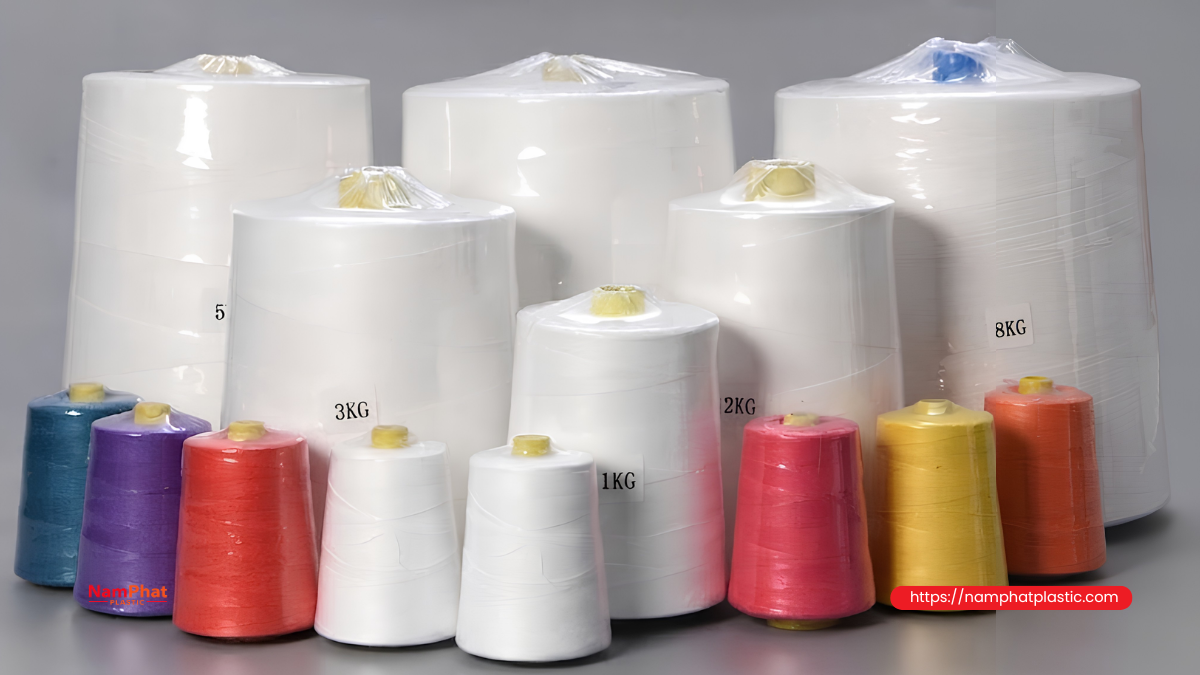
The number 20 in the 20/9 specification refers to the count of the single yarn, commonly understood according to the English Cotton Count system – Ne.
In the Ne system, yarn count is determined based on the number of 840-yard lengths contained in one pound of material. The higher the count, the finer the single yarn; the lower the count, the coarser the single yarn.
Therefore:
- 20/1 is one single yarn with a count of Ne 20.
- 20/6 consists of 6 single yarns with a count of 20 that are plied and twisted together.
- 20/8 consists of 8 single yarns with a count of 20.
- 20/9 consists of 9 single yarns with a count of 20.
Simply put, the number 20 describes the fineness of the single-yarn material rather than directly describing the final thickness of the bag sewing thread spool.
2. How should the 20/9 specification be read?
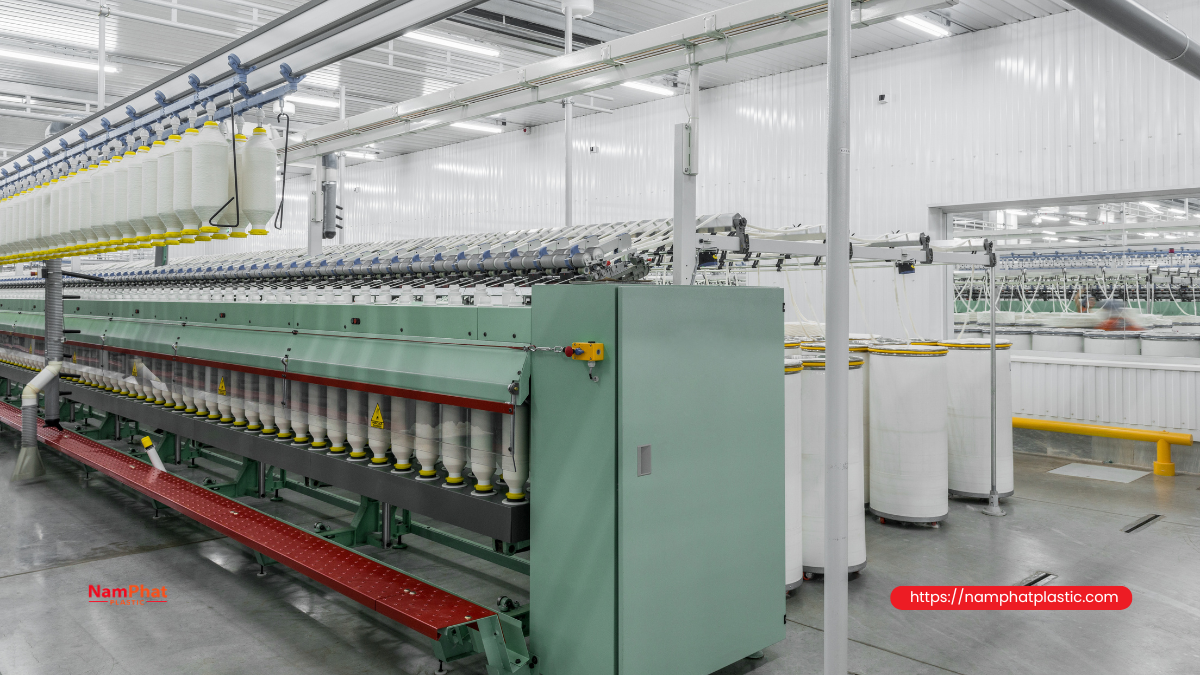
The 20/9 specification can be read as:
- Yarn count 20, plied from 9 single yarns.
In which:
- 20: the count of each single yarn.
- 9: the number of single yarns combined and twisted together.
- 20/9: the structure of the finished thread after plying and twisting.
For example, in the production of PE bag sewing thread, a manufacturer may use PE spun yarn 20/1 and then feed 9 single yarns through a plying machine. The plied yarn is subsequently processed through a twisting machine to create PE 20/9 thread.
Therefore, the number “20” remains in the product name to indicate the type of single-yarn material used initially.
3. Does the number 20 mean a thickness of 20 mm?
No. The number 20 in 20/9 bag sewing thread does not mean:
- A diameter of 20 mm.
- A thickness of 20 microns.
- A weight of 20 grams.
- A breaking force of 20 kg.
- The number of twists per unit length.
- The number of filaments inside the yarn.
It is the yarn count, which is a value used to describe the relationship between the length and mass of the yarn.
In the Ne system, as the count increases, the single yarn becomes finer. For example, under the same material and spinning conditions, Ne 30 is generally finer than Ne 20, while Ne 10 is coarser than Ne 20. This is a characteristic of an indirect yarn-counting system.
4. How is the Ne 20 yarn count determined?
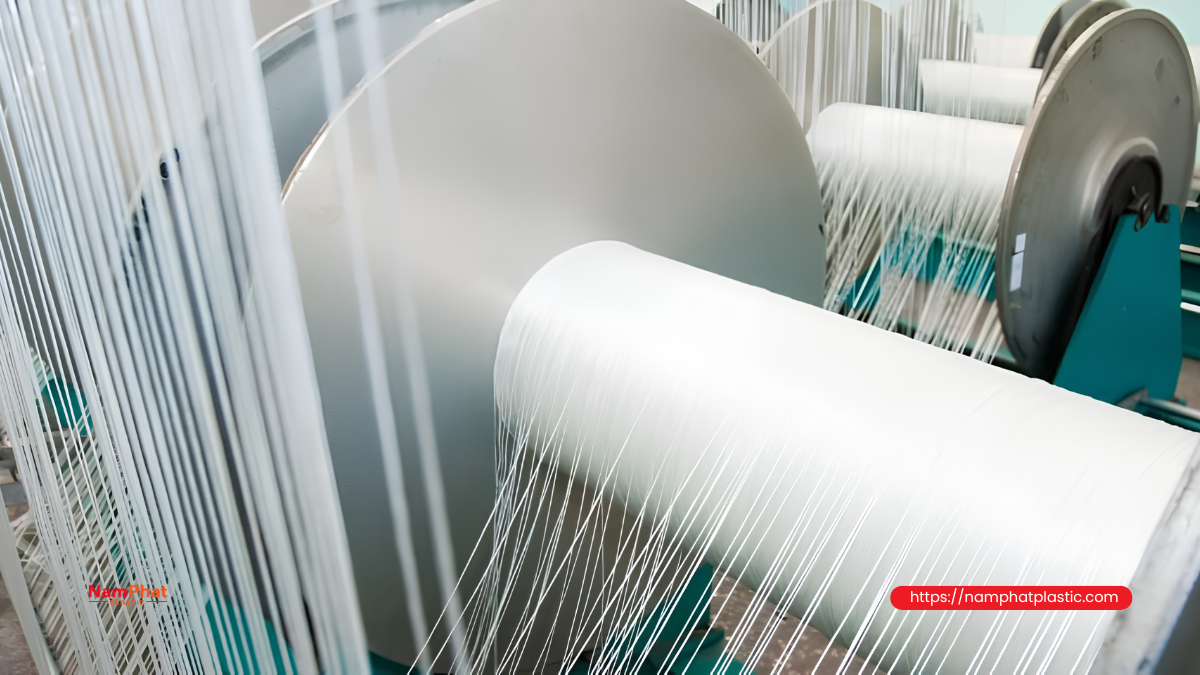
According to the English yarn-count system:
- Ne 20 means that one pound of yarn contains 20 lengths, each 840 yards long.
The theoretical length is therefore:
- 20 × 840 = 16,800 yards/pound
Converted approximately, Ne 20 single yarn has a length of about 33,800 meters per kilogram.
This is the theoretical value for the single yarn. Actual length may vary due to:
- Yarn-count variation in the raw material.
- Single-yarn twist.
- Shrinkage after twisting.
- Oil or finishing-agent content.
- Yarn moisture.
- Material loss during plying and twisting.
Therefore, theoretical length should not be used as a complete substitute for weighing samples and measuring actual length at the factory.
5. Why is 20/9 thread thicker than PE 20/1 yarn?
PE 20/1 yarn contains only one Ne 20 single yarn, whereas PE 20/9 thread is made by combining 9 Ne 20 single yarns.
Although both products carry the number “20,” 20/9 thread is much larger and heavier than 20/1 yarn because the total amount of material per unit length has increased.
In theory:
- One Ne 20 yarn has a fineness of approximately 29.5 tex.
Nine Ne 20 yarns combined have a total fineness of approximately 265.7 tex before accounting for twist-induced shrinkage, finishing oil, and manufacturing variation.
This conversion is based on the relationship between the Ne count system and tex, which describes yarn mass per unit length.
This explains why the number “20” cannot be used alone to evaluate thread size. To understand the product correctly, the complete 20/9 specification must be considered.
6. How do the numbers “20” and “9” affect the thread?
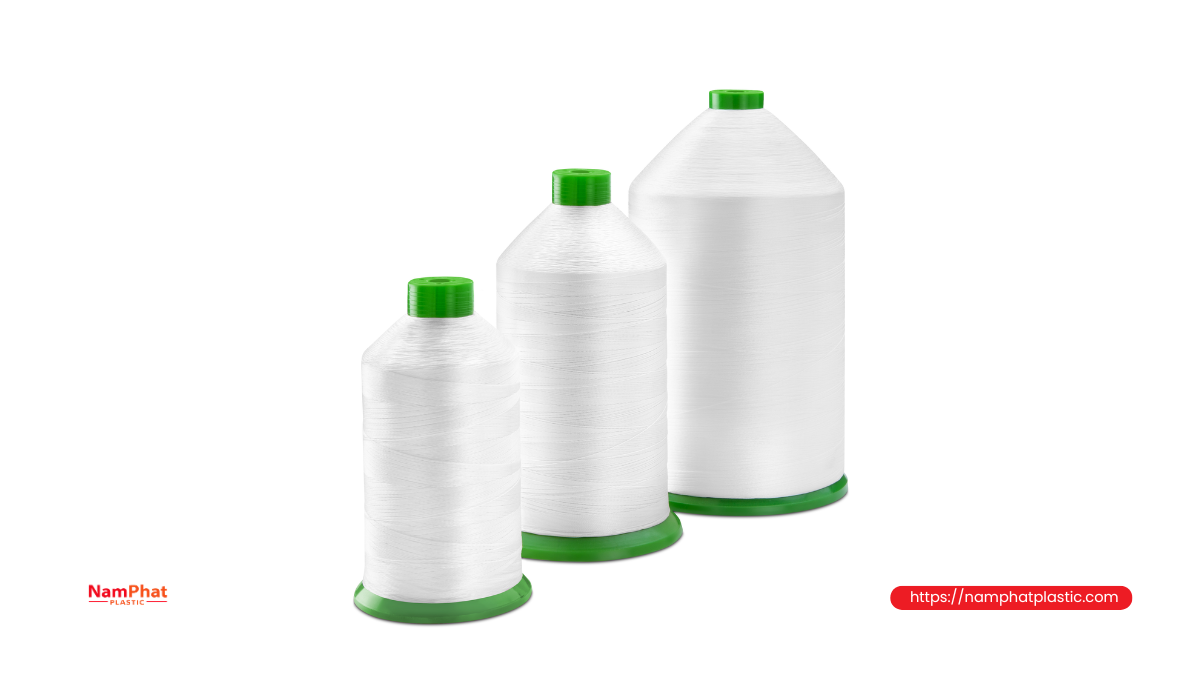
6.1. Effect of the number 20
The number 20 is related to the fineness of each single-yarn component.
Changing the single-yarn count can affect:
- Thread softness.
- Hairiness.
- Fiber cohesion.
- Thread-body uniformity.
- Ability to pass through the needle and tension assembly.
- Strength of each yarn component.
However, quality does not depend on yarn count alone. Two yarns with the same Ne 20 count can still differ significantly in strength, uniformity, and machine-running performance.
6.2. Effect of the number 9
The number 9 indicates the number of single yarns that are plied together. Compared with 20/6 or 20/8, 20/9 thread generally has a larger cross-section and more material per meter.
If the raw materials and manufacturing conditions are comparable, increasing the number of plies can help:
- Increase thread size.
- Increase the load-bearing capability of the seam.
- Create a more visible and stronger sewing line.
- Suit bags requiring higher load-bearing performance.
However, a larger thread is not always better. If the thread is too large for the needle, needle plate, or tension assembly, the machine may experience needle heating, thread abrasion, skipped stitches, or thread breakage near the needle.
7. Does the number 20 determine the strength of 20/9 thread?
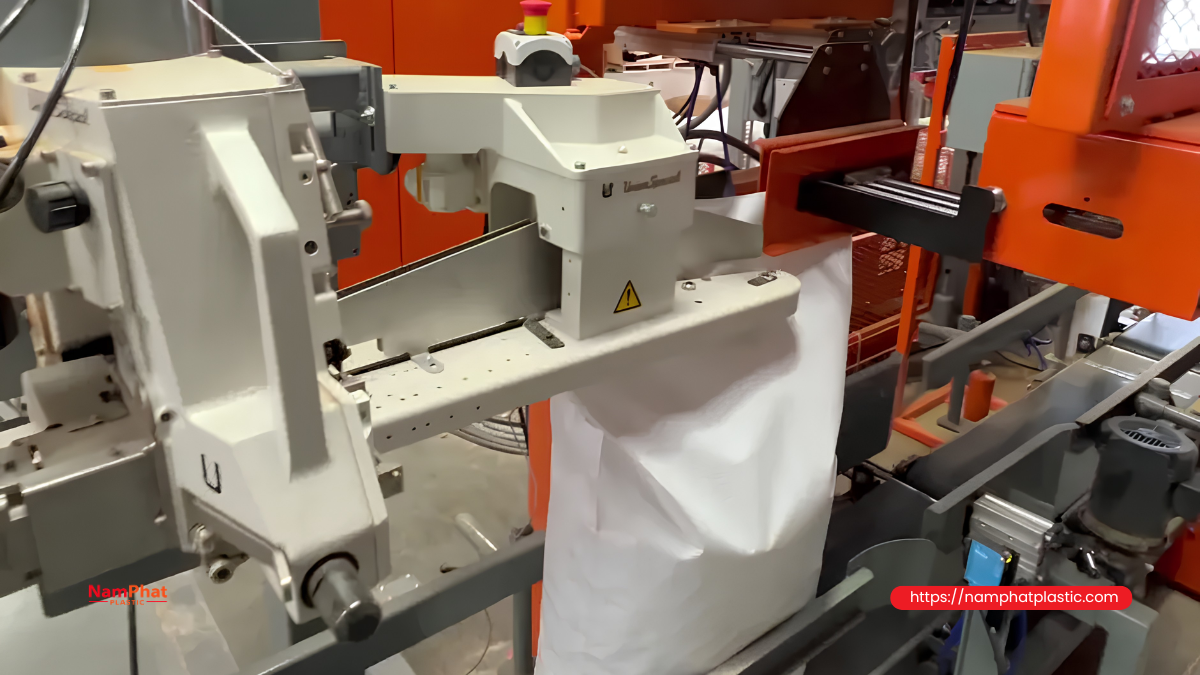
The number 20 affects the thread structure but is not the only factor determining strength.
The actual strength of 20/9 bag sewing thread also depends on:
7.1. Quality of PE 20/1 yarn
The single yarn should have good uniformity, with minimal thin spots, thick spots, and hairiness. If one or more component yarns are abnormally weak, the stability of the finished twisted thread can also be affected.
7.2. Thread twist level
An excessively low twist level can result in loose bonding between the single yarns, causing the thread body to separate and become hairy. Conversely, excessive twist can make the thread stiff, prone to live twist, or difficult to adjust on the sewing machine.
7.3. Twist direction and twist balance
The twist direction should be compatible with the sewing machine structure and the direction in which the thread travels. An unbalanced thread can form loops, become tangled, or make the seam unstable.
7.4. Lubricant
An appropriate amount of lubricant helps reduce friction as the thread passes through the tension assembly, thread guides, and needle eye. Insufficient lubricant can increase heat and thread abrasion, while excessive lubricant can cause dust accumulation or affect packaging cleanliness.
7.5. Sewing machine conditions
A worn needle, an undersized needle, excessive tension, or burrs along the thread path can cause 20/9 thread to break even when the thread itself meets the required specifications.
8. Is 20/9 always stronger than 20/8?
This should not be determined from the product name alone.
With the same raw material and manufacturing conditions, 20/9 generally contains more material than 20/8 and therefore has the potential to achieve a higher tensile force. However, a poor-quality 20/9 product can still be weaker than a well-produced 20/8 product made from better raw materials and manufactured under tighter process control.
When comparing two thread types, it is better to check:
- Average breaking force.
- Elongation at break.
- Diameter uniformity.
- Hairiness.
- Twist level and twist direction.
- Continuous machine-running performance.
- Thread breakage rate during production.
- Seam quality after load testing.
The 20/8 or 20/9 designation only describes part of the structure and is not a complete certification of product quality.
9. Can thread diameter be determined from the number 20 alone?
The exact thread diameter cannot be determined from the Ne 20 count alone.
Actual diameter is also affected by:
- Material density.
- Spun-yarn structure.
- Degree of yarn compression.
- Twist level.
- Surface hairiness.
- Number of plies.
- Finishing-oil content.
- Tension during measurement.
Two types of thread labeled 20/9 but produced with different raw materials and twisting conditions may have different apparent diameters.
For an accurate determination, the manufacturer needs to measure the thread with suitable equipment or check indirect parameters such as tex, mass per unit length, and breaking force.
10. Why can 20/9 thread vary between suppliers?
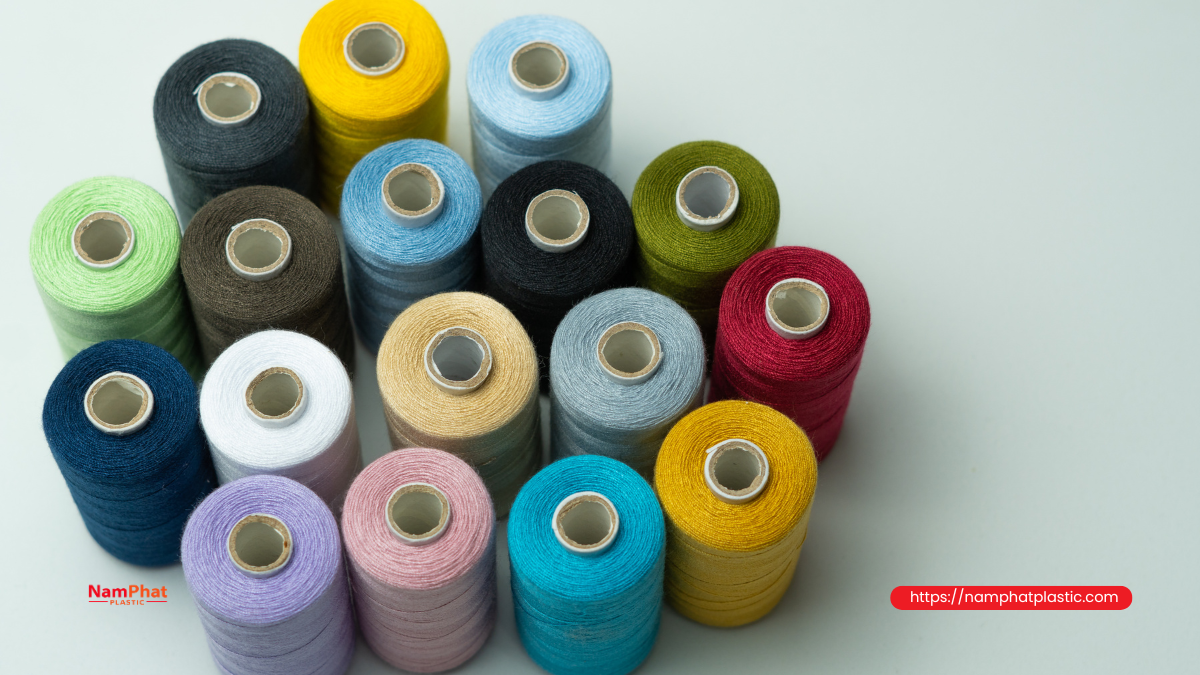
The 20/9 designation describes the nominal structure, but it does not provide all technical specifications.
Products from different suppliers may differ in:
- Type of polymer or PE fiber used.
- Actual count of the 20/1 yarn.
- Weight variation.
- Single-yarn strength.
- Plying technology.
- Final twist level.
- Lubricant content.
- Hairiness.
- Spool weight.
- Actual length per kilogram.
- Lot-to-lot consistency.
Some suppliers also use 20/9 as a familiar commercial designation. Therefore, buyers should request a technical specification sheet or sample rather than relying solely on the product name.
11. How to inspect 20/9 bag sewing thread before use
Check the product label
The label should clearly state the thread type, 20/9 construction, color, spool weight, lot number, and production date.
Weigh the spool
The weight should be checked after deducting the core weight. An underweight spool can affect usage costs and the planned spool-change schedule on the sewing line.
Inspect the thread surface
A satisfactory thread should have a relatively uniform body, without excessive thick sections, thin sections, knots, separated fibers, or abnormal hairiness.
Check for live twist
Release a section of thread freely. If the thread strongly twists itself into multiple loops, the product may have an imbalance in twist.
Run a machine test
At least one spool should be tested on the actual machine, with the actual needle and bag being produced. Monitor thread breakage, needle heating, skipped stitches, tangling, and seam stability.
Test the seam
After sewing, pull-test the bag mouth or perform an appropriate load test. The objective is not simply to ensure that the thread does not break, but that the entire seam meets the actual transportation and usage conditions.
12. When should 20/9 bag sewing thread be used?
20/9 thread is commonly considered for applications requiring relatively strong seams, such as:
- Woven PP rice bags.
- Animal feed bags.
- Fertilizer bags.
- Agricultural-product bags.
- Powder or industrial-material bags.
- Bags with relatively high load requirements.
- Bags that undergo multiple handling and transportation stages.
The final selection should be based on the bag structure, package weight, seam type, stitch density, needle type, and machine speed.
It should not be assumed that every bag requires 20/9 thread. In some applications, 20/6 or 20/8 may already meet the requirements and provide better cost efficiency.
>>> Learn more: What are PE bag sewing threads 20/6, 20/8, and 20/9? How to choose the right type
13. Common misunderstandings about the number 20 in 20/9 thread
The number 20 is the number of plies
Incorrect. In 20/9, the number of plies is 9, while 20 is the count of each single yarn.
The larger the number 20, the larger the finished thread
Not necessarily. In the Ne system, a higher count means a finer single yarn.
All 20/9 threads have the same strength
Incorrect. Strength also depends on raw materials, twist level, manufacturing technology, and quality control.
20/9 thread can always be used with any needle
Incorrect. The needle must have an eye size suitable for the thread. A needle that is too small increases friction and can cause thread breakage near the needle.
The specification alone is enough to decide which thread to buy
It should not be. Buyers should consider technical specifications together with actual machine testing.
Frequently Asked Questions
1. What does the number 20 in 20/9 bag sewing thread mean?
The number 20 indicates the count of each single yarn used to produce the thread, commonly understood as Ne 20. It does not represent the diameter or number of plies.
2. What does the number 9 in 20/9 mean?
The number 9 indicates that the thread consists of 9 single yarns with a count of 20 that are plied and twisted together.
3. Is 20/9 thread made from 20/1 yarn?
In a common production process, the manufacturer uses 20/1 single yarn, combines 9 yarn ends, and then twists them to produce 20/9 thread.
4. Is 20/9 thread thicker than 20/8?
Under the same raw-material and manufacturing conditions, 20/9 is generally larger than 20/8 because it contains one additional single yarn. However, actual thickness and strength should still be measured and tested.
5. Does a higher number 20 mean a thicker yarn?
No. In the Ne count system, a higher number means a finer single yarn. This is an indirect yarn-counting system.
6. Can bag sewing thread be selected based only on the 20/9 designation?
It is not recommended. Breaking force, elongation, twist level, hairiness, spool weight, and actual machine-running performance should also be considered.
Conclusion
In the 20/9 bag sewing thread specification, the number 20 indicates the count of each single yarn, commonly Ne 20. The number 9 indicates the number of single yarns that are plied and twisted together to form the finished thread.
The simplest way to understand it is:
- 20/9 thread is made from 9 single yarns with a count of 20.
However, the 20/9 designation only describes the nominal thread structure. To evaluate bag sewing thread quality, businesses should also check the raw material, breaking force, elongation, twist level, hairiness, spool weight, and actual machine-running performance.
Choosing the right thread not only helps maintain seam strength but also helps reduce thread breakage, minimize machine downtime, stabilize productivity, and lower packaging production costs.
>>> Learn more:
- 0 Comment


