


 Phan Van Hoang
- 29/07/2026
- 136
How does bag sewing thread hairiness affect sewing machine performance?
During bag closing operations, many businesses often focus on tensile strength, thread size, or color, but pay less attention to the hairiness of the sewing thread. In practice, this is one of the factors that can directly affect machine stability, thread breakage frequency, dust accumulation, and seam quality.
A thread spool with relatively good tensile strength can still run unstably if its surface is excessively fuzzy, has many long protruding fibers, or has an uneven yarn structure. In contrast, a thread with a compact surface, suitable twist level, and controlled friction generally passes through the thread guides, tension assembly, and needle eye more smoothly.
However, it is important to understand that spun bag sewing thread naturally contains a certain amount of surface hairiness. The issue is not whether the thread has hairiness, but rather its level, fiber length, uniformity, and tendency to shed fibers during machine operation.
Table of Contents [Hide]
1. What is bag sewing thread hairiness?
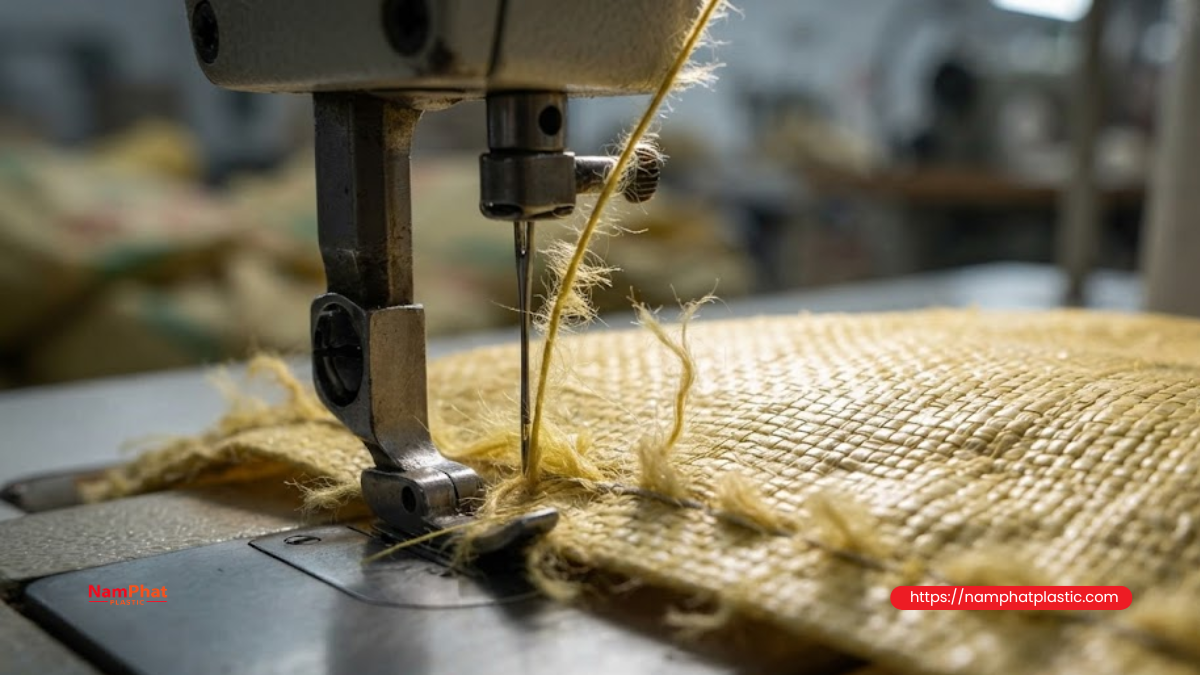
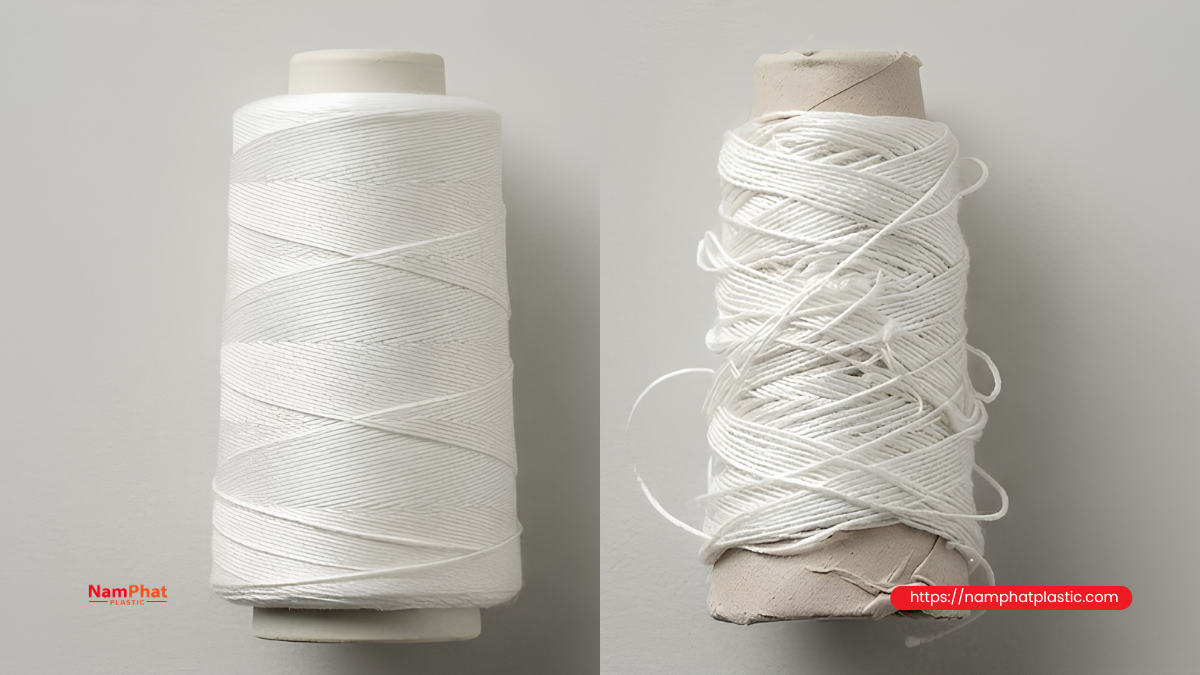
Hairiness refers to the degree to which fiber ends or small fiber segments protrude from the main body of the yarn. When viewed under light or against a dark background, a fine layer of fibers can be seen around the thread.
For thread produced from staple fibers, such as spun PE thread, a small amount of surface hairiness is a natural characteristic of the yarn structure. These fiber ends do not necessarily indicate poor thread quality.
Hairiness becomes a problem when one or more of the following conditions occur:
-
The fibers are long and unevenly distributed.
-
There are many swollen, fuzzy, or lumpy sections.
-
Fibers shed when the thread is lightly rubbed by hand.
-
The thread quickly generates dust when passing through the tension assembly.
-
Hairiness gradually increases from the beginning toward the middle or end of the spool.
-
The thread becomes heavily frayed at the point where it passes through the needle eye.
-
The thread surface is noticeably rougher between spools from the same production lot.
Research on sewing thread structure shows that when the number of loops or protruding fibers on the thread surface becomes excessive, surface friction and irregularity also tend to increase.
2. Why are bag sewing machines sensitive to thread hairiness?
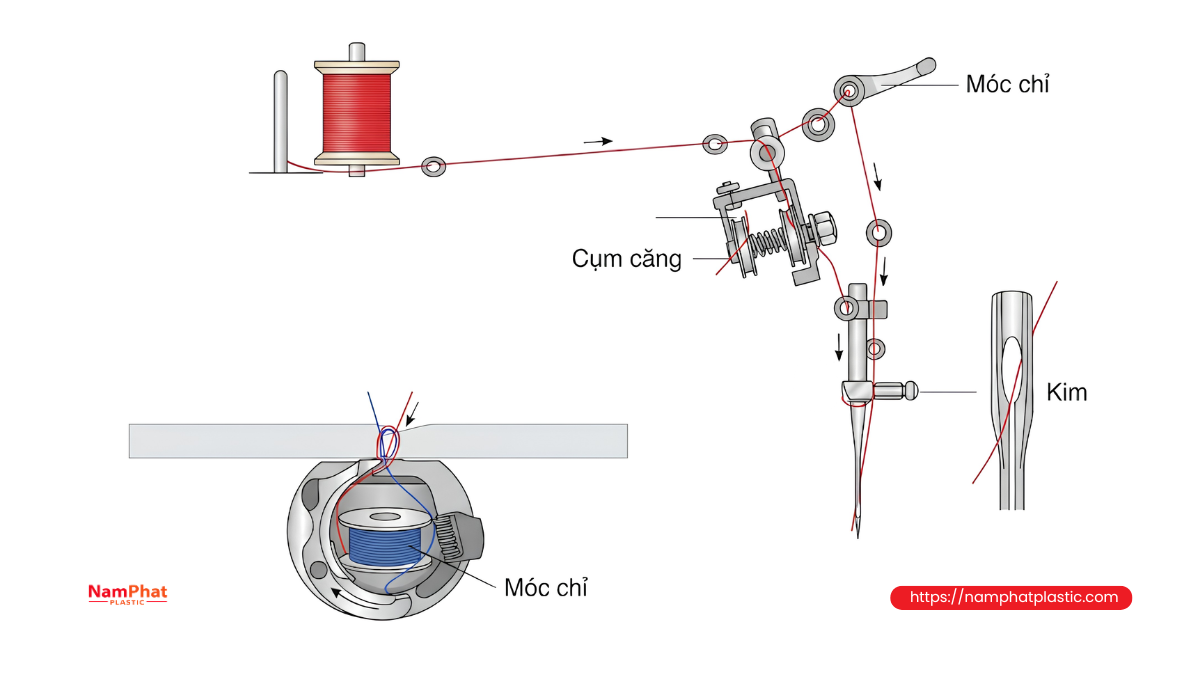
In a bag sewing machine, the thread does not travel directly from the spool to the seam. It continuously passes through multiple points such as:
-
Thread guides.
-
Thread tension adjustment components.
-
Tension spring.
-
Take-up lever.
-
Needle eye.
-
Looper or loop-forming components.
-
Packaging material surfaces.
At each position, the thread is exposed to friction, tension, bending, and changes in speed. When the machine operates continuously, these actions are repeated at high frequency.
If the thread surface contains many long protruding fibers or has a loose structure, the fiber ends can catch on thread guides, tension discs, needle edges, or rough bag surfaces. As a result, resistance becomes unstable, causing the thread to alternate between high and low tension and making it more susceptible to localized abrasion.
This is why a spool may pull smoothly by hand but develop problems when used on a high-speed bag sewing machine.
3. How does hairiness affect machine operation?
3.1. Increasing friction along the thread path
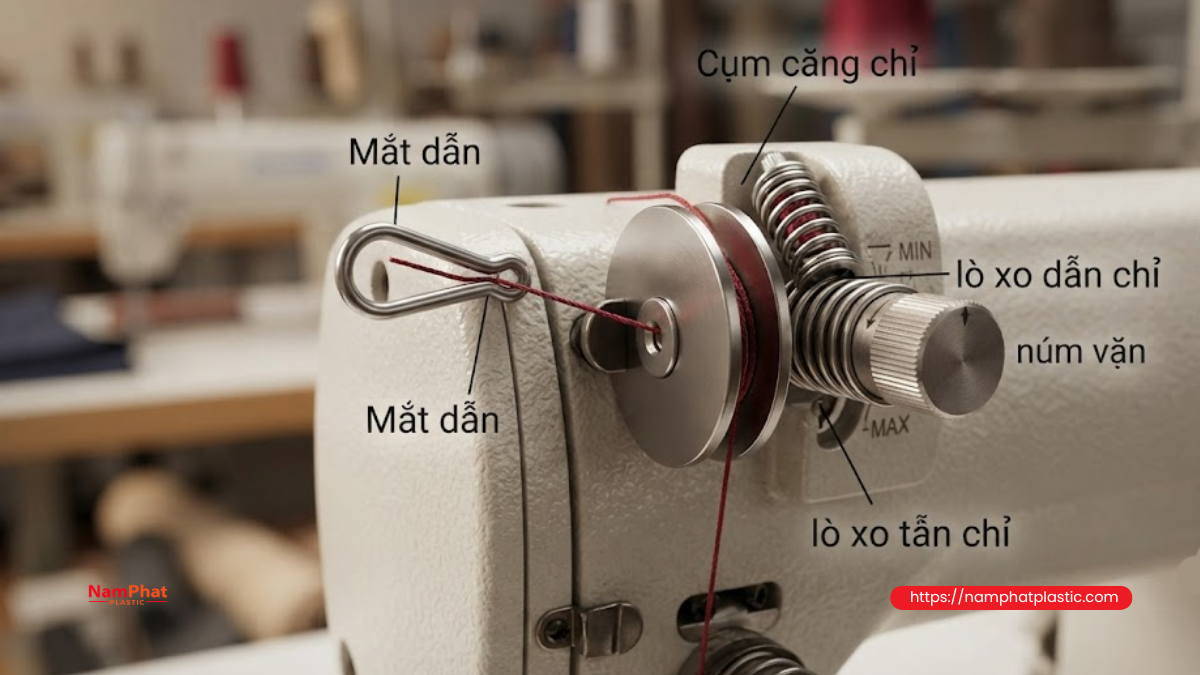
The first effect of excessive hairiness is an increase in the contact area between the thread and machine components.
Instead of a relatively compact surface passing through the thread guide and tension discs, the protruding fibers continuously rub against metal surfaces. As a result, more force is required to pull the thread through the machine.
Common consequences include:
-
Uneven thread delivery.
-
Fluctuating thread tension within the same seam.
-
The machine feeling heavier at certain moments.
-
The seam thread being tight in some sections and loose in others.
-
Operators having to frequently adjust the thread tension knob.
-
The machine only running reliably at a lower speed.
Friction does not depend only on hairiness. It is also related to fiber material, twist level, finishing lubricant, smoothness of the thread guide, and needle condition. Therefore, thread quality should not be judged based on a single symptom.
3.2. Producing more thread dust inside the machine
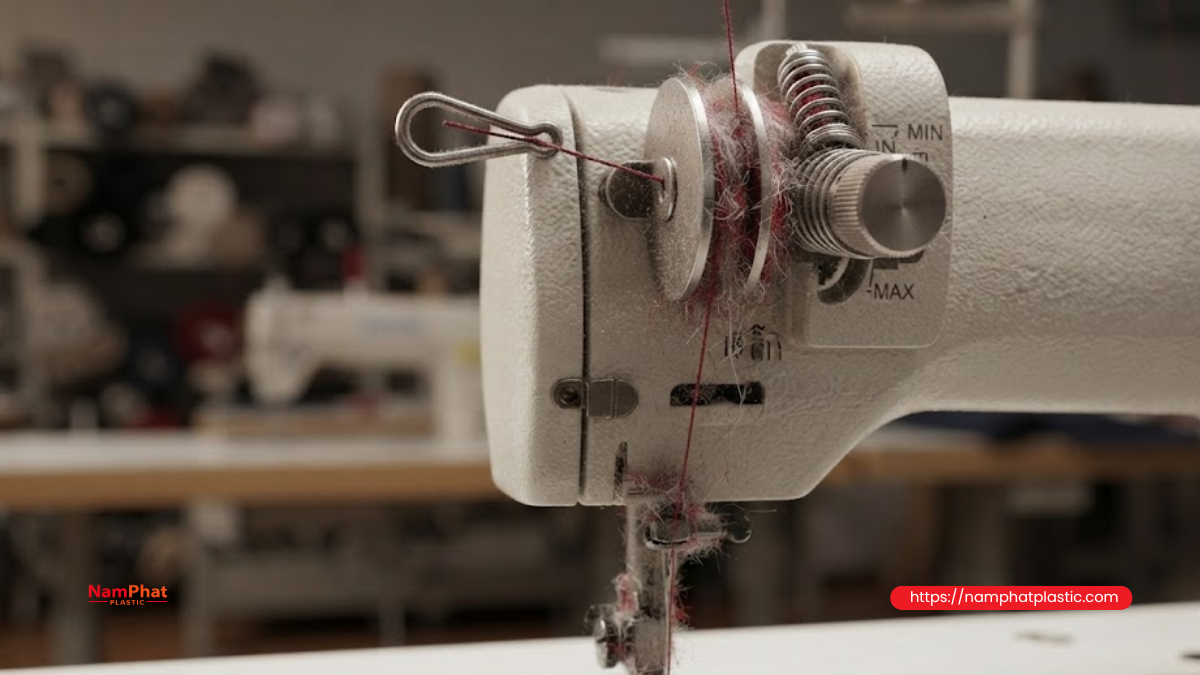
When protruding fibers continuously rub against tension discs, thread guides, and the needle eye, some fibers may separate from the main thread. These small fibers accumulate into dust at high-friction locations.
Thread dust commonly accumulates around:
-
The gap between tension discs.
-
Thread guides near the needle.
-
The take-up lever.
-
Presser foot area.
-
Loop-forming components.
-
Around the needle eye and needle plate.
When dust accumulates inside the tension assembly, the pressure applied to the thread may become unstable. The machine may operate normally at first but later develop loose seams, thread jerking, or unexpected thread breakage.
If the operator simply replaces the spool without cleaning the existing dust, it is also difficult to accurately evaluate the quality of the new spool.
3.3. Causing the thread to become fuzzy and break at the needle eye
The needle eye is one of the points where the thread experiences significant friction. The thread must move through the needle eye at high speed while continuously changing direction.
If the thread contains many long fibers, the protruding fibers can catch on the edge of the needle eye. After repeated cycles, the outer fiber layer becomes worn, the thread body becomes thinner, and the thread eventually breaks.
Common signs include the section of thread near the needle:
-
Becoming brush-like and frayed.
-
Having many white or fine fibers.
-
Losing its twist.
-
Becoming locally thinner.
-
Breaking after several minutes of continuous operation.
-
Breaking more frequently when machine speed increases.
The problem becomes more severe if the needle is worn, the needle eye has a burr, the wrong needle size is used, or the bag material has a very rough surface.
3.4. Increasing needle temperature
When friction between the thread, needle, and material increases, more heat is generated around the needle area. With synthetic threads, excessive heat and friction can cause the surface fibers to soften, deform, or become slightly sticky.
Possible signs include:
-
The broken thread end appearing contracted or hardened.
-
An unusually glossy surface at the friction point.
-
The thread becoming soft or sticky around the needle eye.
-
The machine running normally at low speed but breaking thread at higher speed.
-
The needle becoming noticeably hot after continuous operation.
Suitable lubricants or finishing agents can help reduce friction, dynamic tension, and heat generation during sewing. However, the amount of lubricant must be controlled. Too little may not sufficiently reduce friction, while too much can cause dust to stick, thread slippage, or contamination of the packaging.
3.5. Causing thread tension fluctuations
A thread with an uneven surface does not pass through the tension assembly with constant resistance.
A section with little hairiness may pass relatively easily, while a section with more fibers or a fiber lump may experience greater resistance. This change creates short-duration tension peaks.
Operators may notice:
-
The thread jerking rhythmically.
-
The spool vibrating or rotating unevenly.
-
Sections of the seam becoming tighter.
-
The chain stitch on the back of the bag becoming inconsistent.
-
The thread occasionally being pulled down from the material.
-
Random thread breakage.
If the operator adjusts the tension based on the most hairy section, normal sections may become too loose. Therefore, machine adjustment may reduce the symptoms but cannot resolve an inherently uneven thread structure.
3.6. Affecting stitch formation
A bag sewing machine needs to form a stable thread loop so that the looper or loop-forming component can catch the thread. When tension fluctuates significantly or the thread becomes frayed at the needle, the thread loop may not form correctly.
This can contribute to:
-
Skipped stitches.
-
Uneven stitches.
-
Loose chain stitches on the back.
-
Difficulty starting the seam.
-
Seams that can open more easily in certain sections.
However, skipped stitches are not always caused by hairiness. Other causes, such as a bent needle, incorrect needle installation, incorrect looper timing, an unsuitable presser foot, or worn loop-forming components, should also be checked.
3.7. Reducing seam stability
A thread that becomes heavily frayed before entering the seam may already have lost part of its original structural integrity. Although it may not break immediately on the machine, the load-bearing capacity of that section may have been reduced.
The completed seam may then be more likely to:
-
Have inconsistent tightness.
-
Break at worn sections.
-
Open when the bag experiences impact.
-
Have reduced tensile resistance during transportation.
-
Have excessive fibers sticking to the bag surface.
-
Have reduced appearance quality where clean packaging is required.
A comparative study of sewing thread structures found that thread with lower hairiness and friction also achieved better results in tensile strength and certain seam performance indicators. This indicates that surface quality should be considered together with the mechanical strength of the thread.
3.8. Reducing bag-closing productivity
The greatest cost of hairy thread is not necessarily the price of one spool, but the time the machine has to stop.
Each time the thread breaks, the operator may need to:
-
Stop the machine or conveyor.
-
Locate the break point.
-
Rethread the machine.
-
Reseal the unfinished section of the bag mouth.
-
Inspect the seam again.
-
Clean the machine if unstable operation continues.
If the problem occurs repeatedly during one shift, bag-closing productivity can decrease significantly. In addition to downtime, the company may have to resew bags, create overlapping seams, or face the risk of product leakage during transportation.
4. Does less hairiness always mean better thread?
It should not be assumed that a shinier surface with absolutely no fibers will always run better.
For spun thread, a small amount of surface fiber can provide a certain level of grip within the seam. A thread that is excessively smooth but has an unsuitable twist level or unstable finishing treatment can still cause slippage, chain-stitch loosening, or difficulty controlling tension.
The goal should not be to completely eliminate surface fibers, but to achieve:
-
Short and relatively uniform fibers.
-
No excessive long protruding fibers.
-
No significant fiber shedding during machine operation.
-
A thread body that maintains its structure after friction.
-
Friction within a suitable range.
-
Consistent quality between spools and throughout the spool.
In other words, hairiness should be controlled rather than necessarily reduced to zero.
5. What causes bag sewing thread to become hairy?
Uneven raw fiber quality
If the incoming single yarn has many thin and thick spots, short fibers, or poor fiber cohesion, the thread can develop long protruding fibers, swollen sections, or fiber lumps after plying and twisting.
Twist level is too low
Twist helps bind the component fibers into a unified structure. When the twist is too low, the fiber ends are not held firmly inside the thread body and can easily protrude under friction.
However, excessive twist is not an ideal solution either. Over-twisted thread can become stiff, twist into loops, or become more difficult to form stitches. Therefore, the twist level needs to balance strength, softness, and machine performance.
Unstable twist level
If spindle speed, input tension, or fiber feeding is unstable, the twist level along the thread may vary. Some sections will be compact while others will be loose and highly hairy.
Uneven tension during plying or twisting
Component yarns need to be fed with relatively consistent tension. If one yarn is looser than the others, it may rise to the surface and form loops or swollen sections.
Friction during winding
Worn thread guides, sharp contact surfaces, excessive winding tension, or friction between the spool and machine components can damage the thread surface before it reaches the customer.
Unsuitable finishing agent or lubricant
Finishing agents help reduce friction, limit fiber shedding, and improve machine performance. If the lubricant distribution is uneven, one part of the spool may run well while another part becomes hairy quickly.
The thread is wound too tightly or unevenly
A spool wound too tightly can compress or deform the thread and cause unstable thread delivery. A spool wound too loosely may collapse, tangle, or pull out multiple loops at once.
Improper storage
Thread stored near heat sources, dust, chemicals, or environments with significant humidity fluctuations may experience changes in surface properties. Torn spool packaging can also allow dust to settle on the thread and increase friction during use.
Worn sewing machine components
In many cases, the thread only begins to become hairy after passing through the machine. Possible causes include:
-
A needle eye with a sharp edge.
-
A bent or worn needle.
-
A thread guide with a groove.
-
Tension discs contaminated with residue.
-
Burrs on the looper.
-
The thread rubbing against the machine housing.
-
Incorrect threading.
Therefore, it is necessary to determine whether the thread was already hairy on the spool or became hairy because of the machine before identifying the root cause.
6. How to determine whether thread hairiness comes from the spool or the sewing machine
The inspection can be performed at four points:
Point 1: Thread directly on the spool
Pull approximately one meter of thread that has not passed through the machine and inspect it under light. If there are already many long fibers, fiber lumps, or swollen sections, the cause is likely related to the spool.
Point 2: After the thread tension assembly
Allow the thread to pass through the tension discs, then stop the machine and inspect it. If the thread starts to fray after this point, clean and inspect the surface of the tension discs.
Point 3: Before and after the needle eye
Compare the thread section before the needle with the section immediately after passing through the needle eye. If the thread only becomes frayed after passing through the needle, replace the needle with one of the correct size and check the threading path.
Point 4: After continuous machine operation
Run the machine under fixed conditions and observe the amount of dust generated. If dust is concentrated around a specific thread guide, that component may be causing abnormal friction.
Quick troubleshooting table for bag sewing thread hairiness
| Symptom | Possible cause | Inspection direction |
| Thread is already hairy when pulled from the spool | Raw material, twist level, or winding process | Compare another spool from the same lot and another lot |
| Thread becomes hairy after the tension assembly | Dirty tension discs, excessive pressure, or sharp surface | Clean, reduce tension, and inspect the surface |
| Thread becomes brush-like at the needle | Needle too small, worn needle, sharp needle eye, or high speed | Replace with the correct needle size and test at the same speed |
| Machine runs for a while before thread breaks | Dust accumulation, needle heat, or increasing friction | Clean the machine and check the needle and finishing lubricant |
| Beginning of spool runs well but middle section runs poorly | Uneven spool quality | Take samples from the beginning, middle, and end |
| Thread becomes very hairy when sewing rough bags | Highly abrasive bag material | Review thread size, needle, tension, and machine speed |
| Spool vibrates and thread delivery is jerky | Winding method or spool position is unsuitable | Check the thread stand and unwinding direction |
| Dust forms sticky lumps | Excess lubricant combined with fiber dust | Check cleanliness and lubricant level on the thread |
7. How to check thread hairiness at the factory
If specialized measuring equipment is not available, companies can establish an internal inspection method to compare different thread lots.
7.1. Comparison against a dark background
Take thread samples of the same length, place them against a black background, and shine light across the surface. This makes protruding fibers easier to see.
Samples should be taken from:
-
Beginning of the spool.
-
Middle of the spool.
-
Near the end of the spool.
-
Multiple spools from the same lot.
7.2. Running a test for a fixed period
Use the same machine, same type of bag, same needle, same speed, and same tension settings. After a fixed period, record:
-
Number of thread breaks.
-
Number of tension adjustments.
-
Amount of dust generated.
-
Thread condition at the needle.
-
Seam uniformity.
-
Needle temperature or relative heat level.
-
Ability to increase machine speed.
Actual machine testing is usually more useful than simply testing thread breaking strength by hand.
7.3. Checking fiber shedding
Pass a section of thread through a clean thread guide while maintaining relatively similar tension between samples. Observe the amount of fiber remaining on the thread guide after the same number of passes.
This is only an internal comparison method and does not replace standardized testing equipment.
7.4. Using specialized measuring equipment
Manufacturers can use a hairiness tester to determine the number of fiber ends protruding from the yarn body over a specified length. When using this method, the following conditions should be standardized:
-
Fiber length being measured.
-
Sample length.
-
Testing speed.
-
Temperature and humidity conditions.
-
Sampling location on the spool.
A single threshold should not be applied to every thread type because PE 20/6, 20/8, and 20/9 threads have different structures, diameters, and intended applications.
8. How to deal with hairy bag sewing thread that frequently breaks
Clean the entire thread path
Remove dust from the tension assembly, thread guides, presser foot, and loop-forming components. After cleaning, run the same spool again for evaluation.
Replace the needle with the correct size
Do not rely only on visual inspection to determine whether a needle is still usable. A small scratch inside the needle eye can cause the thread to fray rapidly.
The needle should be large enough for the thread to pass through without excessive compression, but it should not be excessively large because this may create a larger stitch hole or affect seam formation.
Reduce thread tension gradually
Reduce the tension slightly and monitor the seam. Do not reduce it too much at once because this may result in loose stitches or a seam that opens easily.
Check the threading path
Make sure the thread passes through the correct sequence of guides and does not rub against the machine housing, thread stand, or unnecessary components.
Reduce machine speed to identify the cause
If the machine runs stably at low speed but the thread becomes hairy and breaks at higher speed, the cause may be related to friction, needle heat, needle size, or the thread's abrasion resistance.
Reducing speed should only be used as a diagnostic step or temporary solution. The long-term solution is to adjust the thread, needle, tension, and machine condition together.
Test another spool as a control sample
The test should be performed in the following order:
-
Another spool from the same lot.
-
A spool from a different production lot.
-
A spool that has previously run reliably on the machine.
-
The suspected spool on another sewing machine.
This control method helps avoid changing multiple variables at the same time without identifying the actual cause.
9. What factors should thread manufacturers control?
To limit abnormal hairiness, bag sewing thread production should simultaneously control:
-
Uniformity of the single yarn.
-
Plying ratio and number of component yarns.
-
Tension of each yarn during plying.
-
Twist level and twist direction.
-
Stability of twisting machine speed.
-
Condition of thread guides and contact components.
-
Lubricant or finishing-agent level.
-
Winding tension.
-
Spool hardness and shape.
-
Quality at the beginning, middle, and end of the spool.
-
Actual machine-running performance.
Checking only breaking tensile force is not enough. A good bag sewing thread product needs an appropriate combination of strength, elongation, twist, surface uniformity, and abrasion resistance.
10. Selecting bag sewing thread according to operating conditions
The impact of hairiness also depends on the type of bag and operating conditions.
Woven PP bags
The surface of woven PP bags can generate relatively high friction, especially around cut edges. The thread therefore needs good abrasion resistance and must maintain a stable structure while passing through the needle.
Multi-layer paper bags
Paper bags can generate dust and resistance that differ from PP bags. The amount of paper dust combined with thread dust around the tension assembly should be monitored.
Bags with PE liners
When sewing through multiple material layers, needle penetration force and friction can increase. Needle size, thread tension, and thread type should be selected according to the total material thickness.
High-speed bag sewing machines
The faster the machine operates, the higher the requirements for thread uniformity. Small variations in hairiness or twist may not be obvious at low speed but can become clear during continuous high-speed operation.
Conclusion
Bag sewing thread hairiness directly affects friction, dust generation, thread tension, needle temperature, and machine-running stability. However, thread quality should not be judged simply by whether the surface contains fibers.
A suitable product should have controlled surface fibers, consistent twist, good abrasion resistance, and stable quality throughout the entire spool. When a machine experiences excessive hairiness or thread breakage, businesses should inspect each point along the thread path, use control samples, and conduct tests under fixed operating conditions.
For PE 20/6, 20/8, or 20/9 bag sewing thread, the appropriate specification should be selected based on bag type, material thickness, machine speed, and seam load requirements. Nam Phat Plastic can support customers in comparing thread specifications and conducting sample trials before using the thread for large-scale production orders.
Frequently Asked Questions
1. Does surface hairiness mean that bag sewing thread is poor quality?
No. Spun thread normally contains a certain amount of surface fiber. Thread becomes a potential source of problems when the fibers are excessively long, uneven, easily shed, or generate large amounts of dust during machine operation.
2. Why is the thread very strong when pulled by hand but frequently breaks on the machine?
A hand tensile test does not reproduce friction, bending, heat, or continuous tension fluctuations on the machine. A thread may have good tensile strength but poor abrasion resistance or excessive surface hairiness.
3. Can reducing thread tension solve excessive hairiness?
Reducing tension can help reduce friction and limit thread breakage, but it does not remove hairiness that is already present. If the thread structure is uneven, this is only a temporary measure.
4. Does using a larger needle help reduce thread fraying?
A larger needle eye may allow the thread to pass more easily, but the needle must be appropriate for the bag material and thread size. A needle that is too large may create a larger stitch hole or affect seam quality.
5. Why does the beginning of the spool run well but the middle of the spool generate more dust?
The cause may be related to lubricant level, twist, winding tension, or uneven yarn quality along the spool. Samples should be taken from multiple positions rather than checking only the outer layer.
6. Should additional lubricant be applied directly to the thread when the machine frequently breaks thread?
Additional lubricant should not be applied to the spool arbitrarily. Unsuitable or excessive lubricant can cause dust to stick, contaminate the bags, and change thread tension. The cause should first be identified as related to the thread, needle, tension assembly, or threading path.
>>> See also:
- 0 Comment


