


 Phan Van Hoang
- 23/07/2026
- 307
Bag sewing thread may look like a simple consumable, but in reality, it directly affects packaging speed, seam strength, thread breakage rate, and machine downtime.
A type of thread that runs well on a handheld bag sewing machine may continuously break when used on a high-speed production line. Conversely, using thread that is too large for a handheld machine does not necessarily make the seam stronger. It may make the thread difficult to pass through the needle eye, increase friction, cause skipped stitches, or make the needle heat up.
Therefore, choosing thread for a bag sewing machine should not be based solely on the question, “How many kilograms does the bag contain?” Users need to consider the machine type, stitch type, number of needles, number of threads, bag material, and operating speed at the same time.
Table of Contents [Hide]
1. Summary of how to choose thread for each machine
The following can be used as an initial reference:
| Bag code | Opening size | Machine type | Thread type | Stitch density | Kg/1,000 bags | Waste |
| Bag A | 50 cm | Single-needle handheld | 20/9 | 3 stitches/cm | 0.65 kg | 8% |
| Bag B | 60 cm | Single needle, two threads | 20/9 | 3 stitches/cm | 1.10 kg | 6% |
| Bag C | 50 cm | Double needle | According to requirements | 3 stitches/cm | 1.75 kg | 5% |
The table above is only a starting point for machine testing. The final selection should be based on the bag type, seam construction, needle being used, and actual operating conditions.
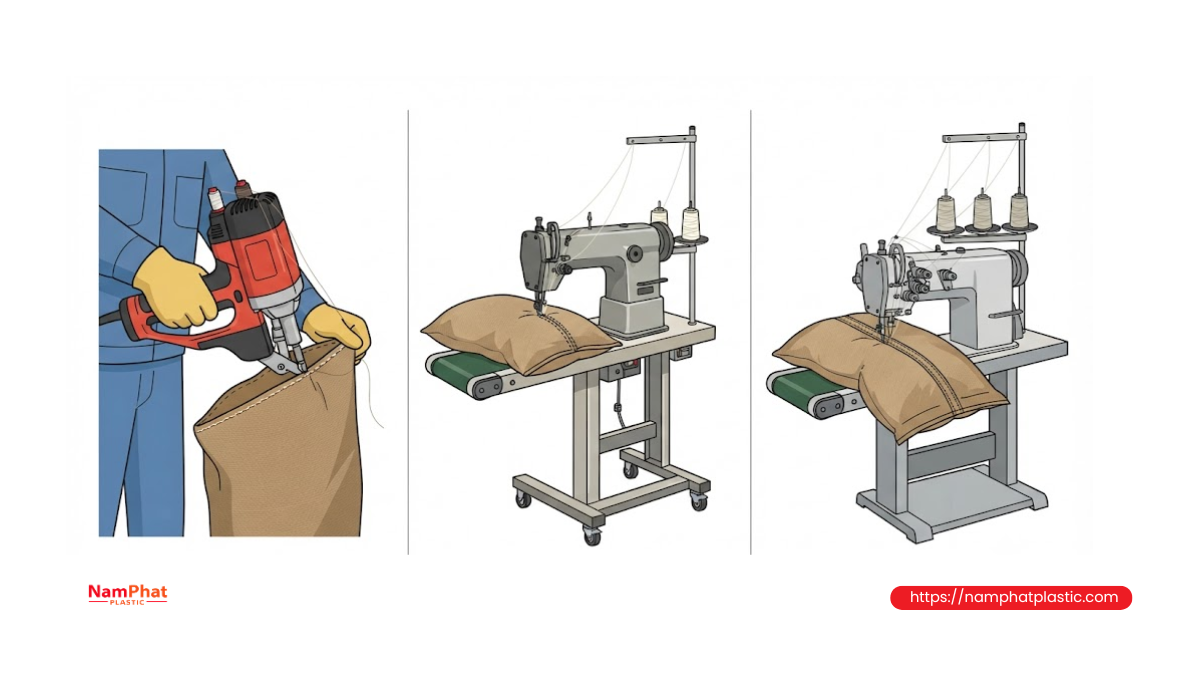
2. First, distinguish the number of needles and the number of threads
A common misconception is that a single-needle machine always uses one thread. In reality, the number of needles and the number of threads are two different concepts.
A single-needle machine can produce:
- Single-thread chain stitch, commonly designated as stitch 101.
- Two-thread chain stitch, commonly designated as stitch 401.
- Seams with or without paper tape, PP tape, or inserted cord.
For example, Newlong NP-7 is a single-needle handheld machine using a single-thread chain stitch, while NP-3II still uses one needle but produces a two-thread chain stitch. Therefore, when purchasing thread, users must check the stitch type rather than simply asking how many needles the machine has.
For double-needle machines, the sewing head creates two parallel seams. Fischbein also classifies twin-needle sewing heads as systems that create two parallel thread lines, serving applications that require stronger and more stable bag closure seams.
3. Seven important criteria when choosing bag sewing thread
3.1. Choosing the right thread according to stitch type
The stitch type determines the number of thread feeds and how the thread forms the interlocking structure on the underside of the bag.
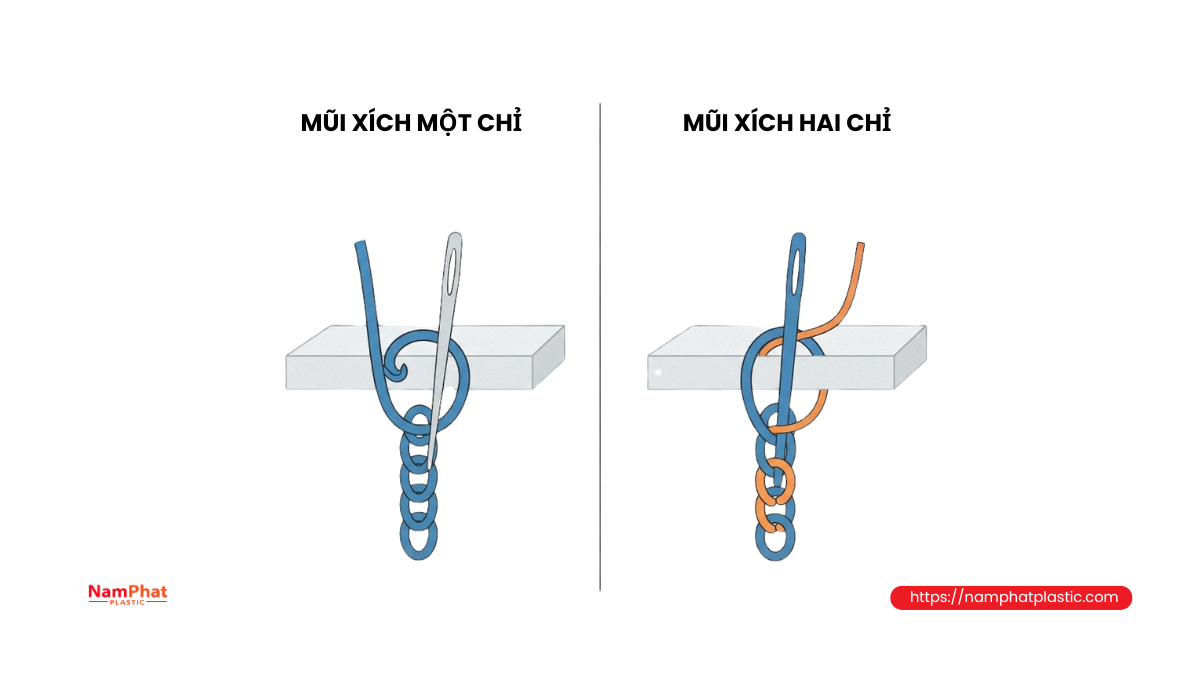
Single-thread chain stitch
A single-thread chain stitch uses one thread supply. This structure is simple, easy to thread, and convenient when the seam needs to be removed to open the bag.
However, the beginning and end of the seam need to be handled correctly. If the thread tail is too short or the seam is pulled in the direction in which the chain can unravel, the bag opening may come apart more quickly than expected.
For this stitch type, the thread should:
- Form even loops at the looper.
- Not be excessively stiff.
- Not twist when coming off the roll.
- Run smoothly through the needle eye and thread guides.
Two-thread chain stitch
A two-thread chain stitch uses needle thread and looper thread to create a stronger interlocking structure. This type of seam is often selected for bags requiring high stability, long-distance transportation, or resistance to vibration during handling.
For two-thread machines, do not inspect only the thread roll on the needle side. The looper thread roll must also have good consistency. If one thread unwinds smoothly while the other pulls unevenly, the seam may develop uneven tension, shrinkage, or skipped stitches.
Union Special documentation shows that automatic bag-closing sewing heads may use either single-thread chain stitch 101 or two-thread chain stitch 401 depending on the configuration. This demonstrates that thread selection cannot be based solely on the external appearance of the sewing head.
3.2. Choosing the appropriate thread size for the needle
The thread must pass freely through the needle eye without being excessively small relative to the needle groove.
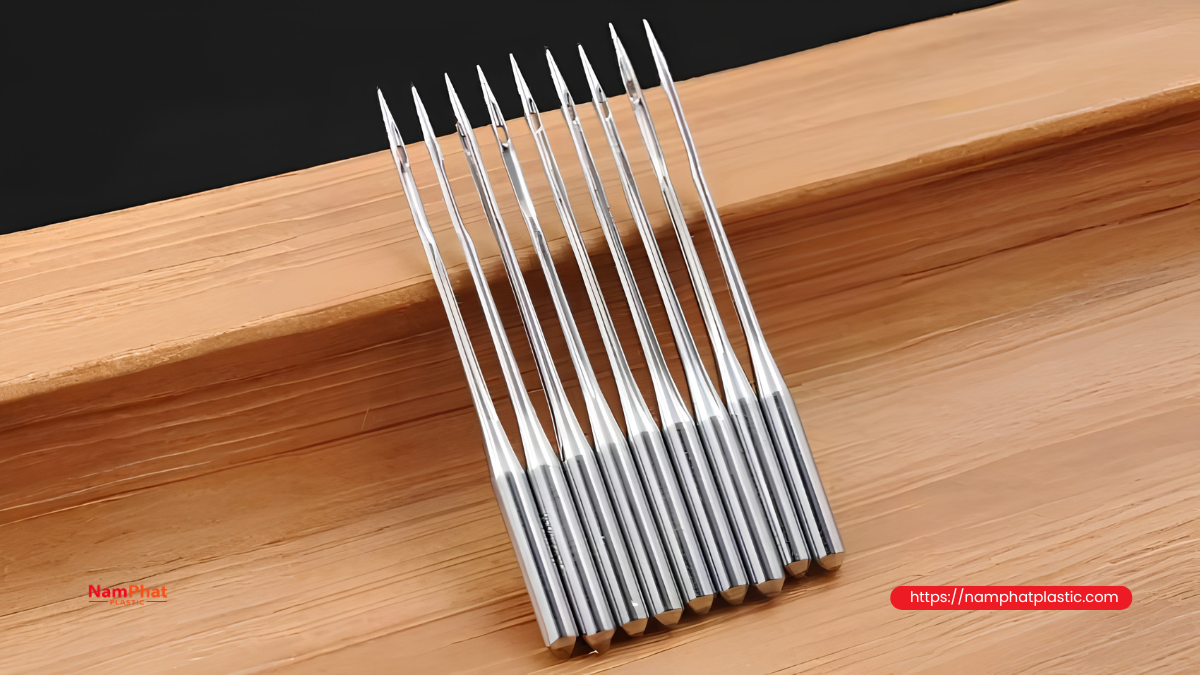
If the thread is too large:
- Friction at the needle eye increases.
- The needle heats up more quickly.
- The thread surface may become fuzzy or separate.
- The machine may skip stitches because the thread loop is not formed properly.
- Higher tension is required to pull the thread through the system.
- The thread may break during continuous operation.
If the thread is too small:
- The seam's load-bearing capacity may not meet requirements.
- The thread may cut into the bag edge when the bag is stretched.
- The seam may appear loose or insufficiently filled.
- Seam service life may decrease during transportation.
Union Special's technical guidance states that needle size should be selected according to thread size and that the thread should pass freely through the needle eye to create stable stitches.
Therefore, when changing from 20/6 to 20/9, do not simply replace the thread roll and continue operating. Recheck:
- Needle size.
- Needle eye condition.
- Needle groove.
- Thread guides.
- Tension discs.
- Needle position relative to the looper.
- Presser-foot pressure.
3.3. Choosing thread size according to bag construction, not just weight
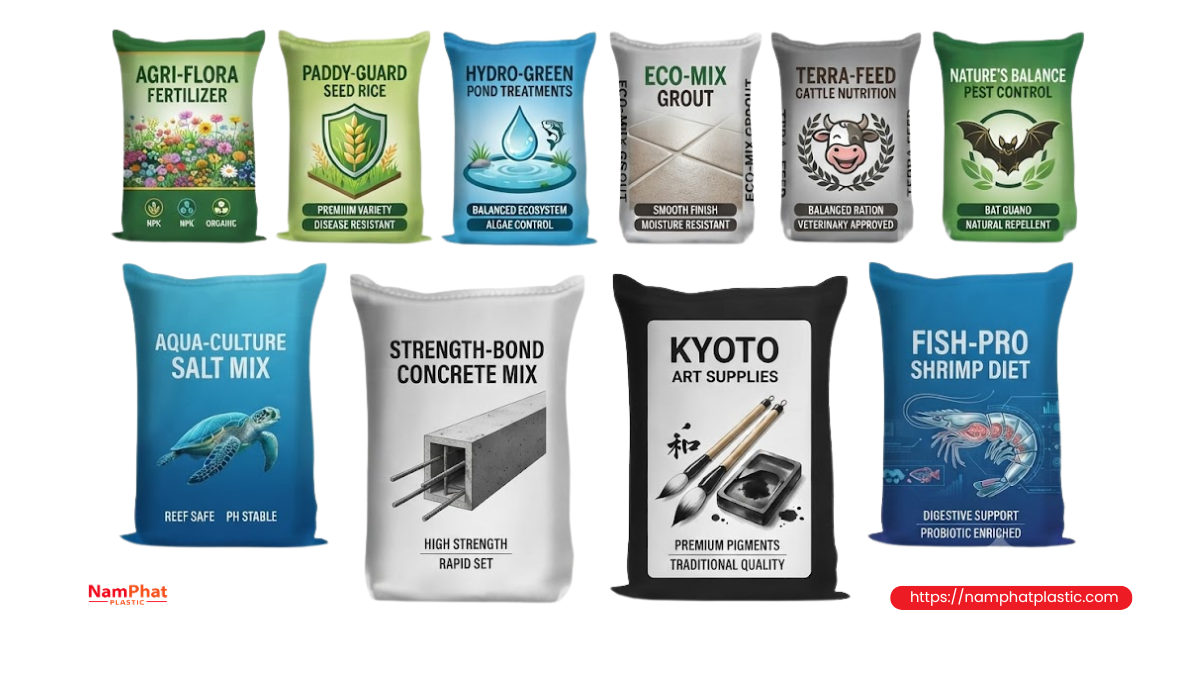
Two bags that both contain 25 kg may have completely different thread requirements.
For example:
- Laminated woven bags.
- BOPP laminated animal feed bags.
- Multi-layer paper bags.
- Mesh bags.
- Canvas or jute bags.
- Plastic resin bags.
- Fine powder bags.
- Bags containing materials with sharp edges.
Each type has different thickness, stiffness, slipperiness, and thread-cutting characteristics.
Therefore, when selecting thread size, at least four factors should be considered:
- Total thickness at the sewing position.
- Number of material layers that the needle must penetrate.
- Possibility of the bag edge being stretched.
- Level of vibration, impact, and stacking after packaging.
Do not assume that a 50 kg bag always requires the largest thread. If the bag is relatively flexible, the opening is folded correctly, and a two-thread seam is used, a medium-sized thread with stable quality may run better than an excessively large thread.
3.4. Choosing according to operating speed
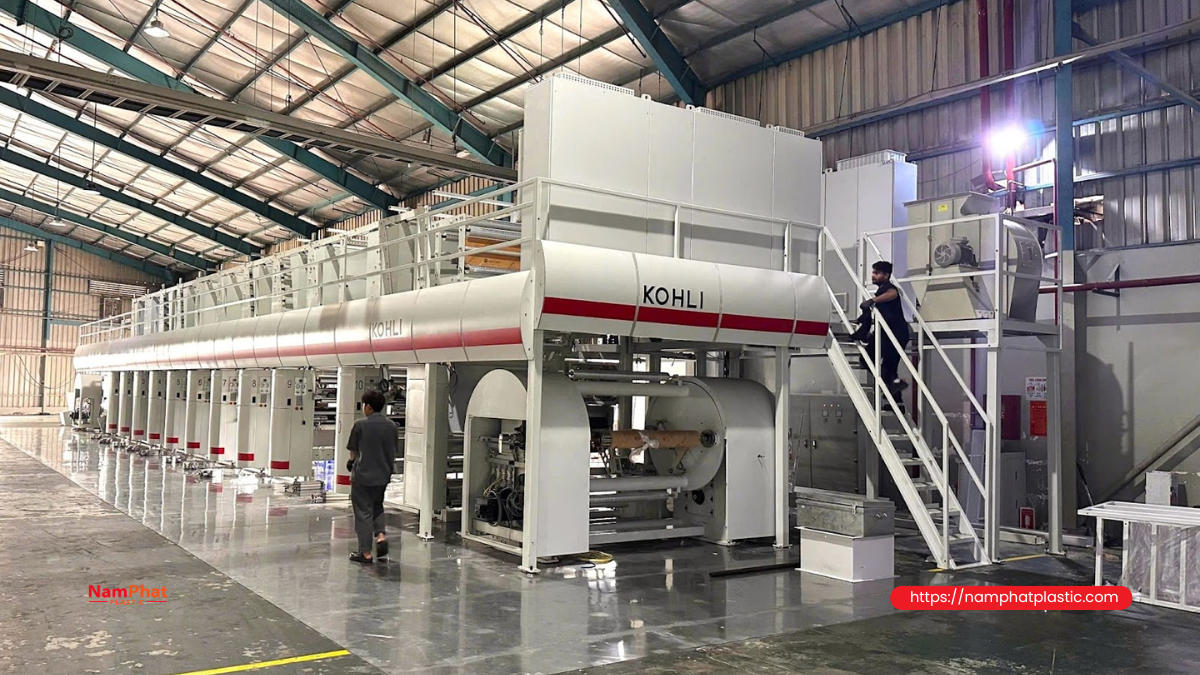
The faster the machine operates, the higher the requirements for thread consistency and surface quality.
As speed increases, the thread continuously passes through:
- Thread guides.
- Tension assembly.
- Take-up spring.
- Needle eye.
- Material surface.
- Loop-forming and looper components.
Every contact point creates friction. Thread with excessive fibers, uneven twist, or an overly dry surface is more likely to generate heat and break during continuous operation.
The Union Special 4500 handheld machine operates at approximately 1,600–1,800 rpm depending on the material. Meanwhile, some high-capacity automatic bag-closing sewing heads can operate at considerably higher speeds and are integrated with automatic thread-chain starting, stopping, and cutting systems.
Therefore, an automatic production line does not simply require “larger thread.” It requires thread with:
- Stable diameter.
- Stable twist.
- A low number of joints.
- A clean surface with minimal fuzz.
- Consistent unwinding from the roll.
- Suitable finishing or lubrication.
- Minimal strength variation between batches.
3.5. Checking twist and twist balance
Twist helps the component fibers remain connected. However, both insufficient and excessive twist can cause problems.
Thread with too little twist
- Fibers can separate easily.
- The surface becomes fuzzy quickly.
- Individual fibers may catch on thread guides.
- Abrasion resistance is low.
- The needle can damage the fibers more easily.
Thread with too much twist
- The thread becomes stiff.
- It can form twisted loops when unwinding from the roll.
- The seam may shrink.
- Loop formation at the looper becomes difficult.
- Tension can fluctuate when the machine runs at high speed.
A simple check is to take approximately one meter of thread, fold it in half, and bring the two ends together. If the thread automatically twists into multiple tight loops, it may contain excessive residual torque.
This test does not replace professional measuring equipment, but it can help operators quickly identify differences between thread batches.
3.6. Checking thread roll consistency
A good thread roll needs not only good thread but also proper winding.
A roll that is wound too tightly may compress the inner layers and make unwinding difficult. A roll that is too loose may collapse, tangle, or pull out multiple loops at once.
Thread rolls used for bag sewing machines should have:
- A relatively flat roll surface.
- Evenly distributed winding layers.
- No abnormal bulges or depressions.
- No collapse during transportation.
- Continuous, non-jerky unwinding.
- A secure core.
- Dimensions compatible with the thread holder.
For double-needle or two-thread machines, rolls operating simultaneously should have comparable winding structures. Differences in winding between two rolls can create different thread tension even when the operator sets both tension assemblies to the same level.
3.7. Choosing thread material according to the operating environment
Industrial thread materials have different characteristics. There is no single material that is absolutely suitable for every type of bag.
PE thread
PE thread is widely used in various bag-closing applications because of its reasonable cost, light weight, and compatibility with many common bag sewing machines.
PE thread is suitable for:
- Sewing standard woven bags.
- Sewing rice bags, agricultural product bags, or animal feed bags.
- Applications requiring reasonable material costs.
- Machines operating at moderate speeds.
- Businesses requiring options such as 20/6, 20/8, or 20/9.
When used on high-speed machines, priority should be given to PE thread with uniform twisting, minimal fuzz, and suitable surface treatment. Do not use rolls that are dry, stiff, or contain excessive joints.
Polypropylene thread has a low density and good resistance to various chemicals, mold, and humid environments. Some industrial PP thread products are developed for geotechnical materials and outdoor applications requiring resistance to chemicals, fungi, and mold.
However, PP thread used for bag closing must be distinguished from very large PP thread used for jumbo bags or geotextiles. Do not take container sewing thread with thousands of denier and use it on a conventional bag-closing sewing head.
Polyester is often selected when higher strength, abrasion resistance, and stability are required during high-speed sewing.
Industrial polyester threads with low-friction lubrication finishes can help reduce the effects of needle heat and abrasion while supporting more stable loop and stitch formation.
The disadvantage is that the cost is usually higher than common PE thread. Therefore, polyester is suitable for products with higher value, seams subjected to greater loads, or situations where the cost of production-line downtime is higher than the difference in thread price.
4. How to choose thread for handheld bag sewing machines
Handheld bag sewing machines are commonly used in agricultural warehouses, animal feed factories, rice packaging facilities, fertilizer plants, plastic resin packaging facilities, and bag-transfer stations.
Handheld machines can use either one-thread or two-thread stitches. For example, Newlong NP-7 uses a single-thread chain stitch, while NP-3II uses a two-thread chain stitch to create a stronger seam.
5. Requirements for handheld machine thread
Because the sewing head is moved directly by the operator, the speed at which the bag is fed is not always completely uniform. The thread should have suitable softness and flexibility to compensate for small variations in operation.
Priority should be given to:
- Low-fuzz thread.
- Small or medium rolls suitable for the thread holder.
- Smooth unwinding.
- No large twisted loops.
- Uniform twist.
- Few and compact joints.
- Not excessively stiff for the thread path.
>>> Read more: Quality requirements for sewing thread
6. Should you use 20/6, 20/8, or 20/9?
- 20/6 thread can be tested for relatively light bags, soft materials, or applications requiring smaller thread that runs easily.
- 20/8 thread is a balanced choice for many woven bags, rice bags, animal feed bags, and common agricultural product bags.
- 20/9 thread is more suitable when the bag opening is thick, the bag contains multiple layers, or the seam needs to withstand high tensile loads. However, needle size and thread path must be checked before use.
For handheld machines, do not automatically assume that 20/9 is always better than 20/8. Larger thread increases pulling load and may require the operator to increase thread tension.
7. How to choose thread for single-needle bag sewing machines
Single-needle machines are a broad category. The machine may be handheld, a post-mounted sewing head, or a sewing head integrated into a conveyor system.
Before choosing thread, answer three questions:
- Does the machine use a single-thread or two-thread chain stitch?
- What needle size is currently installed?
- Does the machine operate intermittently or continuously?
7.1. Single needle – single thread
For a single-needle machine using stitch 101, stable loop formation is an important factor. Thread that is too stiff or has excessive residual twist may prevent the loop behind the needle from opening at the correct time for the looper to catch it.
You can initially test 20/6 or 20/8. Move up to 20/9 only when:
- The needle is sufficiently large.
- The bag is thick or stiff.
- The thread path is unobstructed.
- The machine still forms loops consistently.
- The thread does not heat up or become fuzzy during continuous operation.
7.2. Single needle – two threads
A single-needle, two-thread machine creates a 401 double-chain stitch. This type of seam is generally more stable during transportation.
When selecting thread, consider separately:
- The thread passing through the needle.
- The thread passing through the looper.
- Tension of each thread path.
- Consumption rate of each roll.
- Ability to cut the thread chain after sewing.
In some configurations, the needle thread and looper thread can use the same specification. However, the operator still needs to adjust the tension separately for each thread path rather than simply copying the settings from another machine.
8. How to choose thread for double-needle bag sewing machines
Double-needle machines create two parallel seams. The main purpose is to increase the stability of the bag-closing seam or create a seam structure according to specific product requirements.
An important point is that two needles already create two load-bearing seams. Therefore, it is not necessarily necessary to use the largest thread size for both needles.
In many cases:
- Two consistent 20/6 threads may be more effective than two excessively stiff 20/9 threads.
- 20/8 can provide a balance between seam strength and machine performance.
- 20/9 should only be used when the sewing head, needles, and material actually require it.
Specific requirements for double-needle machines
The two thread rolls should:
- Have the same specification.
- Have approximately the same twist.
- Have consistent thread size.
- Unwind with similar force.
- Not have one roll that is stiff and another that is soft.
- Not differ significantly in lubrication.
If the two thread paths have different tension, the bag edge may be pulled to one side. One seam that is too tight while the other is too loose also reduces the benefit of the double-needle configuration.
Fischbein describes a twin-needle configuration as a system that creates two parallel stitch lines, so synchronization between the two thread supplies is an important operating requirement.
9. How to choose thread for automatic bag sewing lines
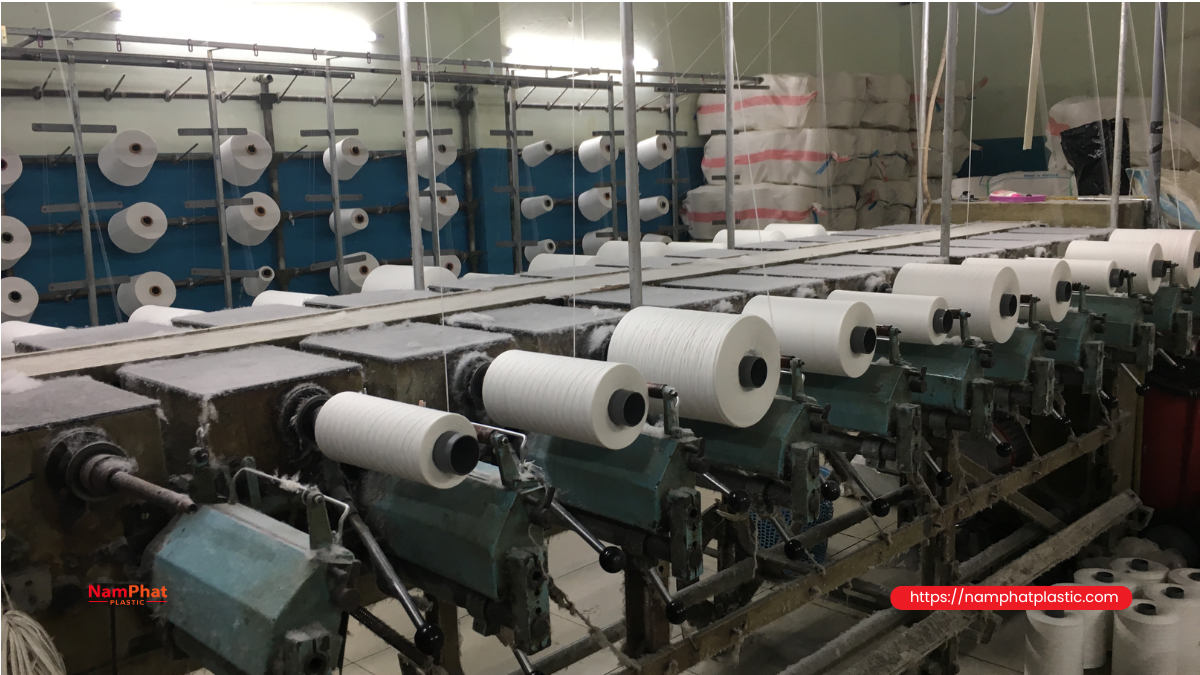
An automatic production line may include:
- Bag-feeding conveyor.
- Bag-mouth guide.
- Folding unit.
- Sewing head.
- Bag detection sensor.
- Thread-chain cutting unit.
- Sewing system with paper tape or PP tape.
- Speed control system.
For this type of machine, stability is more important than saving a small amount on each kilogram of thread.
Some automatic bag-closing systems use sensors to control starting, stopping, and thread-chain cutting. High-capacity sewing heads can operate at high speeds, process thick materials, and run continuously.
10. What requirements should thread for automatic production lines meet?
Consistency along the thread length
A locally thick section of thread may become stuck at the needle eye. A section that is too thin may be weaker than the rest and break precisely when the machine is running at high speed.
Few joints
Large joints can:
- Fail to pass through the needle eye.
- Get caught in the thread guide.
- Cause tension fluctuations.
- Cause skipped stitches.
- Make the thread cutter operate inconsistently.
Thread roll capacity suitable for the machine
Large rolls reduce the number of thread changes but must be compatible with the thread holder and unwinding method. Do not place a large roll directly on a thread stand designed for a small roll without a suitable guide system.
Stable surface and lubrication
Continuous machine operation increases heat and friction. Thread with a suitable surface finish helps reduce fuzz, lower pulling resistance, and maintain loop-forming performance.
Consistent quality between batches
A production line adjusted for one thread batch may become unstable when switching to another batch with different diameter, twist, or lubrication.
Factories should retain reference samples from each batch and record:
- Receiving date.
- Batch number.
- Supplier.
- Thread type.
- Machine used.
- Tension level.
- Number of thread breaks per shift.
- Operator comments.
11. Suggested selection guide for 20/6, 20/8, and 20/9
The specifications below should be considered a starting point for machine testing, not a fixed standard for every factory.
| Specification | Relative characteristics | Applications to test |
| 20/6 | Smaller and softer, with lower machine pulling load | Light bags, soft bags, handheld machines, machines with narrow thread paths |
| 20/8 | Balance between strength and machine performance | Woven bags, rice bags, animal feed, agricultural products |
| 20/9 | Larger thread, requiring suitable needle and thread path | Thick bags, multi-layer bags, high tensile loads, some automatic production lines |
The designations 20/6, 20/8, and 20/9 are common commercial terms based on the structure and number of component plies. They should not be directly converted to denier based solely on the designation. For an accurate comparison between two suppliers, the actual sample length should be weighed and tensile strength measured.
12. Thread testing process before purchasing in large quantities
Businesses should not evaluate thread by sewing only one or two bags. A roll may run well during the first few minutes but begin breaking when the needle heats up or when the roll reaches its inner layers.
Step 1: Record the machine configuration
Record:
- Machine name and model.
- One needle or two needles.
- One thread or two threads.
- Needle size.
- Stitch length.
- Bag type.
- Number of layers at the sewing position.
- Machine speed.
- Current tension level.
Step 2: Inspect the thread roll before installation
Check:
- Roll surface.
- Consistency.
- Amount of fuzz.
- Joints.
- Layer collapse.
- Roll core.
- Manual unwinding behavior.
Step 3: Run at low speed
Sew approximately 10–20 bags to check:
- Whether the machine catches the thread properly.
- Whether skipped stitches occur.
- Whether the seam pulls or wrinkles the bag edge.
- Whether the thread becomes fuzzy around the needle eye.
- Whether the thread chain forms evenly.
Step 4: Run at normal production speed
Continue testing with a sufficiently large quantity so that the machine reaches actual operating conditions. For automatic production lines, continuous operation is preferable instead of stopping after every bag.
Record:
- Number of thread breaks.
- Location of each break.
- Number of skipped stitches.
- Number of tension adjustments required.
- Thread-cutting condition.
- Seam stability.
- Roll replacement time.
Step 5: Inspect after sewing
Do not inspect only the visible side of the seam. Check the underside as well and perform:
- Manual stretching of the bag opening.
- Chain unraveling test.
- Inspection of the beginning and end of the seam.
- Lifting, stacking, or dropping tests according to internal procedures.
- Monitoring of the seam after a period of storage.
Step 6: Compare based on total cost
Do not compare only the purchase price per kilogram of thread.
Actual total cost includes:
- Thread purchase price.
- Machine downtime.
- Bags requiring resewing.
- Spillage.
- Labor for troubleshooting.
- Needle and spare-part wear.
- Complaints caused by seam failure.
- Losses during delivery.
A thread that costs slightly more but reduces thread breaks and production-line downtime may have a lower actual operating cost.
13. Common mistakes when choosing bag sewing thread
Choosing the largest thread possible
Large thread is effective only when the needle, thread guides, and seam construction are compatible. Excessively large thread increases friction and the machine's pulling load.
Focusing only on tensile strength
A thread with high tensile strength can still perform poorly if it is too stiff, has unbalanced twist, or unwinds unevenly.
Failing to check the stitch type
A single-needle machine can use one or two threads. Purchasing the wrong thread quantity or specification makes installation and machine adjustment more difficult.
Using the same thread for all machines
Handheld machines, post-mounted single-needle machines, double-needle machines, and automatic production lines have different speeds and thread paths. One thread type is not necessarily optimal for the entire factory.
Changing thread without adjusting the machine
When changing thread specifications, recheck the needle, tension, thread path, looper position, and stitch length.
Evaluating thread from only one roll
One good sample roll cannot represent batch-to-batch consistency. At least several rolls from different positions within the batch should be tested.
14. Signs that the thread is not suitable for the machine
| Symptom | Possible thread-related cause |
| Thread breaks near the needle eye | Thread too large, excessive fuzz, dry surface, or overheated needle |
| Thread breaks at the tension assembly | Excessive tension, stiff thread, or joint |
| Skipped stitches | Thread difficult to form loops, excessive residual twist, or unsuitable needle size |
| Seam pulls or wrinkles the bag edge | Excessive tension, thread too stiff, or unsuitable stitch length |
| Uneven thread chain | Jerky unwinding, uneven thread size, or incorrect threading |
| Two seams are misaligned | Two thread rolls are inconsistent or the tension differs between sides |
| Thread roll collapses | Unstable winding structure or unsuitable thread stand |
| Thread becomes fuzzy quickly | Low twist, high friction, scratched needle or thread guide |
Note that thread breakage is not always caused by thread quality. A bent needle, dull needle, scratched needle eye, incorrect looper position, worn thread guide, or incorrect threading can also produce similar symptoms.
15. Checklist for selecting bag sewing thread for factories
Before placing an order, confirm:
- Specific machine model.
- Number of needles.
- Number of thread paths.
- Stitch type 101 or 401.
- Needle size currently in use.
- Bag material.
- Total number of layers at the sewing position.
- Whether the bag opening is folded.
- Whether paper tape or PP tape is used.
- Operating speed.
- Continuous operating hours.
- Thread roll dimensions.
- Core diameter.
- Thread color.
- Strength requirements.
- Storage conditions.
- Expected monthly production volume.
A supplier who receives all of the above information can provide more accurate recommendations than one who only knows that the bag weighs 25 kg or 50 kg.
Frequently asked questions
1. What thread is commonly used for handheld bag sewing machines?
Many handheld machines can initially be tested with PE 20/6 or 20/8 thread. However, it is necessary to check whether the machine uses a single-thread or two-thread chain stitch and what needle size is installed.
2. Is 20/9 thread stronger than 20/8 thread?
Under the same raw material and manufacturing conditions, 20/9 generally has a larger structure. However, actual seam performance also depends on component-fiber strength, twist, needle, tension, and stitch type. Larger thread that does not run stably does not necessarily produce a better seam.
3. Can a single-needle machine use two thread rolls?
Yes. Some single-needle machines create a two-thread chain stitch consisting of needle thread and looper thread. Therefore, the machine's stitch type must be checked rather than simply looking at the number of needles.
4. Does a double-needle machine have to use 20/9 thread?
No. Because the machine creates two parallel seams, consistent 20/6 or 20/8 thread may already meet the requirements. The use of 20/9 should be based on the needle, bag material, and seam load.
5. Should automatic production lines use large or small thread rolls?
Large rolls reduce the number of thread changes but must be compatible with the thread holder and guide system. An unevenly wound or excessively heavy roll may cause unstable unwinding.
6. Why does thread run well on a handheld machine but break on an automatic machine?
Automatic machines generally run faster and more continuously, increasing heat and friction. Small variations in thread twist, diameter, surface, or roll construction become more apparent under these conditions.
7. Can the same thread be used for rice bags and fertilizer bags?
It may be possible in some cases, but separate testing is recommended. Rice bags, fertilizer bags, and animal feed bags may have different materials, laminations, stiffness, and storage conditions.
Conclusion
The most accurate way to choose thread for a bag sewing machine is to start with the stitch type, needle size, and operating conditions, and only then select the appropriate thread specification.
Handheld machines generally prioritize soft thread that unwinds easily and produces little fuzz. For single-needle machines, it is necessary to clearly determine whether they use one or two threads. Double-needle machines require consistency between thread rolls. Automatic production lines require thread with stable quality, few joints, a suitable surface, and good continuous-running performance.
The 20/6, 20/8, and 20/9 specifications each have their own applications. Instead of choosing the largest size, businesses should select the smallest thread that can create a sufficiently strong seam while maintaining stable machine operation. This is often the best balance between packaging quality, productivity, and production cost.
Nam Phát Plastic supplies PE bag sewing thread in 20/6, 20/8, and 20/9 specifications according to requirements for roll weight, color, and application. Customers should provide the machine model, bag type, and operating speed to receive recommendations for the appropriate specification before placing large-volume orders.
>>> Read more:
- 0 Comment


