


 Phan Van Hoang
- 22/07/2026
- 333
In the packaging of rice, animal feed, fertilizers, agricultural products and industrial materials, sewing thread represents only a small portion of the total packaging cost. However, it directly affects seam strength, sewing machine efficiency and the risk of bag opening during handling and transportation.
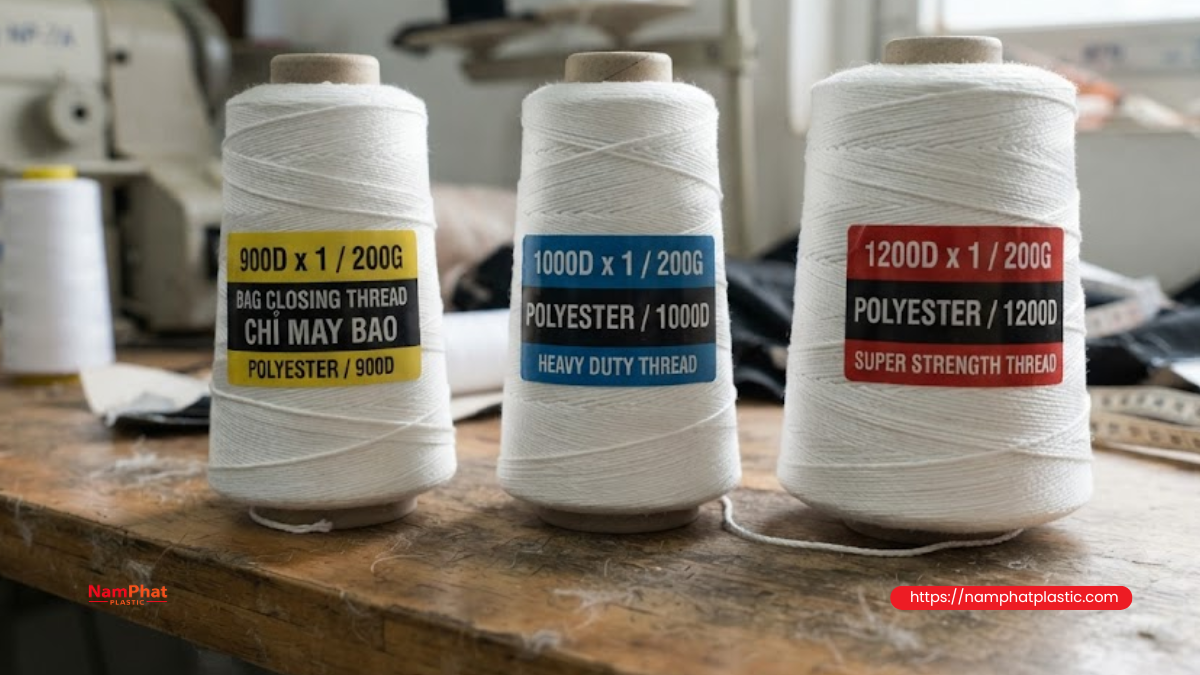
Three of the most commonly used specifications are 900D, 1000D and 1200D bag sewing thread. The most visible difference among them is thread size. However, a higher denier does not automatically mean a better choice.
Businesses should evaluate multiple factors simultaneously, including package weight, bag construction, sewing machine speed, needle size, stitch density and transportation requirements.
This article explains the differences between 900D, 1000D and 1200D bag sewing thread, helping buyers select the appropriate specification and avoid using thread that is either too fine or unnecessarily oversized for the application.
Table of Contents [Hide]
1. What is denier?
Denier, abbreviated as D, is a unit used to express the mass of 9,000 meters of yarn.
For example:
- 9,000 meters of 900D yarn has a nominal mass of approximately 900 grams.
- 9,000 meters of 1000D yarn has a nominal mass of approximately 1,000 grams.
- 9,000 meters of 1200D yarn has a nominal mass of approximately 1,200 grams.
When the same raw materials and manufacturing technology are used, a higher denier generally indicates a larger and heavier yarn for the same length.
Denier formula:
- Denier = Yarn weight in grams × 9,000 / Yarn length in meters
This formula shows that denier reflects the linear density of a yarn but does not fully represent its actual strength.
The strength of sewing thread also depends on:
- Raw material quality.
- Yarn uniformity.
- Number of filaments.
- Molecular orientation.
- Twist level.
- Plying and twisting technology.
- Finish oil content.
- Abrasion resistance and heat resistance.
- Splice quality between yarn sections.
Therefore, two products labeled 1000D can still differ significantly in strength, softness and machine performance.
>>> See also: What are Denier, Tex and Dtex? Industrial Yarn Conversion Chart
2. Comparison table of 900D, 1000D and 1200D bag sewing thread
| Criteria | Fewer filaments, higher DPF | More filaments, lower DPF |
| Softness | Typically stiffer and firmer | Typically softer and more flexible |
| Flexibility | Lower | Better |
| Natural bundle cohesion | Usually easier to control | May separate more easily if lubrication or cohesion is insufficient |
| Surface area | Lower | Higher |
| Sensitivity to oil finish | Usually lower | Usually higher |
| Risk of filament fraying | Fewer components but larger filaments | Can be higher if filaments are not bundled properly |
| Performance over small pulleys | May be less favorable | Usually more favorable |
| Finished yarn feel | Firm, structured appearance | Soft, smooth and conforms better to surfaces |
| Breaking force at the same denier | Cannot be determined solely by filament count | Not automatically higher |
| Manufacturing control requirements | Relatively easier | Higher requirements for filtration, airflow, lubrication and tension control |
The length values shown in comparisons are theoretical figures. Actual length per kilogram may vary depending on twist level, oil content, moisture, manufacturing tolerance and spool core weight.
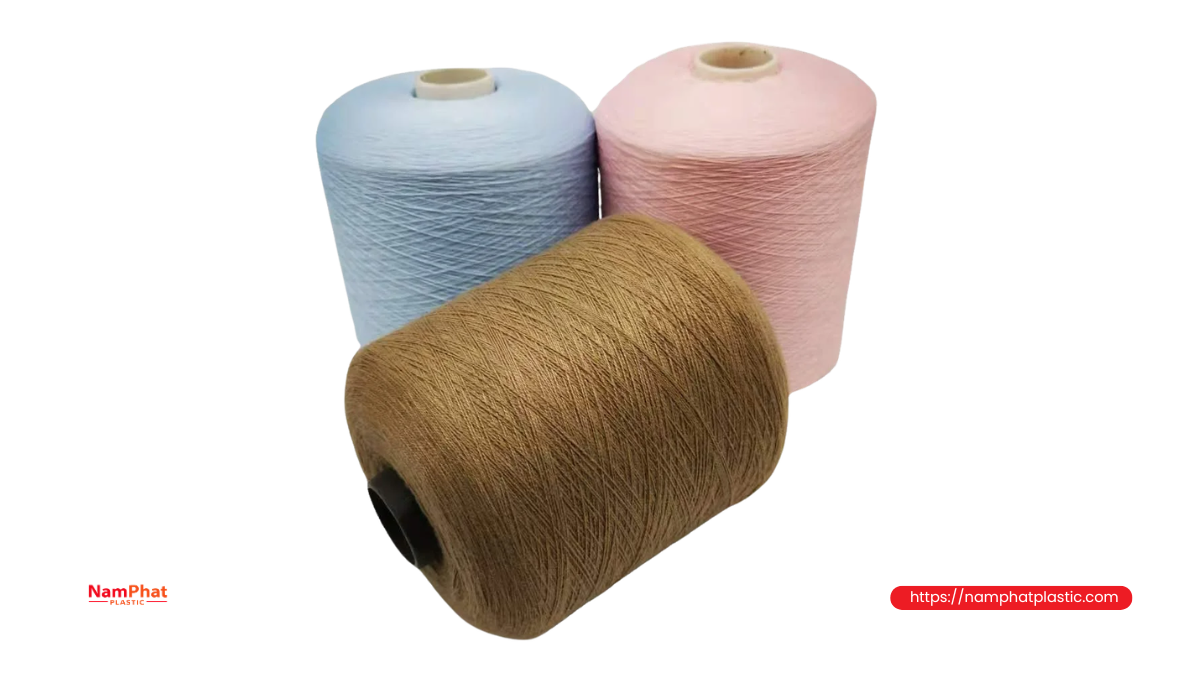
3. Chỉ may bao 900D có đặc điểm gì?
900D bag sewing thread is the smallest specification among the three compared in this article. It is suitable for applications that do not require extremely high seam strength and where machine speed and thread efficiency are priorities.
3.1. Advantages of 900D thread
Greater length per kilogram
Theoretically, 1 kg of 900D thread provides approximately 10,000 meters of yarn. This allows more sewing length from the same thread weight.
Easy threading and machine adjustment
Its relatively small diameter enables smoother movement through thread guides, tension systems and needle eyes. When the machine is properly maintained, 900D thread can run efficiently at relatively high speeds.
Cleaner seam appearance
900D thread creates a seam that is not excessively bulky, making it suitable for bags with medium fabric weight or relatively thin bag openings.
Reduced load on sewing machine components
Smaller thread typically requires lower pulling force, reducing stress on needles, loopers and tension devices.
3.2. Limitations of 900D thread
Because of its smaller size, 900D thread may not be suitable for:
- Heavy-duty bags
- Bags frequently dragged across surfaces
- High stacking applications
- Bags with thick or multi-layer openings
- Long-distance transportation
- Production lines with excessive thread tension
If 900D thread is used beyond its intended load capacity, the seam may appear acceptable during packaging but could fail during handling and transportation.
3.3. What types of bags are suitable for 900D thread?
900D thread may be considered for:
- Light and medium-weight packaging bags
- Small agricultural bags
- Feed bags or material bags requiring moderate strength
- PP woven bags with moderate fabric weight
- Secondary seams or seams not carrying the entire load
The decision should not be based solely on bag weight.
For example, a 20 kg bag containing sharp-edged materials may place more stress on the seam than a 30 kg bag filled with soft materials.
4. What are the characteristics of 1000D bag sewing thread?
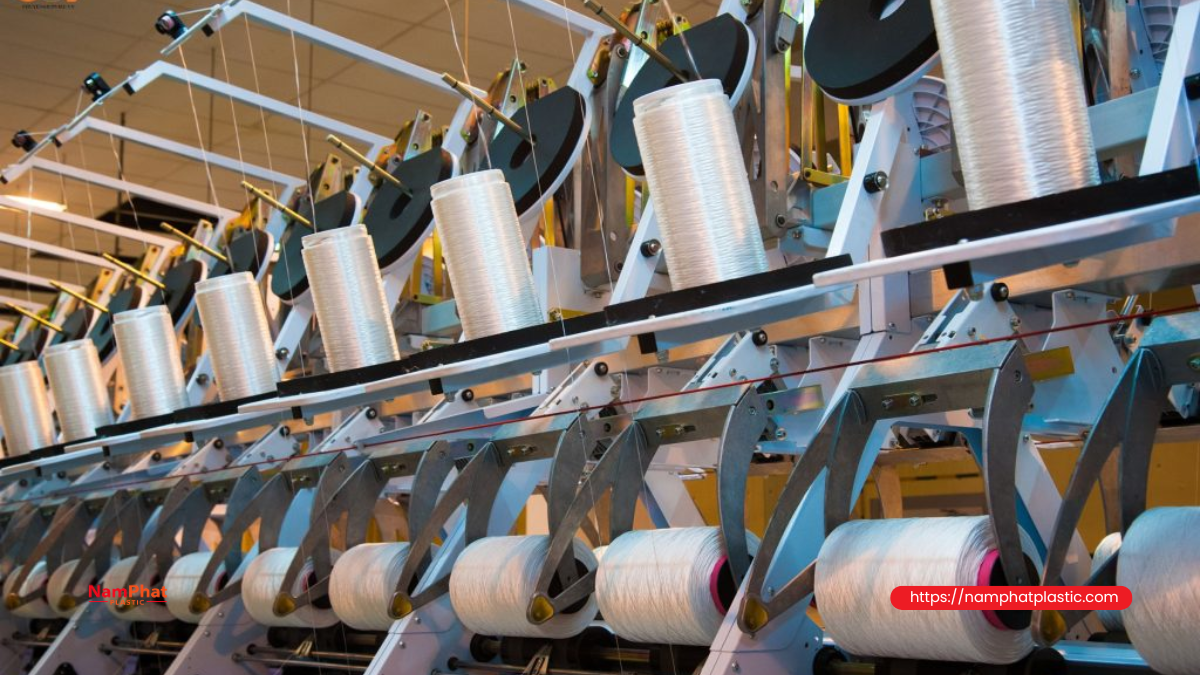
1000D bag sewing thread falls between 900D and 1200D in size. It is often considered the most balanced option in terms of strength, thread consumption and compatibility with a wide range of industrial bag sewing machines.
4.1. Advantages of 1000D thread
Balance between strength and length
Theoretically, 1 kg of 1000D thread provides approximately 9,000 meters of yarn. Although it is shorter than 900D thread, it generally offers a larger cross-sectional area and better load-bearing capability when manufactured from the same raw material.
Suitable for a wide range of applications
1000D thread can be used for many types of PP woven bags, multi-wall paper bags, PE-lined bags and laminated bags without creating an excessively bulky seam.
Relatively easy machine operation
Compared with 1200D thread, 1000D thread is generally easier to run on different bag sewing machines. Operators often do not need to make major adjustments when the needle system, tension mechanism and looper are already functioning properly.
Good seam reliability
This specification is suitable for companies seeking a higher safety margin than 900D thread while not requiring the larger size of 1200D thread.
4.2. Limitations of 1000D thread
1000D thread is not the ideal solution for every situation.
For bags carrying extremely heavy loads, subjected to harsh transportation conditions or exposed to strong impact forces, a larger thread may still be necessary.
On the other hand, for lightweight bags, using 1000D thread may increase thread consumption without providing significant benefits.
4.3. What types of bags are suitable for 1000D thread?
1000D thread is commonly considered for:
- Rice bags
- Animal feed bags
- Raw material bags
- Plastic resin bags
- Powder bags
- Fertilizer bags
- Agricultural product bags
- PP woven bags with or without liners
For many standard packaging operations, 1000D can be regarded as a practical starting point before testing either smaller or larger thread specifications.
5. What are the characteristics of 1200D bag sewing thread?
1200D bag sewing thread is the largest specification among the three. It is typically used when seams must withstand high loads or operate under severe abrasion, impact and tension conditions.
5.1. Advantages of 1200D thread
Larger yarn cross-section
When produced using similar raw materials and manufacturing technology, 1200D thread generally offers greater load-bearing capacity than both 900D and 1000D thread.
Strong and prominent seams
The larger thread size creates a more robust seam appearance, making it suitable for heavy-duty industrial bags and multi-layer packaging.
Better abrasion resistance in certain applications
Because the yarn contains more material per unit length, it may retain strength better when exposed to friction.
However, actual abrasion resistance also depends on finish oil quality and yarn surface characteristics.
Suitable for demanding transportation conditions
1200D thread may be considered when bags are:
- Transported over long distances
- Handled multiple times
- Stacked at greater heights
- Dragged across rough surfaces
- Filled with heavy products
- Exposed to continuous vibration during transportation
5.2. Limitations of 1200D thread
Shorter length per kilogram
Theoretically, 1 kg of 1200D thread provides only about 7,500 meters of yarn.
As a result, thread cost per meter of seam may be higher.
Requires suitable needles and machine settings
If the needle eye is too small, excessive friction may cause filament fraying or thread breakage.
Larger thread can also increase resistance in the tension system and looper mechanism.
Not suitable for very thin bags
Oversized thread may cause wrinkling around the seam, tearing near needle holes or disproportionate seam appearance.
In some cases, the bag material may fail before the thread itself breaks.
May reduce machine speed
If machine settings are not optimized, 1200D thread can contribute to needle heating, skipped stitches, increased tension and a higher rate of thread breakage.
6. 900D, 1000D and 1200D: Which one is the strongest?
If all three thread types are produced from the same raw material, have the same filament structure, twist level and manufacturing quality, 1200D thread will generally have a higher tensile strength because of its larger cross-sectional area.
However, it is incorrect to assume that every 1200D thread is stronger than every 1000D or 900D thread.
A high-quality 1000D thread manufactured with superior raw materials, excellent uniformity and strong splices may perform better in actual production than a poorly manufactured 1200D thread.
When evaluating thread strength, buyers should also examine:
- Average breaking force
- Elongation at break
- Test-to-test consistency
- Number of damaged or frayed filaments
- Twist stability
- Needle abrasion resistance
- Thread break frequency during continuous operation
- Splice quality
- Lubrication and thread smoothness
The objective is not to select the largest denier possible but rather to choose a thread that delivers adequate seam strength with the most efficient level of consumption.
7. Comparing the length of 900D, 1000D and 1200D thread cones
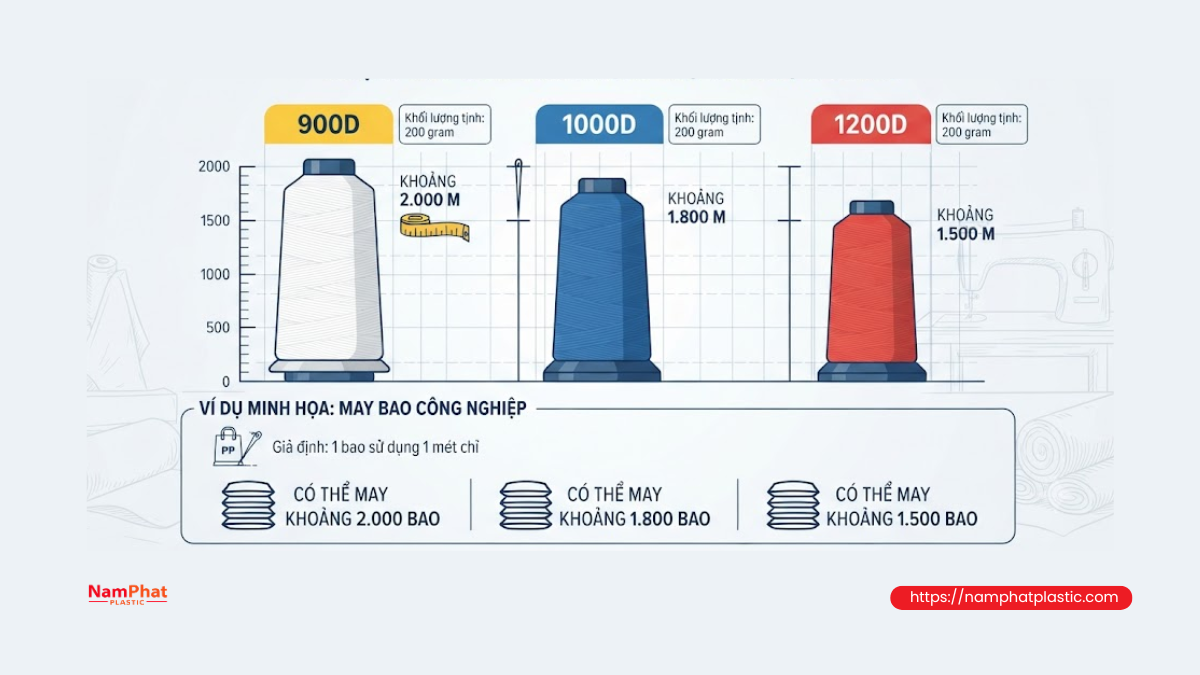
Theoretical yarn length can be calculated using the formula:
- Yarn Length = Yarn Weight × 9,000 / Denier
For a cone weighing 200 grams:
| Specification | Theoretical Length of a 200 g Cone |
| 900D | Approximately 2.000 m |
| 1000D | Approximately 1.800 m |
| 1200D | Approximately 1.500 m |
If one bag requires approximately one meter of thread to complete the seam, then theoretically:
- A 900D cone can sew approximately 2,000 bags.
- A 1000D cone can sew approximately 1,800 bags.
- A 1200D cone can sew approximately 1,500 bags.
In actual production, the number of bags sewn will be lower due to:
- Start and end seam allowances
- Upper and lower thread consumption
- Thread waste during cone replacement
- Chain stitches consuming more thread than seam length
- Losses from thread breaks and splicing
- Cone weight variation
- Shrinkage caused by twisting processes
For this reason, companies should measure actual thread consumption directly on their sewing machines instead of relying solely on theoretical calculations.
8. Should you choose 1200D thread to reduce bag opening failures?
Not every case of bag opening failure is caused by thread that is too weak.
A failed seam can result from many different causes:
Thread breakage
Possible causes include:
- Thread that is too small for the application.
- Excessive thread tension.
- Filament damage caused by the needle.
- Excessive needle heat.
- Inconsistent thread quality.
Stitch unraveling
This issue is often related to:
- Improper seam locking at the beginning or end of the stitch line.
- Insufficient thread tail length.
- Looper mechanism settings.
- Thread cutting procedures after sewing.
Bag fabric tearing
If the thread remains intact while the bag fabric tears around the needle holes, the primary causes may include:
- Fabric weight and strength.
- Seam distance from the bag edge.
- Needle size.
- Stitch density.
In such situations, switching from 1000D to 1200D may not solve the problem.
In fact, a larger thread combined with a larger needle may create larger needle holes and weaken the bag edge.
Seam stretching
Improper thread tension may create seams that are either too loose or too tight.
Loose seams can easily catch on surrounding objects, while overly tight seams may cut into the bag material or cause wrinkling around the seam.
Therefore, when a bag seam fails, the actual failure location and failure mode should be identified before deciding to increase thread denier.
9. Important factors to consider when selecting bag sewing thread
9.1. Packaging weight
The heavier the bag, the greater the load applied to the seam.
However, this is only the first factor to consider.
Two bags with the same weight may place very different stress levels on the seam if one contains soft powder while the other contains hard or sharp-edged materials.
9.2. Bag construction and fabric weight
Thin PP woven bags should not necessarily use oversized thread if the bag edge itself cannot withstand the stress caused by larger needle penetration.
Conversely, multi-layer bags, laminated bags or bags with thick folded edges may require larger thread to maintain seam stability.
9.3. Needle size
The needle should be large enough for the thread to pass smoothly without excessive friction, but not so large that it creates oversized needle holes.
When changing from 900D to 1200D thread, companies should review:
- Needle eye size.
- Needle groove dimensions.
- Needle installation direction.
- Needle wear condition.
- Clearance between needle and looper.
- Equipment manufacturer recommendations.
9.4. Sewing machine speed
Higher sewing speeds generate greater friction and heat at the needle.
A thread with excellent laboratory tensile strength may still break frequently if its surface lubrication is insufficient.
For high-speed production lines, stable machine performance is often more important than simply increasing thread size.
9.5. Stitch density
If stitch density is too low, seam strength may be insufficient.
If stitch density is too high, excessive needle perforations may weaken the bag edge and create a potential tear line.
Stitch density should be selected according to:
- Fabric weight.
- Folded edge thickness.
- Product type.
- Thread size.
- Needle size.
9.6. Handling and transportation conditions
Bags stored only inside a warehouse have different requirements than bags transported over long distances by truck or shipping container.
If bags are frequently thrown, dragged, stacked or exposed to rough surfaces, seam reliability should take priority over minimizing thread cost per bag.
9.7. Thread cone quality
A high-quality thread cone should provide:
- Consistent thread size.
- Uniform winding.
- No overlapping layers.
- No thread slippage.
- Minimal lint and dust.
- Small and strong splices.
- Consistent lubrication.
- Suitable cone core dimensions.
- Stable unwinding performance from beginning to end.
Frequent thread breaks not only increase thread waste but also cause machine downtime, reduce productivity and increase the risk of unsewn or improperly sewn bags.
Suggested thread selection guide
| Application Requirement | Recommended Specification for Testing |
| Light bags with low seam load | 900D |
| General industrial bags | 1000D |
| Balanced strength and machine performance | 1000D |
| Heavy bags or multiple handling cycles | 1200D |
| Thin fabric bags | 900D or 1000D |
| Thick or multi-layer bag openings | 1000D or 1200D |
| High-speed sewing machines with small needle eyes | 900D or 1000D |
| Frequent seam breakage caused by tension loads | Upgrade from 900D to 1000D or 1200D |
| Fabric tearing around needle holes | Do not immediately increase denier; inspect needle size and stitch density first |
This table serves only as a general guideline. The final specification should always be determined through testing on the actual bag type, sewing machine and transportation conditions used by the company.
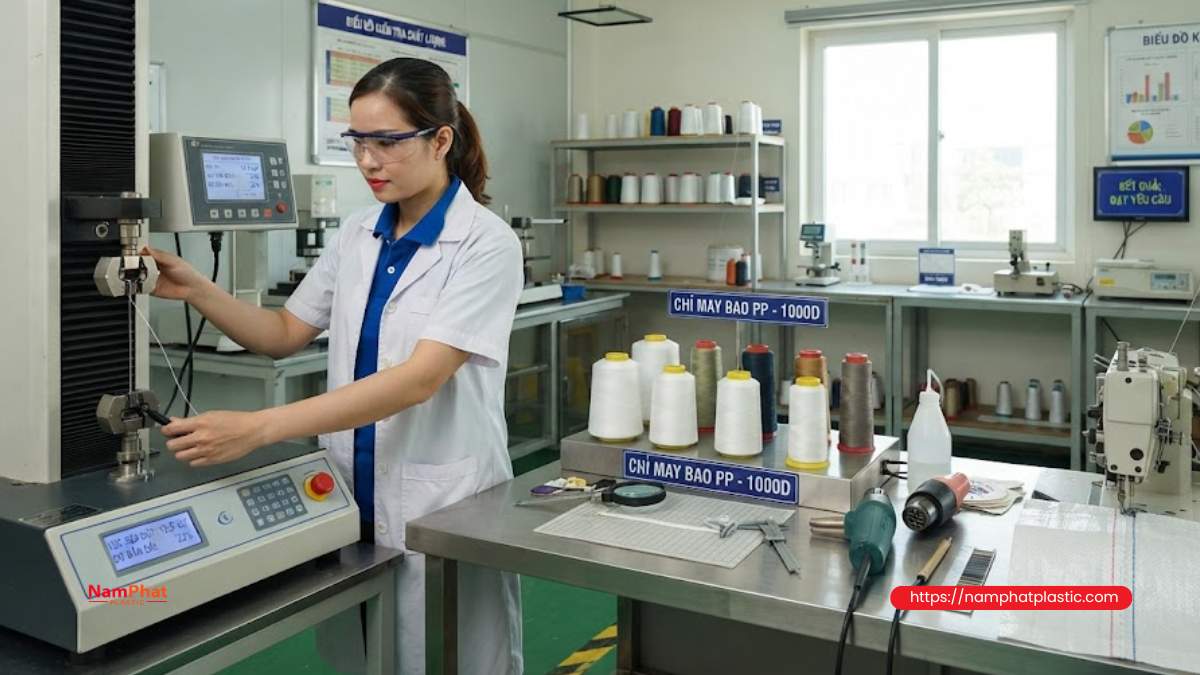
10. Procedure for testing bag sewing thread before placing large orders
Step 1: Check thread cone specifications
Record the following information:
-
Denier.
-
Net weight.
-
Raw material type.
-
Color.
-
Cone style.
-
Number of splices.
-
Manufacturing date.
-
Production batch number.
Step 2: Conduct continuous machine testing
Testing should run long enough to evaluate actual machine performance rather than sewing only a few bags.
Monitor:
-
Number of thread breaks.
-
Filament fraying.
-
Cone unwinding performance.
-
Needle temperature.
-
Skipped stitches.
-
Tension stability.
-
Frequency of machine adjustments.
Step 3: Inspect seam quality
Examine both sides of the seam and verify:
-
Stitch consistency.
-
Thread tightness.
-
Edge wrinkling.
-
Fabric tearing around needle holes.
-
Seam lock security.
-
Proper seam placement relative to the bag edge.
Step 4: Test on filled bags
Bags should be filled to actual production weight and subjected to realistic handling simulations such as:
-
Manual lifting.
-
Stacking.
-
Conveyor movement.
-
Short-distance dragging.
-
Drop testing at appropriate heights.
-
Trial transportation.
Step 5: Calculate total usage cost
Thread selection should not be based solely on price per kilogram.
Total cost should include:
-
Thread purchase price.
-
Number of bags sewn per cone.
-
Machine downtime.
-
Labor required for thread splicing.
-
Re-sewing rate.
-
Product loss and customer complaints.
-
Waste at the beginning and end of cones.
A thread with a lower purchase price but frequent breakage may ultimately cost more than a premium thread that operates consistently.
11. When should you switch from 900D to 1000D?
Businesses should consider switching from 900D to 1000D thread when one or more of the following situations occur:
- The thread frequently breaks at the seam after filling the bag.
- The bags are regularly subjected to high pulling forces.
- Packaging weight has increased.
- The production line has switched to bags with thicker folded edges.
- Pallet stacking height has increased.
- Transportation distance has become longer.
- The rate of bag opening failures increases even though the sewing machine has already been adjusted correctly.
Before making the change, it is important to confirm that the root cause is actually related to thread strength rather than worn needles, incorrect thread tension, or seams positioned too close to the bag edge.
12. When should you switch from 1000D to 1200D?
Switching to 1200D thread may be worth testing when:
- 1000D thread still breaks under actual loading conditions.
- The bags contain heavy products.
- The bags are handled multiple times during distribution.
- The bag edge is thick enough to accommodate a larger needle and thread.
- Customers require higher seam strength.
- The bags are frequently transported under vibration or high-abrasion conditions.
When upgrading to 1200D, the entire thread path system, needle selection, and thread tension settings should be reviewed. It is not recommended to simply replace the thread spool while leaving all machine settings unchanged.
13. Should you use one thread type for all products?
Using a single thread specification can simplify inventory management and production operations. However, it is not always the most cost-effective solution.
For example:
- Using 1200D thread for lightweight bags may result in unnecessary material costs.
- Using 900D thread for heavy-duty bags can increase the risk of seam failure.
- Using 1000D thread for all products is relatively convenient but may still require adjustments for certain special applications.
For companies producing multiple product categories, a practical approach is to establish two standard thread specifications:
- One thread type for light- and medium-duty bags.
- One thread type for heavy-duty bags or applications requiring higher seam strength.
This approach helps reduce the number of inventory items while maintaining reliable seam performance.
14. Conclusion: Should you choose 900D, 1000D, or 1200D bag sewing thread?
There is no single thread specification that is suitable for every type of bag.
- 900D bag sewing thread is suitable when businesses prioritize a neat seam appearance, longer usable thread length, and applications that do not require high load-bearing capacity.
- 1000D bag sewing thread provides a balanced combination of strength, thread consumption, and machine compatibility. It is suitable for many common industrial packaging applications.
- 1200D bag sewing thread is suitable for heavy-duty bags, high-load seams, and demanding handling or transportation conditions, provided that the sewing machine and bag construction can accommodate the larger thread size.
Instead of choosing solely based on denier, businesses should evaluate multiple factors, including tensile strength, elongation, machine runnability, thread consumption, and defect rates after packaging.
In many cases, the most effective approach is to start with a medium specification such as 1000D, then adjust downward to 900D if cost optimization is the priority, or upward to 1200D if additional seam strength is required.
Nam Phat Plastic supplies industrial bag sewing threads in various specifications, colors, and spool weights to meet different production requirements. Customers can provide bag samples, packaging weights, and sewing machine information to receive recommendations before placing large-volume orders.
Frequently asked questions about 900D, 1000D and 1200D bag sewing thread
1. Can 900D thread be used for 50 kg bags?
It can in some cases, but the decision should not be based solely on bag weight. Factors such as thread quality, bag construction, stitch density, transportation conditions, and actual load-testing results should also be considered.
2. Is 1200D thread always better than 1000D thread?
No. Although 1200D thread is larger, it also consumes more material and requires compatible needles and machine settings. For thin bags or machines with small needle holes, 1000D thread may provide better stability and lower operating costs.
3. Does a higher denier always mean the thread is harder to break?
When produced from the same materials and manufacturing process, a higher denier generally provides greater load-bearing capacity. However, actual thread strength also depends on raw material quality, filament count, twist level, finishing oil, and overall thread uniformity.
4. How many meters are there in one kilogram of 1000D thread?
Theoretically, one kilogram of 1000D thread contains approximately 9,000 meters of thread. Actual length may be lower due to twisting, oil content, and manufacturing tolerances.
5. Why does the bag opening fail even though the thread does not break?
Possible causes include stitch slippage, poor seam locking, torn bag fabric, or seams positioned too close to the bag edge. The failure mode should be identified before changing thread specifications.
6. Can 900D, 1000D, and 1200D threads use the same needle size?
Not always. Increasing thread size may require a different needle size and tension adjustment. Needle selection should follow both machine specifications and the equipment manufacturer's recommendations.
7. Should bag sewing thread be purchased by weight or by length?
In practice, thread is usually sold by kilogram or spool weight. However, for accurate cost comparison, businesses should also calculate the number of meters of thread and the number of bags that can be sewn per kilogram.
>>> See also:
- 0 Comment


