


 Phan Van Hoang
- 20/07/2026
- 945
What are Denier, Tex and Dtex? A conversion guide for industrial yarn buyers
In industrial yarn quotations, buyers may encounter three completely different numerical specifications: 1000D, 111.11 tex, and 1111.11 dtex. However, all three values may actually describe the same yarn, differing only in the unit used to express its linear mass.
The difference lies in the reference length used for measurement:
- Denier is based on 9,000 meters.
- Tex is based on 1,000 meters.
- Dtex is based on 10,000 meters.
ISO 1144 specifies the principles and recommended units of the Tex system, applicable to textile fibers, intermediate products, yarns, and similar structures. In the man-made fiber industry, tex and dtex are two widely used expressions of linear density.
Understanding what Denier, Tex, and Dtex are is not only useful for reading catalogs. It also directly affects the calculation of the number of meters per kilogram of yarn, material consumption, production cost per unit, and the ability to compare quotations from different suppliers.
30-second summary
| Unit | Definition | Quick understanding |
| Denier (D or den) | Mass (grams) of 9,000 meters of yarn | 1000D means 9,000 m of yarn weighs 1,000 g |
| Tex | Mass (grams) of 1,000 meters of yarn | 100 tex means 1,000 m of yarn weighs 100 g |
| Dtex (Decitex) | Mass (grams) of 10,000 meters of yarn | 1000 dtex means 10,000 m of yarn weighs 1,000 g |
Relationship to remember:
- 1 tex = 10 dtex = 9 denier
Therefore:
- 1 denier = 0.1111 tex = 1.1111 dtex
- 1 dtex = 0.1 tex = 0.9 denier
- 1000D = 111.11 tex = 1111.11 dtex
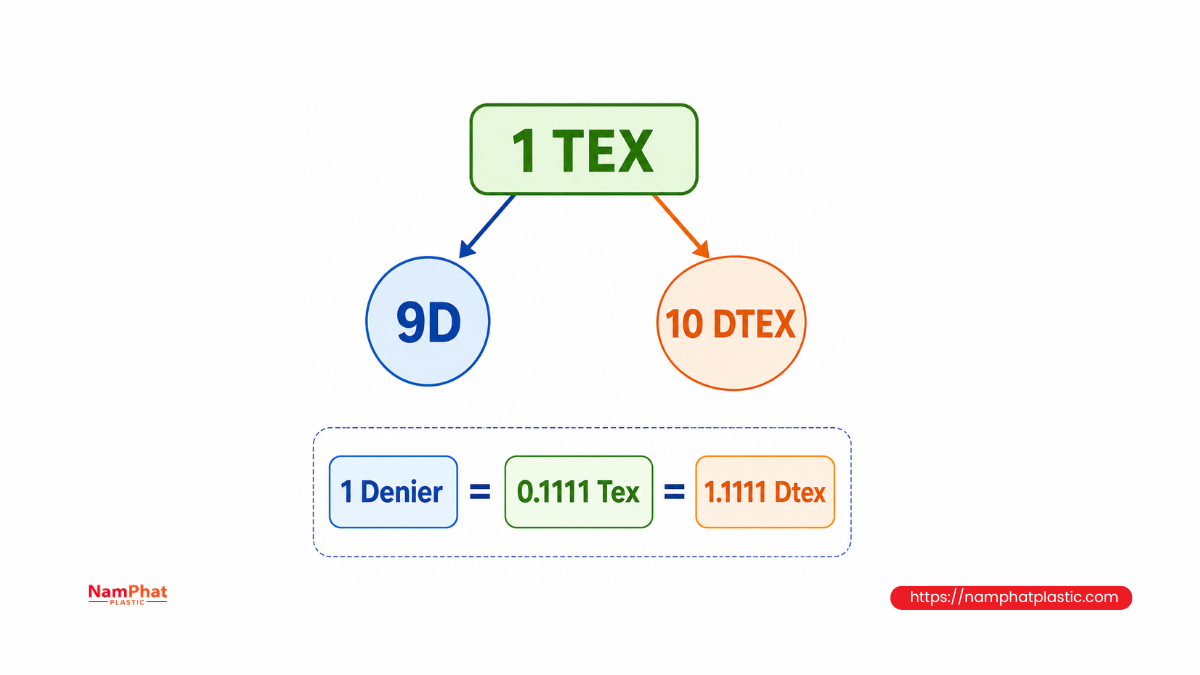
These relationships are derived directly from the definitions of mass over a standard length and are consistent with the conversion tables published by BISFA.
Table of Contents [Hide]
1. The nature of Denier, Tex and Dtex: not yarn diameter
Denier, Tex, and Dtex are all units of linear density, meaning the mass of a yarn over a specified length.
In other words, these units do not directly measure diameter in micrometers or millimeters. Instead, they answer the following question:
How much does a fixed length of yarn weigh?
You can think of these three systems as three people weighing the same yarn but using different sample lengths:
- The first person weighs 1 km and reports the result in tex.
- The second person weighs 9 km and reports the result in denier.
- The third person weighs 10 km and reports the result in dtex.
Because the reference lengths are different, the numerical values are different, even though the yarn itself may be exactly the same.
Does a higher number mean a thicker yarn?
For Denier, Tex, and Dtex, a larger value means the yarn has greater mass over the same length. Therefore, when comparing yarns made from the same polymer, with the same construction, the same number of filaments, and produced under comparable conditions, a higher value generally corresponds to a larger yarn bundle.
However, linear density should not be equated with actual yarn diameter. Two yarns with the same 1000D specification may still differ in:
- Polymer type: PP, PET, PA6, PA66, or another polymer.
- Polymer density.
- Number of filaments.
- Filament cross-sectional shape.
- Degree of molecular orientation.
- Twist level and twist contraction.
- Finish oil content.
- Solid, hollow, profiled, or textured construction.
Therefore, 1000D is not a quality grade, nor does it automatically mean the yarn has higher strength.
2. What is Denier?
Denier, commonly abbreviated as D or den, is the mass in grams of 9,000 meters of yarn.
Formula:
Denier = (Sample weight (g) × 9,000) ÷ Sample length (m)
Example 1: 1000D Yarn
A yarn with a 1000D rating means:
- 9,000 meters of yarn have a nominal weight of 1,000 g.
- 1,000 meters of yarn weigh approximately 111.11 g.
- 1 kilogram of yarn has a theoretical length of approximately 9,000 meters.
Example 2: 1500D Yarn
A 1500D yarn means:
- 9,000 meters of yarn weigh 1,500 g.
- 1,000 meters of yarn weigh approximately 166.67 g.
- 1 kilogram of yarn has a theoretical length of approximately 6,000 meters.
Denier is commonly used in product catalogs for filament yarns, synthetic fibers, and many technical textile materials. When buyers encounter specifications such as 210D, 420D, 840D, 1000D, or 1500D, they should understand that these values represent the linear density of the yarn—not its breaking strength or diameter.
3. What is Tex?
Tex is the mass in grams of 1,000 meters of yarn.
Formula:
Tex = (Sample weight (g) × 1,000) ÷ Sample length (m)
Examples:
- 10 tex: 1,000 meters of yarn weigh 10 g.
- 50 tex: 1,000 meters of yarn weigh 50 g.
- 100 tex: 1,000 meters of yarn weigh 100 g.
- 200 tex: 1,000 meters of yarn weigh 200 g.
One of the biggest advantages of the Tex system is its intuitive calculation. When a yarn is specified as 100 tex, the buyer can immediately understand that every 1,000 meters of yarn has a nominal mass of approximately 100 grams.
ISO 1144 defines the Tex system as the standard for expressing linear density and specifies that it can be applied to a wide range of textile materials.
4. What is Dtex?
Dtex, short for decitex, is the mass in grams of 10,000 meters of yarn.
Formula:
Dtex = (Sample weight (g) × 10,000) ÷ Sample length (m)
Since the prefix "deci" means one-tenth:
- 1 dtex = 0.1 tex
Therefore:
- 10 dtex = 1 tex
Example
A 1000 dtex yarn means:
- 10,000 meters of yarn weigh 1,000 g.
- 1,000 meters of yarn weigh 100 g.
- 1 kilogram of yarn has a theoretical length of approximately 10,000 meters.
- Equivalent to 100 tex or 900D.
Dtex is particularly convenient for describing filament yarns because it allows whole numbers to be used across many product ranges instead of decimal Tex values.
According to BISFA, 1 dtex is equal to 0.1 mg per meter, which is equivalent to 1 decigram per 1,000 meters.
5. Conversion formulas for Denier, Tex and Dtex
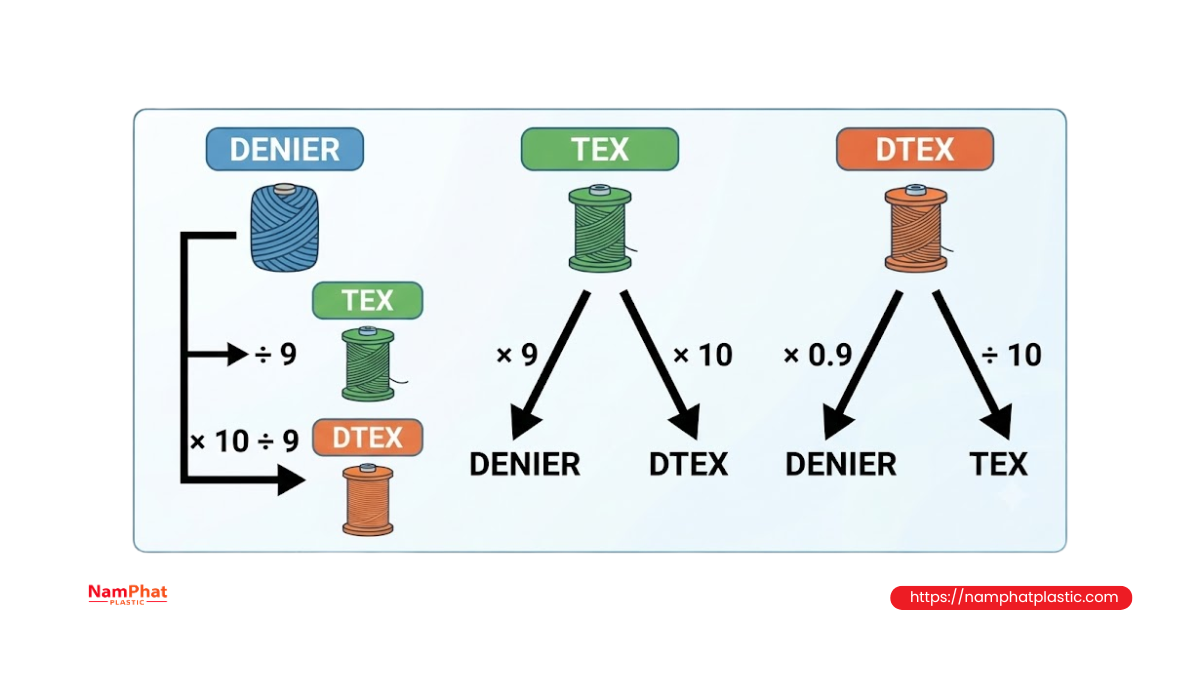
Convert Denier to Tex
- Tex = Denier ÷ 9
Example:
- 1000D ÷ 9 = 111.11 tex
Convert Denier to Dtex
- Dtex = (Denier × 10) ÷ 9
Or:
- Dtex = Denier × 1.1111
Example:
- 1000D × 1.1111 = 1111.11 dtex
Convert Tex to Denier
- Denier = Tex × 9
Example:
- 100 tex × 9 = 900D
Convert Tex to Dtex
- Dtex = Tex × 10
Example:
- 100 tex × 10 = 1000 dtex
Convert Dtex to Denier
- Denier = Dtex × 0.9
Example:
- 1100 dtex × 0.9 = 990D
Convert Dtex to Tex
- Tex = Dtex ÷ 10
Example:
- 1670 dtex ÷ 10 = 167 tex
Summary of conversion formulas
| Conversion | Formula |
| Denier → Tex | Denier ÷ 9 |
| Denier → Dtex | Denier × 10 ÷ 9 |
| Tex → Denier | Tex × 9 |
| Tex → Dtex | Tex × 10 |
| Dtex → Denier | Dtex × 0,9 |
| Dtex → Tex | Dtex ÷ 10 |
Quick memory tip
Just remember one equation:
- 9D = 1 tex = 10 dtex
From this equation, all the other conversion formulas can be derived.
6. Conversion table for Denier, Tex and Dtex used in industrial yarn
The table below includes an additional column showing the theoretical meters per kilogram, allowing purchasing teams and production planners to quickly estimate the usable yarn length.
| Denier | Tex | Dtex | Theoretical m/kg |
| 50D | 5,56 | 55,56 | 180.000 |
| 70D | 7,78 | 77,78 | 128.571 |
| 100D | 11,11 | 111,11 | 90.000 |
| 150D | 16,67 | 166,67 | 60.000 |
| 210D | 23,33 | 233,33 | 42.857 |
| 300D | 33,33 | 333,33 | 30.000 |
| 420D | 46,67 | 466,67 | 21.429 |
| 500D | 55,56 | 555,56 | 18.000 |
| 600D | 66,67 | 666,67 | 15.000 |
| 840D | 93,33 | 933,33 | 10.714 |
| 900D | 100,00 | 1.000,00 | 10.000 |
| 1000D | 111,11 | 1.111,11 | 9.000 |
| 1200D | 133,33 | 1.333,33 | 7.500 |
| 1500D | 166,67 | 1.666,67 | 6.000 |
| 1680D | 186,67 | 1.866,67 | 5.357 |
| 1800D | 200,00 | 2.000,00 | 5.000 |
| 2000D | 222,22 | 2.222,22 | 4.500 |
| 3000D | 333,33 | 3.333,33 | 3.000 |
| 4000D | 444,44 | 4.444,44 | 2.250 |
| 6000D | 666,67 | 6.666,67 | 1.500 |
Notes on using the table
The values above are theoretical values calculated from the nominal yarn count. The actual number of meters per kilogram may differ due to:
- The actual yarn count differing from the nominal value.
- Spin finish or surface treatment.
- Weighing and conditioning conditions.
- Variation in the net package weight.
- Twist shrinkage.
- Losses during splicing, machine setup, and package changes.
Therefore, this table is suitable for quotations and preliminary material calculations. When accepting a shipment, the actual test results obtained using the agreed test method should be used.
7. How to read the specification 1000D/192F
One of the most common mistakes when purchasing multifilament yarn is focusing only on the Denier value while ignoring the number of filaments.
For example:
- 1000D/192F
This specification can be interpreted as follows:
- 1000D: The linear density of the entire yarn bundle.
- 192F: The bundle consists of 192 continuous filaments.
- F: Abbreviation for filament.
Calculating Denier per filament
The Denier of each individual filament, commonly referred to as DPF (Denier per Filament), is calculated as follows:
- DPF = Total Denier ÷ Number of filaments
For a 1000D/192F yarn:
- 1000 ÷ 192 = 5.21 denier per filament
Converted to Dtex:
- 1000D = 1111.11 dtex
Therefore:
- 1111.11 ÷ 192 = 5.79 dtex per filament
Comparing 1000D/192F and 1000D/96F
| Specification | 1000D/192F | 1000D/96F |
| Total Denier | 1000D | 1000D |
| Number of filaments | 192 | 96 |
| DPF (Denier per filament) | 5.21 | 10.42 |
| Linear density of each filament | Smaller | Larger |
Although both yarns have the same total Denier, they have different internal structures. In the 96F yarn, each filament has approximately twice the linear density of a filament in the 192F yarn.
Differences in filament count may affect the flexibility of the yarn bundle, surface coverage, processing characteristics, yarn spread, coating absorption, friction, and running stability on production equipment. The actual impact depends on the polymer type, spinning process, twist level, and end-use application.
Therefore, when selecting an alternative material, two yarns should not be considered equivalent simply because they are both labeled 1000D.
8. Does a higher Denier mean a stronger yarn?
Not necessarily.
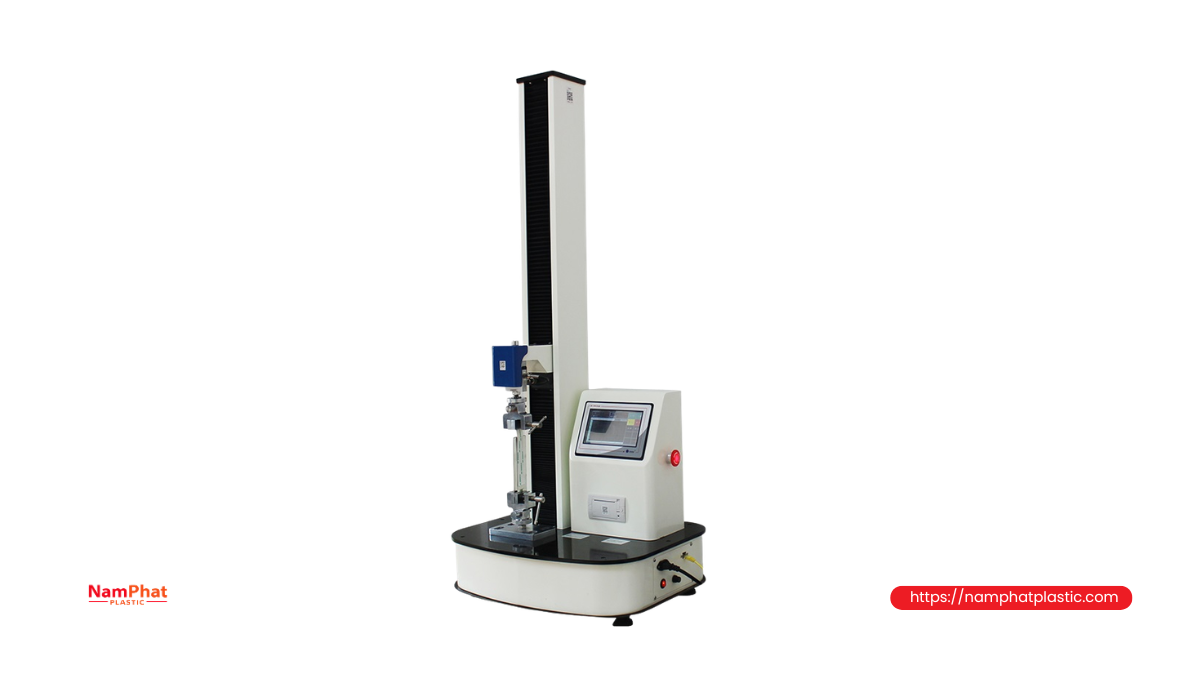
A higher Denier only indicates that the yarn has a greater mass over the same length. To evaluate strength, at least two additional properties should be considered:
- Breaking force, usually expressed in N or cN.
- Tenacity, which is the breaking force normalized by the yarn's linear density.
BISFA expresses tenacity using units such as cN/tex or mN/tex.
The basic relationship is:
- Breaking force (cN) = Tenacity (cN/tex) × Linear density (tex)
Example
A 1000D yarn is approximately 111.11 tex. Assume the published tenacity is 50 cN/tex.
- 50 × 111.11 = 5,555.5 cN
Converted to Newtons:
- 5,555.5 cN = 55.56 N
This is only a calculation example. The actual breaking force must always be determined through testing under specified test conditions.
Two 1000D yarns with tenacity values of 40 cN/tex and 55 cN/tex will have significantly different breaking forces. Therefore, buyers should not use Denier as a substitute for mechanical performance specifications.
9. How to calculate yarn length per kilogram
This calculation is particularly useful when:
- Calculating material consumption.
- Comparing prices between different yarns.
- Estimating the total yarn length on a package.
- Calculating yarn cost for every 1,000 meters of rope, webbing, or netting.
- Checking whether the package weight matches the declared yarn length.
Based on Denier
- Meters/kg = 9,000,000 ÷ Denier
Based on Tex
- Meters/kg = 1,000,000 ÷ Tex
Based on Dtex
- Meters/kg = 10,000,000 ÷ Dtex
Example: A 5 kg package of 1500D yarn
Length per kilogram:
- 9,000,000 ÷ 1500 = 6,000 m/kg
Theoretical length of the 5 kg package:
- 6,000 × 5 = 30,000 m
Therefore, a package with a net weight of 5 kg of 1500D yarn theoretically contains approximately 30,000 meters based on its nominal linear density.
10. How to calculate yarn cost per 1,000 meters
Comparing yarn prices based only on cost per kilogram is not sufficient when the yarns have different linear densities. Buyers should also convert the cost into the price per unit length.
Based on Denier
- kg per 1,000 m = Denier ÷ 9,000
- Cost per 1,000 m = Price per kg × (Denier ÷ 9,000)
Based on Tex
- kg per 1,000 m = Tex ÷ 1,000
Based on Dtex
- kg per 1,000 m = Dtex ÷ 10,000
Example
Assume a 1500D yarn costs VND 45,000 per kilogram.
Weight of 1,000 meters:
- 1500 ÷ 9,000 = 0.1667 kg
Material cost per 1,000 meters:
- 45,000 × 0.1667 ≈ VND 7,500
This figure does not include production waste, scrap, yarn joints, unused yarn remaining on the package, or other processing costs.
11. How to determine Denier, Tex and Dtex from a yarn sample
When a yarn sample is available and its linear density needs to be verified, the following information is required:
- Sample length L (meters).
- Sample weight m (grams).
Formulas
- Tex = (Sample weight (g) × 1,000) ÷ Sample length (m)
- Dtex = (Sample weight (g) × 10,000) ÷ Sample length (m)
- Denier = (Sample weight (g) × 9,000) ÷ Sample length (m)
Example
A yarn sample measuring 100 meters weighs 11.2 g.
Calculate Tex:
- 11.2 × 1,000 ÷ 100 = 112 tex
Calculate Dtex:
- 11.2 × 10,000 ÷ 100 = 1,120 dtex
Calculate Denier:
- 11.2 × 9,000 ÷ 100 = 1,008D
If the yarn was ordered as 1000D, the deviation is:
- Deviation (%) = ((1,008 − 1,000) ÷ 1,000) × 100 = 0.8%
Whether this deviation is acceptable depends on the tolerance specified in the contract, technical specification, internal standard, or agreement between the buyer and supplier.
Why shouldn't a very short sample be weighed?
The shorter the sample, the greater the influence of weighing accuracy, cutting operations, measuring tension, and yarn irregularity on the result.
Official testing should always follow the agreed test method.
ISO 2060 specifies the method for determining the linear density of yarn taken from packages using the skein method, including procedures for sample conditioning and preparation.
ASTM D1907/D1907M also adopts the skein method for determining yarn count.
12. Exact conversion values and commercial values may differ
Mathematically:
- 150D = 166.666... dtex
In commercial documents, this value may be rounded to 167 dtex.
Similarly:
- 1000D = 1111.111... dtex
Manufacturers may use a rounded nominal dtex value based on their product series.
Therefore, buyers should distinguish between:
- Mathematical equivalent values.
- Nominal product values.
- Actual values measured in laboratory testing.
TCVN 3938:2009 remains the applicable Vietnamese standard for converting traditional yarn numbering systems into rounded values under the Tex system for industrial and commercial applications.
Recommended wording for purchase orders
Instead of simply writing:
- 1000D yarn
It is better to specify:
- Nominal linear density: 1000D, mathematically equivalent to 1111.11 dtex; acceptance shall be based on the specified value and tolerance stated in the technical specification.
This wording helps avoid misunderstandings where the supplier uses a rounded nominal dtex value while the buyer expects the exact mathematical conversion.
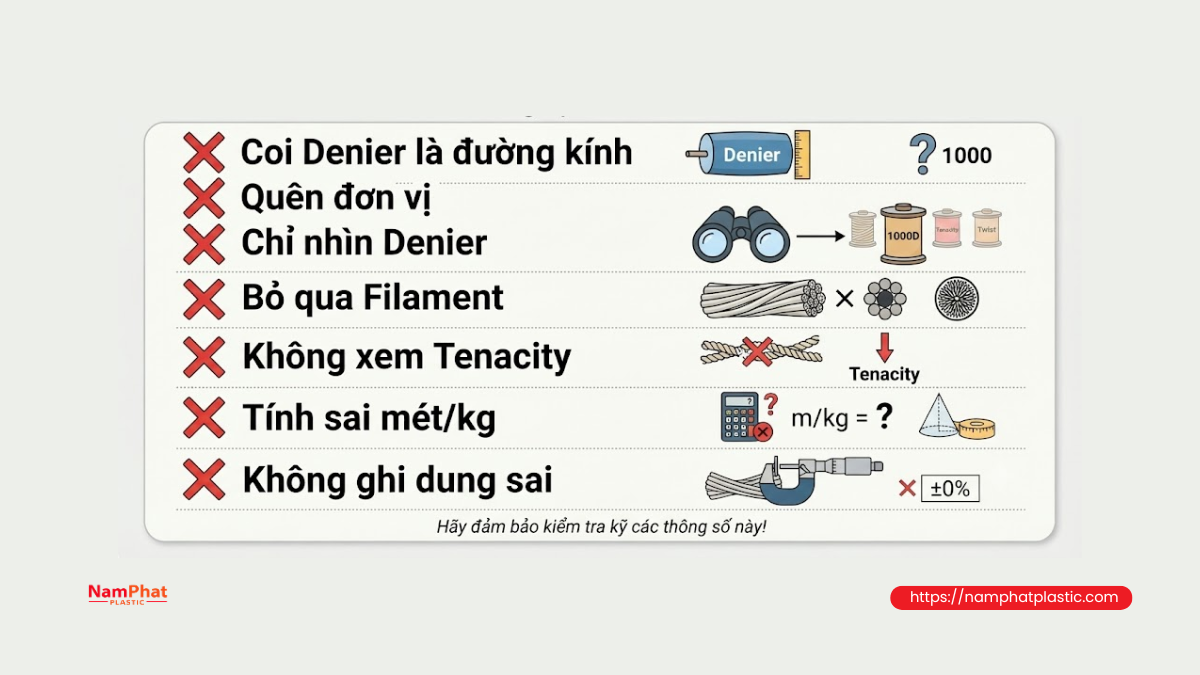
13. Seven common mistakes when purchasing industrial yarn
13.1. Assuming Denier is the yarn diameter
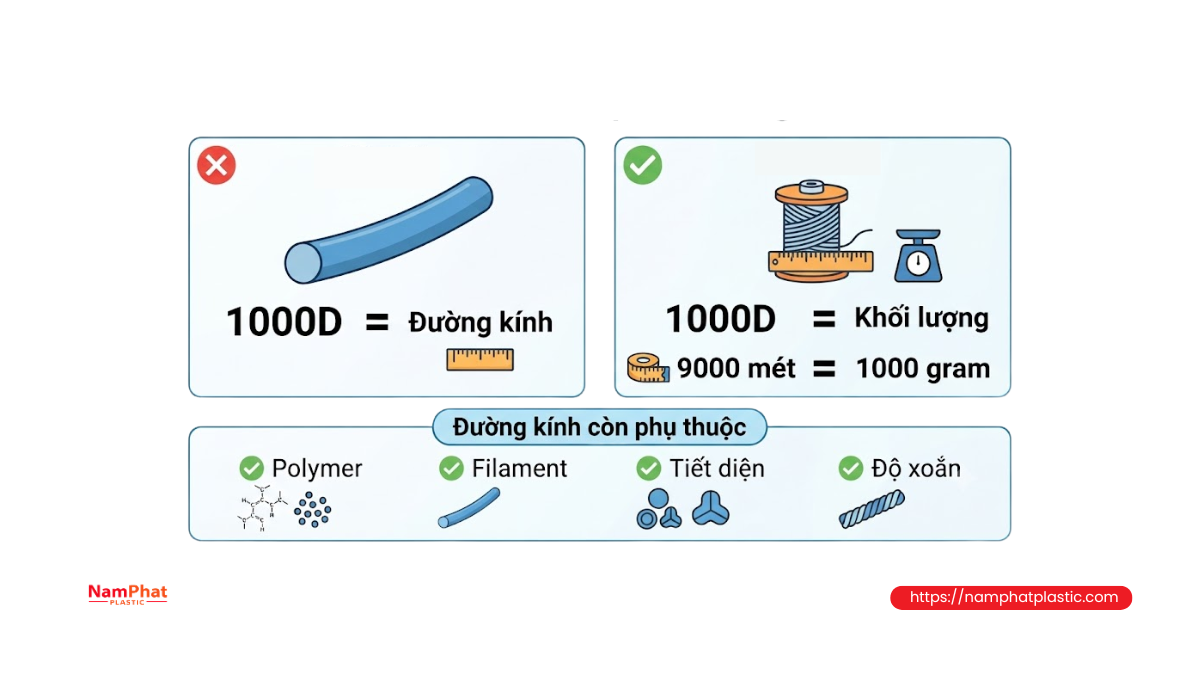
Denier represents mass per unit length. It is not a direct measurement of diameter in micrometers or millimeters.
13.2. Comparing numbers without checking the unit
1000D is not the same as 1000 tex, nor is it the same as 1000 dtex.
- 1000D = 111.11 tex
- 1000 dtex = 100 tex = 900D
- 1000 tex = 9000D
Looking only at the number "1000" without checking the unit can lead to significant errors.
13.3. Comparing only the total Denier while ignoring the filament count
1000D/96F and 1000D/192F have the same total Denier, but their DPF (Denier per Filament) differs by a factor of two.
13.4. Failing to distinguish between single yarn, plied yarn, and twisted yarn
Designations such as 1000D/2 may be interpreted differently across product catalogs. Buyers should clearly specify:
- Number of components.
- Denier of each component.
- Linear density of the finished yarn.
- Twist direction (S or Z).
- Twists per meter (TPM).
- Number of plies or twisting operations.
Twist shrinkage may cause the actual linear density of the finished yarn to differ from the simple arithmetic sum of its individual components.
13.5. Comparing breaking force without considering linear density
A yarn with a higher breaking force may simply be heavier.
To evaluate material performance correctly, tenacity should also be compared.
13.6. Using the total package weight to calculate yarn length
Only the net weight of the yarn should be used. Do not include the weight of:
- Paper cores.
- Plastic tubes.
- Packaging materials.
- Pallets.
13.7. Not specifying the test method and tolerance
The same yarn sample may produce different results if the conditioning conditions, reeling tension, specimen length, or sample preparation method differ.
Therefore, purchase orders and contracts should clearly specify:
- The test method.
- Acceptance conditions.
- Applicable tolerances.
14. Checklist for purchasing PP, polyester, or nylon industrial yarn
Linear density is only one part of the technical specification. A complete quotation request should include the following information.
| Item | Information to specify |
| Material | PP, PET, PA6, PA66, or another specified polymer |
| Construction | Monofilament, multifilament, plied yarn, or twisted yarn |
| Linear density | Denier, tex, or dtex; equivalent units are recommended |
| Tolerance | According to the applicable standard or agreement |
| Filament count | For example: 96F, 144F, or 192F |
| DPF or dtex per filament | To control the fineness of each filament |
| Twist | Untwisted or specified TPM; S or Z direction |
| Strength | Tenacity and/or minimum breaking force |
| Elongation at break | Target value and allowable tolerance |
| Shrinkage | Test conditions and required limits |
| Spin finish | Required type or percentage, if applicable |
| Color | Color code, masterbatch, and color tolerance |
| UV resistance | Required or not required; testing requirements if applicable |
| Package | Package type, winding style, and net weight per package |
| Splices | Maximum allowable splices per package or splice-free length |
| Test methods | ISO, ASTM, TCVN, or internal standard |
| Documentation | COA by lot, weighing record, and traceability code |
ISO 1139:2025 specifies that yarn construction may be described by the Tex linear density system, filament count, twist direction and level, and the number of plies. These are also the key details buyers should clearly specify in an RFQ or purchase order.
>>> Learn more about industrial yarn products:
Sample specification for an RFQ or purchase order
Industrial PP multifilament yarn; nominal linear density 1000D, mathematically equivalent to 1111.11 dtex; 192F; construction and twist according to the approved sample; tenacity, elongation, shrinkage, and spin finish according to the technical data sheet; net weight ... kg per package; linear density acceptance according to ISO 2060; COA supplied for each production lot.
The ellipsis (...) should be replaced with the actual specifications required by the purchaser. A single tenacity, elongation, or tolerance value should not be applied universally to all applications.
15. Should you use Denier, Tex, or Dtex in a contract?
There is no single answer that applies to every transaction. The most practical choice depends on the system used by the customer, the manufacturer, and the target market.
When to use Denier
- The supplier manages products using Denier (D) specifications.
- The factory's equipment and legacy documentation are based on the Denier system.
- The end customer specifies products such as 420D, 840D, 1000D, or 1500D.
When to use Tex
- When the mass per 1,000 meters needs to be calculated quickly.
- The technical documentation uses the Tex system.
- When a direct relationship between yarn count and material consumption is required.
When to use Dtex
- When trading filament yarn or man-made fibers.
- The customer's technical documentation uses the Dtex system.
- When whole-number values are preferred instead of decimal Tex values.
The best way to avoid disputes
Specify the primary unit used by your company and include the equivalent values.
For example:
- 1000D, equivalent to 111.11 tex or 1111.11 dtex
In addition, clearly indicate whether the value refers to:
- Nominal value.
- Exact mathematical conversion or rounded commercial value.
- Acceptable tolerance.
- Measurement method.
- Acceptance criteria.
16. Conclusion
Denier, Tex, and Dtex are not three different yarn properties. They are simply three different ways of expressing the same physical quantity: linear density (mass per unit length).
The three most important relationships to remember are:
- 1 tex = 10 dtex = 9D
- 1D = 1.1111 dtex
- 1 dtex = 0.9D
For industrial yarn buyers, converting between these units is only the first step. To select the right material, it is equally important to evaluate the total Denier or Dtex, filament count, DPF, twist, tenacity, breaking force, elongation, shrinkage, and packaging conditions.
A purchase order that simply states "1000D yarn" still leaves too much room for interpretation. A specification such as "1000D/192F, equivalent to 1111.11 dtex, with specified tolerance, mechanical properties, and test methods" enables both buyers and manufacturers to control quality more effectively, minimize misunderstandings, and reduce the risk of shipment disputes.
17. Frequently asked questions about Denier, Tex and Dtex
1. How many Denier is 1 tex?
- 1 tex = 9 denier.
2. How many Dtex is 1 tex?
- 1 tex = 10 dtex.
3. How many Denier is 1 Dtex?
- 1 dtex = 0,9 denier.
4. How many Dtex is 1 Denier?
- 1 denier ≈ 1.1111 dtex.
5. How many Tex is 1000D?
- 1000 ÷ 9 = 111.11 tex
6. How many Dtex is 1000D?
- 1000 × 10 ÷ 9 = 1111,11 dtex
7. How many Denier is 1100 Dtex?
- 1100 × 0,9 = 990D
8. Does a higher Denier always mean a stronger yarn?
Not necessarily. A higher Denier only indicates a greater mass per unit length. Yarn strength also depends on tenacity, polymer type, filament structure, spinning process, twist, and manufacturing quality.
9. What does 1000D/192F mean?
It refers to a yarn bundle with a total linear density of 1000 Denier consisting of 192 continuous filaments. The average linear density of each filament is approximately 5.21 DPF.
10. Can two 1000D yarns be used interchangeably?
Not always. Additional properties such as filament count, tenacity, breaking force, elongation, shrinkage, twist, spin finish, package size, and machine performance should also be compared.
11. How do you calculate the length of a yarn package?
For yarn specified in Denier:
- Package length (m) = (Net weight (kg) × 9,000,000) ÷ Denier
Example:
A 4 kg package of 1000D yarn has a theoretical length of:
- 4 × 9,000 = 36,000 m
12. Are Dtex and Tex indirect count systems like Nm or Ne?
No. Denier, Tex, and Dtex are direct yarn count systems, meaning that a higher number indicates a greater mass over a fixed length.
Nm and Ne are indirect count systems, where a higher number generally indicates a finer yarn.
>>> See also:
- 0 Comment


