


 Phan Van Hoang
- 09/04/2026
- 1140
Among synthetic fiber materials, polyester is one of the most widely used in the global market. From everyday garments, uniform fabrics, sewing threads, filling materials, and technical textiles to industrial products, polyester appears across nearly every stage of the textile supply chain. Its popularity is not merely the result of cost advantages, but of a more important reality: polyester offers a strong balance of performance, consistent quality, and suitability for large-scale manufacturing.
In many general references, polyester is often briefly described as a “durable, wrinkle-resistant, quick-drying synthetic fiber.” That description is correct, but incomplete. To properly understand this material, it should be examined from three layers: polymer nature, mechanical behavior after drawing, and performance in specific end-use applications. When analyzed from these perspectives, polyester is no longer just a “common synthetic fiber,” but a technically sophisticated material family.
This article provides a comprehensive overview of polyester fiber from a practical and technical perspective, making it useful for engineers, raw material buyers, and website content developers in the fiber industry.
1. What Is Polyester Fiber?
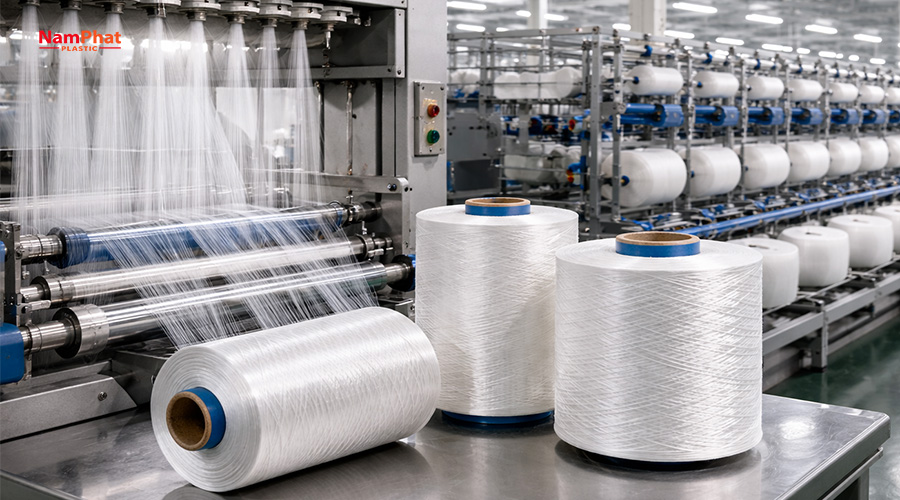
Polyester fiber is a man-made fiber produced from polymers containing ester linkages in their main chain. In the textile industry, the most common type is PET – Polyethylene Terephthalate. This polymer is formed through chemical reactions between basic raw materials and is then melted and extruded through spinnerets to create extremely fine filaments.
Unlike natural fibers such as cotton or wool, polyester is not obtained directly from biological sources. It is manufactured through chemical engineering and material processing. For this reason, producers can control key parameters more precisely, including linear density, filament count, cross-section shape, tensile strength, elongation, and lot-to-lot uniformity.
In other words, polyester is not simply “one type of fiber,” but a material platform that can be engineered to be softer, stronger, bulkier, smoother, or more suitable for high-speed processing conditions.
2. Why Has Polyester Become a Core Material in the Textile Industry?
There are many synthetic fibers on the market, yet polyester has maintained a dominant position for decades. This is not due to a single outstanding property, but rather its excellent overall balance.
First, polyester offers sufficient mechanical strength for both consumer and industrial applications. Second, it remains highly stable in mass production, meaning it shows less variability than many materials that depend on natural sources. Third, polyester can be produced in multiple forms such as continuous filament, staple fiber, textured yarn, and recycled fiber. Fourth, it is highly compatible with modern manufacturing systems, from spinning and weaving to dyeing and finishing.
Another important point is that polyester allows companies to achieve a reasonable balance between performance and cost. In practical commercial terms, very few fibers combine durability, wrinkle resistance, easy maintenance, and large-scale supply availability as effectively as polyester.
3. The Material Nature of Polyester Fiber
To properly understand polyester, one must begin with its material structure. At the molecular level, polyester is a polymer capable of developing a certain degree of crystallinity and molecular orientation after drawing. This largely determines the mechanical performance of the final fiber.
In its initial state, the polymer, after melting and exiting the spinneret, does not yet have optimal strength. Only after the drawing process do the molecular chains become more aligned along the fiber axis. This increases tensile strength, raises modulus, and reduces unwanted deformation during use.
From an engineering perspective, one of polyester’s major advantages is that its final properties are not entirely fixed. They can be adjusted through process conditions. Drawing ratio, heat treatment, texturing, and filament cross-section all directly influence hand feel, drape, strength, and end-use performance.
This is why one type of polyester may be suitable for sportswear, another for sewing thread, and another for technical textiles or load-bearing materials.
4. How Polyester Fiber Is Produced
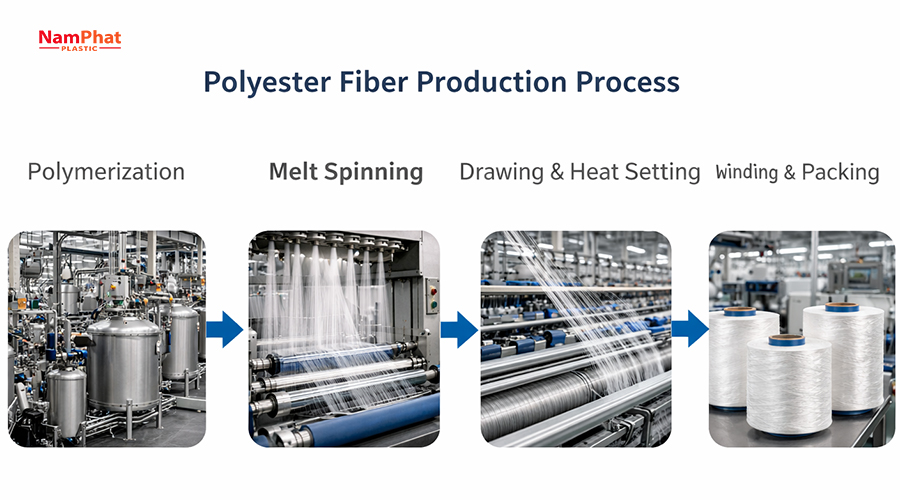
The production of polyester fiber can be viewed as a transformation chain from chemicals into a functional fibrous material. Each stage contributes to the final quality.
4.1. Polymer Formation
The first step is producing PET polymer with the proper viscosity and purity for spinning. This is the foundation. If the polymer quality is poor, downstream problems such as yarn breakage, unstable drawing, poor package formation, or inconsistent mechanical performance will follow.
In practice, polymer quality has a much greater impact than many people realize. Even a modern production line can produce low-quality fiber if the polymer itself is unstable.
4.2. Melt Spinning
After melting, the polymer passes through filtration systems to remove impurities and is then metered to the spinneret. At this stage, it is extruded into extremely fine filaments. These filaments are then cooled to stabilize their initial shape.
Defects such as flow fluctuation, contamination, incorrect temperature, or poor spinneret condition can all reduce yarn uniformity.
4.3. Drawing and Molecular Orientation
This is the stage that makes the fiber mechanically useful. The filaments are stretched at a controlled ratio to rearrange the polymer structure. After this process, the yarn becomes stronger, achieves appropriate elongation, and performs more consistently in downstream processing.
If drawing is insufficient, the yarn will be weak and unstable. If drawing is excessive, it may become brittle or less suitable for dynamic working conditions.
4.4. Finishing
After drawing, the fiber may undergo texturing, heat-setting, oiling, winding, or cutting into staple fiber. The finishing stage strongly affects runnability and surface characteristics.
Many buyers focus only on tensile strength, but in practice, surface lubricity, hairiness, finish oil level, and package quality also directly affect processing efficiency in subsequent stages.
5. Common Types of Polyester Fiber on the Market
Polyester does not exist in just one form. Depending on the technology and end use, it is commercialized in different formats.
5.1. Polyester Filament
This is a continuous yarn form, meaning the filaments extend through the full length of the package. Polyester filament generally has a smooth surface, high uniformity, and is suitable for many applications requiring high processing speed.
Common types include:
- POY: Partially Oriented Yarn
- FDY: Fully Drawn Yarn
- DTY: Drawn Textured Yarn
Each type serves a different purpose and should not be considered fully interchangeable.
5.2. Polyester Staple Fiber
This is polyester cut into short lengths and later spun into yarn. It creates a surface feel closer to natural fibers, making it suitable for products requiring more cover, grip, or softness.
5.3. Polyester Spun Yarn
Polyester spun yarn is made from short staple fibers. Compared with filament yarn, spun yarn usually has more hairiness, higher bulk, and a more textile-like touch. It is commonly used in sewing thread, apparel fabrics, and applications where filament yarn may be too smooth or too lustrous.
5.4. Recycled Polyester
Recycled polyester is receiving increasing attention due to environmental concerns. However, it should not be viewed only through a “green” lens. The key issue remains quality. A recycled product only becomes truly valuable when it maintains sufficient consistency for processing and end use.
6. Key Properties of Polyester Fiber
6.1. Relatively High Tensile Strength
Polyester has good resistance to tensile stress, especially when properly drawn and oriented. This is why it is widely used in products subjected to repeated mechanical loads such as sewing thread, cords, upholstery fabrics, and technical textiles.
6.2. Wrinkle Resistance and Shape Retention
A very practical advantage of polyester is its ability to retain shape. Fabrics with a high polyester content wrinkle less than those made entirely from natural fibers. For users, this means easier maintenance. For manufacturers, it means better dimensional stability in the final product.
6.3. Low Moisture Absorption
Polyester does not absorb moisture as readily as cotton. As a result, it dries faster and is less affected by humid environments. This is beneficial in many industrial and consumer applications. However, the same property also leads some polyester fabrics to feel less breathable if the structure is not properly engineered.
6.4. Good Abrasion Resistance
Its ability to withstand abrasion helps polyester remain competitive in products exposed to frequent friction. This is particularly important in sewing thread, workwear, upholstery, backpacks, bags, and other applications requiring high durability.
6.5. Dimensional Stability
Compared with many natural fibers, polyester is easier to control in terms of shrinkage. This is highly valuable in mass production, where consistent finished dimensions and minimal distortion are essential.
7. Limitations of Polyester That Should Be Viewed Objectively
A technical article should not list only advantages. Polyester also has its limitations.
First, because of its low moisture absorption, it may not always provide the most comfortable wear if fabric construction and finishing are not optimized. A dense, thick polyester fabric with poor finishing can feel hot and less breathable.
Second, polyester tends to generate static electricity more easily in dry conditions. This may cause dust attraction or discomfort in certain environments.
Third, polyester is a thermoplastic material. Under excessive heat, it may shrink, soften, melt, or deform. In garment processing, ironing temperature and needle heat are important factors to control.
For polyester spun yarn, another limitation is the risk of pilling if yarn structure and surface finishing are not optimized.
8. How Polyester Compares with Cotton, Nylon, and Polypropylene
Compared with Cotton
Cotton performs better in moisture absorption and natural hand feel, but it wrinkles more easily and dries more slowly. Polyester does not have the same natural feel, but it is more stable, often more durable in many situations, and better suited to industrial-scale production requiring consistency.
Compared with Nylon
Nylon is known for excellent toughness and abrasion resistance. However, polyester is often preferred for its dimensional stability and better balance between performance and cost. In many mainstream applications, polyester is a more economical choice.
Compared with Polypropylene
Polypropylene is lighter and has very strong moisture resistance, making it useful in certain packaging and technical fiber applications. However, polyester generally offers better surface appearance, a wider range of textile applications, and greater ability to produce products with strong visual and tactile quality.
9. Applications of Polyester Fiber in Practice
9.1. Apparel
Polyester is widely used in T-shirts, jackets, sportswear, uniforms, protective clothing, and blended fabrics. The reason is not only cost, but also shape retention, durability, and quick-drying performance.
9.2. Sewing Thread
Polyester plays a major role in the sewing thread sector. It may be used in spun or filament form depending on the application. For sewing operations requiring high productivity, stable polyester quality helps reduce thread breakage, lower lint generation, and improve machine performance.
9.3. Home Furnishings and Household Products
Curtains, upholstery fabrics, decorative textiles, bedding fillings, and many household materials use polyester extensively. Its advantages lie in durability, consistency, and suitability for high-volume manufacturing.
9.4. Technical Textiles
Polyester is also important in filter fabrics, geotextiles, webbing, tarpaulins, technical nets, and many industrial products. In these uses, its mechanical strength, abrasion resistance, and dimensional stability are especially valuable.
10. Key Parameters to Consider When Selecting Polyester Fiber
Evaluating polyester fiber based on product name alone is not enough. Actual performance depends on technical specifications.
Important parameters include:
- linear density in denier, dtex, or tex
- filament count
- tensile strength
- elongation at break
- evenness
- twist level
- thermal shrinkage
- finish oil content
- hairiness
- package quality
- running stability in processing
For polyester sewing thread, abrasion resistance, yarn cleanliness, needle heat resistance, and splice consistency should also be considered.
For polyester filament used in high-speed weaving or knitting, filament uniformity, surface cleanliness, and package quality are particularly sensitive factors.
11. How to Choose Polyester Fiber for Different Applications
Polyester should not be selected by intuition or price alone.
For apparel, priority should be given to hand feel, drape, bulk, color fastness, and wearing comfort.
For sewing thread, the focus should shift to tensile strength, evenness, low hairiness, and stable machine performance.
For industrial products, more important considerations include load resistance, thermal shrinkage, service life under friction, and lot-to-lot consistency.
For sustainable supply chains, recycled polyester is worth considering, but only when the supplier can ensure good quality control.
12. Future Trends in Polyester Fiber Development
Polyester will remain a major material in the fiber industry, but its development direction is evolving.
One clear direction is increasing use of recycled polyester. A second is the development of functional polyester, such as UV-resistant, moisture-management, antibacterial, stain-resistant, or comfort-enhanced variants. A third is optimizing filament cross-sections and structures so polyester can deliver higher performance while maintaining cost efficiency.
Importantly, modern polyester is no longer limited to the old image of being “hot and cheap.” With advances in spinning, texturing, and finishing technology, polyester is increasingly becoming a high-performance material family with a broad range of applications.
13. Common Misunderstandings About Polyester Fiber
One common misunderstanding is that polyester always means low quality. In reality, quality depends on the polymer grade, spinning technology, yarn design, and finishing process. High-end polyester and low-cost polyester can be very different.
Another misunderstanding is that polyester is suitable only for ordinary clothing. In fact, it is also a key material in sewing thread, technical textiles, home furnishing, nonwovens, and many auxiliary industries.
A third misunderstanding is that polyester is always hot to wear. This is only partly true. Thermal comfort depends on the total product structure, not just the polymer itself.
14. Conclusion
Polyester fiber is a major material platform in the modern textile industry because it combines durability, stability, process flexibility, and large-scale production efficiency. This balance between performance and economics has made polyester dominant in both consumer and industrial sectors.
To use polyester effectively, it is important not to view it as a vague, generic material. One must understand the specific fiber type, the critical technical parameters, and the final application requirements. When the right polyester is selected for the right purpose, manufacturers can significantly improve product quality, production stability, and cost efficiency.
SEO FAQ
What is polyester fiber?
Polyester fiber is a synthetic fiber made from polymers containing ester linkages, most commonly PET. It is known for durability, wrinkle resistance, quick drying, and wide use in both textiles and industry.
Is polyester a man-made fiber?
Yes. Polyester is a man-made synthetic fiber produced through chemical processing and melt spinning rather than being directly obtained from nature.
Is polyester fiber durable?
Yes. Polyester has good tensile strength, good abrasion resistance, and is suitable for many applications requiring stable performance.
What is the difference between polyester filament and polyester spun yarn?
Filament is continuous and generally smoother and more uniform. Spun yarn is made from short fibers, offering more bulk and a feel closer to natural textiles.
What is polyester used for?
Polyester is used in clothing, uniforms, sewing thread, bedding, filling materials, furnishing fabrics, technical textiles, and many industrial products.
- 0 Comment


