


 Phan Van Hoang
- 23/07/2026
- 287
In packaging production, the amount of thread used to sew bag openings is often considered a minor cost. However, when production volume increases to tens of thousands or even millions of bags per month, an error of just a few percent in thread consumption can cause raw material shortages during production, excessive inventory, or inaccurate product costing.
The question, “How much thread is needed to sew 1,000 bags?” cannot be answered accurately based solely on bag width. Thread consumption also depends on stitch type, number of needles, stitch density, thread tail length, thread tension, bag mouth thickness, and the characteristics of each sewing machine.
This article presents three levels of calculation:
- Quick calculation for quotations and material planning.
- Calculation based on thread length and thread specification.
- Building an actual consumption standard using the thread-weighing method in the factory.
Table of Contents [Hide]
1. Why is the seam length not equal to thread consumption?
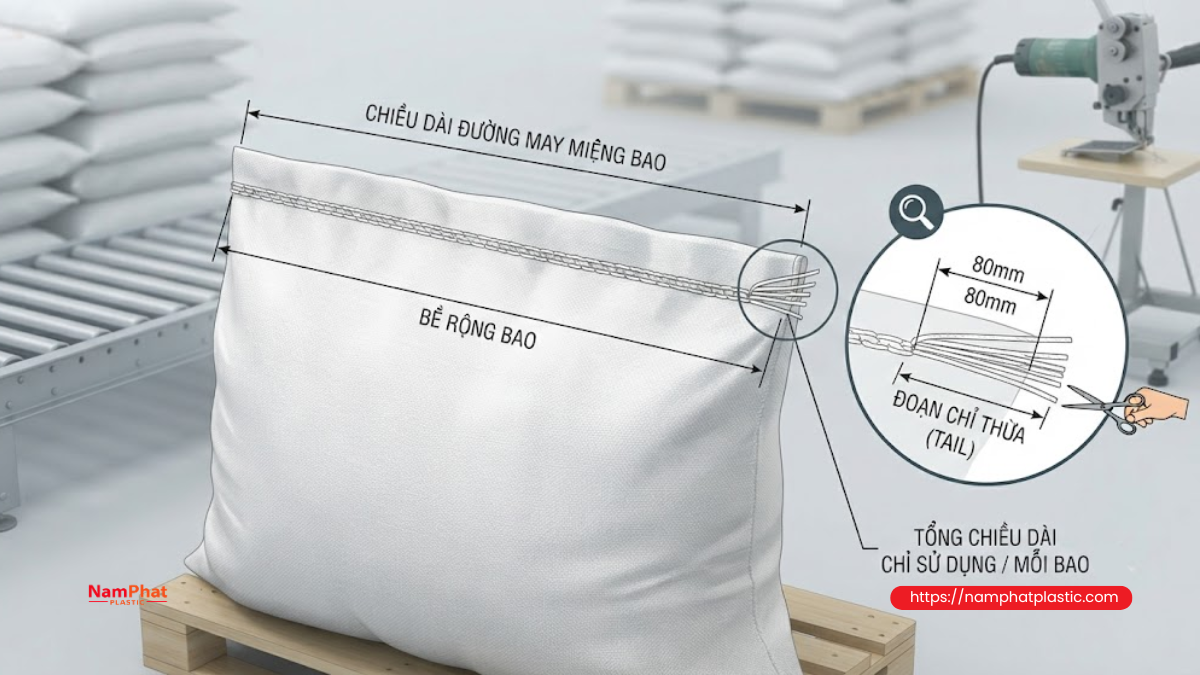
Assume a bag opening width of 50 cm. Many people may think that sewing 1,000 bags only requires:
- 50 cm × 1,000 bags = 500 meters of thread.
This calculation is not correct because the thread does not lie straight across the bag opening. When the machine operates, the thread must wrap around the material, form chain loops, interlock with looper thread, or pass through multiple layers of the bag.
A 50 cm seam may consume anywhere from 1.5 meters to more than 5 meters of thread, depending on the stitch structure.
In addition to the thread used in the seam itself, there are also:
- Leading thread before the bag enters the machine.
- Thread tail after the seam is completed.
- Thread waste during spool changes.
- Thread removed when defective seams are repaired.
- Remaining thread on the cone that cannot continue running through the machine.
- Variations caused by thread tension and stitch density.
Therefore, to establish an accurate consumption standard, a thread consumption coefficient must be used instead of simply multiplying bag width by bag quantity.
2. General formula for calculating thread consumption for 1,000 bags
The required thread length can be calculated using the following formula:
- Total thread length = Number of bags × Actual sewing length per bag × Stitch consumption coefficient × Waste factor
Written as a formula:
- L = N × S × K × (1 + H)
Where:
| Symbol | Meaning | Unit |
| L | Total thread length required | Meter |
| N | Number of bags to be sewn | Bag |
| S | Actual sewing length per bag | Meter/bag |
| K | Stitch consumption coefficient | Ratio |
| H | Estimated waste rate | % |
For an order of 1,000 bags:
- L = 1,000 × S × K × (1 + H)
This formula calculates the total thread required for the entire seam. If the machine uses multiple thread cones simultaneously, the total consumption must then be allocated to each needle thread, looper thread, or sewing line.
3. How to determine the actual sewing length per bag
The actual sewing length should not be considered equal to the bag opening width alone.
The recommended formula is:
- Actual sewing length = Bag opening width + Leading thread + Thread tail
Example:
- Bag opening width: 50 cm.
- Leading thread: 5 cm.
- Thread tail: 5 cm.
Actual sewing length:
- 50 + 5 + 5 = 60 cm = 0.60 meter
Therefore, although the bag opening is only 50 cm wide, the machine actually creates a seam approximately 60 cm long.
How long should the thread tail be?
The appropriate length depends on machine speed, packaging requirements, and thread-cutting methods.
| Sewing method | Recommended total leading and tail thread length |
| Handheld bag sewing machine, manual cutting | 8–15 cm/bag |
| Fixed single-needle machine | 6–12 cm/bag |
| Machine equipped with thread cutter | 4–8 cm/bag |
| Stable automatic sewing line | 3–6 cm/bag |
These figures are only for preliminary calculations. Manufacturers should measure directly on their machines because operator habits can significantly affect thread tail length.
4. Thread consumption coefficient by stitch type
The coefficient K represents the total number of meters of thread required to create one meter of finished seam.
For example, K = 3.6 means that creating one meter of seam consumes approximately 3.6 meters of thread.
Reference coefficient table:
| Machine and stitch type | Reference K coefficient |
| Handheld bag sewing machine, single-needle, single-thread chain stitch | 3.2–4.2 |
| Single-needle, two-thread machine | 4.8–6.5 |
| Two-needle machine | 8.5–12.0 |
| Automatic single-needle sewing line | Depends on stitch type, generally similar to fixed machines but with lower waste |
| Seam with crepe tape or thick folded bag mouth | May be 5–15% higher than standard consumption |
These coefficients are intended for planning purposes. Actual values may vary due to:
- Number of stitches per centimeter.
- Thickness of the bag mouth.
- Whether the bag mouth is folded.
- Woven PP bags, paper bags, or laminated bags.
- Needle and looper thread tension.
- Thread diameter.
- Stitch structure of the machine.
- Condition of the needle, looper, and thread guides.
A single coefficient should not be applied to all machines within a factory.
5. Example calculation for 1,000 bags using a handheld bag sewing machine
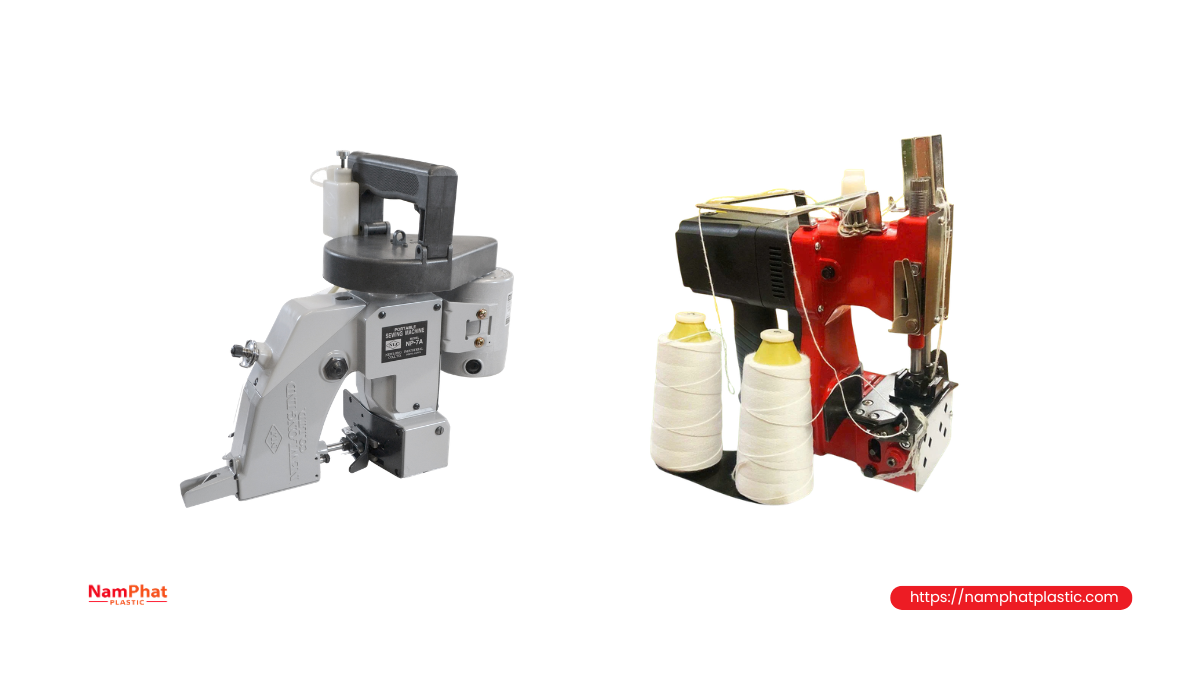
Assume a company needs to sew 1,000 PP woven bags with the following specifications:
- Bag opening width: 50 cm.
- Total leading and tail thread length: 10 cm.
- Actual sewing length: 60 cm, equivalent to 0.60 meter.
- Single-needle handheld bag sewing machine.
- Consumption coefficient K: 3.6.
- Estimated waste rate: 8%.
Apply the formula:
- L = 1,000 × 0.60 × 3.6 × 1.08
Result:
- L = 2,332.8 meters of thread
Therefore, to sew 1,000 bags with a 50 cm opening using a handheld machine, the company should prepare approximately:
- 2,330–2,400 meters of thread
If the thread being used has an actual length of 3,800 meters/kg, the required weight is:
- 2,332.8 ÷ 3,800 = 0.614 kg
Rounded value:
- Approximately 0.62–0.65 kg of thread for 1,000 bags
If each thread cone weighs 200 grams, the number of cones required is:
- 0.65 ÷ 0.20 = 3.25 cones
In practice, at least 4 cones of 200 grams should be prepared to avoid thread shortages during production.
6. Example calculation for a single-needle, two-thread machine
Order specifications:
- Quantity: 1,000 bags.
- Bag opening width: 60 cm.
- Leading and tail thread length: 8 cm.
- Actual sewing length: 68 cm, equivalent to 0.68 meter.
- Total consumption coefficient for two threads: 5.5.
- Waste rate: 6%.
Formula:
- L = 1,000 × 0.68 × 5.5 × 1.06
Result:
- L = 3,964.4 meters of thread
If the thread has an actual length of 3,600 meters/kg:
- 3,964.4 ÷ 3,600 = 1.10 kg
Therefore, the total thread required is approximately:
- 1.1 kg for 1,000 bags
Note that this is the total thread consumption for the entire seam. Needle thread and looper thread are usually not consumed equally. To determine the consumption of each position, each thread cone should be weighed separately before and after trial production.
7. Example calculation for a two-needle machine
Assume:
- Bag opening width: 50 cm.
- Total leading and tail thread length: 10 cm.
- Actual sewing length: 0.60 meter.
- Total consumption coefficient for the two-needle system: 10.
- Waste rate: 5%.
Total thread length:
- L = 1,000 × 0.60 × 10 × 1.05
- L = 6,300 meters of thread
If the actual thread length is 3,600 meters/kg:
- 6,300 ÷ 3,600 = 1.75 kg
Therefore, a two-needle machine may require approximately:
- 1.75 kg of thread to sew 1,000 bags under these conditions
Consumption is higher than with a single-needle machine because the machine simultaneously creates two seams or uses multiple threads to form the stitch structure.
8. Quick calculation table for bags using a single-needle handheld machine
The table below uses the following assumptions:
- Consumption coefficient K = 3.6.
- Total leading and tail thread length = 10 cm.
- Waste rate = 8%.
- Thread actual length = 3,800 meters/kg.
| Bag opening width | Actual sewing length | Thread required for 1,000 bags | Estimated thread weight |
| 40 cm | 0,50 m | 1.944 m | 0,51 kg |
| 50 cm | 0,60 m | 2.333 m | 0,61 kg |
| 60 cm | 0,70 m | 2.722 m | 0,72 kg |
| 70 cm | 0,80 m | 3.110 m | 0,82 kg |
| 80 cm | 0,90 m | 3.499 m | 0,92 kg |
This table is intended for quick reference. When stitch type, stitch density, or thread type changes, the coefficient should be recalculated.
9. How to convert thread length into kilograms
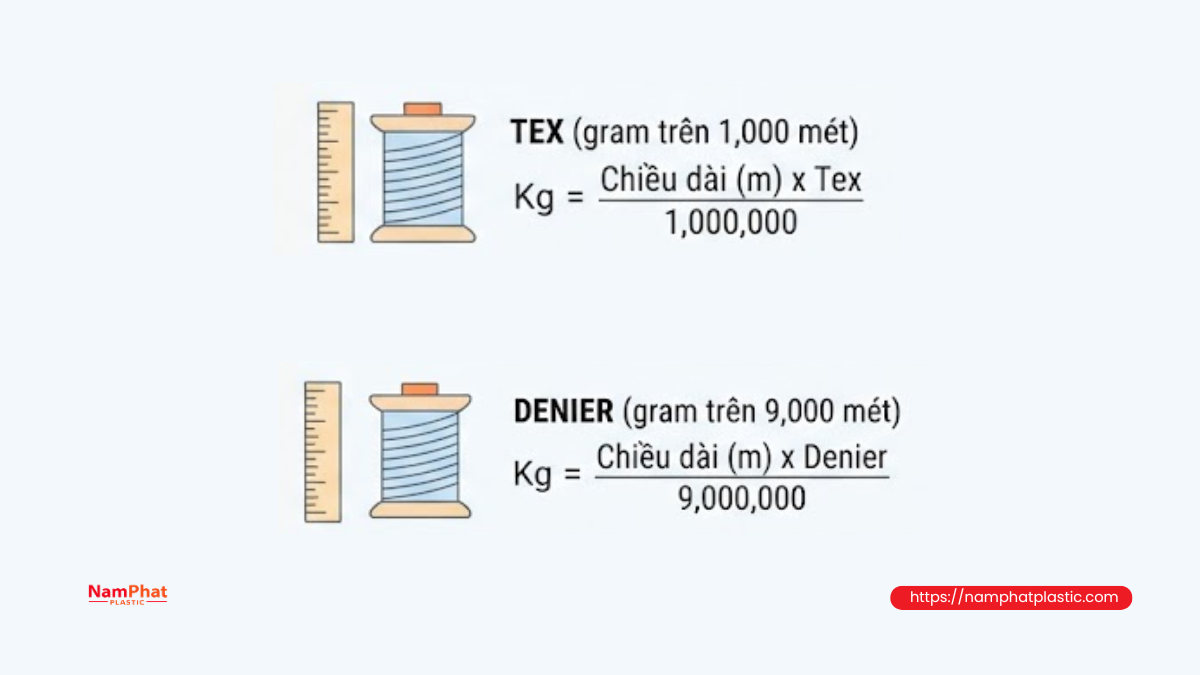
There are three common methods for converting thread length into weight.
9.1. Method 1: Using the actual number of meters per kilogram
This is the simplest method:
- Thread weight = Total required thread length ÷ Number of meters per kilogram
Example:
- Total required thread length: 2,500 meters.
- Actual thread length per kilogram: 3,700 meters.
Required weight:
- 2,500 ÷ 3,700 = 0.676 kg
Manufacturers should use the actual length provided by the supplier or measured internally rather than relying solely on theoretical values.
9.2. Method 2: Calculating using Tex
Tex is the weight in grams of 1,000 meters of yarn.
Formula:
- Thread weight (kg) = Thread length (m) × Tex ÷ 1,000,000
Example:
If the thread count is 266 Tex and 2,333 meters are required:
- 2,333 × 266 ÷ 1,000,000 = 0.621 kg
The result is very close to the calculation based on meters per kilogram.
9.3. Method 3: Calculating using Denier
Denier is the weight in grams of 9,000 meters of yarn.
Formula:
- Thread weight (kg) = Thread length (m) × Denier ÷ 9,000,000
This method is suitable when the supplier specifies thread size in Denier instead of Tex or meters per kilogram.
>>> See also: What are Denier, Tex, and Dtex? Industrial yarn conversion chart
10. Estimated meters per kilogram for 20/6, 20/8, and 20/9 thread
When the specifications 20/6, 20/8, and 20/9 are based on the Ne system, the total yarn fineness can be estimated using:
- Total Tex ≈ 590.5 × Number of plies ÷ Ne count
Example for 20/9 thread:
- Tex ≈ 590.5 × 9 ÷ 20 = 265.7 Tex
Theoretical length per kilogram:
- 1,000,000 ÷ 265.7 ≈ 3,764 m/kg
Reference conversion table:
| Thread specification | Theoretical Tex | Theoretical length |
| 20/6 | Approximately 177 Tex | Approximately 5.645 m/kg |
| 20/8 | Approximately 236 Tex | Approximately 4.234 m/kg |
| 20/9 | Approximately 266 Tex | Approximately 3.764 m/kg |
| 20/12 | Approximately 354 Tex | Approximately 2.822 m/kg |
Actual length is often different from theoretical values because it is influenced by:
- Shrinkage during twisting.
- Thread moisture content.
- Finishing oil applied to the thread surface.
- Variation in raw yarn count.
- Winding density of the thread cone.
- Core and packaging weight.
- Weight tolerance of each cone.
Therefore, although 20/9 thread theoretically provides approximately 3,764 meters per kilogram, the actual product may be lower or higher depending on its structure and manufacturing process.
11. Thread-weighing method: the most accurate way to build consumption standards
Theoretical formulas are suitable for initial quotations. However, the most reliable method is still to run a production trial and weigh the thread directly on the machine.
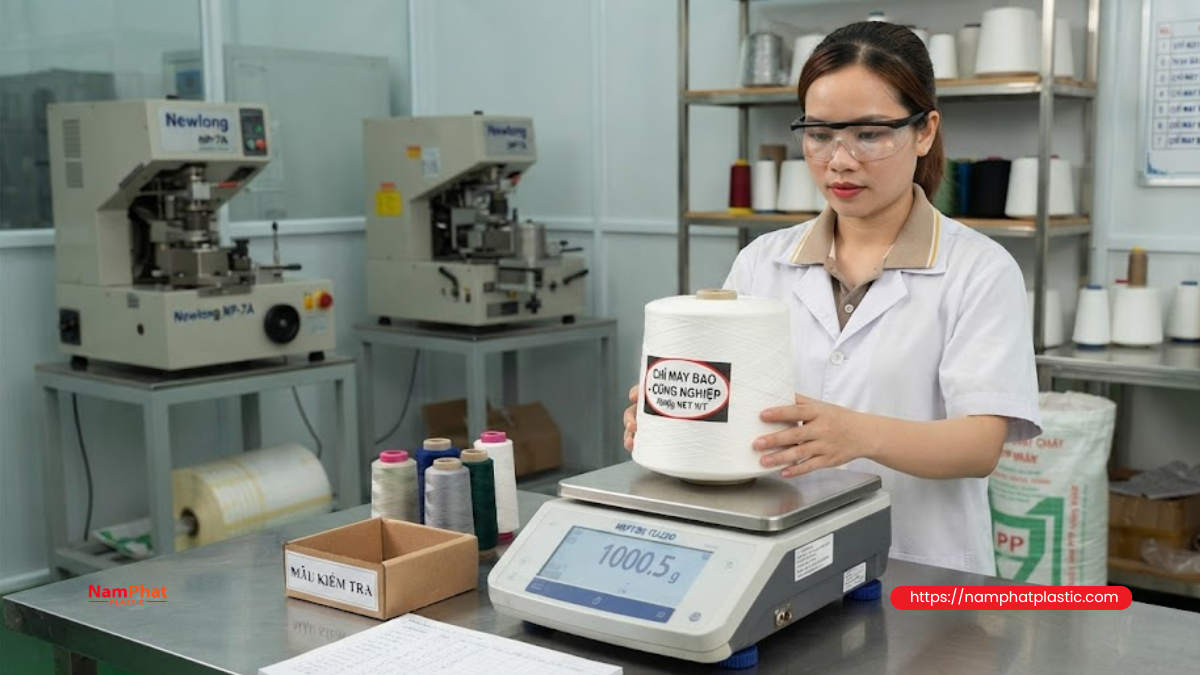
Procedure
Step 1: Prepare a sample batch of bags
Use approximately 100–200 bags with the same dimensions, material, and folded bag-mouth structure as the actual order.
Step 2: Weigh the thread cone before sewing
Use a scale with a minimum accuracy of 1 gram. If the machine uses multiple thread cones, each cone should be weighed and labeled separately.
Step 3: Sew continuously under normal production conditions
Maintain:
-
Machine speed.
-
Stitch density.
-
Thread tension.
-
Thread tail length.
-
Operator handling method.
-
Thread-cutting method.
Do not intentionally shorten the thread tail during the trial because the result will not reflect actual production conditions.
Step 4: Weigh the thread cone again
Thread consumption is calculated as:
-
Weight before sewing − Weight after sewing
Example:
-
Thread cone weight before sewing: 1,250 grams.
-
Thread cone weight after sewing 100 bags: 1,188 grams.
-
Thread consumed: 62 grams.
Thread required for 1,000 bags:
-
62 × 10 = 620 grams
Adding a 5% allowance:
-
620 × 1.05 = 651 grams
Recommended consumption standard:
-
Approximately 0.65 kg of thread per 1,000 bags
Quick formula based on a 100-bag sample
-
Thread required for 1,000 bags (kg) = Thread consumed for 100 bags (grams) × 0.01
Then multiply by the desired allowance factor.
Example:
If 70 grams are consumed for 100 bags:
-
70 × 0.01 = 0.70 kg per 1,000 bags
With a 7% allowance:
-
0.70 × 1.07 = 0.749 kg
The standard can be set at:
-
Approximately 0.75 kg per 1,000 bags
12. How much waste allowance should be added?
The allowance rate should not be fixed for all production lines.
| Production condition | Recommended allowance |
| Stable automatic machine with accurate thread cutting | 3–5% |
| Fixed machine with consistent operator performance | 5–7% |
| Handheld bag sewing machine | 7–10% |
| New order with no production history | 8–12% |
| Thick bags, difficult sewing conditions, or frequent rework | 10–15% |
The allowance should not be set excessively high to hide machine instability. If actual thread consumption consistently exceeds the standard, the root cause should be investigated instead of simply increasing the thread allocation rate.
13. Factors that cause abnormal increases in thread consumption
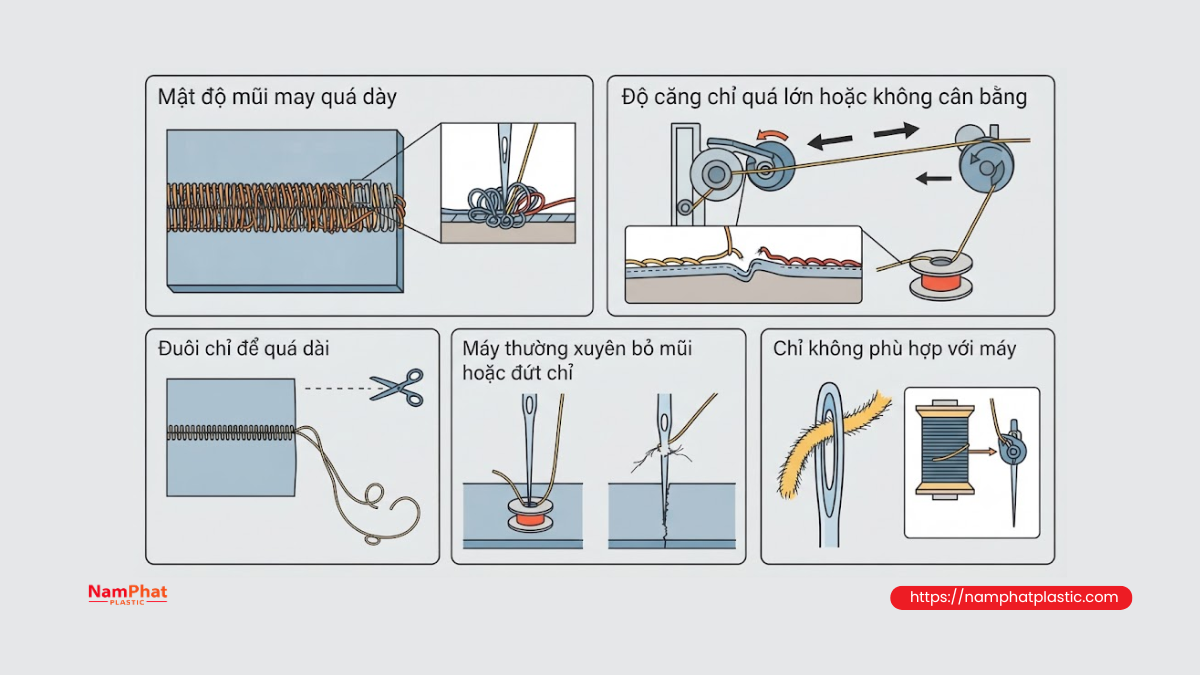
Excessively high stitch density
When the number of stitches per centimeter increases, the thread must form more loops. The seam may become stronger and more attractive, but thread consumption also increases.
Stitch density should be sufficient to seal the bag opening and should not exceed technical requirements.
Excessive or unbalanced thread tension
When needle thread and looper thread are not balanced, stitch loops may become distorted, seams may wrinkle, or thread may break easily. Frequent thread breakage results in additional splicing and re-sewing, increasing consumption.
Excessively long thread tails
An extra 5 cm of thread per bag may seem insignificant. However, for 100,000 bags:
- 5 cm × 100,000 = 5,000 meters
If the thread length is 3,700 meters/kg, the company may waste more than 1.3 kg of thread solely due to excessive tail length.
Frequent skipped stitches or thread breakage
Bent needles, dull needles, worn loopers, damaged thread guides, or improper tension settings all increase the need for seam repairs.
Thread not matched to the machine
Oversized thread may have difficulty passing through the needle and guides. Undersized thread may break easily or fail to provide sufficient seam strength.
Selecting the appropriate specification such as 20/6, 20/8, 20/9, or another size should be based on:
- Bag type.
- Product weight inside the bag.
- Machine speed.
- Needle size.
- Required seam strength.
- Storage and transportation conditions.
Uneven thread cone weight
Two cones labeled 200 grams may produce different numbers of bags if weight tolerances are large. Manufacturers should verify both net weight and actual thread length.
14. Common mistakes when calculating bag sewing thread
Multiplying bag width by quantity only
This method ignores the stitch formation coefficient and can produce results that are several times lower than actual consumption.
Ignoring the leading and tail thread lengths
For handheld machines, excess thread can account for a significant portion of total consumption, especially when sewing small bags.
Failing to include the total thread used by multi-needle machines
Two-needle or two-thread machines cannot be calculated the same way as single-needle, single-thread machines.
Using theoretical thread length instead of actual thread length
Twist shrinkage, finishing oil, and raw material variation can all affect the actual number of meters per kilogram.
Testing with only a few bags
A trial of 5–10 bags is usually insufficient to reflect thread splicing, thread breakage, and normal operator handling. At least 100 bags should be tested.
Using the same consumption standard for different products
A bag with a 40 cm opening and a bag with an 80 cm opening should not share the same consumption standard. Likewise, thin woven PP bags and multi-layer paper bags will have different thread requirements.
15. How to manage thread consumption standards in a factory
Companies should establish a consumption standard table for each product code, including:
| Bag code | Bag opening width | Machine type | Thread type | Stitch density | Kg/1,000 bags | Waste allowance |
| Bag A | 50 cm | Single-needle handheld | 20/9 | 3 stitches/cm | 0.65 kg | 8% |
| Bag B | 60 cm | Single-needle, two-thread | 20/9 | 3 stitches/cm | 1.10 kg | 6% |
| Bag C | 50 cm | Two-needle machine | As required | 3 stitches/cm | 1.75 kg | 5% |
After each production batch, the following should be reviewed:
- Thread issued.
- Remaining thread.
- Number of accepted bags.
- Number of bags requiring resewing.
- Number of thread breakages.
- Unidentified thread loss.
If actual consumption differs by more than 5–10% from the planned standard, the machine condition, operating method, and thread quality should be reviewed.
16. Formula for calculating how many bags can be sewn with one thread spool
Once the thread consumption per bag is known, it is possible to calculate how many bags can be sewn from a single thread spool.
- Number of bags that can be sewn = Usable thread length on the spool ÷ Thread consumption per bag
Example:
- 20/9 thread has an actual length of 3,500 meters/kg.
- Thread spool weight: 200 grams.
- Thread length on the spool: 3,500 × 0.2 = 700 meters.
- Bag opening width: 50 cm.
- Actual sewing length: 0.60 meter.
- Consumption coefficient: 3.6.
- Waste allowance: 8%.
Thread required per bag:
- 0.60 × 3.6 × 1.08 = 2.3328 meters
Number of bags that can be sewn from one spool:
- 700 ÷ 2.3328 ≈ 300 bags
Therefore, under these conditions, a 200-gram spool of 20/9 thread can sew approximately 300 bags.
The actual number may be lower if thread breakage occurs frequently or if operators leave excessively long thread tails.
17. How to reduce thread consumption without weakening the seam
To reduce costs, companies should not arbitrarily reduce thread size or lower stitch density. A better approach is to eliminate thread consumption that does not create value.
Effective measures include:
- Standardizing thread tail length.
- Installing or adjusting thread-cutting devices.
- Periodically inspecting needles, loopers, and thread guides.
- Properly adjusting needle and looper thread tension.
- Using thread spools with consistent quality.
- Selecting needle sizes that match thread diameter.
- Reducing machine stoppages and thread splicing.
- Training operators to maintain continuous sewing operations.
- Monitoring thread consumption by shift.
- Establishing separate consumption standards for each bag type.
The goal is not to use the least amount of thread possible, but rather to create seams that meet strength requirements while maintaining stable and efficient thread consumption.
Frequently asked questions
1. How many kilograms of thread are needed to sew 1,000 bags with a 50 cm opening?
If a single-needle handheld bag sewing machine is used, the total leading and tail thread length is approximately 10 cm, the consumption coefficient is 3.6, and the thread length is about 3,800 m/kg, the estimated consumption is approximately 0.61 kg.
After adding a safety allowance, approximately 0.65 kg of thread should be prepared.
This is only a reference example and should not be considered a fixed standard for all machines.
2. How many bags can one kilogram of 20/9 thread sew?
If one kilogram of thread has an actual length of approximately 3,600–3,800 meters and each bag consumes around 2.3 meters of thread, one kilogram can sew approximately:
-
1,550–1,650 bags
The actual quantity depends on bag width, stitch type, thread tails, and machine condition.
3. Between 20/6 and 20/9 thread, which can sew more bags per kilogram?
Theoretically, 20/6 thread is finer and longer than 20/9 thread, so one kilogram can sew more bags.
However, selecting a smaller thread solely to save material is not recommended because the seam must still meet strength requirements and machine speed demands.
4. Why do two machines sewing the same bag consume different amounts of thread?
The most common reasons include:
-
Stitch density.
-
Thread tension.
-
Thread tail length.
-
Stitch structure.
-
Operating speed.
-
Condition of needles and loopers.
5. Should an additional 10% of thread always be added for every order?
Not necessarily.
A stable automatic machine may require only a 3–5% allowance, while a handheld machine or a new order may require 8–12%.
6. What is the most accurate method for calculating thread consumption?
The most accurate method is to weigh each thread spool separately before and after sewing at least 100 bags under normal production conditions.
The result can then be converted to a per-1,000-bag basis and adjusted with an appropriate allowance factor.
Conclusion
To calculate the amount of thread required for 1,000 bags, manufacturers must determine four key factors:
- Actual sewing length.
- Stitch consumption coefficient.
- Thread length or thread fineness.
- Production waste allowance.
The general formula is:
- Thread required = Number of bags × Sewing length per bag × Consumption coefficient × Waste factor
This formula is useful for initial material planning. However, the most reliable consumption standard should always be established through actual thread-weighing tests on the production machine.
Nam Phat Plastic supplies sewing thread specifications suitable for handheld bag sewing machines, single-needle machines, two-needle machines, and automated bagging lines. Customers should provide bag dimensions, machine type, sewing speed, and seam requirements to select the appropriate thread specification and estimate the most suitable consumption standard.
>>> See also:
- 0 Comment


