


 Phan Van Hoang
- 29/07/2026
- 151
In the yarn, textile, and industrial thread manufacturing industries, the terms spun, filament, and multifilament frequently appear in technical specifications, quotations, and purchase requirements. However, many people still mistakenly assume that these are three completely separate types of thread.
In essence, there are only two fundamental structural groups:
- Spun yarn: yarn made from multiple staple fibers.
- Filament yarn: yarn made from one or more continuous filaments.
Filament yarn can then be divided into:
- Monofilament: consists of only one continuous filament.
- Multifilament: consists of multiple fine filaments running continuously along the length of the yarn.
From a technical classification perspective, multifilament is a type of filament rather than a completely separate category at the same level as filament. A filament refers to a fiber with continuous length; a filament yarn may contain one or multiple continuous filaments.
Understanding the structure of each thread type helps businesses select products that are better suited to the sewing machine, material being sewn, seam strength requirements, and production costs.
Table of Contents [Hide]
1. What is spun yarn?
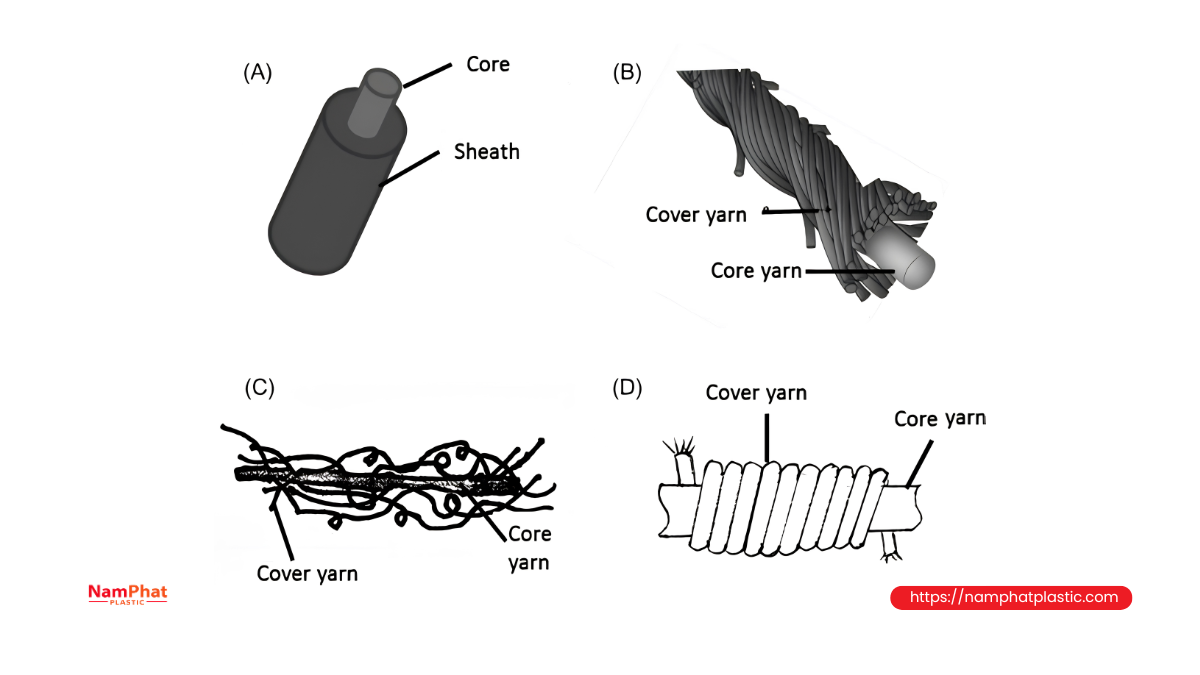
Spun yarn, also known as staple-fiber yarn, is made by gathering multiple fibers with limited lengths, drafting them, and twisting them together to form a continuous yarn.
Fibers used to produce spun yarn may include:
- Natural cotton fibers.
- Cut polyester fibers.
- Viscose fibers.
- Acrylic fibers.
- Aramid fibers.
- Certain polyolefin fibers used for industrial applications.
During production, the fibers typically go through processes such as opening, carding, drawing, roving, spinning, and winding. For sewing thread, multiple single yarns may also be plied and twisted together to create a stronger structure. A typical spun polyester production process includes fiber opening, carding, drawing, roving, spinning, and finished-yarn processing.
1.1. Structural characteristics of spun yarn
Because spun yarn is made from overlapping staple fibers, small fiber ends often protrude from the yarn surface. This is known as yarn hairiness or fuzziness.
Hairiness is not necessarily a disadvantage. In many applications, a fibrous surface allows the thread to:
- Feel softer.
- Grip fabric or packaging surfaces better.
- Produce a matte, natural-looking seam.
- Retain lubricating oil relatively well.
- Form stable thread loops on certain sewing machines.
Compared with filament yarn, spun yarn generally has more surface hairiness, lower uniformity, and a less glossy appearance. Filament yarn, by contrast, is generally smoother, more uniform, and glossier.
1.2. Advantages of spun yarn
Spun yarn is widely used because of the following advantages:
Soft and less glossy surface
Seams made with spun yarn generally have a natural appearance without strong reflection. This makes it suitable for apparel, home textiles, packaging, and products that do not require a highly glossy thread surface.
Good material grip
The fibrous surface creates a certain amount of friction between the thread and material. This can help stabilize stitches, especially on certain woven fabrics or packaging materials with smooth surfaces.
Available in many sizes
Spun yarn can be produced in various counts and then plied into structures such as 20/2, 20/3, 20/6, 20/8, or 20/9 depending on the numbering system and intended application.
Suitable cost for common applications
In many cases, spun yarn is more cost-competitive than high-strength filament thread or filament thread with bonding treatment.
Wide range of applications
Spun polyester is one of the widely used sewing threads because it is available in many sizes and colors and is suitable for various conventional sewing operations.
1.3. Limitations of spun yarn
Despite its advantages, spun yarn also has certain limitations:
- Tensile strength at the same fineness is generally lower than continuous filament thread made from the same material and of comparable quality.
- It can generate more fiber dust or thread lint during high-speed operation.
- Uniformity depends heavily on fiber quality and spinning technology.
- The surface may become increasingly fuzzy after repeated abrasion.
- Abrasion resistance is generally lower than that of high-strength multifilament thread.
- Splices or uneven sections can affect sewing stability.
However, it should not be concluded that all spun yarn is weak. Actual strength also depends on fiber type, fiber length, fineness, twist level, number of plies, raw-material quality, and finishing technology.
2. What is filament yarn?
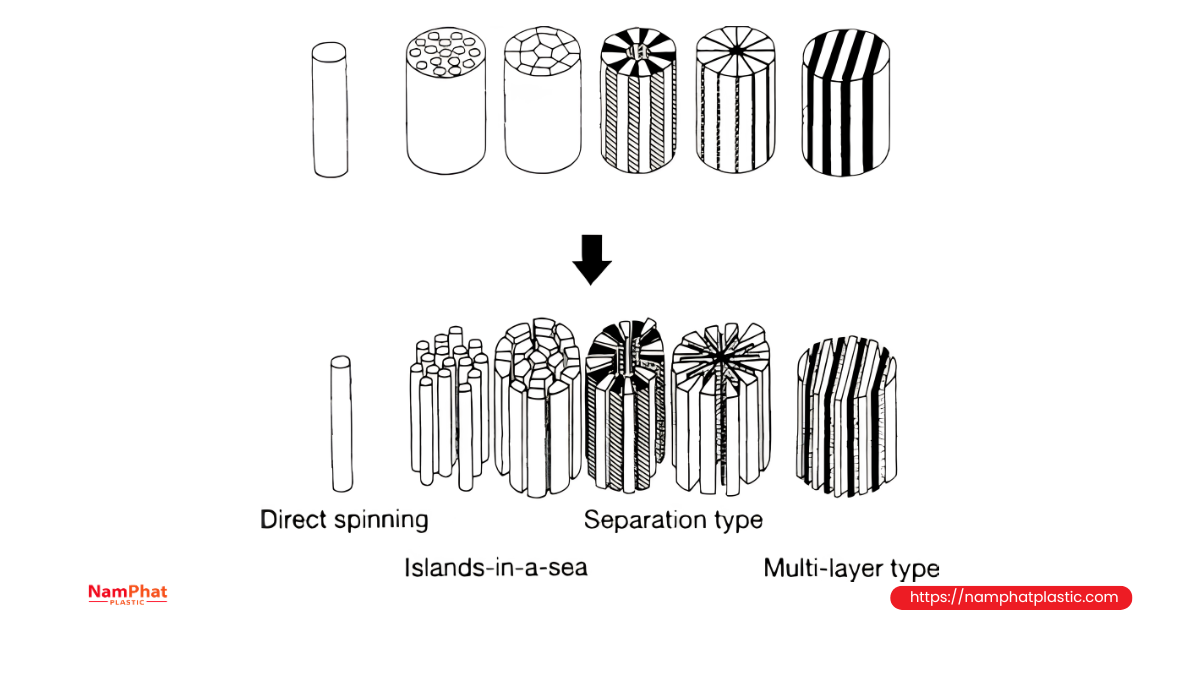
Filament yarn is made from one or more fibers with continuous lengths. Each filament can extend through almost the entire length of the yarn, rather than being assembled from multiple short fibers like spun yarn.
Synthetic filament is commonly produced by:
- Melting or dissolving the polymer.
- Extruding the material through small holes in a spinneret.
- Cooling or coagulating the polymer stream.
- Drawing the filament to orient the molecules.
- Gathering, processing, and winding the yarn.
- Twisting, plying, or forming the required structure.
A filament yarn may consist of:
- A single filament.
- Multiple fine filaments.
- Straight filaments.
- Textured or bulked filaments.
- Twisted filaments.
- Air-interlaced filaments.
- Filaments coated with bonding agents.
Common filament materials include polyester, nylon, polypropylene, rayon, and certain engineering polymers.
3. Are filament and multifilament the same?
Filament and multifilament are directly related but are not completely synonymous.
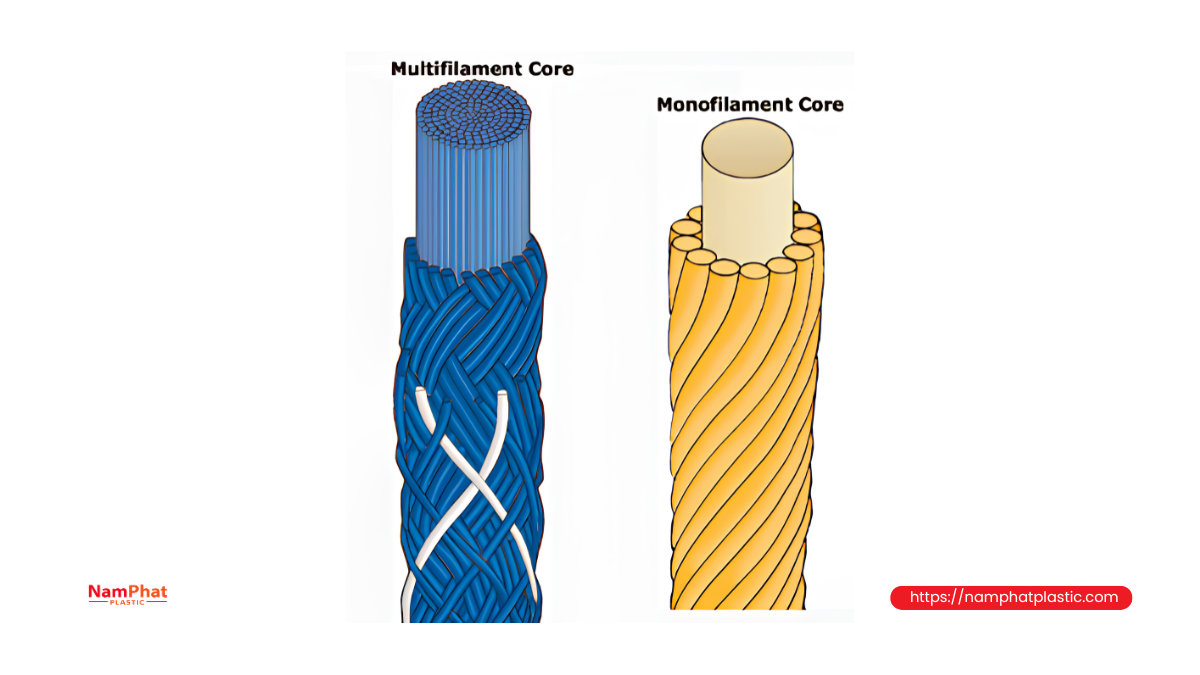
Filament is a general term for a structure that uses continuous fibers. This group has two basic forms:
3.1. Monofilament
Monofilament consists of a single continuous filament with a relatively large diameter.
It can be visualized as being similar to a thin fishing line. Because it contains only one filament, its surface is generally very smooth, with little hairiness and no large number of small fibers separating from the surface.
Monofilament is used in:
- Fishing lines.
- Nets.
- Filter fabrics.
- Transparent sewing thread.
- Technical textiles.
- Brushes.
- Certain types of straps and industrial materials.
A limitation of monofilament is its relatively high stiffness. For seams that come into direct contact with skin, this type of thread may feel stiffer or less comfortable than softer thread structures.
3.2. Multifilament
Multifilament consists of multiple fine filaments gathered into a yarn bundle. The filaments may be parallel, twisted, plied, air-interlaced, or surface-treated to increase cohesion.
For example, a 900D PP multifilament yarn may consist of dozens or hundreds of fine filaments. The total fineness of the entire yarn bundle is 900 denier, while the number and fineness of individual filaments depend on the product design.
Because it consists of many fine filaments, multifilament is generally softer and more flexible than a monofilament with the same total fineness.
>>> Read more: What is PP multifilament and monofilament? A detailed comparison from structure to applications
4. What is multifilament yarn?
Multifilament yarn is a type of yarn made from multiple fine continuous filaments running along the length of the yarn. These filaments are gathered into a bundle and may then be twisted or plied into finished sewing thread.
An industrial multifilament thread may go through processes such as:
- Filament extrusion and drawing.
- Drawing and molecular orientation.
- Gathering multiple filaments into a bundle.
- Single-yarn twisting.
- Plying multiple yarns.
- Final twisting.
- Heat setting.
- Oil or lubricant application.
- Bonding when increased resistance to filament separation is required.
- Winding onto finished packages.
Twisted multifilament yarn is produced by twisting polyester or nylon filaments into an integrated bundle, which may then be plied into sewing thread. This structure generally provides high strength relative to size, good abrasion resistance, and good durability in use.
4.1. Advantages of multifilament yarn
High tensile strength
Because each filament runs continuously along the yarn length, the load can be distributed relatively evenly. Multifilament thread generally provides higher strength than spun yarn of equivalent material and comparable fineness.
Technical literature on industrial sewing thread also recognizes that continuous filament thread generally has higher strength than spun or cotton threads of similar size.
Good uniformity
When extrusion, drawing, and twisting are well controlled, yarn diameter and mechanical properties remain relatively consistent. This helps reduce tension fluctuations during machine operation.
Low fiber dust
Continuous filaments do not have numerous short fiber ends protruding from the surface like spun yarn. Therefore, they generally generate less lint and fiber dust.
Good abrasion resistance
A continuous surface and compact structure make multifilament thread suitable for seams exposed to friction, repeated loading, or demanding operating conditions.
More flexible than monofilament
Multiple fine filaments can move and shift relatively within the yarn bundle. As a result, multifilament is generally softer and more flexible than a monofilament of equivalent overall size.
Properties can be adjusted through filament count
For the same total denier, changing the number of filaments produces different feel and performance:
- Fewer filaments, larger individual filaments: stiffer and stronger yarn.
- More filaments, smaller individual filaments: softer, smoother, and more flexible yarn.
4.2. Limitations of multifilament yarn
- Production costs may be higher than those of common spun yarn.
- Filaments may separate or fray if twist level is unsuitable.
- The yarn can snag when it comes into contact with sharp edges.
- Certain structures require bonding to prevent fraying and improve stability.
- A smooth surface can change loop formation characteristics on sewing machines.
- Thread tension, needle selection, machine speed, and lubrication must be properly controlled.
- For polymers with low softening temperatures, needle friction can heat, melt, or break the yarn.
5. Comparison of spun, monofilament, and multifilament yarns
| Criteria | Spun yarn | Monofilament | Multifilament |
| Structure | Multiple short fibers drafted and twisted | One continuous filament | Multiple continuous filaments |
| Surface | Hairy, relatively matte | Very smooth, low hairiness | Smooth, may be glossy |
| Softness | Soft | Generally stiffer | Soft and flexible |
| Uniformity | Depends on spinning process | Very uniform | Relatively uniform |
| Strength at the same fineness | Medium to fairly high | Fairly high | High |
| Abrasion resistance | Medium | Good | Good to very good |
| Fiber dust | Higher | Very low | Low |
| Separation/fraying | No filament separation but may become fuzzy | No bundle separation | May fray if twist or bonding is insufficient |
| Seam appearance | Matte, natural | Fine, somewhat stiff | Smooth, defined, may be glossy |
| Applications | Apparel, packaging, home textiles | Nets, filters, transparent thread | Packaging, footwear, leather goods, straps, nets, technical textiles |
| Price level | Generally competitive | Depends on polymer and size | Generally higher than common spun thread |
The table above reflects general trends only. It is not possible to determine which thread is better solely from its structural classification. High-quality spun yarn may perform better than poorly manufactured or unsuitable multifilament yarn.
6. Why is multifilament yarn often stronger than spun yarn?
The difference lies in how load is transferred within the yarn.
In spun yarn, load is transferred through:
- Friction between staple fibers.
- Holding forces generated by twist.
- The degree of fiber cohesion.
- The length and strength of individual fibers.
When tension is applied, some fibers may slip relative to one another before breaking. Short, weak, or unevenly distributed fibers can become weak points.
In multifilament yarn, multiple filaments run continuously along the yarn length. The load is distributed among multiple continuous components, reducing the effect of fiber slippage.
However, final strength is still affected by:
- Polymer type.
- Raw-material grade.
- Total denier or tex.
- Filament count.
- Draw ratio.
- Molecular orientation.
- Twist level.
- Number of plies.
- Heat-setting process.
- Damage occurring during production.
- Storage and operating conditions.
Therefore, the word “multifilament” alone should not be used to conclude that a product is automatically more suitable.
7. What is PP multifilament yarn?
PP multifilament yarn is a yarn bundle made from multiple continuous polypropylene filaments. PP resin is melted, extruded through a multi-hole spinneret, cooled, drawn, and gathered into a bundle.
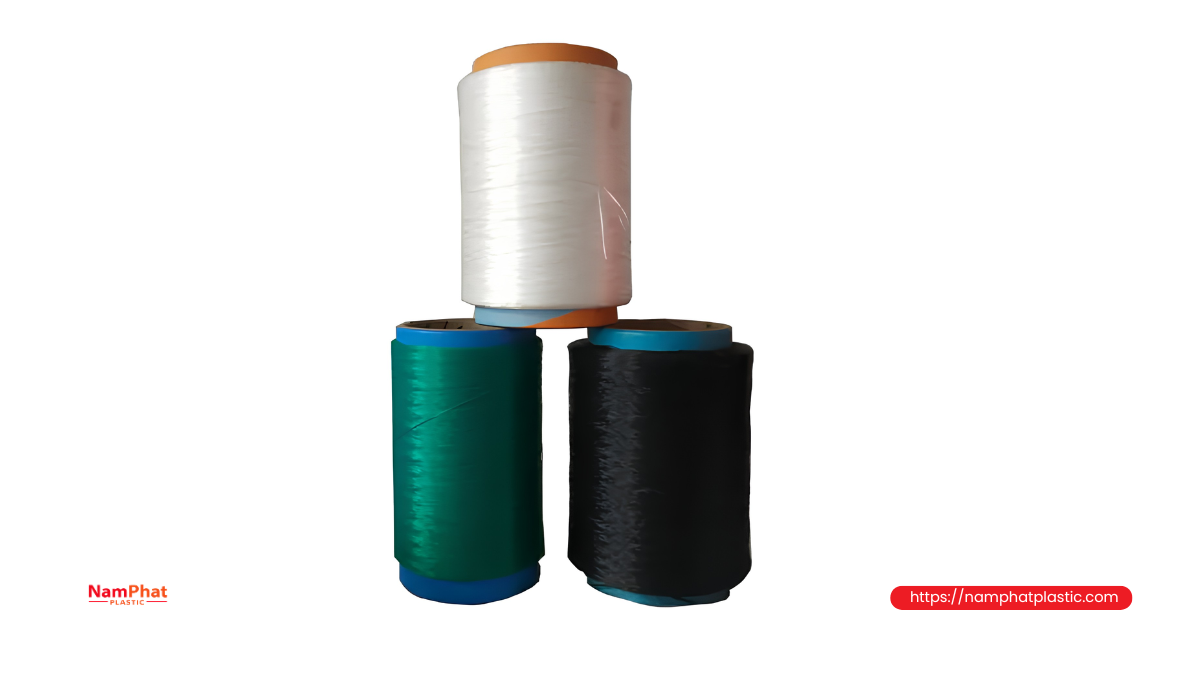
After the drawing process, PP multifilament can be:
- Twisted.
- Plied into multiple layers.
- Colored.
- Lubricated.
- Heat-set.
- Wound onto tubes, cones, or bobbins.
- Processed into sewing thread, ropes, straps, or technical textiles.
PP multifilament is commonly considered for the following properties:
- Low density.
- Very low moisture absorption.
- Resistance to many chemicals.
- Low weight compared with many other fibers.
- Availability in various denier levels.
- Suitability for many industrial applications.
Common applications include:
- Industrial bag sewing thread.
- Woven ropes and straps.
- Tying cords.
- Nets.
- Filter fabrics.
- Technical textiles.
- Lightweight cable components.
- Textile components for agriculture and packaging.
Important considerations when using PP multifilament as sewing thread
Polypropylene has different thermal characteristics from polyester or nylon. During high-speed sewing, friction between the needle, thread, and material can cause the needle temperature to rise significantly.
If the settings are unsuitable, the thread may experience:
- Surface fuzzing.
- Local shrinkage.
- Deformation.
- Softening or melting.
- Breakage near the needle eye.
- Sticking inside the needle groove.
- Loss of strength after passing through the needle.
To minimize these problems, control:
- Needle size.
- Needle-point geometry.
- Needle groove and eye condition.
- Machine speed.
- Thread tension.
- Finishing lubricant quality.
- Stitch density.
- Material thickness.
- Production environment temperature.
8. How are spun PE thread and PP multifilament different?
In bag sewing applications, spun PE thread and PP multifilament may both be used, but their structures and properties are different.
Spun PE thread
Spun PE thread is commonly produced as spun single yarn and then plied and twisted into specifications such as 20/6, 20/8, or 20/9.
Common characteristics include:
- Some degree of surface hairiness.
- A relatively matte seam appearance.
- Good material grip.
- Compatibility with many bag sewing machines.
- Reasonable cost for high-volume production.
- Availability in various ply configurations.
PP multifilament
PP multifilament is made from multiple continuous PP filaments.
Common characteristics include:
- Smoother surface.
- Less fiber dust.
- Good uniformity.
- Potentially high strength relative to weight.
- Suitable for applications requiring lightweight and strong thread.
- Properties can vary significantly according to filament count and twist level.
Which type should you choose?
There is no single correct choice for every type of bag. Businesses should consider:
- Weight of the goods packed in the bag.
- Bag material.
- Whether the bag has a PE liner.
- Seam construction.
- Stitch spacing.
- Machine speed.
- Requirements for preventing bag-mouth opening.
- Transportation conditions.
- Drop resistance.
- Cost per seam.
The best approach is to test the thread on the actual machine and material before placing a large-volume order.
9. What do denier, tex, and filament count mean?
When purchasing filament or multifilament yarn, users commonly encounter specifications such as 600D, 900D, 1000D, or 1200D.
What is denier?
Denier expresses the mass in grams of 9,000 meters of yarn.
A higher denier generally means greater overall linear density. However, two 900D yarns do not necessarily have the same structure or strength.
For example:
- 900D yarn with 48 filaments.
- 900D yarn with 96 filaments.
- 900D yarn with 144 filaments.
All three have a total fineness of 900D, but the fineness of each individual filament is different. Yarns with more fine filaments are generally softer and more flexible, while yarns with fewer, larger filaments tend to be stiffer and coarser.
What is tex?
Tex is the mass in grams of 1,000 meters of yarn. It is a unit used to express yarn linear density.
When comparing products, clearly determine:
- Whether the specification applies to the single yarn or finished thread.
- Whether the number of plies has already been included.
- Whether the product uses denier, tex, or an indirect yarn-count system.
- Permitted weight tolerance.
- Shrinkage after heat treatment.
10. Suitable applications for each type of thread
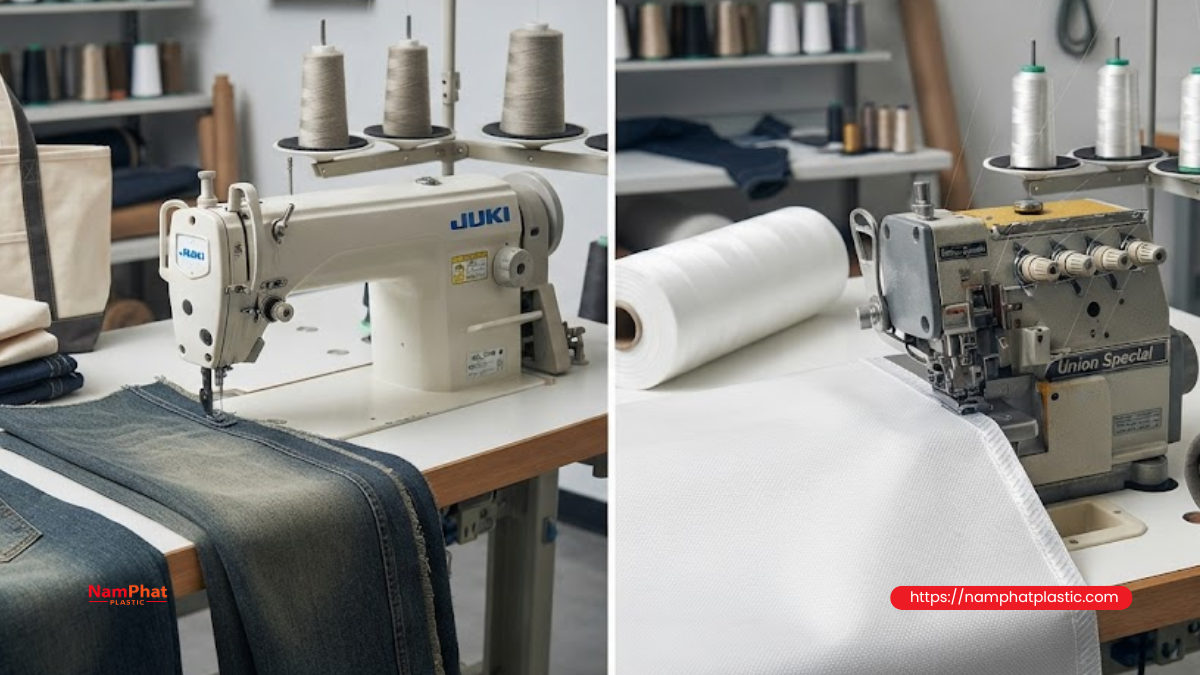
Spun thread is suitable for:
- Common apparel.
- Home textiles.
- Woven PP bags.
- Multi-layer paper bags.
- Agricultural bags.
- Certain animal-feed bags.
- Seams requiring a matte appearance.
- Products where cost is a priority.
- Applications requiring relatively good thread grip.
Monofilament is suitable for:
- Transparent stitching.
- Quilting.
- Blind stitching.
- Nets.
- Filter fabrics.
- Technical materials.
- Products requiring a round cross-section and smooth surface.
Multifilament is suitable for:
- Footwear.
- Bags.
- Leather goods.
- Straps.
- High-load packaging.
- Industrial nets.
- Geotextiles.
- Outdoor products.
- Seams exposed to tensile and abrasion loads.
- Components requiring high strength while retaining flexibility.
Bonded nylon or polyester multifilament thread is particularly suitable for load-bearing, abrasion-resistant seams or multidirectional sewing because the bonding layer helps reduce filament separation and fraying.
11. What is the difference between straight filament and textured filament?
Not all filament yarn has a smooth, low-bulk surface.
Straight filament
The filaments are relatively parallel and straight along the yarn axis. This type generally has:
- Smooth surface.
- Higher gloss.
- Low bulk.
- Good uniformity.
- High tensile strength.
Textured filament
The filaments are crimped, false-twisted, or otherwise processed to increase bulk. This type generally provides:
- Softer feel.
- Better seam coverage.
- Higher extensibility.
- A surface that feels less like monofilament.
- Suitability for loopers or lower threads in overlock seams.
Filament yarn may be textured or non-textured; non-textured filament generally remains straight and parallel and has low bulk.
12. Is corespun a spun or filament yarn?
Corespun is a hybrid structure combining the two groups.
A corespun yarn commonly consists of:
- An inner core made from continuous polyester filament.
- An outer covering made from spun cotton or polyester fibers.
This structure combines:
- The strength of the filament core.
- The softness and grip of the spun-fiber covering.
- A more matte appearance than pure filament thread.
- Stable sewing performance across many sewing operations.
Corespun is neither purely spun yarn nor purely filament yarn. It is a hybrid structure designed to balance strength, abrasion resistance, and sewability.
13. Factors to check when purchasing industrial thread
The terms spun or multifilament only describe part of the structure. To evaluate actual quality, businesses should also check the following factors.
Actual fineness
Tex or denier should be measured across multiple samples. Variation in fineness can change thread tension, coverage, and consumption.
Tensile strength
Do not only examine average breaking force. Also check variation between samples. A batch with high average breaking strength but large variation can still cause unexpected breakage during machine operation.
Elongation at break
Elongation affects force absorption, loop formation, and seam stability. Thread with too little elongation may break more easily under sudden loads, while excessive elongation can cause loose or distorted seams.
Twist level
Too little twist can leave the yarn bundle loose and prone to fraying. Excessive twist can make the thread stiff, cause reverse twisting, or create unstable loops.
Twist direction
The S or Z twist direction and its compatibility with the machine structure should be determined. An unsuitable twist direction can cause the thread to untwist during certain operations.
Uniformity
Check thick and thin sections, knots, splices, fuzzy areas, and twisting defects. These are common causes of tensioner blockage or sudden thread breakage.
Lubrication
Finishing lubricant directly affects friction, needle temperature, sliding behavior, and machine performance. Too little lubricant can cause overheating and thread breakage; too much can attract dust or leave marks on the product.
Thread package quality
The thread package should be wound evenly and should not be excessively hard or loose. The ends of the package should not collapse, tangle, or allow the thread to come off in loops.
Thermal shrinkage
This is particularly important for polyester, nylon, and polypropylene. Excessive shrinkage after heat exposure can cause seam puckering or pull on the material.
Actual sewing test
All laboratory specifications should be validated through practical testing:
- Run the thread on the actual machine.
- Use the correct needle.
- Sew the actual material.
- Maintain the expected production speed.
- Check the seam after tensile, impact, or drop testing.
14. Common mistakes when comparing spun and multifilament
Comparing only by visual diameter
A yarn with a fuzzy surface may appear larger than a filament yarn of the same mass. Therefore, visual inspection does not accurately indicate fineness.
Assuming that shinier thread is always better
Gloss is mainly related to filament structure, cross-sectional shape, and finishing. It does not directly prove strength or machine performance.
Focusing only on initial breaking strength
Industrial seams are also exposed to abrasion, repeated bending, heat, chemicals, and impact. Both post-sewing and post-use strength should be evaluated.
Assuming multifilament never breaks
Poor-quality multifilament, insufficient lubrication, incorrect twisting, or damaged filaments can still cause frequent breakage.
Using the same machine settings for every type of thread
When switching from spun to filament, businesses may need to adjust:
- Thread tension.
- Needle size.
- Machine speed.
- Stitch length.
- Presser-foot pressure.
- Hook position.
- Thread path.
Choosing thread based only on price per kilogram
Price per kilogram does not fully represent the cost of use. A more stable thread may help:
- Reduce machine stoppages.
- Reduce defective seams.
- Reduce thread-joining time.
- Reduce rework.
- Increase production-line speed.
- Reduce complaints about seam opening.
Businesses should calculate the cost per finished product rather than simply comparing raw-material prices.
15. How to choose between spun, filament, and multifilament
The following principles can be used:
Choose spun yarn when:
- A soft and matte surface is required.
- The machine already runs reliably with spun thread.
- Extremely high strength is not required.
- Cost optimization is important.
- Good material grip is desired.
- A certain amount of fiber dust is acceptable.
Choose monofilament when:
- Transparent or less visible stitching is required.
- An extremely smooth surface is needed.
- The product does not require direct skin contact comfort.
- The structure requires a single individual filament.
Choose multifilament when:
- High tensile strength is required.
- The seam is exposed to abrasion.
- Reduced fiber dust is desired.
- The thread needs to be softer than monofilament.
- The product is subjected to repeated loading.
- High uniformity is required.
- Thread tension and needle temperature can be properly controlled.
Choose corespun when:
- You want to combine filament strength with the surface characteristics of spun yarn.
- The product requires both strength and good sewability.
- The seam should have a more matte appearance than pure filament.
- A higher cost than standard spun yarn is acceptable.
Conclusion
The fundamental difference between spun, filament, and multifilament thread lies in the length and arrangement of the fibers within the yarn.
- Spun yarn is made from multiple staple fibers, giving it a soft, slightly hairy surface and making it suitable for many general sewing applications.
- Filament yarn is a broader group made from continuous fibers.
- Monofilament consists of a single large filament.
- Multifilament consists of multiple fine continuous filaments and generally offers good strength, uniformity, and abrasion resistance.
- Corespun combines a filament core with a spun-fiber covering to balance strength and sewability.
Thread should not be selected based solely on its name, appearance, or price per kilogram. Businesses should consider the material, tex or denier, filament count, twist, tensile strength, elongation, lubricant, and actual sewing-test results.
For industrial packaging products, selecting the appropriate thread structure can improve seam strength while reducing thread breakage, machine downtime, defective products, and overall production costs.
Frequently Asked Questions
1. Is multifilament thread a type of filament thread?
Yes. Multifilament is a type of filament yarn. It consists of multiple fine continuous filaments, whereas monofilament contains only one filament.
2. Is spun thread always weaker than filament thread?
Not necessarily. When material, fineness, and quality are comparable, continuous filament generally has a strength advantage. However, high-quality spun thread can still be stronger than low-quality or unsuitable filament thread.
3. Why is spun thread hairy?
Spun yarn is made from fibers with limited lengths. Some fiber ends remain on the outer surface of the yarn, creating hairiness.
4. Which type of thread produces less dust?
Monofilament and multifilament generally produce less fiber dust than spun yarn. However, damaged multifilament exposed to severe friction can still generate fine filaments.
5. Does 900D represent the strength of the thread?
No. 900D indicates the mass of 9,000 meters of yarn; it is not a breaking-force value. Two 900D yarns can have significantly different strength.
6. Is more filament always better?
Not necessarily. More fine filaments can make the yarn softer, but they can also increase the risk of fraying if the structure and twist are unsuitable. Filament count must be matched to the application.
7. Should spun or multifilament thread be used for sewing PP bags?
Both can be used. Spun thread is suitable for many general bag-sewing applications and offers reasonable cost. Multifilament is suitable when higher strength, uniformity, or abrasion resistance is required. Testing on the actual bag material and sewing machine is recommended before selection.
8. Which thread is suitable for high-speed sewing machines?
High-speed performance depends on thread structure, lubricant, needle, tension, and sewing material. Filament thread can provide good uniformity but requires control of needle temperature; spun thread can provide good grip but may generate more fiber dust.
>>> Read more:
- 0 Comment


