


 Phan Van Hoang
- 20/07/2026
- 358
Elongation is the increase in the length of a yarn when subjected to tensile force compared with its original length, usually expressed as a percentage. The most commonly used indicator is elongation at break, which indicates how much the yarn can extend before breaking.
For PP yarn, elongation is not merely a number entered into a technical specification sheet. This indicator directly affects the ability to absorb sudden loads, dimensional stability, product sagging, yarn breakage during processing, and the service life of finished products.
However, it cannot be concluded that higher or lower elongation automatically means better yarn. A suitable elongation level must be evaluated together with tenacity, modulus, breaking force, thermal shrinkage, creep, and consistency between samples.
Summary: Elongation indicates how much a PP yarn can deform before breaking. Low elongation generally supports dimensional stability and rapid force transmission, while high elongation provides a greater deformation range for absorbing loads. The optimal value depends on the final application.
Table of Contents [Hide]
1. What is elongation in the yarn industry?
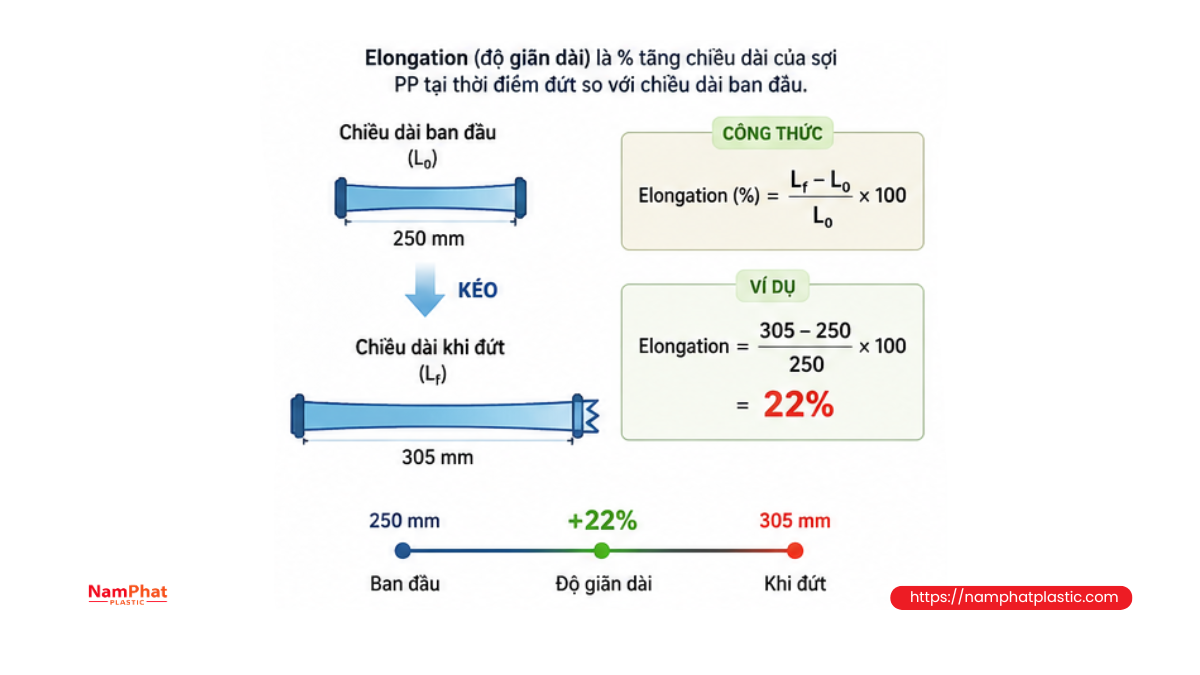
Elongation refers to the relative increase in the length of a test specimen under tensile force. The basic formula is:
Elongation (%) = ((L1 − L0) / L0) × 100
Where:
- L0 is the initial gauge length of the specimen;
- L1 is the specimen length at the point being evaluated, usually at break;
- L1 − L0 is the increase in length.
Example of elongation calculation
- A PP yarn specimen has an initial gauge length of 250 mm. When pulled to break, the length increases to 305 mm.
- Elongation = ((305 − 250) / 250) × 100 = 22%
- Therefore, the elongation at break of the yarn specimen is 22%.
Two concepts should be distinguished:
- Extension: the amount of additional length, expressed in mm or cm.
- Elongation: the ratio of the increase in length to the original length, expressed as a percentage.
- Elongation makes it easier to compare specimens with different gauge lengths. However, results can only be meaningfully compared when specimens are tested under the same gauge length, initial tension, pulling speed, environmental conditions, and clamping method.
2. What is elongation at break?
Elongation at break is the percentage increase in the length of a yarn at the moment the specimen breaks. It is a common parameter found on COAs, TDSs, or PP yarn quality inspection reports.
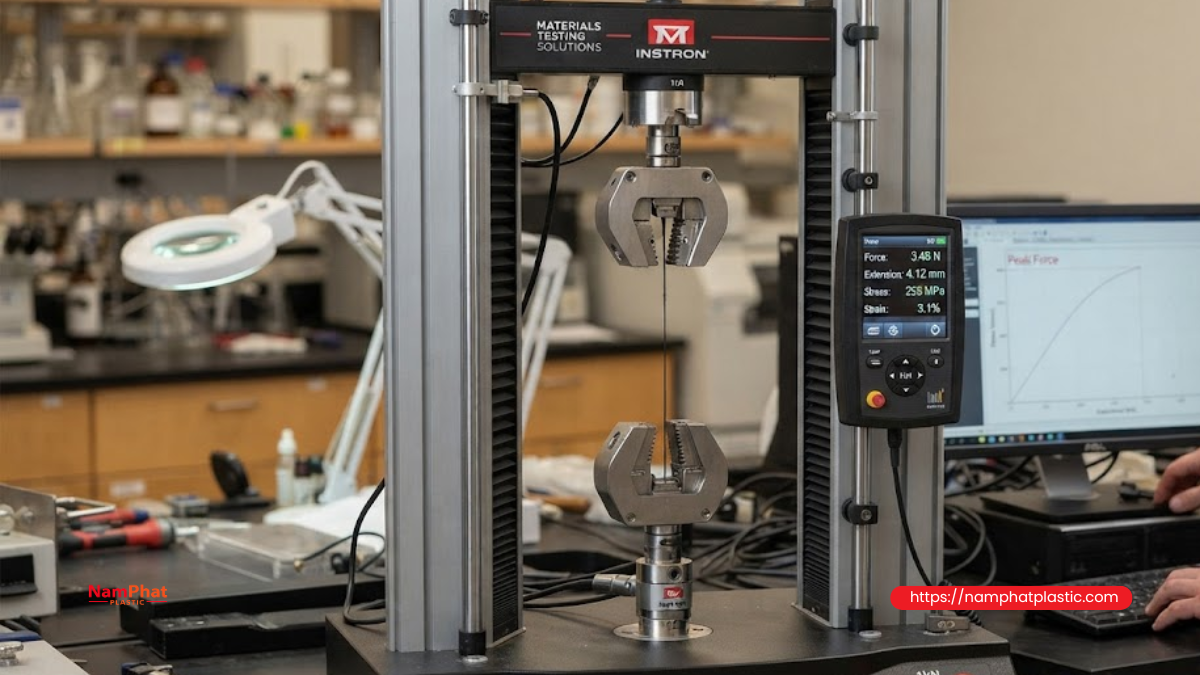
For example:
- Elongation at break: 20% ± 2%
- This means the yarn is designed to achieve an average elongation of approximately 20% at break, with a specified tolerance of 18–22%.
However, elongation at break only describes the final condition of the tensile test. It does not fully indicate how much the yarn will elongate under normal working conditions.
Two yarn specimens with the same elongation at break of 20% may still behave very differently:
- The first specimen may elongate very little at low loads and then deform significantly near the breaking point.
- The second specimen may begin to elongate considerably even under a small load.
Therefore, for products requiring dimensional stability, elongation at a specified load can sometimes provide more practical information than elongation at break.
3. Difference between elongation, elasticity, creep, and shrinkage
A common mistake is to equate elongation with elasticity. In reality, these are different concepts.
| Parameter | Meaning | Question answered by the parameter |
| Elongation at break | Elongation at the moment the yarn breaks | How far can the yarn extend before failure? |
| Elongation at specified load | Elongation at a specified force level | How much does the yarn extend under working load? |
| Elastic recovery | Ability to return toward its original length after load removal | What portion of the deformation can recover? |
| Permanent set | Remaining deformation after load removal | How much permanent elongation remains? |
| Creep | Gradual increase in elongation when a constant load is maintained over time | Will the product continue to sag under long-term loading? |
| Stress relaxation | Gradual decrease in yarn force when elongation is held constant | How well can the yarn maintain tension? |
| Shrinkage | Reduction in length caused by heat or treatment | How much does the yarn shrink when exposed to heat? |
High elongation at break does not necessarily mean good elasticity
A PP yarn with an elongation at break of 30% does not necessarily mean that it can be stretched by 30% and then return completely to its original length. Part of the deformation may be plastic and irreversible.
To evaluate products that need repeated stretching, businesses should also check:
- Recovery after load removal;
- Permanent deformation;
- Loading and unloading characteristics under cyclic conditions;
- Creep under prolonged loading;
- Stress relaxation when the length is held constant.
PP is a viscoelastic material, so the mechanical response of the yarn depends on both the applied load and the duration of loading. Research on PP multifilament yarn has also shown clear stress-relaxation behavior, while the degree of molecular orientation can alter this behavior.
4. Why can PP yarn elongate?
PP yarn is made from polypropylene, a semicrystalline polymer. The yarn structure contains regions with different levels of molecular organization:
- Crystalline regions with relatively ordered structures;
- Amorphous regions containing more mobile polymer chains;
- Molecules connecting different structural regions;
- Microfibril and fibril systems formed during the drawing process.
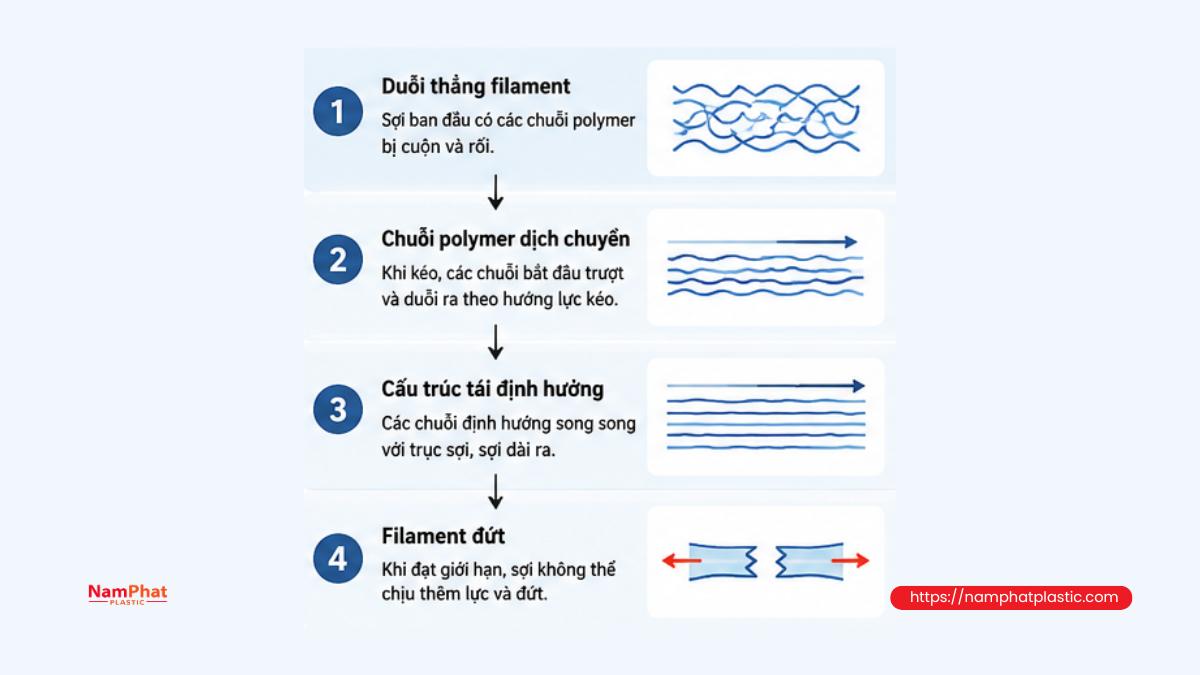
When the yarn is subjected to tensile force, deformation can occur through several stages.
Stage 1: Straightening of the initial structure
Molecular segments, filaments, and small bends in the yarn begin to straighten. At low loads, part of the deformation may recover after the force is removed.
Stage 2: Movement of molecular chains
As the force increases, components in the amorphous regions begin to slip and rearrange in the direction of the applied force. The yarn enters a more pronounced deformation region.
Stage 3: Structural reorientation
Molecular chains, crystallites, and fibrils continue to rotate or align along the yarn axis. At this stage, part of the deformation is no longer completely recoverable.
Stage 4: Filament failure
When the number of load-bearing connections is no longer sufficient to sustain the applied load, filaments begin to break and the entire yarn bundle fails.
The force–elongation curve of PP yarn therefore contains much more information than a single elongation value. Research on PP multifilament has identified yielding and structural reorientation regions before yarn breakage, showing that yarn deformation is directly related to the movement of polymer chains, crystallites, and fibrils.
5. Relationship between elongation, tenacity, and modulus
To properly evaluate PP yarn quality, at least three groups of mechanical properties should be considered together.
Tenacity – specific tensile strength
Tenacity represents the breaking force per unit linear mass of the yarn, commonly expressed in cN/tex or g/denier.
High tenacity indicates that the yarn can withstand a greater force relative to its fineness.
Modulus – resistance to deformation
Modulus indicates how difficult it is to stretch the yarn. A yarn with a high modulus generally requires greater force to produce the same level of elongation.
For applications requiring dimensional stability, modulus in the working-load region can be just as important as tenacity.
Toughness – ability to absorb energy before breaking
Toughness is related to the area under the force–elongation curve. This property depends on both the force the yarn can withstand and its deformation range.
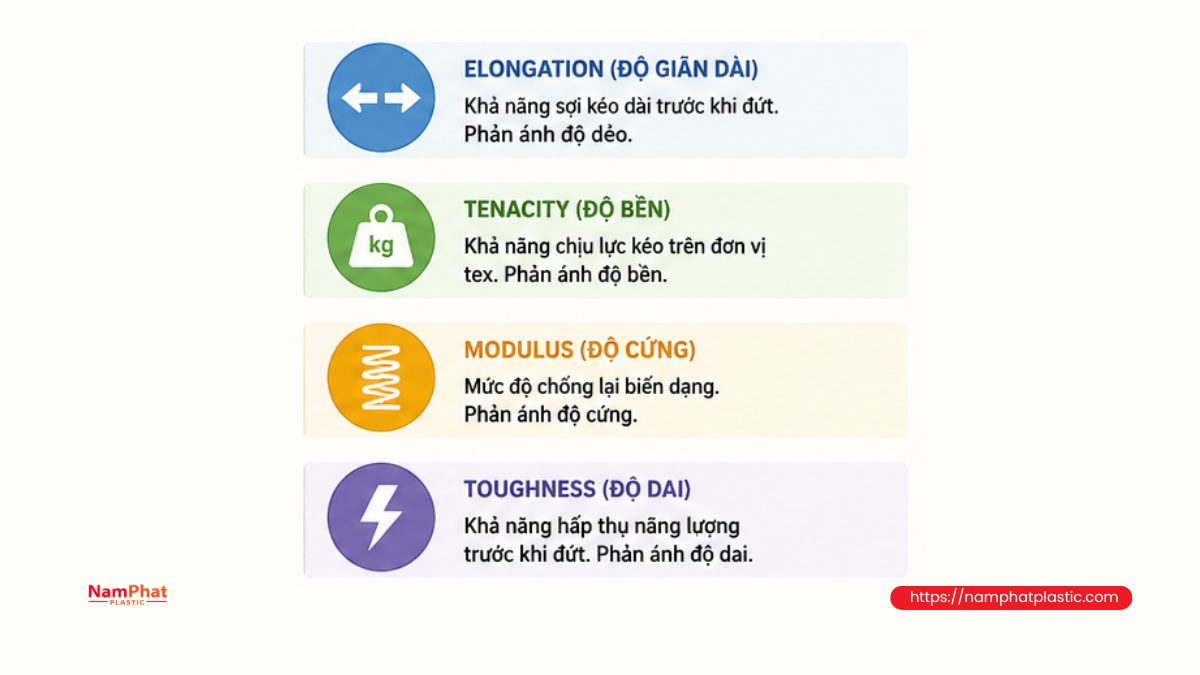
Therefore:
- A yarn with high elongation but low breaking force may not necessarily absorb a large amount of energy.
- A yarn with high tenacity but excessively low elongation may have little deformation range before breaking.
- A yarn with a balanced combination of strength and elongation is often more suitable for impact or variable loading.
ASTM D2256/D2256M uses the force–elongation curve to determine or calculate properties such as elongation at break, force at specified elongation, modulus, and toughness. This shows that a single elongation value is not sufficient to fully describe the tensile behavior of a yarn.
6. How does draw ratio affect PP yarn elongation?
Draw ratio is one of the process variables with the greatest influence on the mechanical properties of PP yarn.
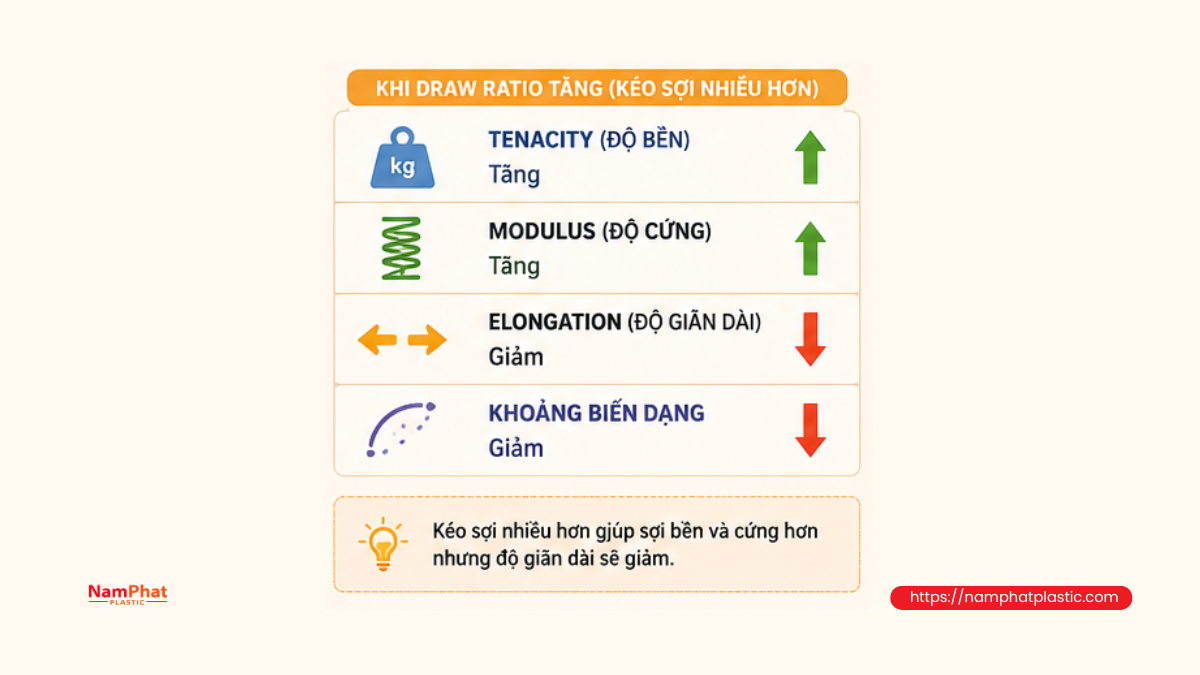
As the draw ratio increases, polymer chains generally become more strongly oriented along the yarn axis. Under the same material system and production conditions, the common trend is:
- Tenacity increases;
- Modulus increases;
- Elongation at break decreases;
- The yarn becomes more stable under low loads;
- The deformation range before failure becomes narrower.
A study on PP multifilament produced at three different draw ratios reported the following results:
| Draw ratio | Breaking tenacity | Elongation at break | Specific work of rupture |
| 3,73 | 26,4 cN/tex | 122,4% | 248 J/g |
| 5,53 | 44,3 cN/tex | 61,1% | 215 J/g |
| 7,30 | 64,8 cN/tex | 24,3% | 99 J/g |
As the draw ratio increased from 3.73 to 7.30, breaking tenacity increased significantly, while elongation at break decreased from 122.4% to 24.3%. At the same time, specific work of rupture decreased, showing that the yarn became stronger and stiffer while its deformation range before breaking became narrower. These are laboratory research results and should not be treated as universal specifications for all PP yarns.
The results illustrate an important principle:
- Maximizing tenacity does not necessarily mean maximizing usability.
If the yarn is intended for structures where deformation must be limited, a high draw ratio may provide an advantage. Conversely, for products that need to withstand sudden loads or require a safety deformation range, reducing elongation too much may reduce suitability.
7. How does elongation affect the usability of PP yarn?
7.1. Effect on sudden load absorption
When a yarn or cord is subjected to a sudden load, part of the energy can be dissipated through deformation.
A yarn with a suitable elongation range may experience a lower instantaneous force increase than a material that undergoes almost no deformation. This characteristic can be useful for:
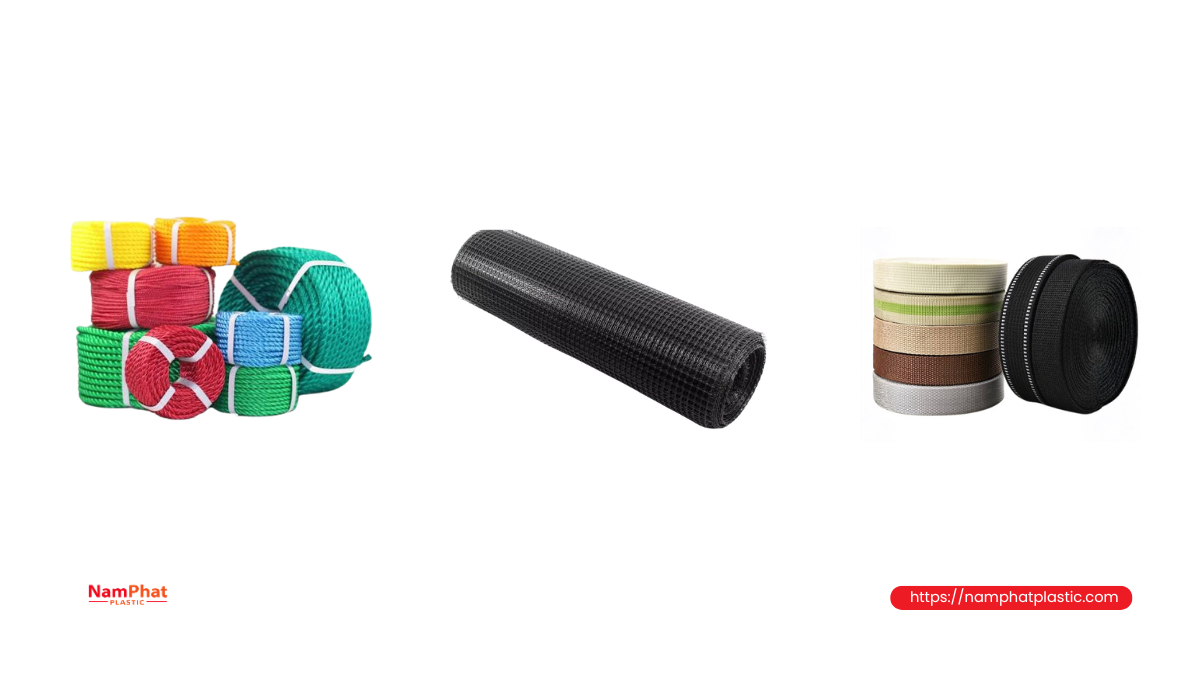
- Ropes, nets, or cords subjected to vibration;
- Products exposed to impact loads;
- Tying cords subjected to changing loads;
- Structures that must withstand short-duration peak loads.
However, high elongation only helps absorb energy when the yarn continues to maintain sufficient tensile force during deformation. Therefore, the force–elongation curve or toughness should be considered rather than looking only at the percentage elongation at break.
7.2. Effect on dimensional stability
A yarn with low elongation and an appropriate modulus generally helps finished products undergo less deformation under load.
This is particularly important for:
- Technical fabrics that need to maintain dimensions;
- Filter fabrics that need stable pore dimensions;
- Belts and webbing where length must be controlled;
- Nets where sagging must be minimized;
- Reinforcement structures requiring rapid load transfer.
If elongation at the working load is too high, the finished product may stretch, sag, or change shape even though the yarn is still far from its breaking point.
7.3. Effect on yarn breakage during processing
During weaving, braiding, twisting, winding, or industrial sewing, yarns are subjected to short-duration force peaks caused by:
- Acceleration and deceleration;
- Friction at guides;
- Changes in yarn tension along the running path;
- Equipment vibration;
- Local weak points in filaments.
Excessively low elongation can reduce the available deformation reserve and make the yarn more sensitive to force peaks.
Conversely, excessively high or inconsistent elongation can cause:
- Difficulty controlling yarn tension;
- Soft or unstable yarn packages;
- Differences in length between yarn ends;
- Variations in fabric structure;
- Sagging after processing.
Therefore, for machine-running performance, elongation consistency among samples and among filaments can be just as important as the average value.
7.4. Effect on load sharing between filaments
PP multifilament yarn consists of many small filaments that share the load. If some filaments have significantly lower elongation, they may begin carrying load earlier and break first. The remaining filaments then have to take additional load, causing failure to progress through the yarn.
Conversely, when the mechanical properties among filaments are consistent, the load is more likely to be distributed evenly throughout the yarn bundle.
Therefore, a lot with an average elongation of 22% but high CV may not run as well as a lot that also has an average of 22% but much lower variation.
7.5. Effect on sagging and long-term deformation
Elongation at break is the result of a relatively short tensile test. This indicator does not replace a creep test.
A yarn with low elongation at break can still gradually deform when subjected to continuous loading for hours, days, or months. For long-term load-bearing applications, additional factors should be considered:
- Creep at the operating temperature;
- Stress relaxation;
- Elongation at working load;
- Effects of thermal cycling;
- Changes after environmental aging.
This is particularly important for nets, ropes, webbing, reinforcement materials, and products that remain under tension continuously.
7.6. Effect on finished product structure
The elongation of a finished product is not necessarily equal to the elongation of the raw yarn.
In braided cords, woven fabrics, or twisted products, initial deformation may result from:
- Straightening of yarn crimp within the fabric;
- Self-tightening of the braided structure;
- Filament twist angle;
- Slippage between yarn ends;
- Structural settling and rearrangement.
After the structural deformation has been used up, the filaments begin to experience more direct tensile loading. Therefore, the finished product should be tested rather than relying entirely on the yarn COA.
8. What applications are suitable for high or low elongation?
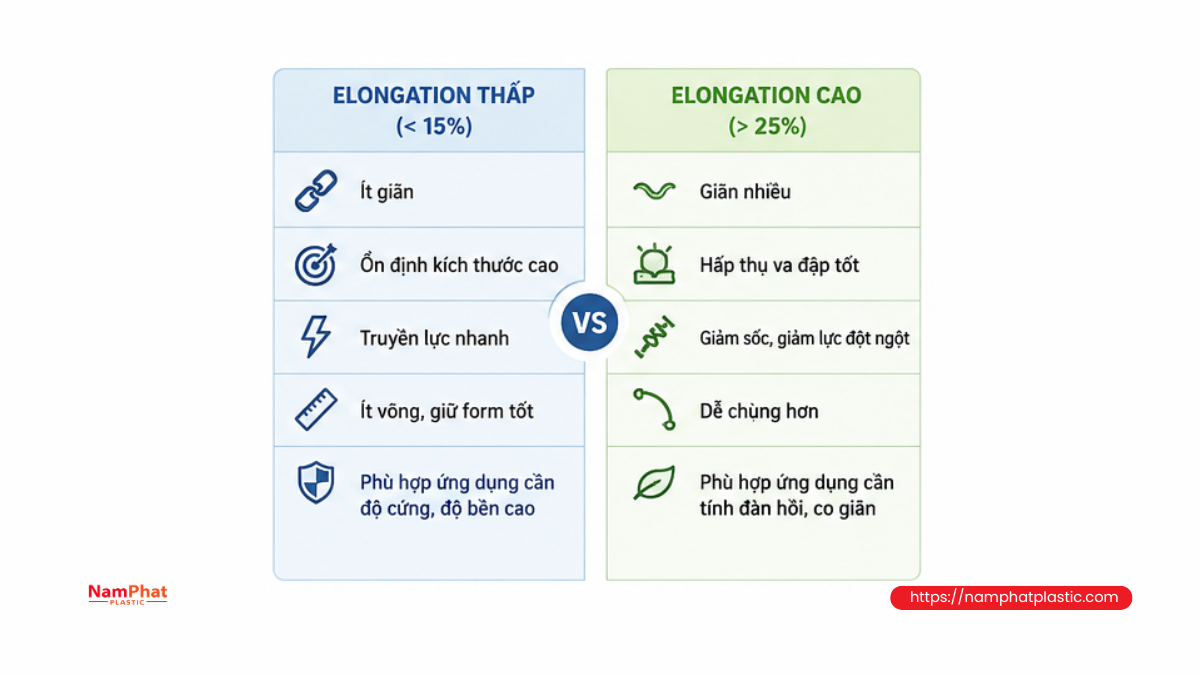
There is no single elongation level that is suitable for all PP yarns. The following table shows general selection trends according to application requirements.
| Application | Preferred elongation trend | Properties to check together |
| Technical PP fabric | Low to medium, with low variation | Modulus, tenacity, thermal shrinkage, CV, machine performance |
| Rope, cord, braided rope | Sufficient elongation to reduce sudden loads without excessive sagging | Toughness, creep, force at specified elongation, knot strength |
| Agricultural and protective nets | Enough elongation to withstand wind and impact while maintaining shape | Creep, UV resistance, finished-product elongation, joint strength |
| PP sewing thread | Stable elongation to withstand stitch formation | Loop strength, knot strength, friction, consistency |
| Webbing and straps | Low when positioning is important; medium when impact reduction is required | Modulus, elongation at working load, cyclic loading |
| Filter fabric | Low to medium to maintain pore structure | Creep, chemical resistance, temperature, dimensional stability |
| Reinforcement materials | Low, with high modulus for early load transfer | Force at low elongation, creep, tenacity, long-term strength |
| Knitted and soft textile products | Higher elongation may be acceptable | Elastic recovery, hand feel, thermal shrinkage |
| Cable filler yarn | Elongation is generally not the only determining parameter | Density, porosity, thermal shrinkage, process compatibility |
The table above only provides a general selection direction. The final target value should be based on finished-product structure, denier, number of filaments, twist level, working load, and customer requirements.
9. When does low elongation provide an advantage?
Low elongation is often beneficial when the product needs to:
- Transfer force rapidly from a small amount of deformation;
- Maintain length or shape under load;
- Limit sagging and slack;
- Maintain pore dimensions or woven structure;
- Provide a firm and stable feel;
- Reduce movement of secured components.
However, low elongation only provides an advantage when the yarn also has appropriate tenacity, toughness, and consistency. If elongation is reduced by excessive drawing or operation outside a stable process window, the manufacturer may experience:
- Increased filament breakage;
- Greater variation between bobbins;
- Reduced specific work of rupture;
- Greater sensitivity to surface defects;
- More difficult processing under pulsating loads.
Therefore, the goal is not to create the lowest possible elongation, but to achieve low elongation under controlled conditions.
10. When does high elongation provide an advantage?
Higher elongation may be beneficial when the yarn needs to:
- Withstand fluctuating loads;
- Adapt to changes in shape;
- Absorb part of impact energy;
- Reduce force peaks over short periods;
- Provide greater softness and formability;
- Pass through processes with small variations in yarn tension.
However, excessively high elongation can create difficulties when the finished product needs dimensional stability. Some common issues that should be monitored include:
- Finished products becoming longer after loading;
- Nets or ropes sagging;
- Uneven tension between yarn ends;
- Changes in fabric structure after winding or relaxation;
- Difficulty maintaining package length;
- Significant shrinkage or deformation after processing.
The important point is to distinguish useful elongation from uncontrolled deformation. Useful elongation is accompanied by an appropriate force curve and suitable recovery characteristics, whereas uncontrolled deformation often results in sagging or dimensional loss.
11. Production factors that change PP yarn elongation
11.1. Polymer type and molecular weight distribution
MFR, molecular weight, molecular weight distribution, and raw material consistency can all affect:
- Spinning performance;
- Melt strength;
- Degree of orientation;
- Ability to withstand the draw ratio;
- Tenacity and elongation of the filament.
Raw material should not be evaluated based on MFR alone. Two resins with similar MFR values can still provide different spinning windows and mechanical properties.
11.2. Extrusion temperature
A temperature that is too low may result in unstable melt flow or insufficient additive dispersion. A temperature that is too high may increase the risk of polymer degradation when residence time is long or the system is not properly controlled.
Extrusion temperature affects melt viscosity, filament formation, and the final yarn structure.
11.3. Flow rate through the spinneret
The flow rate per spinneret hole affects the denier per filament, cooling rate, and degree of orientation on the spin line.
Flow variation between holes can create filaments with different properties within the same bundle, increasing the CV of tenacity and elongation.
11.4. Cooling conditions
The speed and uniformity of the quench air flow affect the crystallization process and filament structure.
Non-uniform cooling can result in:
- Differences in filament diameter;
- Differences in crystallinity;
- Uneven drawability;
- Increased risk of filament breakage during drawing.
11.5. Take-up speed
Take-up speed can create initial orientation directly on the spin line. When speed and tension change, the structure of the as-spun yarn also changes, which in turn affects drawability and final elongation.
11.6. Draw ratio
This is often the most direct process variable for adjustment. Increasing draw ratio tends to increase orientation, tenacity, and modulus while reducing elongation at break.
However, the draw ratio must be set within a suitable window according to:
- Polymer type;
- Godet temperature;
- Line speed;
- Denier per filament;
- Cooling conditions;
- Spinneret condition;
- Additive and masterbatch system.
11.7. Drawing temperature
Temperature determines the mobility of polymer chains during the drawing process. If the chains are not sufficiently mobile, the filament may develop localized stress or break. If the temperature is too high, the resulting structure may not achieve the desired degree of orientation or other variations may occur.
Therefore, draw ratio and draw temperature should be optimized as a pair rather than adjusted independently.
11.8. Heat setting and relaxation
Heat setting can help stabilize the structure after drawing, reduce residual stress, and control thermal shrinkage. Controlled relaxation can also change elongation, modulus, and dimensional stability.
Yarns with the same tenacity but different heat-setting histories may behave differently at low loads and under heat exposure.
11.9. Twist
Twist helps bundle the filaments, increases cohesion, and improves handling. However, as the twist angle increases, the filaments are no longer completely parallel to the yarn axis.
As a result, twist can change:
- Apparent breaking force;
- Elongation of the yarn bundle;
- Slippage between filaments;
- Loop strength and knot strength;
- Load-sharing behavior.
Therefore, elongation of zero-twist yarn should not be directly compared with that of twisted yarn without specifying the sample structure.
11.10. Masterbatch, additives, and recycled materials
Color masterbatch, UV additives, antistatic agents, and recycled materials can all affect crystallization and spinnability.
The actual effect depends on:
- Blending concentration;
- Compatibility with the base resin;
- Dispersion quality;
- Size and nature of additive particles;
- Degree of polymer degradation;
- Contaminants or gels.
A good additive formulation must not only achieve the required color or UV resistance but also maintain a stable drawing window.
Studies on PP multifilament show that tensile properties are significantly influenced by the physical structure of the filament, while this structure itself depends on the input materials and filament formation conditions. Extrusion temperature, pumping speed, and other process variables can simultaneously affect linear density, breaking force, modulus, and elongation.
12. How to accurately measure PP yarn elongation
Two commonly referenced tensile-testing methods for yarn are ISO 2062 and ASTM D2256/D2256M.
- ISO 2062 specifies the determination of breaking force and elongation at break of yarn taken from packages using a CRE – constant rate of extension – tensile tester. The standard describes test methods for conditioned specimens, relaxed skein specimens, and wet specimens. ISO also specifies its scope for single-end yarn testing.
- ASTM D2256/D2256M covers various monofilament, multifilament, and spun yarns within the scope of the standard and allows determination of breaking force, elongation, tenacity, modulus, and toughness.
Conditions that should be clearly reported
A reliable elongation report should include:
| Information | Why it needs to be reported |
| Test standard | Identifies the procedure used |
| Gauge length | Affects the result and the likelihood of encountering weak points |
| Initial tension | Defines the starting condition of the specimen |
| Pulling speed or time to break | PP behavior depends on strain rate |
| Clamp type | Affects specimen slippage and breakage at the clamps |
| Conditioning conditions | Ensures repeatability |
| Number of specimens | Required to evaluate variation |
| Average value | Represents the tested lot |
| Standard deviation or CV | Reflects consistency |
| Min–max | Helps identify abnormal specimens |
| Break location | Excludes slippage or invalid breaks |
Do not compare results from different test conditions
The same yarn can produce different elongation results when changing:
- Gauge length;
- Initial tension;
- Pulling speed;
- Time to break;
- Number of wraps around the clamps;
- Clamp pressure;
- Specimen relaxation time;
- Yarn twist condition.
Therefore, an “elongation 20%” value is not sufficient to compare two suppliers if the test method is not disclosed.
Special note for PP tape yarn
ISO 2062 excludes polyolefin tape from its scope. Therefore, for PP tape yarn or raffia tape, the manufacturer and customer should agree on a suitable test method based on the product standard or purchasing requirements rather than automatically stating ISO 2062 on the COA.
13. How to read elongation values on a PP yarn COA
A good COA should not show only one average value. Yarn buyers should check at least four levels of information.
Level 1: Elongation at break
This indicates the deformation limit before failure. It is useful for evaluating the overall deformation range but does not fully represent working conditions.
Level 2: Elongation at a specified load
This is important when the product needs to maintain its dimensions. The specified load may be defined as an absolute force or in cN/tex.
Example specification:
- Elongation at X cN/tex: not greater than Y%
- X and Y should be established according to the application rather than using one common level for every yarn type.
Level 3: Recovery after load removal
This indicates whether the yarn returns toward its original state or retains permanent deformation. It is particularly important for products subjected to repeated loading.
Level 4: Time-dependent deformation
Creep and stress relaxation indicate whether the yarn can maintain dimensions or tension over a long period.
For ropes, nets, belts, or reinforcement materials, the fourth level often determines long-term performance more strongly than elongation at break.
14. Why is elongation CV important?
Suppose two yarn lots both have an average elongation of 22%:
- Lot A has most results between 21–23%;
- Lot B has results ranging from 15–29%.
The two lots have the same average value but may perform very differently.
Lot B may show:
- Early filament breakage;
- Differences in tension between yarn ends;
- Unstable package quality;
- More machine stoppages;
- Variations in finished-product structure;
- Intermittent quality complaints that are difficult to trace.
Therefore, the factory should manage:
- Average value + CV + Min/Max + trend over time
Delivery tolerances for customers should also not be used as internal control limits. Factory control limits should be narrower to create a safety margin for production variation and testing error.
15. How to determine suitable elongation for an application
Instead of asking “What elongation is good?”, the following five questions should be answered in sequence.
1. Does the product experience static, dynamic, or cyclic loading?
Long-term static loading requires attention to creep. Dynamic loading requires attention to toughness and load-absorption capability. Cyclic loading requires checking recovery and permanent deformation.
2. What is the maximum allowable deformation?
A product may not be broken but may already be unusable because it has stretched excessively. Therefore, the service limit should generally be established before the breaking point.
3. What percentage of the breaking load is the working load?
If the working load is low but dimensional requirements are strict, initial modulus and elongation at low loads become important.
4. Does the finished product have a woven, twisted, or braided structure?
Crimp, twist angle, and braided structure create their own contribution to elongation. Structural deformation must be separated from polymer deformation.
5. Does the application environment involve heat, UV, or chemicals?
Initial mechanical properties do not always represent mechanical properties after aging. Yarn used outdoors or in special environments should be tested after the corresponding aging conditions.
After answering these five questions, the manufacturer can establish a target elongation window and then confirm it through finished-product testing.
16. Sample technical requirements for PP yarn elongation
The following is a reference structure. Values X and Y should be established through actual testing.
| Parameter | Requirement |
| Yarn type | PP multifilament, with defined structure and twist |
| Linear density | X dtex or denier, with specified tolerance |
| Breaking force | Not less than X N |
| Tenacity | Not less than X cN/tex or g/den |
| Elongation at break | X% ± Y% |
| CV elongation | Not greater than X% |
| Elongation at specified load | Not greater than X% at Y cN/tex |
| Initial/chord modulus | According to application requirements |
| Thermal shrinkage | Not greater than X% under specified conditions |
| Test conditions | Specify standard, gauge length, pretension, and speed |
| Number of specimens | According to test method or agreement |
| Finished-product testing | Weaving, braiding, sewing, or load testing according to application |
This specification structure is better than simply stating “elongation approximately 20%” because it connects yarn properties with the actual behavior of the finished product.
17. Common mistakes when evaluating PP yarn elongation
Assuming that lower elongation means better yarn
Low elongation may be accompanied by high modulus and tenacity, but it may also reduce the deformation range before failure. Evaluation must be based on the application.
Assuming that high elongation means high elasticity
Elongation at break does not indicate how much of the deformation can recover. Elasticity must be evaluated through loading–unloading or cyclic testing.
Checking only the average value
The average can hide extremely low or high specimens. CV, min–max, and the distribution of results should also be monitored.
Comparing results from different test methods
Differences in gauge length, pretension, and pulling speed can produce different results. Comparison should only be made when test conditions are equivalent.
Using yarn elongation to directly predict finished-product elongation
Fabric, rope, and net structures also undergo structural deformation. Finished products must be tested at the product level.
Ignoring elongation at working load
For applications requiring dimensional stability, behavior at low or medium loads is often more important than behavior at the breaking point.
18. Conclusion: elongation determines the suitability of PP yarn
Elongation is the relative increase in yarn length when subjected to tensile force. Elongation at break indicates how much the yarn can extend before breaking.
For PP yarn, elongation affects four main groups of properties:
- Deformation capability and sudden load absorption;
- Dimensional stability of the finished product;
- Machine-running performance during weaving, braiding, twisting, or sewing;
- Sagging, creep, and the ability to maintain tension during long-term use.
Low elongation is not automatically better than high elongation. The appropriate level must be determined according to working load, finished-product structure, and operating conditions.
A complete evaluation should combine:
- Elongation at break + elongation at working load + tenacity + modulus + toughness + creep + thermal shrinkage + CV.
For manufacturers of PP multifilament yarn, maintaining stable elongation between lots and between bobbins often provides greater practical value than simply pursuing an extremely high or extremely low number.
Frequently asked questions about PP yarn elongation
1. Are elongation and tensile strength the same?
No. Elongation indicates how much the yarn can extend, while tensile strength or breaking force indicates the force the yarn can withstand before breaking. A yarn may have high strength but low elongation, or high elongation but relatively low breaking force.
2. Does higher elongation mean the yarn is more ductile?
High elongation indicates that the yarn has a large deformation range before breaking, but it is not enough to conclude that the yarn has good elasticity or recovery. Elastic recovery and permanent set should also be evaluated.
3. What elongation is good for PP multifilament yarn?
There is no single value that applies to every product. Technical fabrics, ropes, nets, sewing threads, webbing, and knitted products have different requirements. The target value should be established together with tenacity, modulus, thermal shrinkage, and working load.
4. Why does increasing draw ratio usually reduce elongation?
A higher draw ratio causes polymer chains to become more strongly oriented along the yarn axis. The yarn tends to become stronger and stiffer, while the amount of structural deformation and reorientation that can continue during tensile loading decreases, resulting in lower elongation at break.
5. Can ISO 2062 be used to test every type of PP yarn?
No. ISO 2062 applies to many types of yarn taken from packages and single-end testing, but the standard excludes polyolefin tape. For PP tape or raffia tape, the parties should agree on a suitable test method.
6. Why can two suppliers report the same elongation of 20% but their yarns perform differently on the machine?
The reason may lie in CV, the force–elongation curve, tenacity, modulus, twist, friction, filament variation, thermal shrinkage, or the test method. The average elongation value alone does not fully describe machine-running performance.
>>> See also:
- 0 Comment


