


 Phan Van Hoang
- 07/07/2026
- 371
What is tenacity g/d? How to understand tensile strength in practice is a common question among people researching quality indicators for industrial yarns. In practice, many people confuse Tenacity with Breaking Force or load-bearing capacity, which can lead to incorrect assessments of material performance. In this article, you will understand the nature of the g/d (gram per denier) index, how to read Tenacity specifications, and the practical significance of this indicator.
Table of Contents [Hide]
1. What is tenacity g/d?
Tenacity g/d (gram per denier) is an indicator of the relative tensile strength of yarn, showing the pulling force that a yarn can withstand per unit of linear density (Denier) before breaking. It is one of the most important specifications in the yarn, textile, and technical materials industries, used to objectively and accurately evaluate the load-bearing capability of yarn.
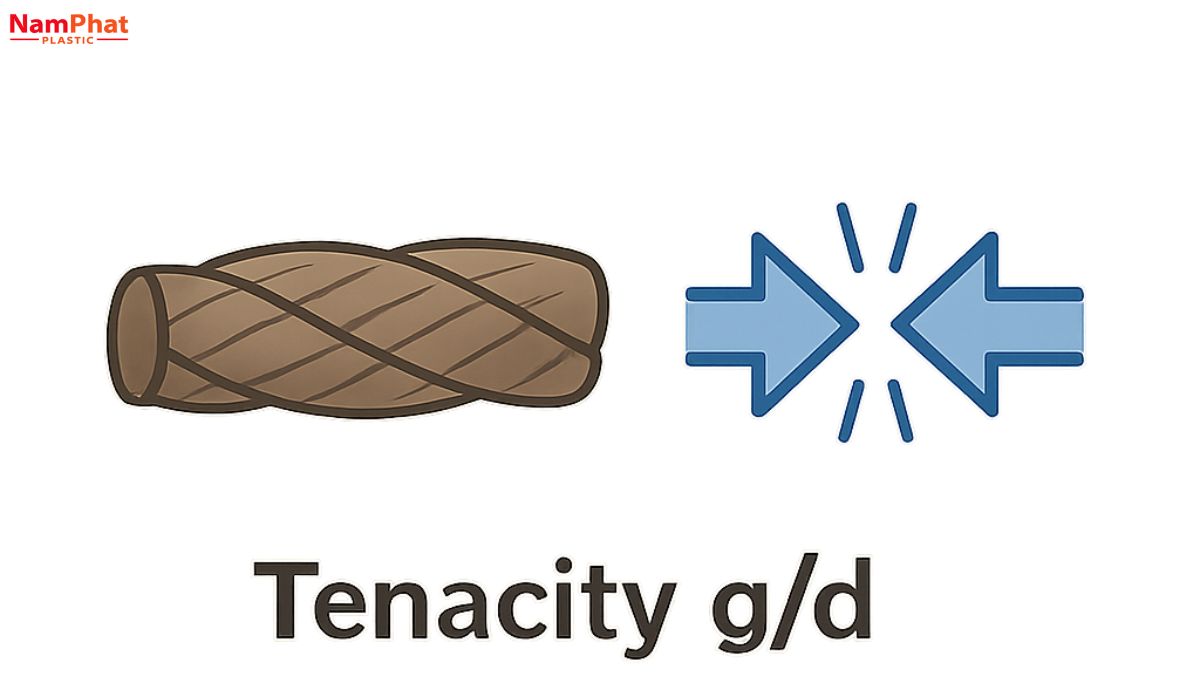
Tenacity g/d – an indicator for evaluating the relative tensile strength of yarn
2. Tenacity calculation formula
To accurately evaluate yarn tensile strength, Tenacity is calculated based on the relationship between breaking force and the linear density of the yarn. This formula eliminates the influence of yarn size, thereby providing a more accurate representation of the material's load-bearing capability. It is also a commonly used calculation method in the textile and technical yarn industries.
Tenacity calculation formula:
Tenacity (g/d or g/den) = Breaking Force (gf) / Denier
Where:
- Breaking Force: The maximum force that the yarn can withstand before breaking. This value is commonly measured in gram-force (gf), Newton (N), or centiNewton (cN).
- Denier (D): A unit of linear density defined as the mass, in grams, of 9,000 meters of yarn. It is commonly used to calculate and express Tenacity in g/d.
In addition to g/d, many international technical documents use the SI-based unit cN/dtex. The corresponding formula is:
Tenacity (cN/dtex) = Breaking Force (cN) / dtex
Here, cN (centiNewton) is a unit of force and dtex is a unit of linear density in the SI system. The use of g/d or cN/dtex depends on the applicable testing standard and the technical documentation provided by each manufacturer. Some commonly used conversions include:
- 1 N ≈ 101.97 gf
- 1 g/d ≈ 0.883 cN/dtex
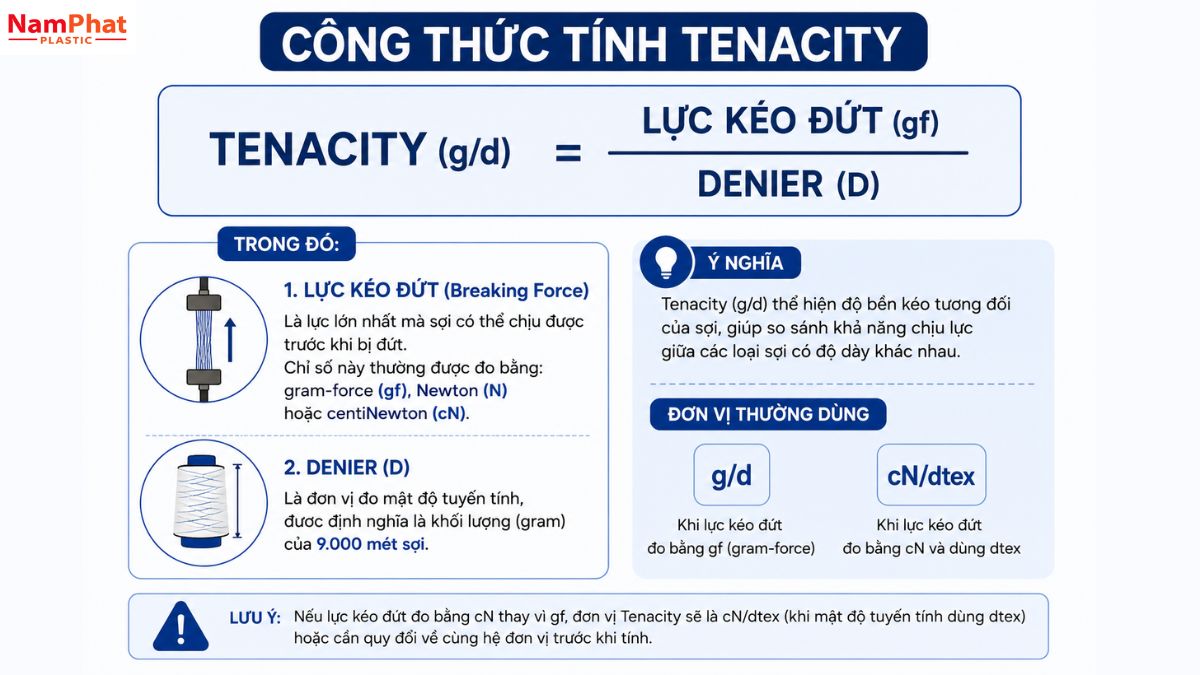
Tenacity calculation from breaking force and linear density
3. Tenacity khác gì với lực kéo (Breaking Force)?
Tenacity and Breaking Force are both indicators used to evaluate the load-bearing capability of yarn, but they reflect two different aspects. Breaking Force indicates the maximum force that a yarn can withstand before breaking, while Tenacity is normalized according to linear density to evaluate the mechanical performance of the material. The table below helps distinguish these two concepts.
| Criterion | Tenacity | Breaking Force |
| Definition | Relative tensile strength of yarn per unit of linear density. | Maximum force that the yarn can withstand before breaking. |
| Unit | g/d, cN/dtex | gf, N, or cN |
| Meaning | Evaluates the mechanical performance and material quality of the yarn. | Evaluates the load-bearing capability of a specific yarn sample. |
| Does it depend on thickness? | Tenacity is normalized by Denier or dtex, making it suitable for comparing the mechanical performance of yarns with different sizes. However, Denier and Breaking Force should still be considered when evaluating an actual product. | Yes. A thicker yarn generally withstands a greater pulling force. |
| When is it used? | When comparing the quality of yarns with different sizes. | When determining the maximum load that a yarn or product can withstand. |
| Example | Two 500D and 1000D yarns can have the same Tenacity of 7 g/d if their material quality is equivalent. | A 1000D yarn generally has a higher Breaking Force than a 500D yarn because it has a larger size. |
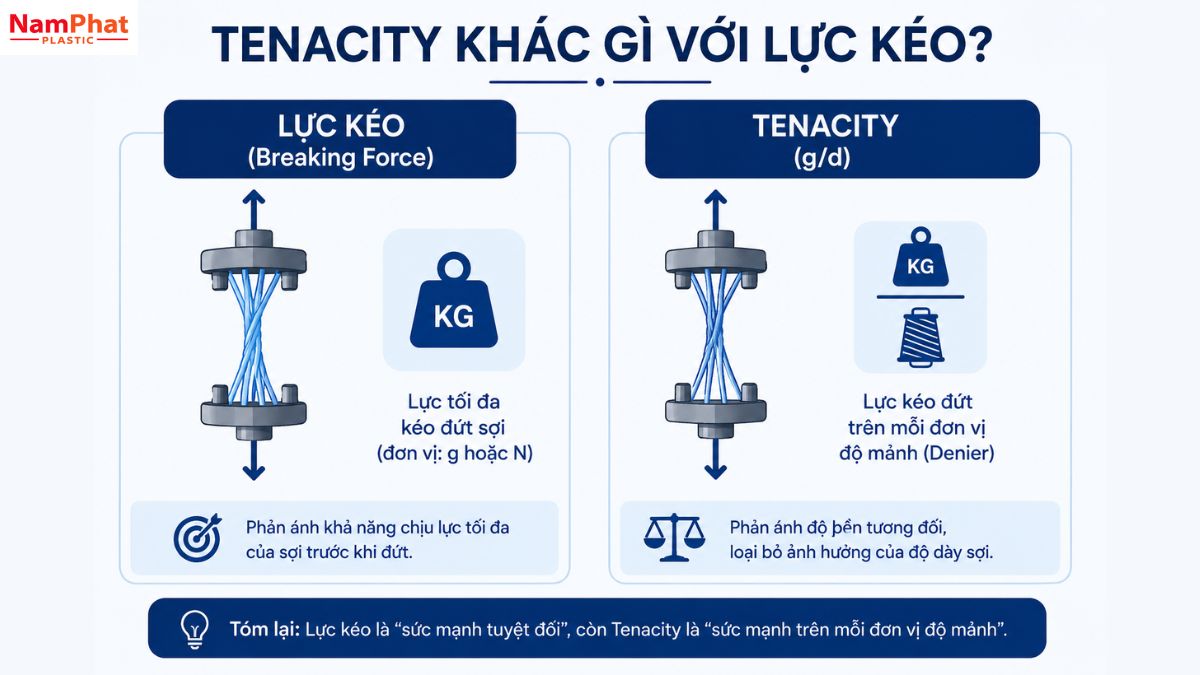
Difference between tenacity and breaking force of yarn
4. How to understand tenacity in practice
Tenacity can be a relatively abstract technical indicator if you only look at the g/d number. The following examples and analysis help you understand how to read and evaluate Tenacity when selecting materials.
4.1. Why can two yarns have different breaking forces but the same tenacity?
This is a situation that often causes confusion when reading yarn specifications. For example, a 500D yarn may have a breaking force of approximately 3,500 g, while a 1000D yarn may withstand approximately 7,000 g. Although the 1000D yarn has twice the breaking force, if both have a Tenacity of 7 g/d, this indicates that their material quality and load-bearing capability per unit of Denier are equivalent. The difference in breaking force mainly comes from the larger size and mass of the 1000D yarn.
4.2. Is higher tenacity always better?
Not necessarily. Higher Tenacity means better tensile performance, but it is not always the optimal choice for every application. In practice, a quality product also needs a balance between tensile strength, elongation, flexibility, abrasion resistance, and service life. If the focus is only on increasing Tenacity while ignoring other properties, the yarn may become stiffer, less flexible, or unsuitable for the technical requirements of the application.
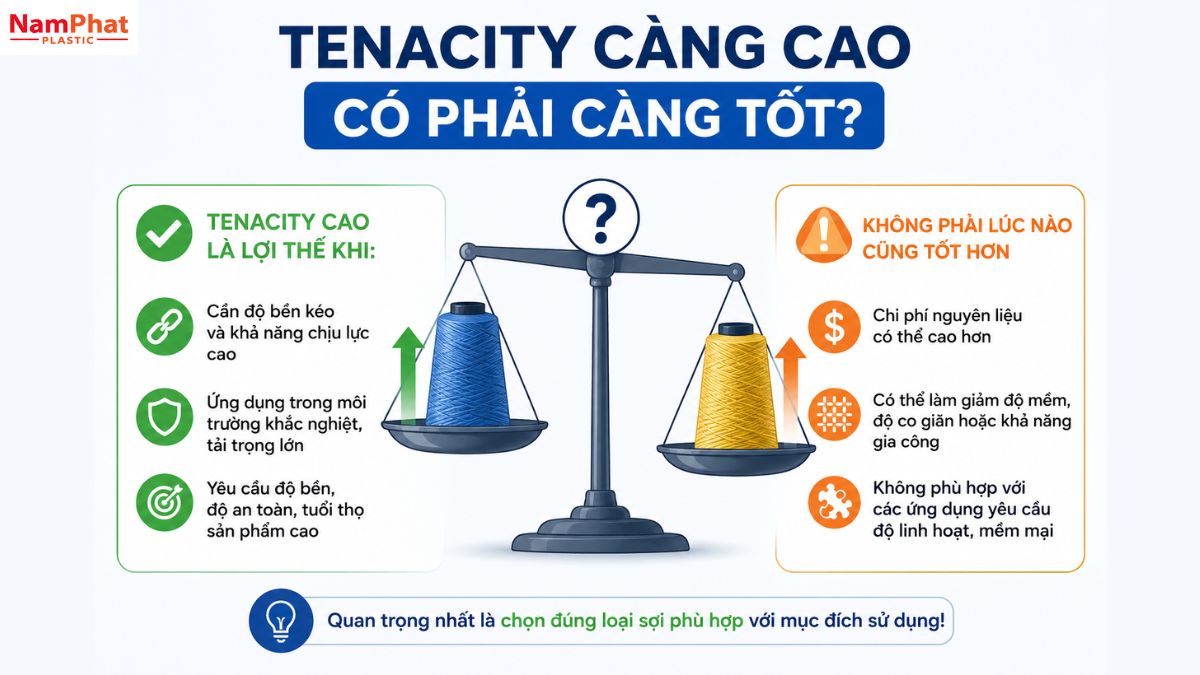
Relationship between tenacity and the practical performance of different yarn types
4.3. Example with PP multifilament yarn
For example, a PP multifilament yarn has a Denier of 1000D and a Tenacity of 7 g/d. Its theoretical Breaking Force is:
Breaking Force = Tenacity × Denier = 7 × 1000 = 7,000 gf
Converted to the SI system:
7,000 gf ≈ 68.6 N
This example shows that even with the same Tenacity, changing the Denier will result in a corresponding change in Breaking Force. Therefore, in practice, both Tenacity and Denier should be considered rather than looking at only one specification.
Practical purchasing situation: Two suppliers offer 1000D PP multifilament yarn, but one states a Tenacity of 6.5 g/d while the other achieves 7.2 g/d. Instead of comparing only the Tenacity value, the buyer should also ask about testing conditions, Elongation, Denier tolerance, and the applicable testing standard to accurately assess product quality.
4.4. Common mistakes when reading a TDS
Some common mistakes when reading a Technical Data Sheet (TDS) include:
- Confusing Tenacity (g/d) with load-bearing capacity in kilograms.
- Confusing Tenacity with Breaking Force.
- Comparing two yarns without checking the testing standard.
- Focusing only on tensile force while ignoring Elongation and other mechanical properties.
- Failing to verify the actual Denier before evaluating yarn quality.
5. Common tenacity levels of different yarn types
Each yarn type has a different polymer structure and manufacturing process, so its Tenacity is also different. In practice, Tenacity depends on the raw material grade, yarn production technology, and intended application. The following table provides reference Tenacity ranges for several common industrial yarns to give you a general basis for comparison and material selection.
| Yarn type | Reference Tenacity |
| PP multifilament | 5–8 g/d |
| Polyester (PET) | 6–9 g/d |
| Nylon (PA 6/PA 66) | 7–10 g/d |
| UHMWPE | 30–45 g/d |
| Aramid (Kevlar®, Twaron®...) | 20–28 g/d |
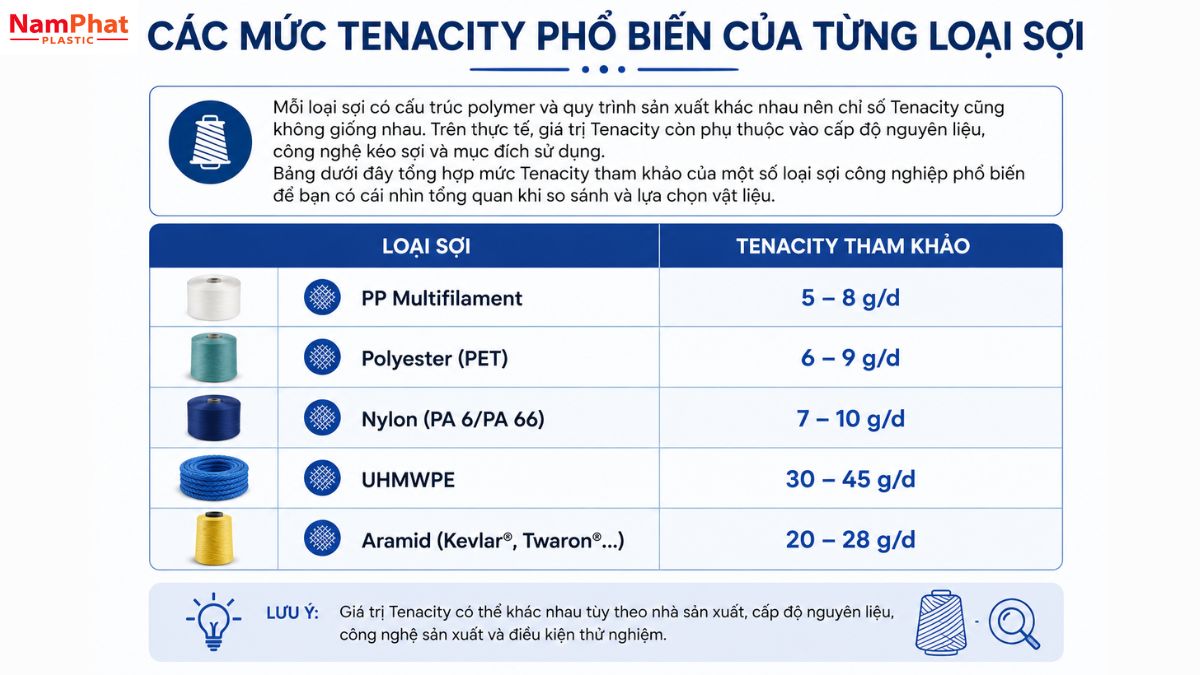
Reference Tenacity levels of common industrial yarns
Note: The values in the table are for reference only. Actual Tenacity may vary depending on the manufacturer, raw material grade, yarn production technology, molecular orientation, testing standard such as ASTM D2256/D2256M or ISO 2062, and testing conditions. Therefore, this table should not be used to make an absolute assessment of yarn quality.
6. Factors affecting tenacity
From the nature of the polymer and yarn production technology to testing conditions, many factors can significantly affect this indicator. Understanding these factors helps businesses optimize production processes and accurately evaluate material performance before application.
6.1. Polymer type
The nature of the polymer is an important factor determining yarn Tenacity. Each material has a different molecular structure, degree of crystallinity, and molecular orientation, resulting in different tensile strength. For example, PP (Polypropylene) typically has a Tenacity of approximately 5–8 g/d, PET (Polyester) around 6–9 g/d, Nylon around 7–10 g/d, while UHMWPE and Aramid can exceed 20–40 g/d due to their special molecular structures and very high molecular orientation.
6.2. Yarn drawing process
After the yarn is formed, the Drawing process helps polymer chains align in the same direction, increasing the load-bearing capability of the yarn. The higher the degree of molecular orientation, the greater the Tenacity. At the same time, the crystallinity of the material also directly affects tensile strength because crystalline regions make the yarn stiffer and better able to withstand loads.

Drawing process helps increase molecular orientation and yarn Tenacity
6.3. Additives during production
Additives incorporated during production can also affect yarn Tenacity. Certain heat stabilizers, UV stabilizers, or mechanical reinforcement additives help the yarn maintain its strength in demanding environments. However, if the additive content is too high or unsuitable, it may reduce bonding between polymer chains and negatively affect tensile strength.
6.4. Testing conditions
Tenacity values are meaningful only when measured according to the same testing standard. Standards such as ASTM D2256/D2256M or ISO 2062 specify conditions including temperature, humidity, specimen length, gauge length, and pulling speed. When comparing two yarn samples from different suppliers, it is important to ensure that they are tested according to the same standard; otherwise, the results may not accurately reflect differences in material quality.
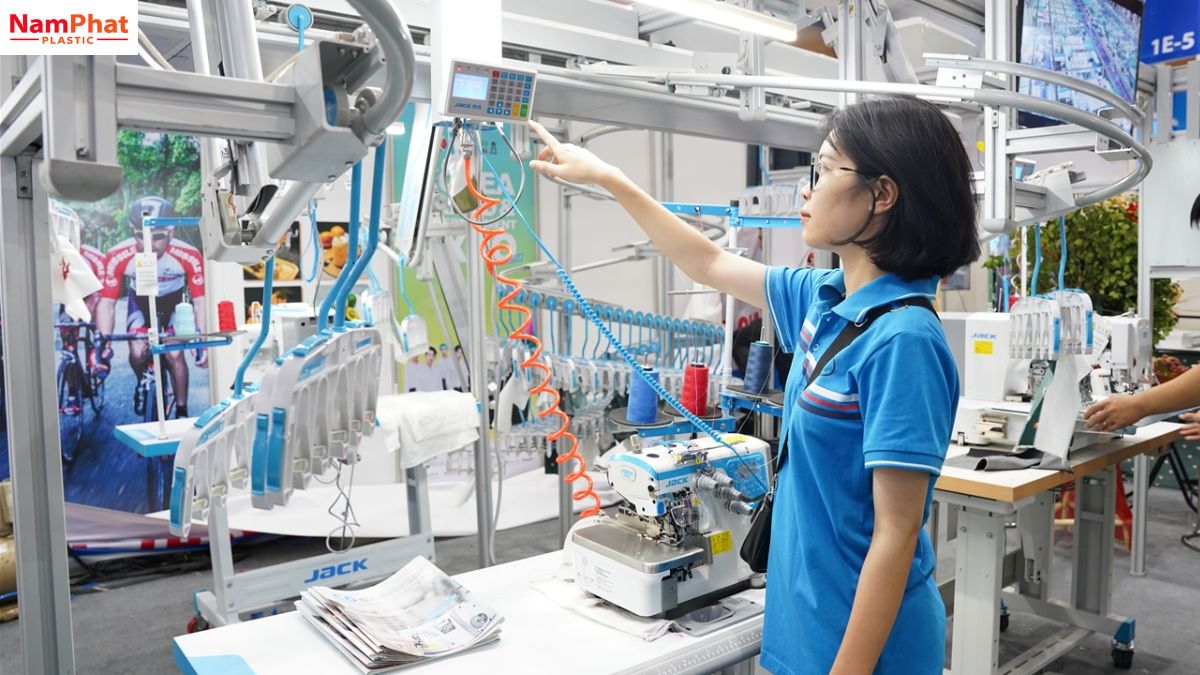
Factors such as temperature, humidity, and pulling speed affect Tenacity test results
7. How is tenacity applied?
Tenacity is widely used in yarn design, production, and quality control. This indicator helps manufacturers evaluate the load-bearing capability of materials, select yarn types according to specific technical requirements, and ensure that products meet standards for strength, safety, and service life.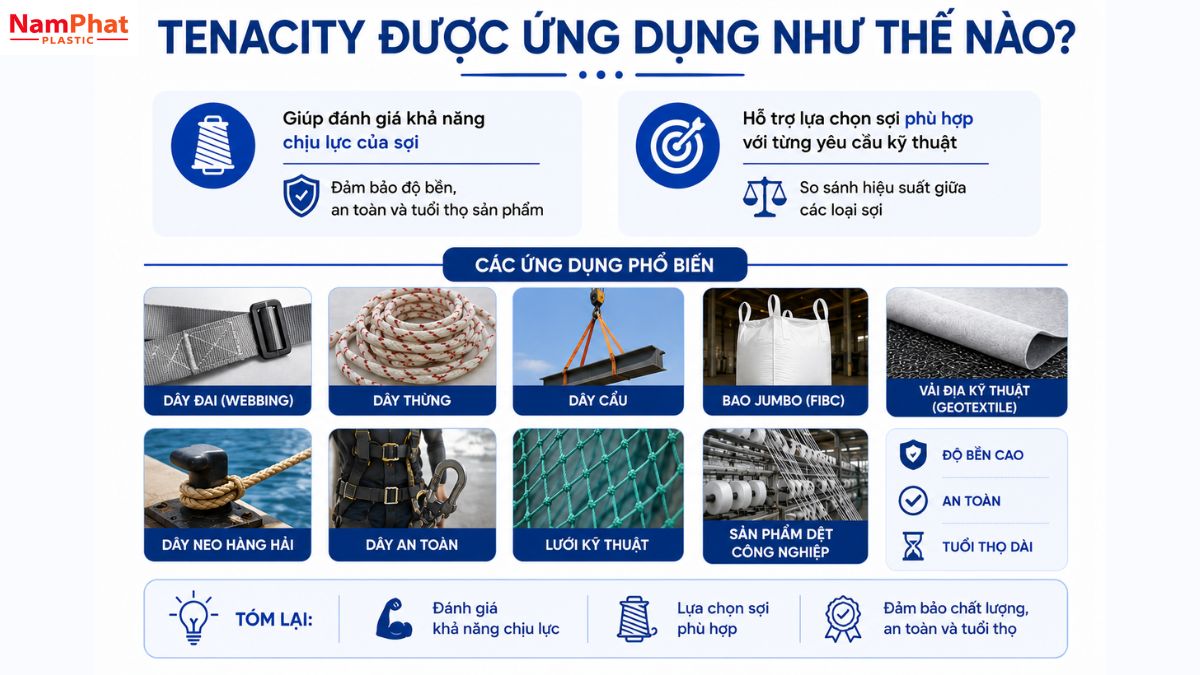
Applications of Tenacity in production
In practice, Tenacity is an important specification in many fields, including webbing, ropes, lifting slings, Jumbo bags (FIBC), geotextiles, marine mooring ropes, safety ropes, technical nets, and industrial textile products. The indicator is also used to compare the performance of yarns such as PP, Polyester, Nylon, UHMWPE, and Aramid in order to select the appropriate material for each application.
From a factory perspective when selecting PP yarn, Tenacity is only one of many specifications that should be evaluated. When selecting PP multifilament yarn, businesses commonly consider actual Denier, Tenacity, Breaking Force, Elongation, filament count, yarn evenness, Shrinkage, UV stabilizers, color, and testing conditions at the same time. A comprehensive evaluation helps businesses choose the right yarn for each application instead of focusing only on Tenacity. Before selecting industrial yarn, buyers should request the supplier to provide the following information:
- Actual Denier
- Tenacity
- Breaking Force
- Elongation
- Testing standard (ASTM D2256/D2256M or ISO 2062)
- COA or Technical Data Sheet (TDS)
- Recommended applications for each yarn type
Frequently asked questions about tenacity g/d
When learning about what Tenacity g/d is and how to understand tensile strength in practice, many people wonder how to evaluate this indicator and what it means in real-world applications. Below are some common questions and concise answers to help you understand Tenacity correctly and avoid confusion when reading yarn specifications.
How much tenacity is considered good?
There is no single Tenacity value that can be considered "good" for every type of yarn. The appropriate value depends on the material and intended application. For example, PP yarn commonly achieves around 5–8 g/d, while UHMWPE can reach 30–45 g/d due to its special molecular structure.
Can g/d be converted to MPa?
g/d cannot be directly converted to MPa because the two units measure different quantities. g/d represents tensile strength relative to the linear density of yarn, while MPa represents stress per unit cross-sectional area. Additional information about yarn dimensions and cross-sectional area is required for conversion.
Why does PP have lower Tenacity than UHMWPE?
UHMWPE has extremely long polymer chains and a high degree of molecular orientation, allowing it to withstand much higher loads than PP. PP has a simpler molecular structure, resulting in lower Tenacity, although it still performs well in many common industrial applications.
Does higher Denier mean higher Tenacity?
No. Denier only reflects the thickness or mass of the yarn, while Tenacity represents its load-bearing capability per unit of Denier. Therefore, a yarn with a higher Denier does not necessarily have higher Tenacity if the material quality is poor.
Are ASTM and ISO Tenacity tests different?
Yes. Both ASTM and ISO provide methods for testing Tenacity, but they may differ in testing conditions such as specimen length, pulling speed, temperature, or humidity. Therefore, when comparing results, it is important to ensure that the samples were tested according to the same standard.
Should you look only at Tenacity when selecting yarn?
No. Tenacity only reflects the tensile performance of the material per unit of linear density. To fully evaluate yarn quality, you should also consider Denier, Breaking Force, Elongation, yarn evenness, testing conditions, and the technical requirements of the actual application.
Understanding Tenacity g/d correctly not only helps you read technical specifications accurately but also provides a basis for evaluating the quality and performance of different yarns in practical applications. Hopefully, this article has answered the question "What is Tenacity g/d? How to understand tensile strength in practice?" and provided you with a better basis for selecting the right yarn for your needs.
- 0 Comment


