


 Phan Van Hoang
- 22/07/2026
- 324
When selecting PP multifilament yarn, many people only pay attention to the total denier, such as 600D, 900D, or 1200D. However, two yarns with the same total denier do not necessarily provide the same feel, strength, or processing performance.
One commonly overlooked specification is the number of filaments, represented by the letter F. For example, 600D/60F and 600D/120F both have a nominal total fineness of 600 denier, but their internal structures are completely different. 600D/60F consists of 60 relatively thick filaments, while 600D/120F is made up of 120 finer filaments.
This difference can affect:
- Yarn softness and flexibility;
- Breaking force and tenacity;
- Abrasion resistance;
- The tendency of filaments to fray or separate;
- Unwinding stability;
- Running performance on weaving, twisting, braiding, and other high-speed processing machines.
However, the number of filaments cannot be evaluated independently. To select the right yarn, buyers need to consider the total denier, number of filaments, denier per filament, twist, finish oil, and quality of the yarn drawing process at the same time.
Table of Contents [Hide]
1. What is a filament?
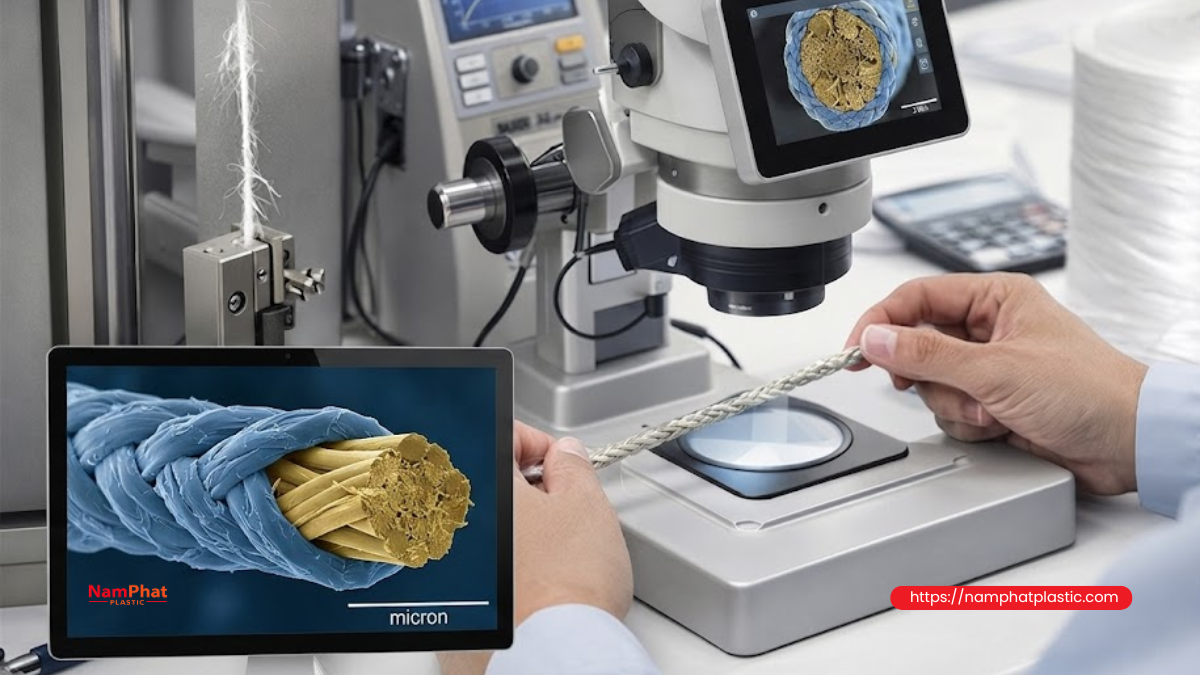
A filament is a continuous single strand formed when molten plastic passes through an opening in a spinneret. Multiple filaments gathered together form multifilament yarn.
Examples:
- 600D/60F: total yarn count of 600 denier, consisting of 60 filaments;
- 600D/120F: total yarn count of 600 denier, consisting of 120 filaments;
- 900D/100F: total yarn count of 900 denier, consisting of 100 filaments;
- 1200D/144F: total yarn count of 1200 denier, consisting of 144 filaments.
In yarn specifications, the number of filaments is often listed together with linear density, twist, and the number of yarn plies. This information allows buyers to understand not only the mass per unit length but also the internal structure of the yarn bundle.
2. What is DPF? Why is DPF more important than simply looking at the number of filaments?
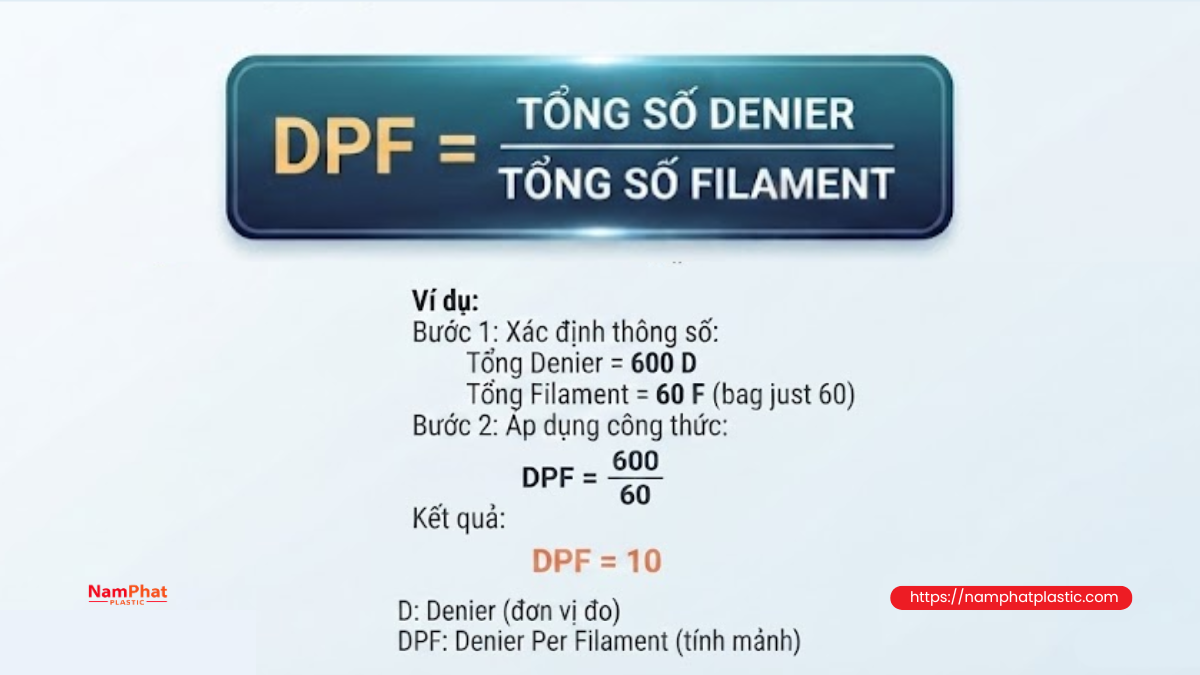
To accurately evaluate the effect of the number of filaments, it is necessary to calculate DPF – Denier Per Filament, which refers to the denier of each individual filament.
Formula:
- DPF = Total denier ÷ Number of filaments
For example, with 600D yarn:
| Specification | Total denier | Number of filaments | DPF |
| 600D/60F | 600D | 60 | 10 |
| 600D/120F | 600D | 120 | 5 |
| 600D/180F | 600D | 180 | 3,33 |
Therefore, when the total denier remains constant:
- The higher the number of filaments, the finer each filament becomes;
- The lower the number of filaments, the larger each filament becomes;
- A lower DPF generally produces a softer and more flexible yarn bundle;
- A higher DPF generally creates a firmer, stiffer feel with a more defined structure.
This is why buyers should not conclude that “yarn with more filaments is always better.” A 900D/144F yarn cannot be directly compared with 600D/120F simply based on 144F versus 120F. The first step is to convert them to DPF.
3. Two cases that must be distinguished when increasing the number of filaments
Case 1: Keeping the total denier constant
For example, compare:
- 600D/60F;
- 600D/120F;
- 600D/180F.
The total amount of material per unit length remains approximately unchanged. Increasing the number of filaments mainly makes each individual filament finer.
In this case, the most noticeable changes are usually related to:
- Softness;
- Flexibility;
- Surface area;
- Filament separation;
- Sensitivity to friction and finish oil.
Case 2: Increasing the number of filaments while also increasing the total denier
For example, compare 600D/60F with 1200D/120F.
Here, the number of filaments doubles, but the DPF remains 10. The total cross-sectional area and amount of raw material in the yarn also increase approximately twofold.
The breaking force of 1200D yarn may be significantly higher, but the main reason is that the yarn has a higher total denier, not simply because it contains more filaments.
Therefore, when studying the specific effect of filament count, the total denier should be kept approximately constant.
4. How does the number of filaments affect softness?
4.1. More filaments usually make yarn softer when denier remains constant
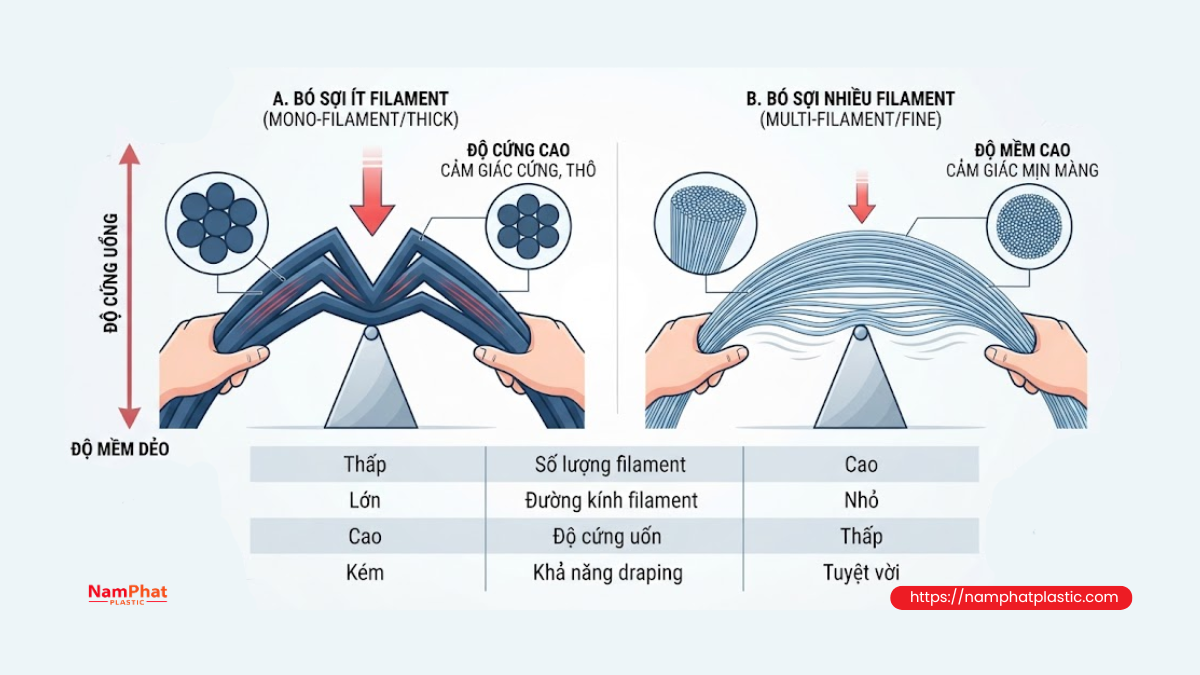
When the total denier remains unchanged, increasing the number of filaments reduces the diameter of each individual filament. Fine filaments can bend more easily around pulleys, yarn guides, and product surfaces.
A bundle consisting of many fine filaments can deform more flexibly than a bundle consisting of fewer, larger filaments. As a result, the yarn generally has:
- A softer hand feel;
- Better drape and surface conformity;
- Greater flexibility when tying knots;
- Better ability to bend around components with small radii;
- A smoother finished surface with less of a rough or stiff feel.
Technical literature on multifilament yarns also indicates that smaller filament diameters reduce bending stiffness and create more flexible products compared with structures consisting of larger filaments. Studies on DPF show that filament fineness has a clear influence on mechanical properties at low loads and on the surface feel of textile materials.
4.2. Fewer filaments usually create a firmer and stiffer feel
With the same total denier, yarn with fewer filaments has a higher DPF. Each filament is larger and more difficult to bend, which can make the entire yarn bundle:
- Stiffer;
- Better at maintaining its shape;
- Less likely to flatten under light compression;
- More structurally defined on the finished surface;
- Firmer rather than soft.
This characteristic is not necessarily a disadvantage. For certain types of cords, nets, industrial fabrics, or products requiring greater body and stiffness, a moderately higher DPF may be more suitable than an overly soft yarn.
4.3. More filaments do not necessarily mean a yarn is always more porous
Yarn bulkiness and porosity also depend on:
- Twist;
- Interlace or air entanglement;
- Filament cross-sectional shape;
- Thermal shrinkage;
- Texturing process;
- Tension during winding;
- Compactness of the yarn package.
A high-filament yarn can still become stiff if it is tightly twisted. Conversely, a low-filament yarn with low twist and a more open structure can remain relatively soft.
5. How does the number of filaments affect strength?
This is the section most likely to cause confusion. It is necessary to distinguish between breaking force and tenacity.
5.1. Breaking force
Breaking force represents the total force required to break a yarn specimen, commonly expressed in N or cN.
Yarn with a higher total denier generally has a larger material cross-sectional area and therefore tends to have a higher breaking force when other conditions are equivalent.
5.2. Tenacity
Tenacity is the breaking force normalized by linear density, commonly expressed in cN/tex or g/den.
This parameter is more suitable when comparing yarns with different total deniers. ASTM D2256 also considers breaking force, elongation, and tenacity to be fundamental characteristics for evaluating yarn processing performance and intended applications.
5.3. Increasing the number of filaments does not automatically increase strength
If the total denier remains constant, the total amount of polymer in the yarn does not increase significantly. Therefore, increasing the number of filaments does not directly increase breaking force in proportion to the filament count.
Actual strength also depends on:
- Raw material quality;
- Molecular weight distribution;
- Percentage of recycled material;
- Colorant and additive ratio;
- Extrusion temperature;
- Uniformity of melt flow through each spinneret hole;
- Cooling conditions;
- Draw ratio;
- Heating temperature;
- Molecular orientation;
- Shrinkage;
- Twist;
- Finish oil;
- Degree of filament damage during production.
A yarn with 144 filaments but uneven drawing, weak filaments, or frequent surface damage may have a lower breaking force than a 96-filament yarn manufactured under stable conditions.
5.4. More fine filaments may help distribute load more effectively
When the filaments are highly uniform, a bundle containing many fine filaments can distribute the load across more individual components. If several filaments are damaged, the remaining filaments can continue to carry the load for a certain period.
Fine filaments may also cool and draw more uniformly under certain production conditions. This can potentially improve molecular orientation and yarn uniformity.
However, these benefits only occur when:
- Filament fineness is uniform;
- Tension is distributed relatively evenly;
- The yarn bundle does not separate;
- The oil level is appropriate;
- The drawing process is stable;
- There are not many hidden filament breaks.
5.5. The load carried by individual filaments is never completely equal
In an actual yarn bundle, filaments may differ in:
- Effective length;
- Shrinkage;
- Elongation;
- Molecular orientation;
- Position within the bundle;
- Twist angle;
- Contact with yarn guides.
During tensile loading, some filaments become taut and carry load earlier, while others do not fully participate immediately. Therefore, the breaking force of a multifilament bundle cannot simply be calculated by multiplying the breaking force of one filament by the total number of filaments.
5.6. Twist can change the result
An appropriate level of twist helps gather the filaments, reduce separation, and improve processing stability. However, if the twist is too high:
- Filaments are no longer completely parallel to the load axis;
- The longitudinal force component decreases;
- Internal friction increases;
- The yarn may become stiffer;
- Straight-line breaking force may decrease.
Research on friction between multifilament bundles shows that twist directly affects bundle cohesion, friction, and filament damage mechanisms during processing.
6. How does the number of filaments affect abrasion resistance?
It is not possible to simply conclude that high-F or low-F yarn always has better abrasion resistance. The result depends on the type of friction involved.
When friction breaks individual filaments
Yarn with many fine filaments has a larger total surface area and more components in contact with surrounding surfaces. If the yarn bundle is not properly consolidated, the outer filaments may:
- Become scratched;
- Separate from the bundle;
- Form fuzz;
- Wear locally;
- Become caught in yarn-guide gaps;
- Break individually.
This is one reason why yarn may appear intact while its surface has already developed fibers, fraying, or white fuzz.
When the yarn must bend around small pulleys
Larger filaments have greater bending stiffness and may therefore experience higher bending stress when passing through:
- Small ceramic guides;
- Small-diameter pulleys;
- Large changes in direction;
- Bent or sharply angled yarn paths.
In this situation, yarn with more fine filaments is generally more flexible and can adapt better to the machine path.
Role of finish oil
Finish oil helps:
- Reduce yarn-to-metal friction;
- Reduce yarn-to-yarn friction;
- Control static electricity;
- Consolidate the filament bundle;
- Reduce fuzz formation;
- Stabilize yarn tension during unwinding.
As the number of filaments increases and DPF decreases, the total surface area of the yarn bundle generally increases. Therefore, the same nominal oil ratio does not necessarily provide equivalent lubrication.
If the oil level is too low or unevenly distributed, high-filament yarn may become more sensitive to scratching and static electricity. Conversely, excessive oil can cause slippage, dust accumulation, deposits on yarn guides, or problems in subsequent processing.
7. Effects on machine running performance at the yarn manufacturing plant
7.1. Spinning process
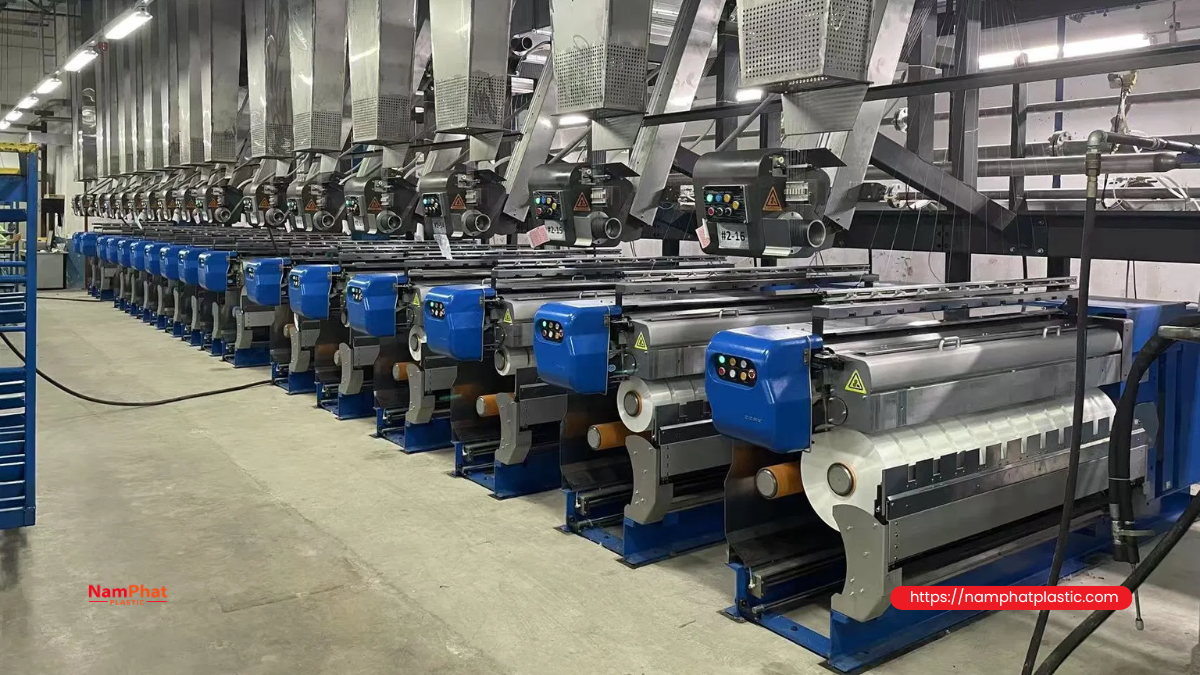
Increasing the number of filaments generally means using more spinneret holes or smaller-diameter holes.
This places greater demands on:
- Cleanliness of the plastic resin;
- Melt filtration capability;
- Temperature uniformity;
- Extrusion pressure;
- Spinneret cleanliness;
- Flow balance through individual holes.
Even a small number of clogged or low-flow spinneret holes can produce abnormally fine filaments, filament breaks, or differences in drawing behavior within the yarn bundle.
7.2. Cooling process
The filaments need to be cooled sufficiently and uniformly before being gathered into a bundle. If the airflow is unstable:
- Filaments on the sides may cool differently from those in the center;
- The yarn bundle may vibrate;
- Filaments may stick together;
- Linear density may vary between filaments;
- The downstream drawing process may become unstable.
As the number of filaments increases, controlling airflow, cooling distance, and yarn gathering position becomes increasingly important.
7.3. Drawing process
The strength of PP multifilament yarn depends significantly on molecular orientation during drawing. If filament dimensions are inconsistent, fine filaments may be over-drawn while larger filaments are not drawn sufficiently.
Potential consequences include:
- Breakage of fine filaments;
- Uneven elongation between filaments;
- Fluctuation in breaking force;
- Local weak points in the yarn;
- Increased breakage frequency at high machine speeds.
7.4. Oil application process
High-filament yarn requires careful control of:
- Oil concentration;
- Oil supply rate;
- Stability of the oiling roller;
- Oil penetration and distribution;
- Cleanliness of the solution;
- Long-term consistency.
Do not only check the total amount of oil relative to yarn weight. Also observe fuzzing, static electricity, dust accumulation, and the condition of yarn guides after prolonged running.
7.5. Yarn winding process
Fine, high-filament yarn can be sensitive to winding tension and package surface conditions.
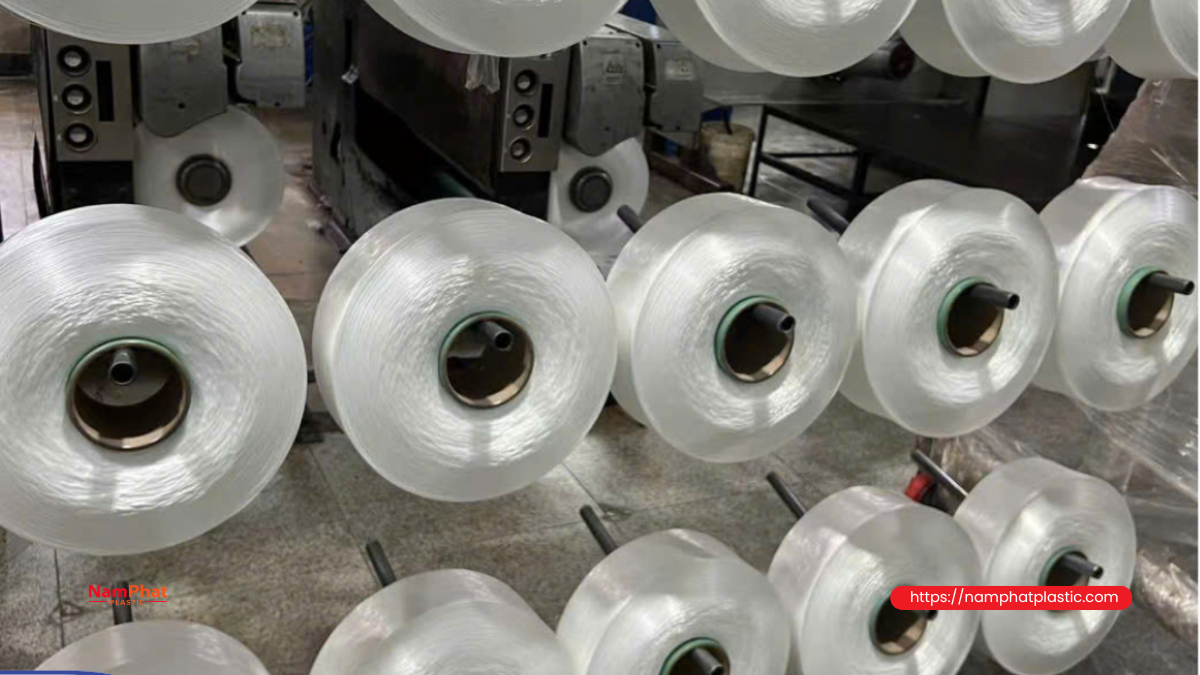
If the tension is too low:
- The yarn bundle may loosen;
- The package becomes soft;
- Yarn layers may slip;
- Unwinding becomes unstable.
If the tension is too high:
- Filaments may become compressed;
- Yarn softness may decrease;
- The package becomes excessively hard;
- Unwinding force increases;
- Internal filaments may become additionally stretched.
Therefore, increasing the number of filaments may sometimes require adjustments to winding tension, winding angle, traverse speed, and contact pressure of the winding system.
8. Effects on twisting, braiding, and weaving machines used by customers
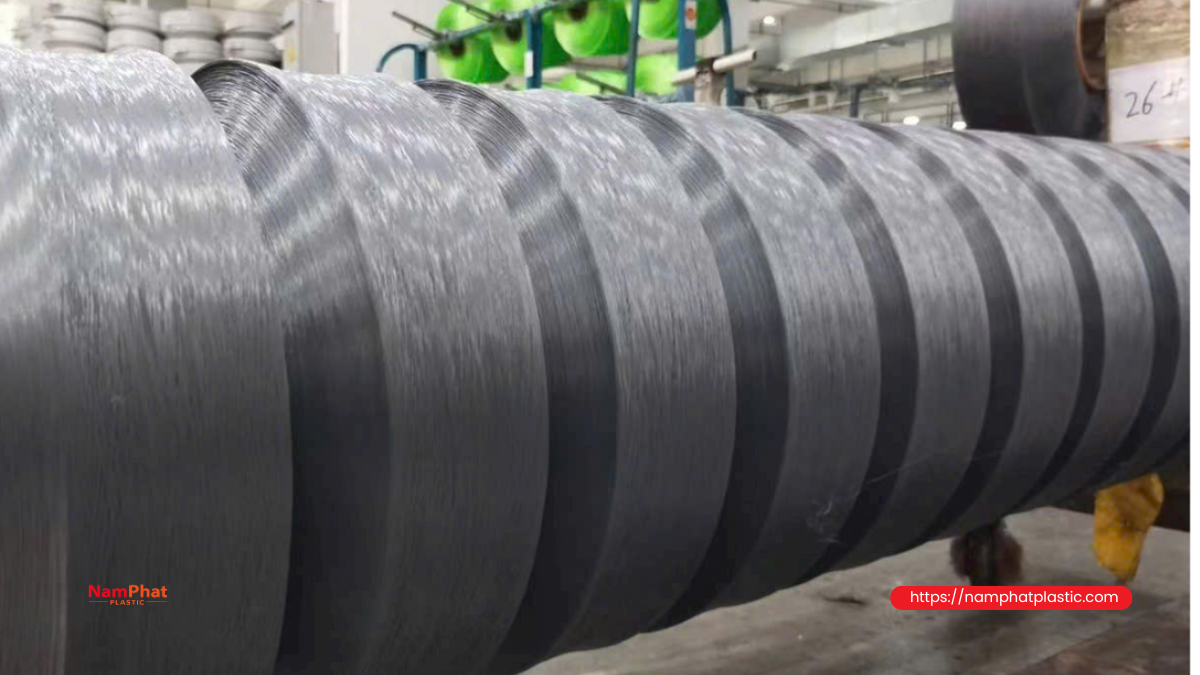
8.1. On twisting machines
High-filament yarn with low bundle cohesion may separate before entering the twisting zone. Loose filaments can become wrapped around:
- Yarn guides;
- Rotating shafts;
- Pulleys;
- Tension devices;
- Bobbin edges.
An appropriate pre-twist, air entanglement, or finish-oil formulation can help improve running stability.
Low-filament yarn is generally easier to observe and less prone to filament separation, but if the filaments are too large, the yarn bundle may become stiff, making it difficult to follow the yarn path and potentially causing vibration as speed increases.
8.2. On braiding machines
Braiding machines typically involve repeated changes in direction and continuous bobbin movement. The yarn is subjected simultaneously to:
- Friction;
- Repeated bending;
- Fluctuating tension;
- Impact at yarn guides;
- Centrifugal force.
Low-DPF yarn generally bends well but requires good bundle cohesion to prevent fuzzing. High-DPF yarn may maintain its structure better but requires inspection of pulley radius and yarn-guide angles.
8.3. On weaving machines
For warp yarns, machine running stability is strongly affected by:
- Yarn-to-yarn friction;
- Friction with heddles and reeds;
- Package uniformity;
- Number of interlace points;
- Twist;
- Broken-filament condition;
- Tension variation.
Weaving process simulations indicate that filaments or filament bundles separating from the main yarn body can increase unwinding force, create irregular gaps, and increase the defect rate.
9. Comparison table of low-filament and high-filament yarns with the same total denier
| Criteria | Low filament, high DPF | High filament, low DPF |
| Softness | Generally firmer and stiffer | Generally softer and more flexible |
| Bending ability | Lower | Better |
| Natural bundle cohesion | May be easier to control | May separate more easily if oil or entanglement is insufficient |
| Surface area | Lower | Higher |
| Sensitivity to oil | Generally lower | Generally higher |
| Risk of filament fraying | Fewer components, but larger filaments | May be higher if filaments are not properly consolidated |
| Bending around small pulleys | Can be disadvantageous | Generally more favorable |
| Finished-product feel | Firm, structured, clearly defined | Soft, smooth, better surface conformity |
| Breaking force at the same denier | Cannot be determined from filament count alone | Not automatically higher |
| Production control requirements | Relatively easier | Higher requirements for filtration, airflow, oil, and tension control |
The table above shows common trends rather than absolute rules. Filament cross-sectional shape, twist, crystallinity, elongation, and finish oil can significantly change the results.
10. How should the number of filaments be selected for different requirements?
For products requiring softness and good surface conformity
Consider prioritizing yarn with:
- A higher number of filaments;
- Lower DPF;
- Moderate twist;
- Uniform finish-oil distribution;
- Sufficient bundle cohesion to limit fraying.
This group is suitable for products requiring a soft feel, flexibility, or a smooth surface.
For products requiring stiffness and structural firmness
Consider:
- Medium or higher DPF;
- A moderate number of filaments;
- Appropriate twist;
- Highly uniform filaments;
- Good surface abrasion resistance.
However, excessively high DPF should be avoided if the yarn must continuously pass through small pulleys or sharply angled yarn paths.
For products running on high-speed machines
Do not simply specify “more filaments.” A complete set of specifications should be considered, including:
- Stable total denier;
- Appropriate filament count and DPF;
- Breaking force;
- Elongation;
- Variation in breaking force;
- Number of broken filaments per unit length;
- Bundle cohesion;
- Friction coefficient;
- Oil ratio;
- Unwinding force;
- Package quality.
In actual production, the best-running yarn is not necessarily the yarn with the highest number of filaments. Instead, it is usually the yarn that achieves the best balance between softness, bundle cohesion, filament strength, and friction.
11. What specifications should be included on a PP multifilament yarn technical data sheet?
A complete technical data sheet should include:
- Raw material type: virgin PP, recycled PP, or a blend;
- Color;
- Total denier or dtex;
- Number of filaments;
- DPF;
- Average breaking force;
- Tenacity;
- Elongation at break;
- Denier coefficient of variation;
- Breaking-force coefficient of variation;
- Thermal shrinkage;
- Twist;
- S or Z twist direction;
- Finish-oil ratio;
- Number of interlace points, if applicable;
- Package weight;
- Core type;
- Unwinding direction;
- Storage conditions;
- Recommended applications.
Publishing both total denier and filament count helps buyers avoid confusing “larger yarn” with “yarn containing more fine filaments.”
12. How to test and determine the appropriate number of filaments
Because each customer's machine configuration is different, the most reliable method is a controlled trial.
Step 1: Keep the main variables constant
When comparing samples, keep the following constant:
- PP type;
- Color ratio;
- Total denier;
- Twist;
- Package weight;
- Package core;
- Storage conditions;
- Machine speed;
- Yarn path.
Step 2: Change the number of filaments
For example, test three configurations with the same total 600D:
- 600D/60F;
- 600D/120F;
- 600D/180F.
Step 3: Measure key parameters in the laboratory
The following can be tested:
- Actual denier;
- Breaking force;
- Tenacity;
- Elongation;
- Shrinkage;
- Twist;
- Friction coefficient;
- Bundle cohesion;
- Number of broken filaments;
- Uniformity between packages.
ASTM D1907 specifies methods for determining the linear density of yarn from a package, while ASTM D2256 and ISO 2062 are used to determine yarn breaking force and elongation.
Step 4: Run the samples on the actual machine
At minimum, record:
- Number of breaks per shift;
- Number of machine stoppages;
- Amount of yarn fraying;
- Fuzz accumulation around yarn guides;
- Tension fluctuation;
- Unwinding performance;
- Defect rate;
- Maximum sustainable speed;
- Finished-product surface quality.
A sample with the highest laboratory breaking force is not necessarily the sample that delivers the highest production efficiency. In many cases, a yarn with slightly lower breaking force but less fraying, stable unwinding force, and continuous machine running can result in lower overall production costs.
13. Common mistakes when selecting the number of filaments
Only comparing filament count without comparing total denier
120F is not necessarily finer than 96F. DPF must be calculated before drawing a conclusion.
For example:
- 600D/120F has a DPF of 5;
- 1200D/120F has a DPF of 10.
Both yarns have 120F, but the fineness of each filament differs by a factor of two.
Assuming that more filaments always means higher strength
Strength depends heavily on molecular orientation, drawing quality, uniformity, and the degree of filament damage. Filament count is only one part of the yarn structure.
Only checking average breaking force
Two yarn lots may have the same average breaking force but different levels of variation, resulting in different machine-running performance. A lot with a high breaking-force CV may contain more local weak points and be more prone to unexpected breaks.
Failing to check hidden filament breaks
Some filaments may already be broken while still remaining attached to the main yarn body. A tensile tester may not fully reflect this condition, while on weaving or braiding machines, the broken filament ends can separate and become caught in yarn guides.
Using the same oil formulation for every filament count
As DPF changes, surface area and oil distribution also change. The oil formulation, concentration, or supply rate may therefore need to be adjusted.
14. Conclusion
The number of filaments has a clear effect on the softness, flexibility, friction, and processing performance of PP multifilament yarn. When the total denier remains constant, increasing the filament count reduces DPF, generally making the yarn softer and easier to bend. However, the yarn bundle may also become more sensitive to finish oil, static electricity, scratched yarn guides, and filament separation.
In terms of strength, more filaments do not necessarily mean higher breaking force or tenacity. The result also depends on raw material quality, cooling conditions, draw ratio, filament uniformity, twist, and the degree of damage during production.
Therefore, when selecting yarn, businesses should evaluate the following together:
Total denier – number of filaments – DPF – breaking force – elongation – twist – finish oil – bundle cohesion – unwinding performance – actual machine trial results.
A suitable filament configuration can not only produce a softer or stronger product but also reduce yarn breaks, machine stoppages, and defects while improving the overall efficiency of the production line.
Frequently asked questions
1. Does a higher filament count always make yarn softer?
Generally, yes, when total denier, raw material, filament cross-sectional shape, and twist are kept constant. As the filament count increases, DPF decreases and each filament becomes easier to bend. However, the yarn can still become stiff if the twist is high or the package is wound too tightly.
2. Is high-filament yarn stronger than low-filament yarn?
This cannot be determined from filament count alone. Total denier, tenacity, elongation, uniformity, and manufacturing quality must also be compared.
3. Is looking only at the 600D specification enough?
No. Two yarns such as 600D/60F and 600D/120F can differ significantly in softness, friction, and machine-running performance. Buyers should ask suppliers to provide both filament count and DPF.
4. Why does high-filament yarn tend to fray more easily?
Because it contains more fine filaments on the surface. If the oil level is insufficient, bundle cohesion is low, yarn guides are scratched, or tension fluctuates, the outer filaments can separate from the bundle more easily.
5. Is low DPF always better for high-speed machines?
No. Low DPF helps the yarn bend more easily, but it also increases the requirements for finish oil, interlace, yarn-guide quality, and static-electricity control.
6. How can I determine which filament configuration is most suitable?
Compare samples with the same total denier and run them on the customer's actual machine. The most important criteria are not simply whether the filament count is high or low, but the number of breaks, productivity, defect rate, and finished-product quality.
See also:
- 0 Comment


