


 Phan Van Hoang
- 29/07/2026
- 163
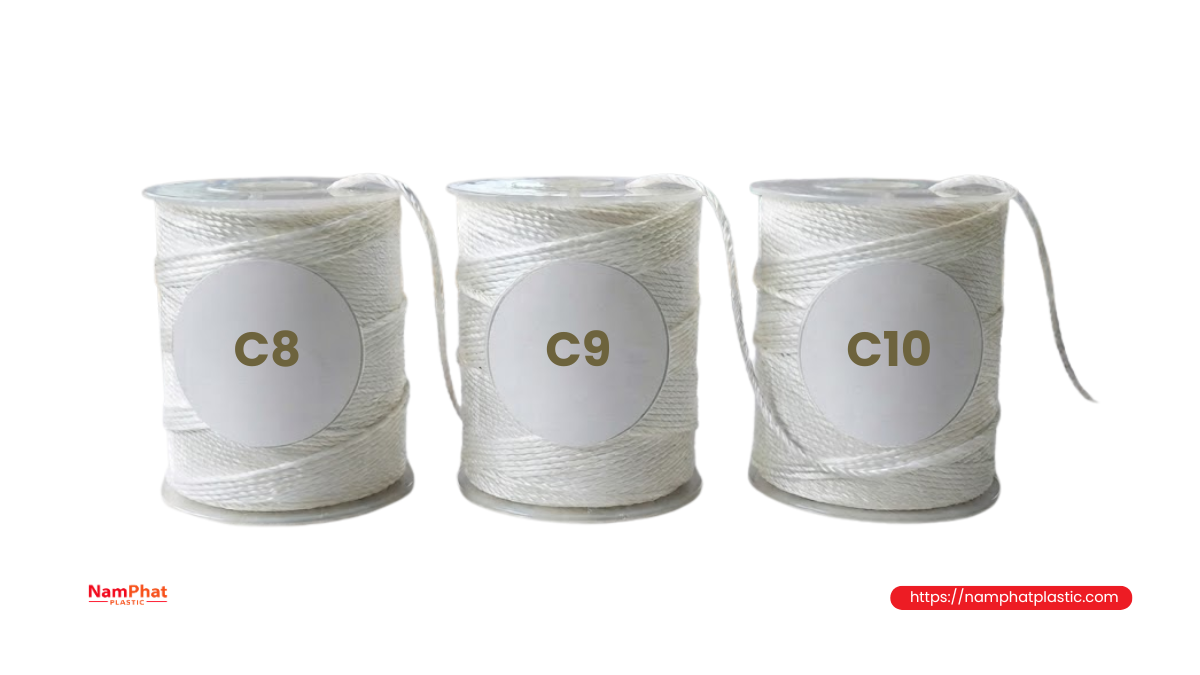
When buying bag sewing thread, customers often come across names such as PE C8, PE C9, or PE C10. Many people assume these are three different raw materials or that C10 is always better than C8. In reality, the main difference lies in the number of single yarns plied and twisted together to form the finished thread.
According to common market terminology:
- PE C8 bag sewing thread usually corresponds to 20/8.
- PE C9 bag sewing thread usually corresponds to 20/9.
- PE C10 bag sewing thread usually corresponds to 20/10.
Therefore, the numbers 8, 9, and 10 do not indicate quality grades but the number of component yarns combined. The greater the number of component yarns, the larger and heavier the finished thread generally is, with higher load-bearing potential. However, actual thread strength also depends on the raw material, twist level, uniformity, twisting technology, and how the thread is used on the machine. The C8–C10 naming is widely used in bag sewing thread transactions in Vietnam, while full technical specifications are usually listed as 20/8, 20/9, or 20/10.
Table of Contents [Hide]
1. What is PE bag sewing thread?
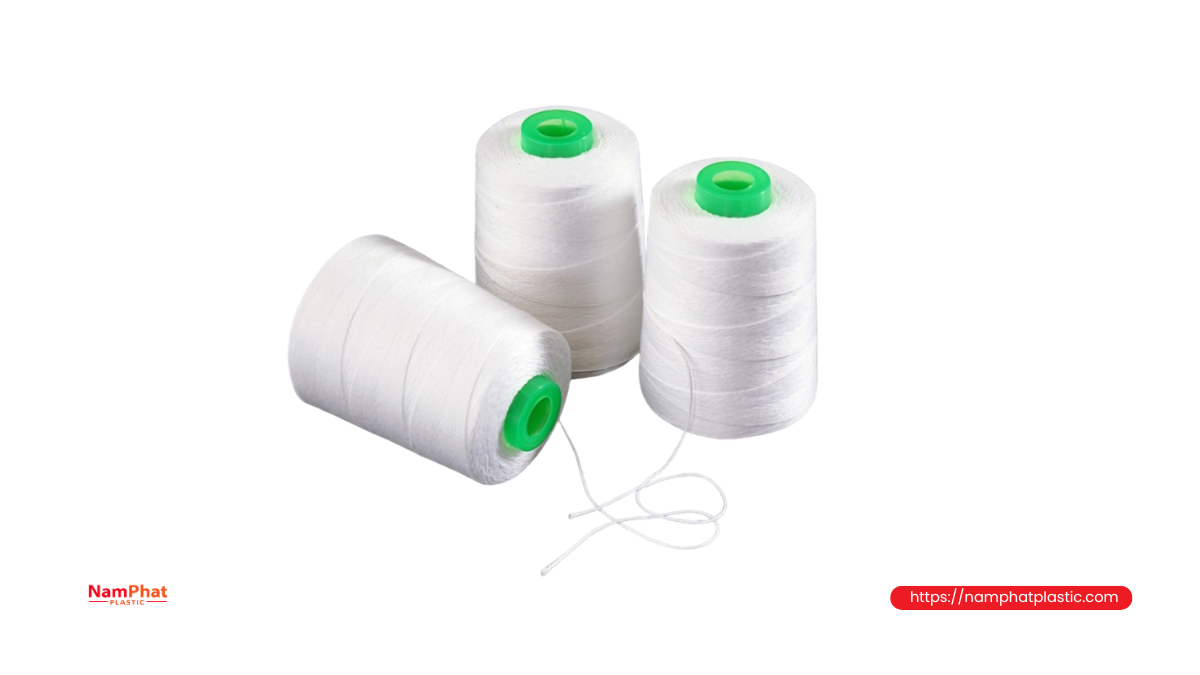
In the bag sewing thread industry in Vietnam, “PE thread” is commonly a commercial term for thread made from spun polyester fibers, followed by plying, twisting, surface treatment, and winding into spools.
It should be noted that “PE” in this terminology should not simply be understood as polyethylene plastic used to produce plastic bags. When preparing technical documents or providing specifications to international customers, businesses should clearly state:
- Spun polyester bag closing thread – 20/8, 20/9, or 20/10.
This wording helps avoid confusion between polyester fiber used for sewing thread and polyethylene material used to produce films, bags, or plastic packaging. PE 20/8 and 20/9 threads are used for closing rice bags, agricultural product bags, animal feed bags, and industrial packaging.
A finished bag sewing thread needs to meet multiple requirements at the same time:
- Appropriate breaking tensile force.
- Stable twist throughout the spool.
- Low hairiness and minimal fiber dust.
- No tangling or loop slippage during thread feeding.
- Resistance to friction as the thread passes through the thread tensioner, needle, and bag mouth.
- Evenly wound spool, neither too soft nor too hard.
- Stable performance on handheld and industrial bag sewing machines.
Therefore, looking only at the C8, C9, or C10 designation is not enough to determine whether a spool of thread is high quality.
2. What do the 20/8, 20/9, and 20/10 specifications mean?
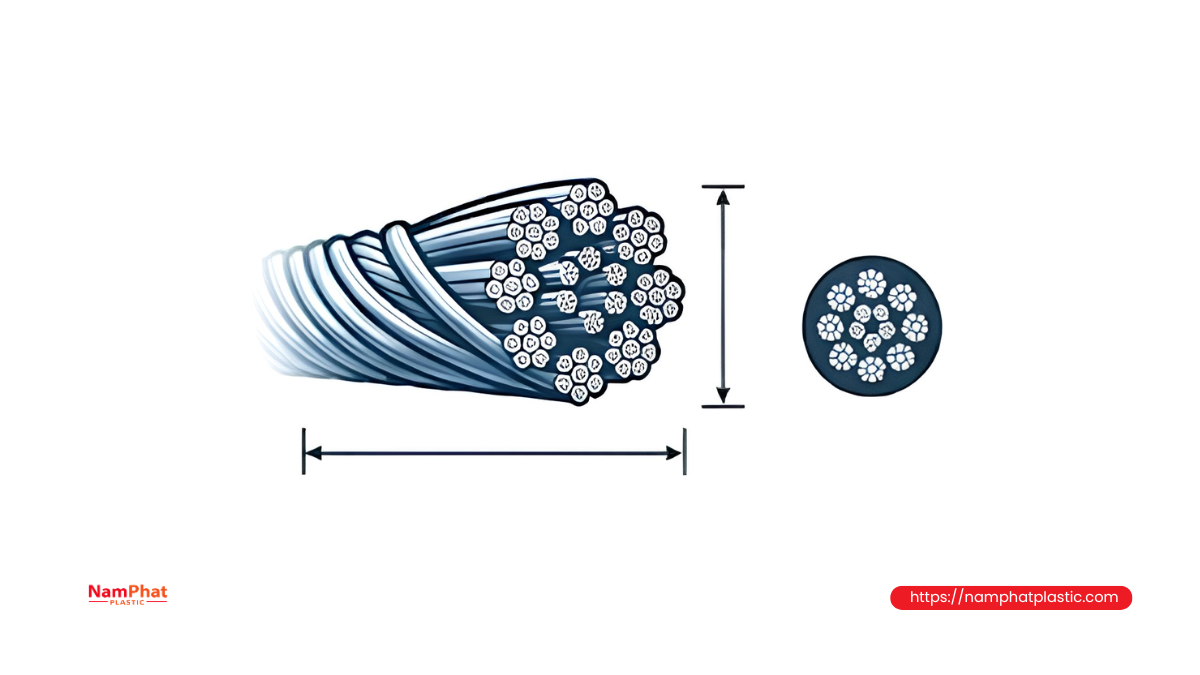
To understand PE C8, C9, and C10 correctly, the two parts of the technical designation need to be separated.
What does the number 20 mean?
The number 20 generally indicates the fineness of the single yarn according to the indirect yarn count system, commonly referred to as Ne 20 or 20/1.
In the Ne system, the higher the count, the finer the single yarn. For example, Ne 30 is finer than Ne 20 when production conditions are comparable.
The 20/1 yarn is the input material. These single yarns are fed into a plying machine to combine multiple yarns, then twisted to create the finished bag sewing thread.
What do the numbers 8, 9, or 10 mean?
The number after the slash indicates the number of component yarns plied together:
- 20/8: 8 strands of 20/1.
- 20/9: 9 strands of 20/1.
- 20/10: 10 strands of 20/1.
In yarn technology, the number after the slash is commonly used to indicate the number of component strands in a plied yarn structure. The Tex system expresses the mass in grams of 1,000 meters of yarn and is applied to many types of fibers, yarns, and textile structures.
3. Theoretical size and length of C8, C9, and C10
A Ne 20/1 yarn has a theoretical fineness of approximately:
- 590.6 ÷ 20 = 29.53 tex
From this, the theoretical size of each thread can be estimated:
| Thread type | Specification | Theoretical size | Theoretical length per 1 kg |
| PE C8 | 20/8 | About 236 tex | About 4,230 m |
| PE C9 | 20/9 | About 266 tex | About 3,760 m |
| PE C10 | 20/10 | About 295 tex | About 3,390 m |
The table above is only a theoretical calculation. The actual length of the finished product may vary due to:
- Length shrinkage during twisting.
- Twist level.
- Variation in the fineness of the raw yarn.
- Oil or surface-treatment content.
- Yarn moisture.
- Weighing and spool-core tolerances.
- The length measurement method used by each manufacturer.
Therefore, when purchasing in large quantities, customers should not evaluate thread based only on spool weight. They should also check usable length, breaking tensile force, and machine performance.
4. What is PE C8 bag sewing thread?
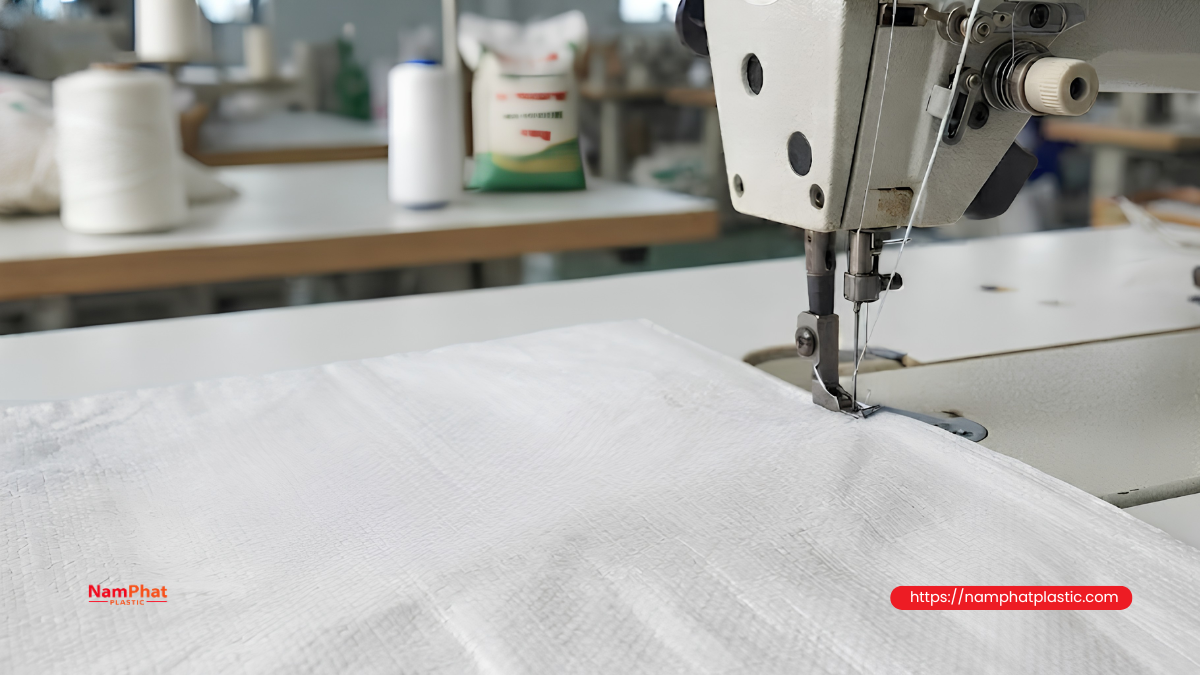
PE C8 bag sewing thread is a shortened designation for PE 20/8 thread, made by plying and twisting 8 strands of 20/1 single yarn.
Compared with C9 and C10, C8 generally has a smaller cross-section, lower mass per meter, and greater length per kilogram.
Advantages of PE C8 thread
- Relatively compact yarn structure and easy thread feeding.
- Greater usable length per kilogram.
- Less bulky seams.
- Suitable for many handheld bag sewing machines.
- Can reduce thread consumption when the required strength is already met.
- Suitable for light- and medium-load bags.
Typical applications
C8 thread can be used for sewing:
- Small rice and agricultural product bags.
- Dry food bags.
- Seed bags.
- Flour and lightweight raw-material bags.
- Coated or uncoated woven PP bags.
- Products requiring a compact, non-bulky seam.
In some cases, C8 can also be used for 25 kg or 50 kg bags. However, this decision should be based on practical testing because bag weight is not the only factor affecting seam strength.
A 50 kg bag handled gently may place less stress on the seam than a 25 kg bag containing hard products with sharp edges that is frequently thrown or dropped.
When should C8 not be the priority?
C8 may not be the optimal choice when:
- Bags are frequently dragged across the floor.
- The contents place high pressure on the bag mouth.
- Bags undergo frequent handling.
- The stitch length is too long.
- The bag edge is rigid or can cut into the thread.
- The seam is subjected to strong jerking forces.
- The customer requires a high safety margin.
5. What is PE C9 bag sewing thread?
PE C9 bag sewing thread, corresponding to 20/9, is made from 9 strands of 20/1 single yarn.
C9 falls between C8 and C10 in size. It is often a balanced choice between seam strength, machine performance, and thread consumption.
Advantages of PE C9 thread
- Moderate size, neither too fine nor too coarse.
- Higher load-bearing potential than C8 when the same raw material and production technology are used.
- Suitable for medium- to relatively heavy-load bags.
- Compatible with many handheld and industrial bag sewing machines.
- Creates a strong but not excessively bulky seam.
- Suitable for continuous bag-closing operations.
PE 20/8 and 20/9 threads are commonly used on handheld bag sewing machines, industrial machines, and sewing units integrated into bagging systems. However, the spool specifications, thread tensioner, and needle still need to be adjusted to suit each production line.
Typical applications
C9 is often selected for sewing:
- 25 kg and 50 kg rice bags.
- Rice, corn, beans, and other agricultural product bags.
- Animal feed bags.
- Flour, starch, and food ingredient bags.
- Fertilizer bags.
- Woven PP bags for long-distance transportation.
- Export bags requiring relatively high stability.
Why is C9 often considered a balanced option?
If C8 provides greater thread length while C10 prioritizes load-bearing capability, C9 falls between the two:
- About 12.5% more component strands than C8.
- About 10% fewer component strands than C10.
- Does not make the seam excessively thick in most common applications.
- Can meet the requirements of many bag types without using an unnecessarily large thread.
However, the percentage of component strands does not mean that breaking tensile force increases by exactly the same percentage. Poor yarn uniformity, unsuitable twist, or poor spool quality can cause a well-made C8 thread to outperform a poorly produced C9 thread.
6. What is PE C10 bag sewing thread?
PE C10 bag sewing thread generally corresponds to 20/10, meaning that 10 strands of 20/1 single yarn are plied and twisted into one finished thread.
Under the same raw-material and production conditions, C10 generally has a larger size and higher breaking tensile force than C8 and C9. In return, its length per kilogram is lower and the seam may be thicker.
Advantages of PE C10 thread
- Larger cross-section.
- Good resistance to load and jerking forces.
- Suitable for heavy bags or harsh transportation conditions.
- Provides a higher safety margin for the seam.
- Can offer better resistance to cutting and friction when the thread structure is appropriate.
- Suitable for certain industrial bag-sewing lines operating at stable speeds.
Typical applications
C10 can be considered for:
- Heavy-load bags.
- Fertilizer and granular chemical bags.
- Industrial raw-material bags.
- Bags transported through multiple handling stages.
- Bags frequently pulled, thrown, or stacked high.
- Bags with thick edges or relatively rigid materials.
- Orders requiring higher thread breaking tensile force.
Important limitations
C10 is not always the best choice. Thread that is too large can cause:
- Difficulty passing through the needle or thread path.
- Higher tension requirements.
- Increased friction and heat at the needle.
- Excessive seam thickness or poor appearance.
- Higher thread consumption by weight.
- Unstable operation on some low-power machines.
- Fiber fuzzing, fraying, or breakage when the needle is unsuitable.
Therefore, businesses should not switch from C8 or C9 to C10 simply because they believe “larger thread is always better.”
7. Comparison table of PE C8, C9, and C10 thread
| Criteria | PE C8 – 20/8 | PE C9 – 20/9 | PE C10 – 20/10 |
| Number of component strands | 8 strands | 9 strands | 10 strands |
| Relative size | Small | Medium | Large |
| Length per 1 kg | Highest | Medium | Lowest |
| Potential breaking force | Lower | Balanced | Higher |
| Seam thickness | Compact | Moderate | Thicker |
| Thread consumption by weight | Lower | Medium | Higher |
| Performance on small machines | Favorable | Relatively favorable | Requires careful testing |
| Applications | Light and medium bags | General-purpose bags | Heavy-load bags |
| Machine adjustment requirements | Low to medium | Medium | Potentially higher |
This comparison assumes that the three thread types are made from the same raw material, with the same single-yarn quality and comparable production technology. If the raw material or twisting method differs, actual performance can vary significantly.
8. Is C10 definitely stronger than C9 and C8?
In terms of the number of component strands, C10 contains more strands than C9 and C8. However, the breaking tensile force of the finished thread is also affected by many other factors:
Quality of the 20/1 yarn
The single yarn should have good uniformity, with minimal thin spots and defects. Even a few weak component strands can reduce the stability of the entire plied thread.
Thread twist
Insufficient twist can cause poor binding between the strands, making the thread prone to opening or snagging. Excessive twist can make the thread stiff, prone to looping, and less suitable for machine operation.
Twist balance
An unbalanced thread can twist on its own, form knots, or slip from the spool. This is a common reason operators believe the thread is “not compatible with the machine.”
Surface treatment
An appropriate amount of oil or lubricant reduces friction as the thread passes through the needle and tensioner. Too little can cause heating and fuzzing, while too much can contaminate the bag or cause abnormal thread slippage.
Winding quality
A good spool should be evenly wound from the inside to the outside. Spools that are too hard, too soft, uneven, or contain many splices can make thread feeding unstable.
Therefore, a high-quality C8 spool can run more stably and provide better practical performance than a C10 spool produced with poor uniformity.
9. Should you choose C8, C9, or C10 thread?
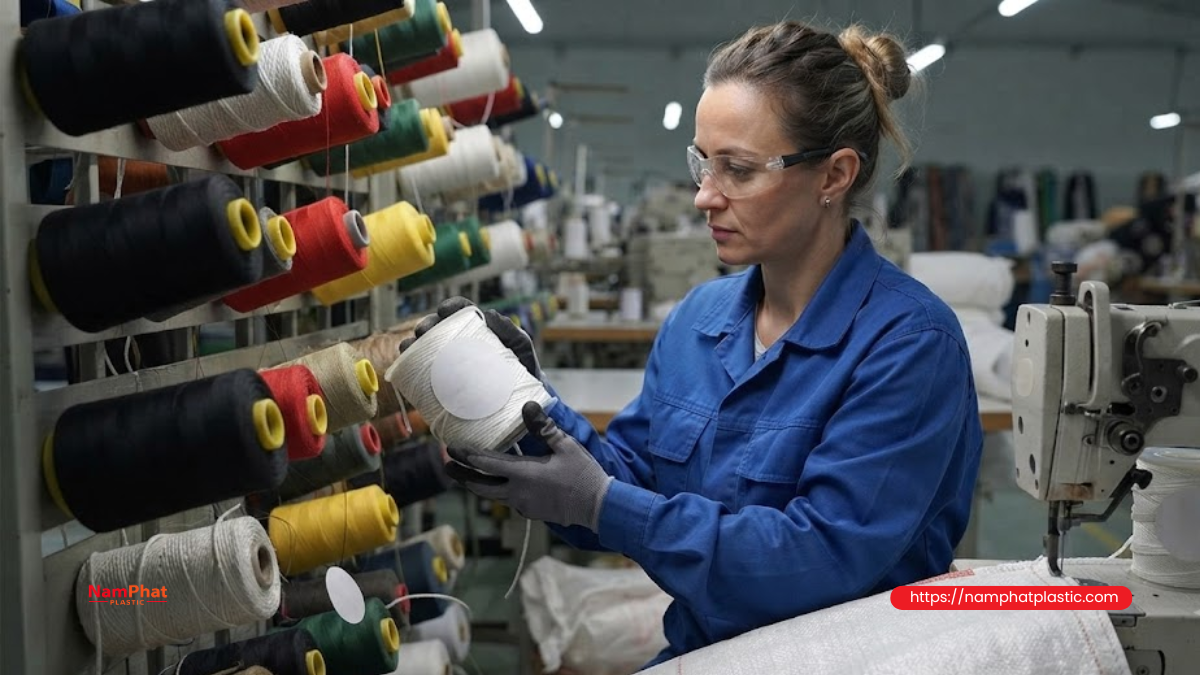
There is no single specification suitable for every type of bag. Businesses should select thread based on the following factors.
9.1. Bag load capacity
The greater the load, the higher the requirements for the seam generally are. However, thread should not be selected based only on the number of kilograms stated on the bag.
The following should also be evaluated:
- Compression level of the contents.
- Pressure exerted by the contents on the bag mouth.
- Stacking method.
- Number of handling cycles.
- Transportation distance.
- Possibility of the bag being dropped.
9.2. Properties of the packaged product
Fine powder products create different loads on the seam compared with hard granular products.
For example:
- Rice, corn, or plastic pellets can create localized forces when the bag is impacted.
- Fine powder can leak through seam gaps.
- Products with hard edges can deform the bag when stacked.
- Products with high moisture content can affect the bag material and storage conditions.
9.3. Type of bag used
Consider whether the bag is made from:
- Woven PP fabric.
- Coated PP.
- Laminated bags.
- Multi-layer paper bags.
- Bags with paper reinforcing strips at the mouth.
- Bags with an inner PE liner.
Thick or multilayer bag edges may require a different needle and thread from thin woven PP bags.
9.4. Type of bag sewing machine
Determine whether the business is using:
- Handheld bag sewing machines.
- Tabletop bag sewing machines.
- Industrial bag sewing machines.
- Sewing units integrated into weighing and bagging lines.
- Single-needle or double-needle machines.
A thread that runs well on a fixed industrial machine may not necessarily be suitable for a low-power handheld machine.
9.5. Stitch length
When stitch length increases, the number of stitches over a given seam length decreases. This can concentrate more load on each stitch.
If a business wants to use a smaller thread to reduce costs, it should simultaneously check stitch length, thread tension, and the strength of the finished seam.
9.6. Production line speed
High-speed production increases friction between the thread, guides, and needle. A suitable thread should have:
- Consistent twist.
- Low hairiness.
- Good unwinding performance.
- Appropriate surface treatment.
- Minimal splices.
For high-speed lines, consistency may be more important than simply increasing the number of component strands.
Quick selection guide
The following can be used as an initial guideline:
- Choose C8 when a compact seam is required for light- to medium-load bags and greater usable thread length is desired.
- Choose C9 when a balanced option is needed for rice, agricultural products, animal feed, and common industrial bags.
- Choose C10 when the bag carries a heavy load, faces harsh transportation conditions, or requires a higher safety margin for the seam.
This is only an initial guideline. Before placing a large order, businesses should test the thread on the actual bag type, sewing machine, and production speed.
10. Signs that the thread being used is too small
The thread may be too small or have insufficient strength when the following occur:
- Thread breaks when machine speed increases.
- The seam opens after bags are stacked.
- The thread is cut at the bag edge.
- The seam fails the drop test.
- The thread stretches noticeably after filling.
- The first or last stitches frequently come loose.
- The rate of bags requiring resewing increases.
Before switching to C9 or C10, check the needle, tensioner, thread path, and stitch length as well. Not every case of thread breakage is caused by thread size.
11. Signs that the thread being used is too large
The thread may be too large for the machine or bag when:
- It is difficult to thread through the needle.
- The machine sounds unusually strained.
- The needle heats up quickly.
- The thread becomes fuzzy or melts around the needle.
- Skipped or uneven stitches appear.
- The seam is excessively bulky.
- The bag edge wrinkles.
- The thread tensioner requires excessive adjustment.
- Thread consumption by weight increases without a significant improvement in seam strength.
In this case, switching from C10 to C9 may help the machine run more smoothly while still meeting the application requirements.
12. How to test thread samples before placing a large order
A trial process should include the following steps:
Step 1: Record the initial specifications
Record:
- Machine type.
- Needle code.
- Machine speed.
- Bag type.
- Bag load.
- Stitch length.
- Current thread tension.
Step 2: Test each thread type
Run C8, C9, and C10 separately under equivalent conditions. Avoid changing multiple machine settings at the same time because this makes it difficult to identify the cause of performance differences.
Step 3: Monitor machine performance
Record:
- Number of thread breaks.
- Number of tangles or thread slippages.
- Needle heating.
- Hairiness level.
- Stitch consistency.
- Machine downtime.
Step 4: Inspect finished bags
Perform appropriate tests such as:
- Direct seam tensile testing.
- Lifting the bag by the mouth.
- Stacking for a specified period.
- Drop testing at an internally specified height.
- Trial transportation through actual handling stages.
- Inspecting the seam after 24–48 hours.
Step 5: Calculate the cost per acceptable bag
Do not compare only the price per kilogram of thread. Low-priced thread that frequently breaks, causes machine downtime, or requires resewing may result in higher total costs.
Actual costs should include:
- Thread cost.
- Machine downtime.
- Labor for troubleshooting.
- Number of bags requiring resewing.
- Product loss from spills or leakage.
- Complaint costs.
- Production-line productivity losses.
13. Are C8, C9, and C10 the same as 900D, 1000D, and 1200D PP thread?
The two groups of designations should not be directly compared.
- C8, C9, and C10 are commonly used for spun polyester thread with 20/8, 20/9, and 20/10 structures.
- 900D, 1000D, and 1200D are denier-based specifications commonly found in filament yarns such as PP multifilament.
Denier expresses the mass in grams of 9,000 meters of yarn, while Ne is an indirect count system expressing length per unit mass. Because they use different measurement systems and different yarn structures, 20/9 cannot be considered exactly equivalent to any particular Denier specification without measuring the actual yarn size.
Frequently asked questions about PE C8, C9, and C10 bag sewing thread
1. Can C8 thread sew 50 kg bags?
Yes, if the bag type, sewing machine, stitch length, and transportation conditions are suitable. However, testing and drop testing should be conducted before large-scale use.
2. Is C9 the most commonly used type?
C9 is often selected for rice, agricultural products, and animal feed bags because it falls between C8 and C10. However, each production line may require a different specification.
3. Is C10 always stronger than C9?
Not in every case. With the same raw-material quality and production technology, C10 generally has higher potential breaking tensile force. However, a uniformly produced C9 spool can still perform better than C10 with unstable twist or poor yarn quality.
4. Does a higher C number mean a longer spool?
No. At the same weight, the greater the number of component strands, the heavier the thread per meter and the shorter the total length. Therefore, one kilogram of C8 thread is generally longer than one kilogram of C9 or C10 thread.
5. Can the same needle be used for C8, C9, and C10?
Some machines may use the same general needle size range, but it should not be assumed that one needle will be optimal for all three specifications. When switching to a larger thread, check the needle eye size, needle groove, tension, and needle temperature.
6. Should thread be purchased by kilogram or by length?
Industrial customers should monitor both. Weight is convenient for transactions, but usable length and the number of bags sewn better reflect actual efficiency. Thread breakage rate and machine downtime should also be considered.
Conclusion
PE C8, C9, and C10 bag sewing threads generally correspond to 20/8, 20/9, and 20/10 specifications. The main difference lies in the number of 20/1 strands plied and twisted together to form the finished thread:
- C8 contains 8 component strands, providing a compact seam and greater length per kilogram.
- C9 contains 9 component strands, balancing strength and machine performance.
- C10 contains 10 component strands, suitable for applications requiring greater load-bearing capability.
However, the number of strands is not the only factor determining quality. Businesses should also evaluate the raw material, twist level, uniformity, breaking tensile force, winding quality, and machine performance.
For accurate selection, provide the manufacturer with information about the bag type, load, packaged product, machine type, spool specification, and production-line speed. Testing samples before placing a large order can help reduce the risk of thread breakage, seam opening, and machine downtime during production.
Nam Phát Plastic supplies PE C8, C9, and C10 bag sewing threads in various spool specifications and colors, suitable for handheld bag sewing machines, industrial machines, and bagging lines. Customers can request samples for direct testing on their existing equipment before placing large orders.
>>> See more:
- 0 Comment


