


 Phan Van Hoang
- 23/09/2026
- 49
PE 20/1 yarn is single polyester yarn spun from staple fibers, with a nominal count of Ne 20. In the bag sewing thread industry, it is used as a raw material for plying and twisting into specifications such as 20/6, 20/8, or 20/9. When purchasing, businesses should consider yarn count, strength, evenness, and unwinding performance together, because the 20/1 designation alone does not fully indicate raw material quality. 1
Table of Contents [Hide]
1. What is PE 20/1 yarn? Understanding the material and designation
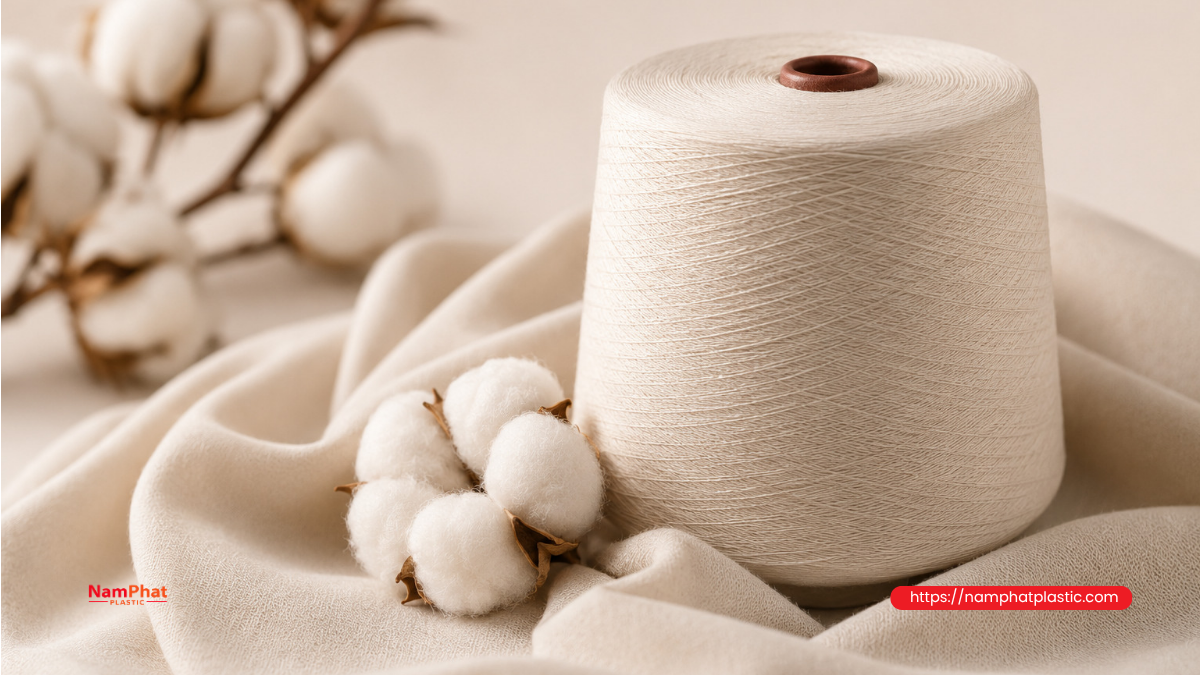
In the commercial terminology used by the yarn and sewing thread industry in Vietnam, “PE” is commonly used to refer to polyester. However, in the plastics industry, PE is the familiar abbreviation for polyethylene. Therefore, in technical communication or purchasing documents, it is advisable to specify “staple polyester yarn, Ne 20/1” to clearly identify the material.
Staple polyester yarn, also known as spun polyester yarn, is made from many short fibers held together in a yarn structure. This is different from filament yarn, which is made from continuous filaments. A single 20/1 yarn still contains many fibers; the number “1” does not mean that it contains only one polyester fiber. 2
The Ne 20/1 designation can be understood as follows:
-
20: the count of the single yarn according to the English cotton count system, Ne.
-
1: one single yarn, not yet plied into a multi-yarn structure.
-
The higher the Ne count, the finer the yarn in terms of weight per unit length.
For example, Ne 30 is finer than Ne 20, while Ne 10 is coarser than Ne 20. The number 20 is not the yarn diameter, denier, or strength rating.
2. Basic specifications of 20/1 polyester yarn
The table below describes the nominal specifications and conversion values. It is a basis for product identification and does not replace the test report for a specific product lot.
| Item | Description or reference value |
| Material | Staple polyester; specific composition should be verified against the lot documentation |
| Structure | Single yarn, spun yarn |
| Nominal count | Ne 20/1 |
| Linear density | Approximately 29.53 tex |
| Conversion to dtex | Approximately 295.27 dtex |
| Conversion to denier | Approximately 265.74D |
| Theoretical length | Approximately 33.87 km/kg of net yarn |
| Breaking force, elongation, hairiness, twist | To be determined according to yarn type and test results |
| Color, core type, package weight | According to purchasing specifications |
Tex, dtex, and denier only describe mass per unit length. A conversion to approximately 266D does not mean PE 20/1 yarn is fully equivalent to 266D filament yarn in terms of strength, surface characteristics, or machine performance. 3
How many meters are there in 1 kg of PE 20/1 yarn?
Based on the conversion relationship between Ne and tex:
Tex = 590.54 / Ne
For Ne 20:
Tex = 590.54 / 20 = 29.527 tex
Since 1 tex corresponds to 1 gram per 1,000 meters of yarn:
Theoretical length = 1,000,000 / 29.527 ≈ 33,867 meters/kg.
Therefore, 1 kg of PE 20/1 yarn has a theoretical length of approximately 33.87 km. The calculation applies to yarn with the nominal count.
When calculating material requirements, the net yarn weight should be used after deducting the core and packaging. Actual yarn count, moisture, finishing agents, and weighing conditions can cause actual results to differ from the theoretical value. The gross weight of a package including the core should not be used directly to calculate meters per kilogram of yarn.
3. How is PE 20/1 yarn produced?
In principle, the spinning process for staple polyester includes fiber preparation and opening, carding and drawing, spinning, and winding. The detailed sequence depends on the spinning system.
For example, ring spinning generally includes a roving stage before final spinning, while rotor spinning uses a different technological configuration. Therefore, two products with the same 20/1 count can differ in structure, hairiness, and processing characteristics. 4
For buyers, useful information includes the spinning technology, output specifications, and consistency between production lots. The machine name or individual technology alone is not enough to determine whether a raw material is suitable for a particular production line.
4. Applications of PE 20/1 yarn
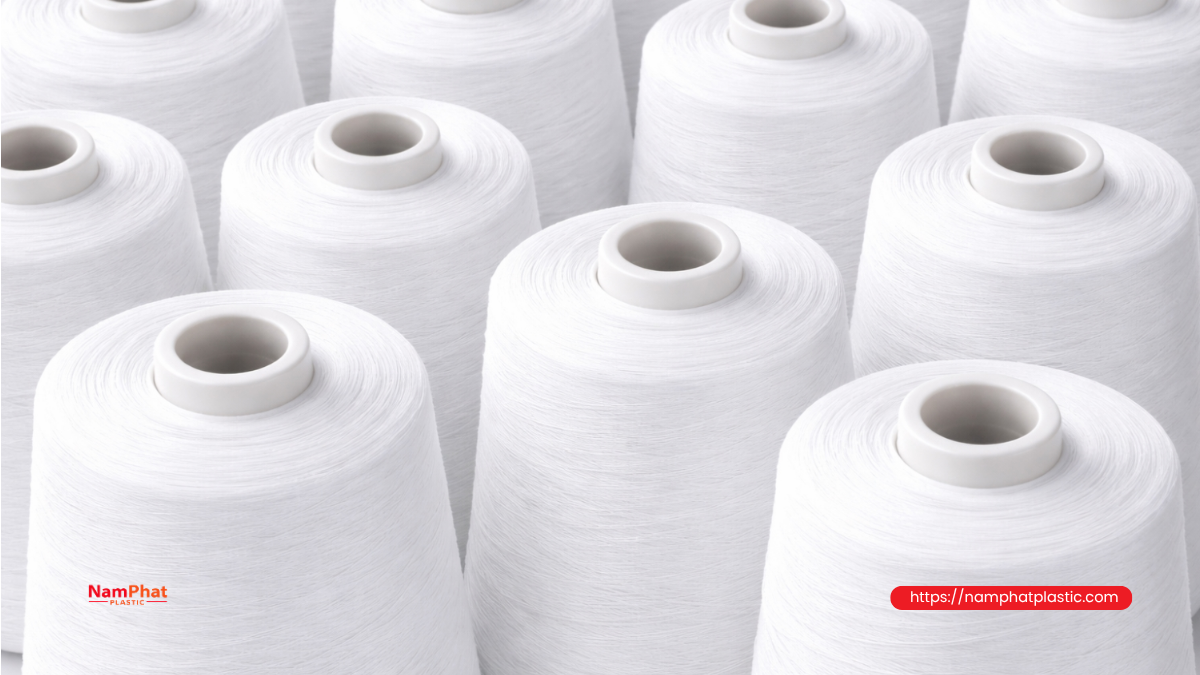
4.1. Raw material for plying and twisting bag sewing thread
One application of 20/1 single yarn is as a raw material for industrial bag sewing thread. Multiple single yarns are plied and twisted, then finished and wound according to the intended application.
Under the 20/n designation, where n is the number of Ne 20 single yarns plied together, the approximate values can be calculated as follows:
| Specification | Number of Ne 20 single yarns | Theoretical linear density | Theoretical length per 1 kg |
| 20/1 | 1 | 29.53 tex | Approximately 33,867 m |
| 20/6 | 6 | 177.16 tex | Approximately 5,645 m |
| 20/8 | 8 | 236.22 tex | Approximately 4,233 m |
| 20/9 | 9 | 265.74 tex | Approximately 3,763 m |
The table is calculated from nominal yarn specifications and does not account for length contraction caused by twisting or changes in mass during finishing. 3
20/1 single yarn is a raw material, while 20/8 or 20/9 sewing thread is a multi-yarn structure. The strength of a single yarn cannot simply be multiplied by the number of yarns to accurately predict the breaking force of the finished thread.
Businesses can also refer to how to calculate the length of PE 20/6, 20/8, and 20/9 thread when calculating material requirements for each thread specification.
4.2. Weaving and yarn processing
Staple polyester yarn is also used in knitting and weaving. However, the suitability of a specific Ne 20/1 yarn should be determined based on fabric structure, surface requirements, and processing equipment. 5
When purchasing yarn for weaving, additional requirements should be discussed, including whether it will be used as warp, weft, or knitting yarn, as well as dyeing condition, hairiness, and color consistency. A yarn that performs well during thread twisting may not necessarily meet all fabric requirements.
5. Key quality indicators of PE 20/1 yarn
Two lots labeled 20/1 can produce different productivity levels and defect rates. The inspection checklist should cover both yarn characteristics and package quality.
| Indicator | What should be checked? | Significance in use |
| Actual yarn count | Average value and variation between samples and packages | Controls material quantity per length and material consumption |
| Breaking force | Test result, N or cN, and variation | Evaluates load-bearing capacity and consistency |
| Elongation at break | Percentage %, measured using the same method | Evaluates yarn behavior under tensile load |
| Mass evenness | CVm%, thin places, thick places, and neps | Identifies variation and yarn defects |
| Hairiness | Measurement index, equipment type, and test conditions | Evaluates fibers protruding from the yarn body |
| Twist and twist direction | Number of turns per length, S or Z direction | Basis for selecting raw material for subsequent twisting |
| Winding quality | Package shape, unwinding stability, and yarn joints | Reduces tangling, layer slippage, and interruptions in yarn feeding |
5.1. Difference between breaking force and tenacity
Breaking force, usually expressed in N or cN, is the force required to break a yarn sample under specified test conditions.
Tenacity, usually expressed in cN/tex, is the breaking force normalized by linear density. This indicator is useful when comparing yarns of different fineness, but the test method and conditions must be consistent.
A single breaking-force value should not be stated for all PE 20/1 yarns. If a buyer requires a specific specification, both parties should agree on acceptance limits, sampling procedures, and test methods.
5.2. Understanding evenness and hairiness
CVm% describes the variation in mass along the yarn. Thin places, thick places, and neps are groups of defects that should be evaluated together with hairiness rather than judging yarn quality solely from the appearance of the package. These are also among the parameters measured in Uster yarn testing systems. 6
When comparing two test reports, the defect-count thresholds, test length, equipment, and measurement conditions should also be compared. A lower value alone is not enough to conclude that an entire lot is better if other indicators or measurement conditions differ.
5.3. Test methods for reference
-
ISO 2060: Determination of the linear density of yarn from packages using the skein method. 7
-
ISO 2062: Determination of breaking force and elongation at break of yarn using a constant-rate-of-extension tensile tester, commonly referred to as CRE. 8
These are test methods, not certifications that every 20/1 product meets a fixed quality threshold. The test report should clearly state the method, conditions, and results for the tested sample.
6. Should you choose virgin or recycled polyester yarn?
Fiber source is an important point to confirm when purchasing PE 20/1 yarn. The 20/1 designation does not indicate whether the material is virgin, recycled, or a blend.
If an order requires a specific fiber source, this requirement should be stated in the purchase specification and verified against the raw material documentation. For recycled yarn, the recycled content and supporting source documentation provided by the supplier should be clearly confirmed.
For production efficiency, samples should be compared using the same set of criteria: yarn count, strength, elongation, evenness, cleanliness, color consistency, and trial-run results. Selection should be based on the finished-product requirements and data from the actual yarn specification.
7. How to test samples before placing a large order
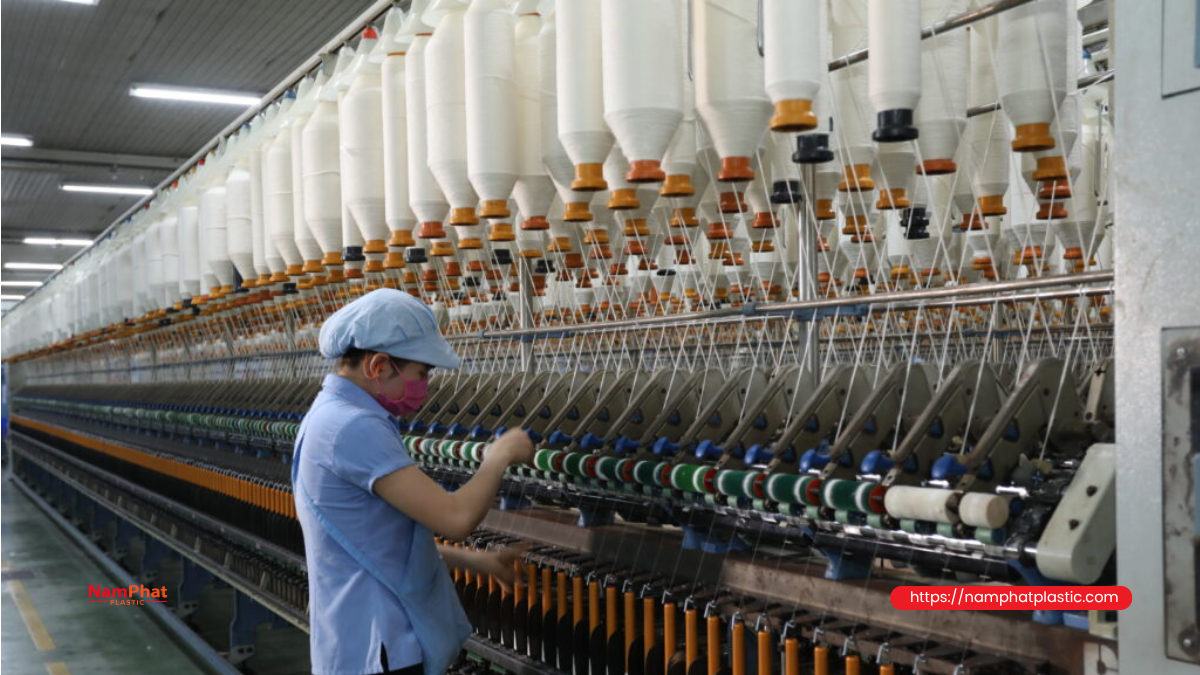
To evaluate usability, samples should be taken from multiple packages within the trial lot, with part of the sample retained for comparison.
-
Identification check: yarn count, material, lot number, fiber source, color, and net weight.
-
Package inspection: check whether the core is deformed, the package edges are damaged, or the yarn is dirty or contaminated with other colors.
-
Trial run under comparable conditions: record the machine, speed, operating time, and trial output.
-
Monitor interruptions: yarn breaks, yarn joints, tangling during unwinding, and downtime.
-
Evaluate the processed product: if the yarn is used for thread twisting, inspect the finished thread and conduct sewing trials on the intended bag type.
Breaks or stoppages should be normalized to the same production quantity or operating time. Comparing two lots operated under different conditions can lead to an incorrect purchasing decision.
Some signs to monitor include:
| Observed issue | Potential causes to investigate |
| Repeated yarn breaks | Yarn strength and evenness, localized weak points, tension, and yarn-guide surfaces |
| Tangling or layer slippage during unwinding | Winding quality, core, package condition, and yarn feeding method |
| Excessive fiber accumulation on guides | Hairiness, friction, contact-part condition, and operating conditions |
| Uneven thread after twisting | Incoming yarn, insufficient number of yarn ends, tension on individual ends, and twisting process |
These signs only provide a direction for inspection; actual observation is required to determine the cause in each case.
8. What factors affect the price of PE 20/1 yarn?
To compare quotations, businesses should ask suppliers to quote using the same configuration:
-
Composition and fiber source.
-
Spinning technology, quality specifications, and tolerances.
-
Color, dyeing condition, or finishing.
-
Net weight per package, core type, and packaging method.
-
Order quantity, delivery terms, and supply lead time.
Price per kilogram is only one part of the total cost. When the yarn enters production, losses, defect-handling labor, and machine downtime should also be considered.
Hypothetical example: If 100 kg of net yarn is purchased at VND 40,000/kg and 97 kg of usable material remains after processing, the allocated purchase cost is:
4,000,000 / 97 ≈ VND 41,237 per kg of usable material.
This example illustrates a cost calculation method and is not a quotation from Nam Phát Plastic. When comparing suppliers, actual loss and productivity data from each sample should be used.
9. Yarn storage and lot management
Yarn should be stored in clean packaging in a dry area, raised off the floor, and protected from direct sunlight. Avoid impacts and compression that may deform the core or package edges.
In storage and during material feeding, lot labels should be maintained, opened packages should be separated from unopened stock, and lots should not be mixed before their consistency has been evaluated. Lot traceability makes it easier to identify the source of a problem when production differences are detected.
Yarn showing signs of moisture, contamination, or package deformation should be inspected again before being fed into the production line.
10. PE 20/1 yarn consultation at Nam Phát Plastic
To discuss raw yarn and bag sewing thread requirements accurately, customers can provide Nam Phát Plastic with the following information:
-
Intended application: plying and twisting, weaving, or other processing.
-
Specification: staple polyester, Ne 20/1, and fiber-source requirements.
-
Current yarn sample or specification sheet that needs to be met.
-
Color, core type, and net weight per package.
-
Expected quantity, delivery location, and required delivery time.
-
Problems to be improved, such as yarn breaks, hairiness, material loss, or package quality.
If the yarn will be used directly on a bag sewing machine, customers should also provide the bag type, machine configuration, and current sewing-thread sample so that the appropriate finished-thread specification can be selected.
Contact Nam Phát Plastic to discuss specifications, samples, and quotation requirements.
Phone: 0911 904 968
Email: contact.namphat@gmail.com
Website: namphatplastic.com
Frequently Asked Questions
1. Is PE 20/1 yarn polyethylene?
In the context of bag sewing thread raw materials discussed in this article, PE 20/1 refers to staple polyester yarn. When placing an order, the material and yarn-count system should be specified clearly to avoid confusion with polyethylene yarn.
2. Can 20/1 yarn be used directly to sew bags?
The sewing thread should be selected according to the requirements of the seam and sewing machine. 20/1 single yarn is primarily discussed here as a raw material for twisted sewing thread; it should not be directly substituted for 20/6, 20/8, or 20/9 thread simply because they share the number 20.
3. Can 40/2 yarn replace 20/1 yarn?
In terms of mass per unit length, Ne 40/2 and Ne 20/1 can be approximately equivalent based on nominal calculations before accounting for twist contraction. However, 40/2 is a two-ply structure made from finer single yarns, while 20/1 is a single yarn. Substitution must be tested according to the product requirements.
4. Can yarn strength be determined from the 20/1 designation?
No. This designation indicates the yarn count and number of component yarns according to the applicable numbering system. Strength must be determined from the test report or sample testing of the actual product specification.
5. Does the twist direction of 20/1 yarn affect the finished twisted thread?
Yes. The relationship between the twist direction of the single yarn and the twist direction during subsequent twisting should be considered. Buyers can refer to how to distinguish S and Z twist and select twist direction according to machine configuration, while also agreeing on the requirements according to the thread structure to be produced.
Technical References
- 0 Comment


