


 Phan Van Hoang
- 01/08/2026
- 151
When purchasing or using bag sewing thread, many businesses manage consumption by kilogram. However, sewing machines do not consume thread by weight; they consume it by length. Therefore, the question “How many meters are there in 1 kg of PE 20/6, 20/8, or 20/9 sewing thread?” is important when businesses need to:
- Calculate thread consumption standards for each type of bag.
- Compare the actual cost between different thread types.
- Estimate how many bags can be sewn from one spool.
- Control waste during production.
- Compare quality between thread batches.
- Detect underweight spools or incorrect specifications.
In principle, the thicker the thread and the more plies it has, the fewer meters there will be per kilogram. Therefore, 1 kg of PE 20/6 thread will be longer than 1 kg of PE 20/8, while PE 20/9 will have the shortest length among the three types.
However, actual length does not depend solely on the names 20/6, 20/8, or 20/9. Twist level, shrinkage during plying, finishing oil content, moisture, and variations in the raw yarn can all affect the result.
Table of Contents [Hide]
1. What do PE 20/6, 20/8, and 20/9 mean?
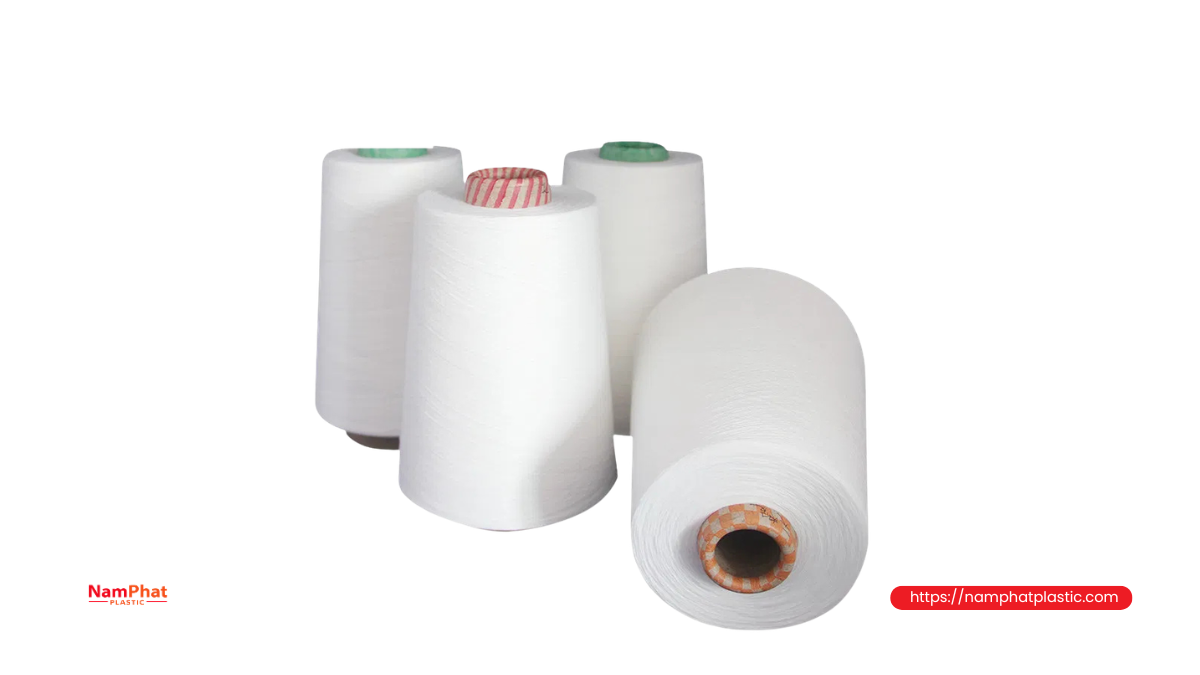
In the bag sewing thread market in Vietnam, the term “PE thread” is commonly used to refer to polyester spun thread, which is made from short polyester fibers that are first spun into single yarns and then plied and twisted together.
The naming structure can be understood as follows:
- 20/6: consists of 6 single yarns with a nominal count of Ne 20.
- 20/8: consists of 8 single yarns with a nominal count of Ne 20.
- 20/9: consists of 9 single yarns with a nominal count of Ne 20.
The number after the slash indicates the number of single yarns plied together before twisting.
For example:
- PE 20/6 is made from 6 ends of PE 20/1 yarn.
- PE 20/8 is made from 8 ends of PE 20/1 yarn.
- PE 20/9 is made from 9 ends of PE 20/1 yarn.
As the number of plies increases, the finished thread becomes larger, heavier per unit length, and generally has higher breaking force. In return, the length obtained per kilogram decreases.
Note: The calculations in this article assume that the raw material is actually Ne 20/1 yarn. Some suppliers may use the commercial names 20/6, 20/8, or 20/9 even though the actual count is not exactly the same. When high accuracy is required, businesses should check the COA, TDS, or measure the thread directly.
2. Principle of calculating the number of meters of thread per 1 kg
The length of thread per kilogram depends on the linear density of the yarn.
Simply put:
- Finer and lighter yarn has more meters per 1 kg.
- Larger and heavier yarn has fewer meters per 1 kg.
- The more plies there are, the fewer meters there will be per 1 kg.
With the Ne count system, theoretical length can be calculated using:
- Theoretical length, m/kg = Ne × 1,693.4 ÷ number of plies
Where:
- Ne is the count of the single yarn.
- 1,693.4 is the conversion factor from Ne to meters per kilogram.
- Number of plies is 6, 8, or 9.
For Ne 20/1 yarn:
- Single yarn length of 20/1 = 20 × 1,693.4 = 33,868 m/kg
After multiple yarn ends are plied together, the theoretical length of the finished thread is calculated by dividing by the number of plies.
3. How to calculate how many meters of PE 20/6 are in 1 kg
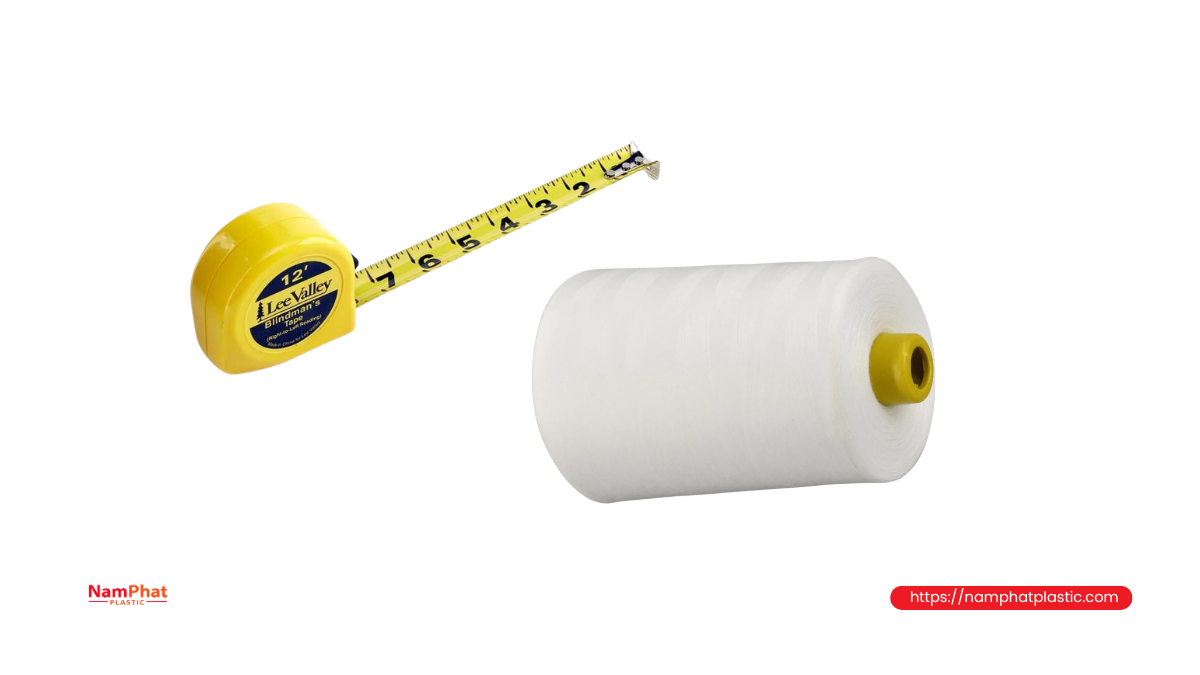
PE 20/6 consists of 6 ends of Ne 20/1 yarn.
Applying the formula:
- PE 20/6 length = 20 × 1,693.4 ÷ 6
Result:
- Theoretical PE 20/6 length ≈ 5,645 m/kg
Therefore, if shrinkage during twisting, finishing oil, and production variations are ignored, 1 kg of PE 20/6 thread has approximately 5,645 meters.
In actual production, the length is usually lower than the theoretical value. Therefore, businesses can initially use an estimated range of:
- Approximately 5,200–5,500 meters/kg
This range is for reference only. Some thread batches with lower twist, less oil, and finer raw yarn may have a length closer to the theoretical value. Conversely, tightly twisted thread, thread with more oil, or thread with a higher actual linear density will have fewer meters.
4. How to calculate how many meters of PE 20/8 are in 1 kg
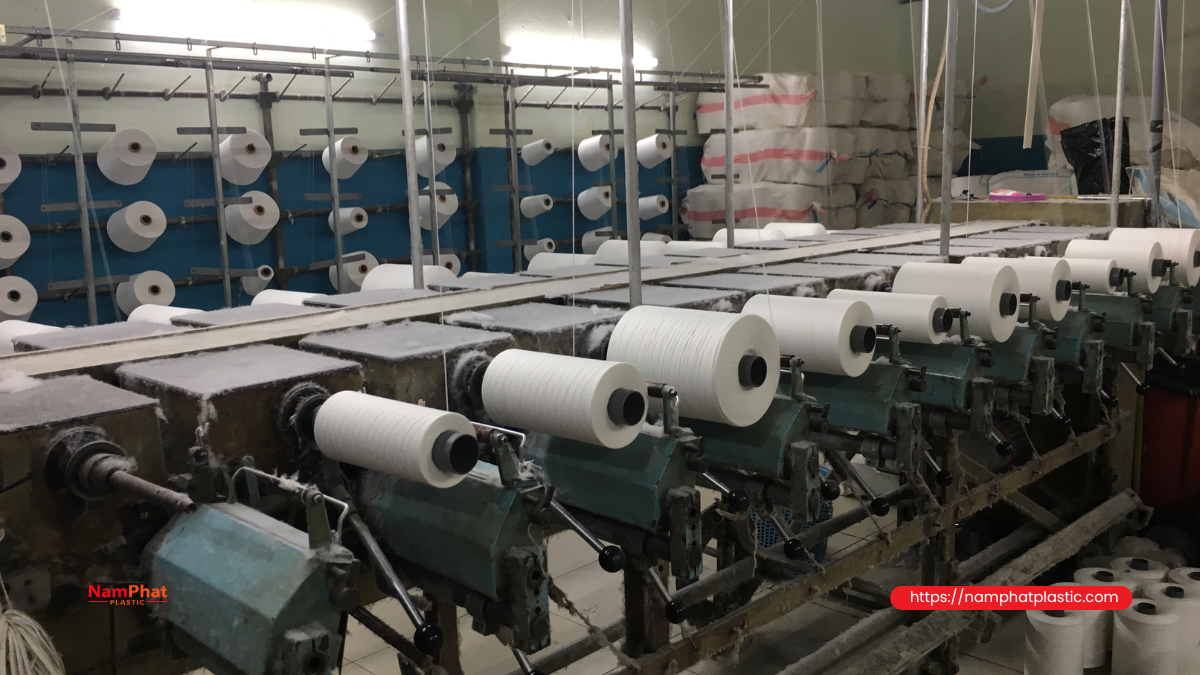
PE 20/8 consists of 8 ends of Ne 20/1 yarn.
Calculation:
- PE 20/8 length = 20 × 1,693.4 ÷ 8
Result:
- Theoretical PE 20/8 length ≈ 4,234 m/kg
After taking actual production factors into account, the length can be estimated at:
- Approximately 3,900–4,150 meters/kg
Compared with PE 20/6, PE 20/8 has two additional single-yarn ends. Therefore, for the same kilogram of thread, the theoretical length of PE 20/8 is approximately 25% lower than PE 20/6.
This is also why businesses should not compare prices only by kilogram. A thread type that has a lower price per kilogram but significantly fewer meters may not necessarily result in a lower sewing cost.
5. How to calculate how many meters of PE 20/9 are in 1 kg
PE 20/9 consists of 9 ends of Ne 20/1 yarn.
Formula:
- PE 20/9 length = 20 × 1,693.4 ÷ 9
Result:
- Theoretical PE 20/9 length ≈ 3,763 m/kg
After accounting for twisting shrinkage, oil content, and raw-material variation, the actual length may be approximately:
- 3,450–3,700 meters/kg
PE 20/9 has the largest cross-section among the three specifications considered. Therefore, it generally feels stronger and fuller, but it also has the lowest number of meters per kilogram.
6. Estimated meters of PE thread per 1 kg
| Thread specification | Number of plies | Theoretical length | Estimated actual range |
| PE 20/6 | 6 plies | Approximately 5,645 m/kg | Approximately 5,200–5,500 m/kg |
| PE 20/8 | 8 plies | Approximately 4,234 m/kg | Approximately 3,900–4,150 m/kg |
| PE 20/9 | 9 plies | Approximately 3,763 m/kg | Approximately 3,450–3,700 m/kg |
The table above is suitable for preliminary calculations when actual test results are not yet available.
For quotations or production standards, businesses should use the average meters measured from the actual batch being used rather than applying one fixed figure to all suppliers.
7. Quick conversion table by spool weight
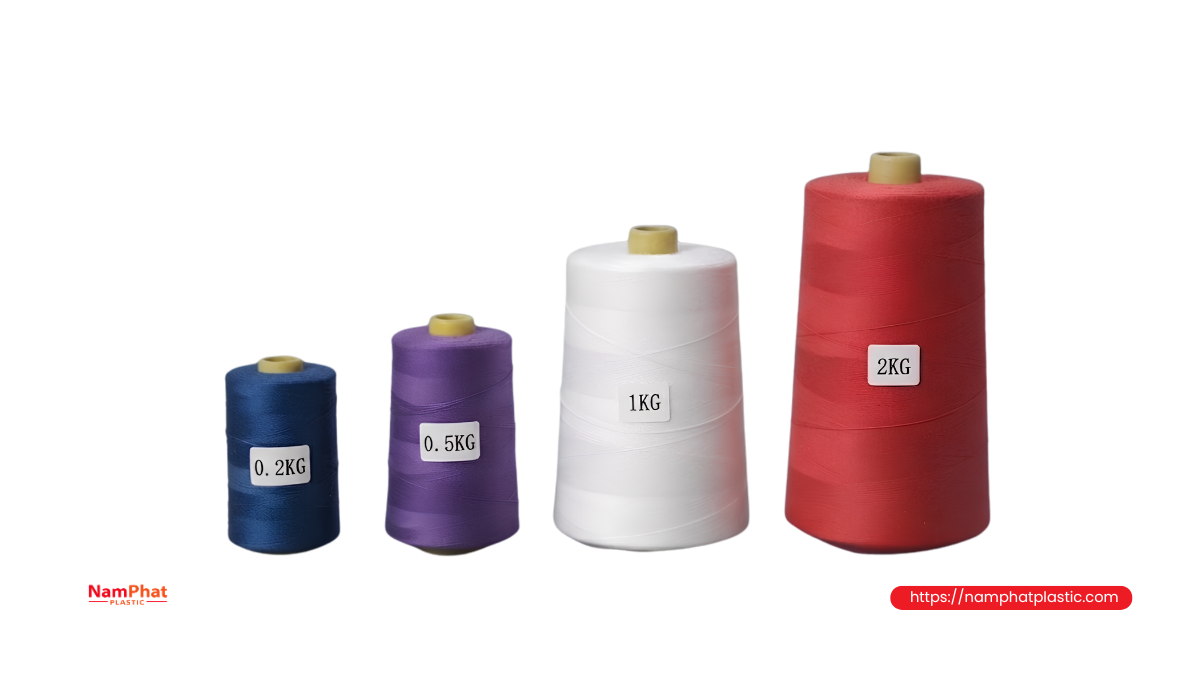
A reference average can be used as follows:
- PE 20/6: approximately 5,350 m/kg.
- PE 20/8: approximately 4,025 m/kg.
- PE 20/9: approximately 3,575 m/kg.
Based on these values, the estimated lengths of common thread spools are:
| Net weight | PE 20/6 | PE 20/8 | PE 20/9 |
| 0.2 kg | Approx. 1,070 m | Approx. 805 m | Approx. 715 m |
| 0.5 kg | Approx. 2,675 m | Approx. 2,013 m | Approx. 1,788 m |
| 1 kg | Approx. 5,350 m | Approx. 4,025 m | Approx. 3,575 m |
| 2 kg | Approx. 10,700 m | Approx. 8,050 m | Approx. 7,150 m |
| 3 kg | Approx. 16,050 m | Approx. 12,075 m | Approx. 10,725 m |
Conversion formula:
- Total thread length = net thread weight × average meters per kilogram
For example, a PE 20/9 spool with a net weight of 2.5 kg:
- 2.5 × 3,575 = 8,937.5 meters
Therefore, the spool has an estimated length of approximately 8,900–9,000 meters.
8. Why is the actual length lower than the theoretical result?
The calculation based on the Ne system assumes that the yarn count is completely accurate, with no oil, no shrinkage, and no production variation. In reality, these conditions rarely occur simultaneously.
8.1. Yarn shrinks during the twisting process
When single yarns are twisted together, their path is no longer completely straight. Each yarn follows a helical path around the axis of the finished thread.
The higher the twist level, the greater the length contraction. Therefore, one kilogram of finished thread generally has a lower length than the result calculated directly from the single-yarn count.
8.2. Finishing oil content
Bag sewing thread is commonly treated with oil to:
- Reduce friction as the thread passes through the needle and tension system.
- Reduce hairiness.
- Reduce heat generation at the needle.
- Improve continuous machine running.
- Reduce fiber dust.
This oil contributes to the spool weight but does not add thread length. A spool with a higher oil ratio will therefore have fewer meters per kilogram than a spool with less oil.
However, thread should not be evaluated simply based on whether it contains more or less oil. The oil level needs to be controlled appropriately to ensure machine performance without making the thread excessively slippery, attracting dust, or significantly affecting weight.
8.3. Variation in the count of the 20/1 yarn
The designation Ne 20/1 is a nominal count. In actual production, the raw yarn may be slightly finer or coarser than this value.
For example:
- Yarn finer than Ne 20 will provide more meters.
- Yarn coarser than Ne 20 will provide fewer meters.
- Unevenness along the yarn length can also cause sample-to-sample variation.
Two suppliers may both label their product PE 20/9, but the length per kilogram can still differ because their 20/1 raw yarn is not identical.
8.4. Moisture and storage conditions
Polyester has much lower moisture absorption than many natural fibers. However, surface moisture, oil, dust, and storage conditions can still cause slight changes in weight.
If the thread is weighed immediately after production, after long-term storage, or in a high-humidity environment, the results may not be exactly the same.
8.5. Core and packaging weight
A common mistake is to use the total spool weight to calculate the number of meters without subtracting:
- Paper or plastic core weight.
- Packaging bag.
- Product label.
- Binding material.
- Carton or other auxiliary materials.
For example, if the total spool weight is 2.1 kg but the core weighs 100 g, the actual net thread weight is only 2 kg.
If 2.1 kg is used for the calculation, the estimated length will be approximately 5% too high.
9. How to accurately measure meters of thread per 1 kg at the factory
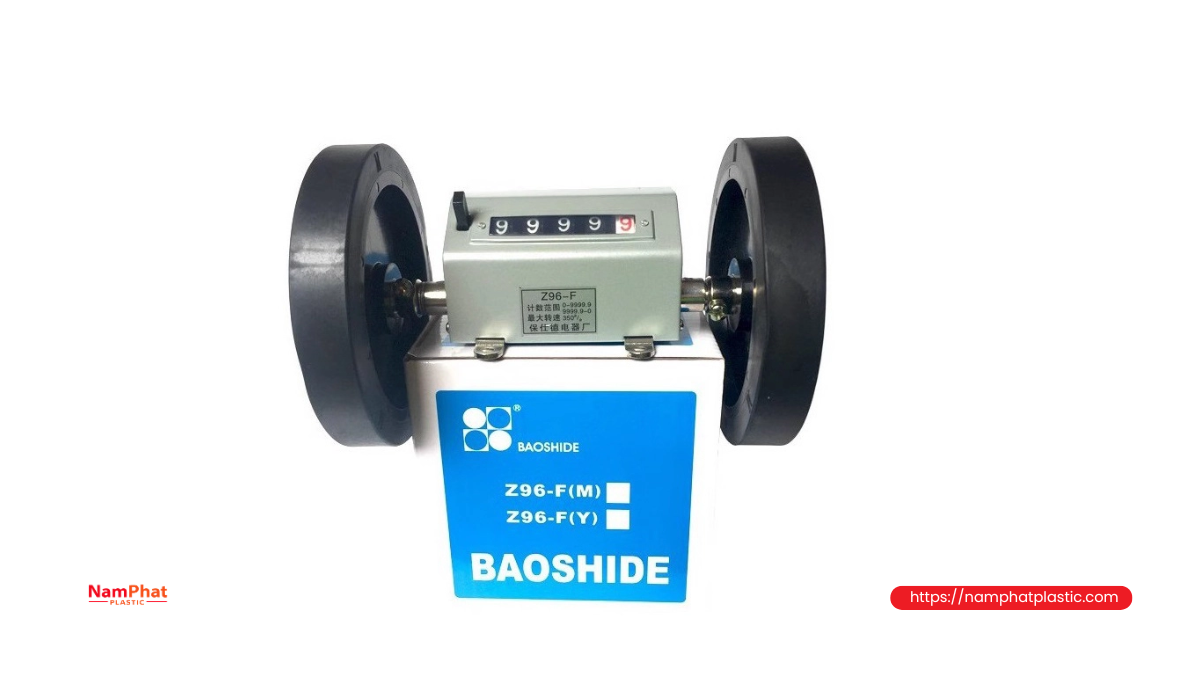
The theoretical formula is suitable for estimation. However, the most reliable method is still to take samples directly from each production batch.
Step 1: Prepare the equipment
You need:
- A length counter or winding machine with a length meter.
- An electronic scale with a minimum resolution of 0.1 g.
- A sample core with stable weight.
- Scissors for cutting the thread.
- A record sheet.
Step 2: Weigh the empty core
Weigh the core before winding the thread and record its weight.
Example:
- Empty core weight: 32.4 g
Step 3: Wind a specified length
A sample of 500–1,000 meters is recommended to reduce weighing error.
A sample that is too short, such as 10 or 20 meters, has a very small weight, so scale error will have a significant effect on the result.
Example:
- Sample length: 500 meters
Step 4: Weigh the core after winding
Suppose the weight of the core plus thread is:
- 124.4 g
Net thread weight:
- 124.4 – 32.4 = 92 g
Equivalent to:
- 0.092 kg
Step 5: Calculate meters per 1 kg
Formula:
- Meters/kg = sample length ÷ sample weight in kg
Applying the formula:
- 500 ÷ 0.092 = 5,435 meters/kg
Therefore, the measured batch has an actual length of approximately 5,435 meters per kilogram.
This result is consistent with the estimated range for PE 20/6.
Step 6: Take multiple samples and calculate the average
Do not rely on a single sample. Businesses should take at least:
- Three spools from the beginning, middle, and end of the batch.
- One or two samples from each spool.
- Calculate the average.
- Record the highest and lowest values.
This method helps identify inconsistencies between spools, twisting positions, or production periods.
10. How to establish an actual conversion factor for each thread type
After collecting measurement data from multiple batches, businesses can establish an internal factor.
Formula:
- Actual factor = measured length ÷ theoretical length
Example for PE 20/6:
- Theoretical length: 5,645 m/kg.
- Actual measured length: 5,420 m/kg.
Actual factor:
- 5,420 ÷ 5,645 = 0.96
The business can use a factor of 0.96 for batches with the same:
- 20/1 yarn source.
- Twist level.
- Oil formulation.
- Twisting equipment.
- Machine speed.
- Production conditions.
Then:
- Estimated length = theoretical length × actual factor
Developing a dedicated factor is much more accurate than applying one general reduction to every product.
11. How to calculate the number of bags that can be sewn from 1 kg of thread
After determining the number of meters per kilogram, the business can calculate the number of bags that can be sewn.
General formula:
- Number of bags = total thread length ÷ thread consumption per bag
Thread consumption per bag depends on:
- Bag mouth width.
- Seam type.
- Single-needle or double-needle sewing machine.
- Stitch density.
- Stitch length.
- Excess thread length at both ends.
- Thread breakage rate.
- Thread wasted when changing spools.
- Operator skill.
- Sewing machine stability.
The bag mouth width should not be directly treated as thread consumption. A chain stitch uses more thread than the actual seam length.
A more accurate method is to conduct a trial:
- Prepare a spool with a known net weight.
- Sew 100 or 500 bags.
- Weigh the remaining thread.
- Calculate the amount of thread consumed.
- Convert the consumed weight into meters.
- Divide by the number of bags sewn.
For example, 100 bags consume a total of 220 meters of thread:
- Average thread consumption per bag = 220 ÷ 100 = 2.2 meters
- If 1 kg of PE 20/9 contains approximately 3,575 meters:
- Theoretical number of bags = 3,575 ÷ 2.2 ≈ 1,625 bags
- Then the production waste rate should be deducted to obtain the actual standard.
12. Why thread prices should not be compared only by kilogram
Suppose:
- Thread A costs VND 70,000/kg and provides 5,400 m/kg.
- Thread B costs VND 67,000/kg but provides only 5,000 m/kg.
Cost per 1,000 meters for thread A:
- 70,000 ÷ 5,400 × 1,000 ≈ VND 12,963
Cost per 1,000 meters for thread B:
- 67,000 ÷ 5,000 × 1,000 = VND 13,400
Although thread B is VND 3,000 cheaper per kilogram, its actual cost per unit length is higher.
Therefore, when evaluating the economic efficiency of bag sewing thread, businesses should consider:
- Price per kilogram.
- Meters per kilogram.
- Breaking force.
- Hairiness.
- Thread breakage rate.
- Machine running performance.
- Consistency between spools.
- Seam quality.
- Rework rate.
A spool with more meters but frequent thread breakage, skipped stitches, or machine downtime may not necessarily result in lower overall costs.
13. Common mistakes when estimating thread length
Only using the kilogram figure printed on the packaging
The weight printed on the label may not be the exact net thread weight. Scale error should be checked and the core weight deducted.
Assuming every 20/9 thread is identical
Two products with the same 20/9 designation can differ in raw material, twist, oil content, and actual linear density.
Using theoretical length as the production standard
Theoretical length does not account for twisting shrinkage or finishing oil. Using this number directly may result in an overly optimistic consumption standard.
Measuring a sample that is too short
The shorter the sample, the greater the effect of weighing error. A minimum of 500 meters is recommended when the equipment allows.
Not checking periodically
When changing raw-material suppliers, oil formulation, twist level, or machine speed, the meters per kilogram may also change.
14. How should the meters/kg specification be controlled?
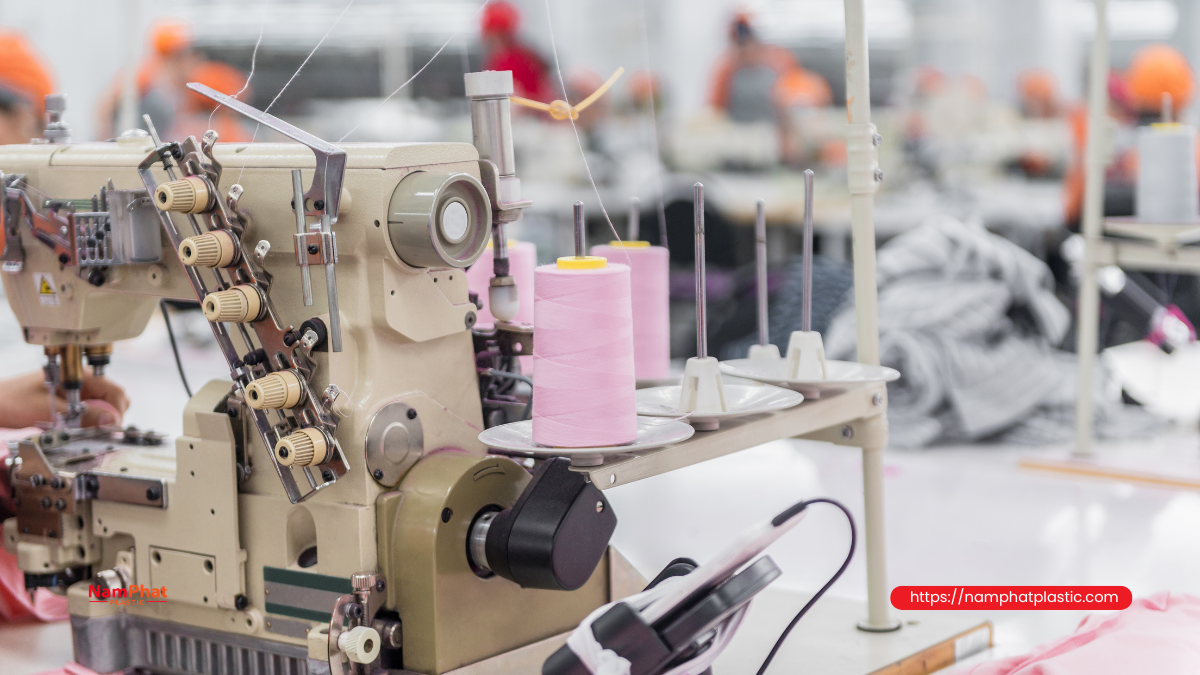
For bag sewing thread manufacturers, meters/kg should be checked together with other parameters such as:
- Net weight per spool.
- Finished yarn count.
- Turns per meter.
- Twist direction.
- Breaking force.
- Elongation at break.
- Hairiness.
- Oil content.
- Thread-joining defect rate.
- Thread unwinding performance.
- Stability during sewing machine operation.
Businesses can establish internal control limits, such as:
- Target value.
- Acceptable deviation.
- Number of samples per batch.
- Procedure for handling out-of-specification results.
- Sample retention requirements.
- Daily or shift-based monitoring forms.
When meters/kg decreases abnormally without a corresponding increase in breaking force, the following should be checked:
- Whether the raw yarn is coarser than the specification.
- Whether the oil content is too high.
- Whether the twist level is excessive.
- Whether the spool contains moisture or contaminants.
- Whether the electronic scale is inaccurate.
15. Conclusion: How many meters are there in 1 kg of PE 20/6, 20/8, and 20/9?
If the raw material is Ne 20/1 yarn and the correct number of yarn ends are plied together, the theoretical length per kilogram is:
- PE 20/6: approximately 5,645 meters/kg.
- PE 20/8: approximately 4,234 meters/kg.
- PE 20/9: approximately 3,763 meters/kg.
Under actual production conditions, the following reference ranges can be used:
- PE 20/6: approximately 5,200–5,500 meters/kg.
- PE 20/8: approximately 3,900–4,150 meters/kg.
- PE 20/9: approximately 3,450–3,700 meters/kg.
These figures are suitable for preliminary estimation. To establish accurate production standards, businesses should measure samples directly using a length counter and electronic scale, then establish an actual factor for each specification, raw-material source, and twisting process.
Evaluating bag sewing thread by meters per kilogram helps businesses compare costs more accurately, control waste more effectively, and avoid choosing products based solely on price per kilogram.
Frequently Asked Questions
1. How many meters are there in 1 kg of PE 20/6 thread?
The theoretical length of PE 20/6 is approximately 5,645 meters/kg. In practice, approximately 5,200–5,500 meters/kg can be used as a reference, depending on twist, oil content, and the actual count of the raw yarn.
2. How many meters are there in 1 kg of PE 20/8 thread?
PE 20/8 has a theoretical length of approximately 4,234 meters/kg. The actual length can generally be estimated at around 3,900–4,150 meters/kg.
3. How many meters are there in 1 kg of PE 20/9 thread?
PE 20/9 has a theoretical length of approximately 3,763 meters/kg. In practice, approximately 3,450–3,700 meters/kg can be used as a reference.
4. Why can two suppliers have different meters per kilogram even though both products are PE 20/9?
The difference may result from the actual count of the 20/1 yarn, twist level, twisting shrinkage, oil content, moisture, weighing error, and the method used to determine net weight.
5. Can meters per kilogram be used to evaluate thread quality?
Meters per kilogram is an important parameter, but it is not sufficient to determine quality. Breaking force, elongation, hairiness, machine performance, and seam quality should also be evaluated.
6. Which thread has the most meters per kilogram?
Among PE 20/6, 20/8, and 20/9, PE 20/6 has the most meters per kilogram because it is made from fewer single-yarn plies.
7. How long should the sample be when measuring meters/kg?
A sample of 500–1,000 meters is recommended to reduce the effect of weighing error. With a lower-precision scale, a longer sample provides more reliable results.
8. Is it necessary to subtract the core weight when calculating thread length?
Yes. The net thread weight should be used, excluding the paper or plastic core, packaging bag, label, and other auxiliary materials.
>>> See more:
- 0 Comment


