


 Phan Van Hoang
- 31/07/2026
- 120
In the packaging manufacturing industry, many businesses often ask: can PE 20/9 thread be replaced with PP 900D, 1000D, or 1200D thread?
Both notations are related to yarn size, but they belong to different sizing systems. PE 20/9 thread is usually identified by the count of the single yarn and the number of plies, while PP filament thread is commonly specified by denier.
Therefore, you cannot look at the numbers “20/9” and “900D–1200D” and conclude which type is larger, stronger, or directly interchangeable.
In theory, PE 20/9 has a total linear density of nearly 2,400D, which is considerably larger than PP 900D–1200D if these denier values refer to finished single-ply thread. However, if the PP product is 1200D/2, meaning two 1200D strands twisted together, the nominal total linear density will be close to 2,400D and therefore quite close to PE 20/9.
However, being “close in denier” does not mean that the two thread types can be used as a 1:1 replacement on a bag sewing machine.
Quick answer
PE 20/9 should not be directly converted to PP 900D, 1000D, or 1200D based only on the product names.
It can be summarized as follows:
- The theoretical equivalent of PE 20/9 is approximately 266 tex or 2,390–2,400D.
- Finished PP 900D thread is approximately 100 tex.
- Finished PP 1000D thread is approximately 111 tex.
- Finished PP 1200D thread is approximately 133 tex.
- PP 1200D/2 has a nominal total linear density of approximately 267 tex or 2,400D, making it the closest to PE 20/9 in terms of mass per unit length.
- Actual substitution still requires checking breaking force, elongation, yarn construction, twist, surface characteristics, and the ability to form a stable thread loop on the machine.
Table of Contents [Hide]
1. What does the PE 20/9 designation mean?
In the common terminology used for spun bag sewing thread, the designation 20/9 is generally understood as:
- “20” is the count of the original single yarn, commonly associated with the Ne system.
- “9” is the number of single-yarn strands plied and twisted together to form the finished thread.
Therefore, PE 20/9 is commonly produced from nine strands of PE 20/1 yarn.
Ne is an indirect yarn-count system based on a fixed mass. Ne indicates the number of 840-yard hanks contained in one pound of material. In this system, a higher Ne indicates a finer yarn. In contrast, tex and denier are mass-per-unit-length systems, so a higher number indicates a heavier and coarser linear density.
When multiple yarn strands are twisted together, the overall count in the indirect system is calculated by dividing the single-yarn count by the number of plies:
- Finished Ne = 20 ÷ 9 ≈ 2.22 Ne
However, it is important to note that in the market, “20/9” may sometimes be used as a commercial product code. Therefore, before making an accurate conversion, it is necessary to confirm whether the “20” actually refers to Ne 20 or is simply a designation defined by the manufacturer.
2. What does the PP 900D–1200D designation mean?
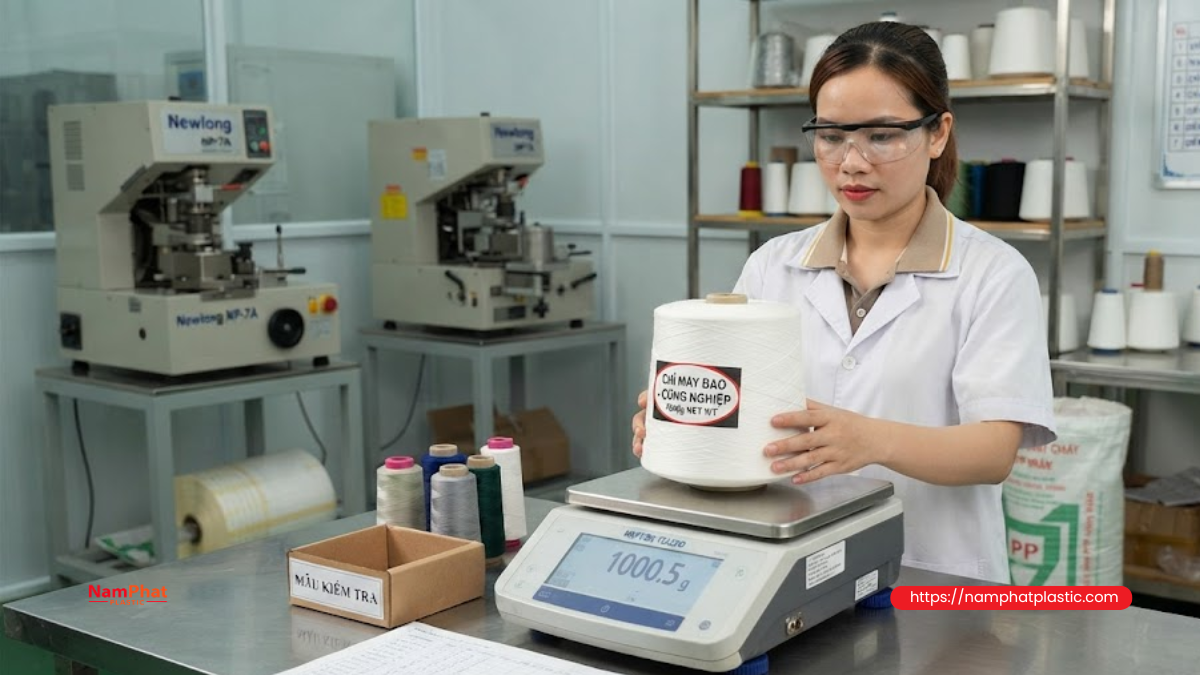
The letter “D” stands for denier. Denier indicates the mass in grams of 9,000 meters of yarn.
For example:
- 9,000 meters of 900D PP yarn has a nominal mass of 900 grams.
- 9,000 meters of 1000D PP yarn has a nominal mass of 1,000 grams.
- 9,000 meters of 1200D PP yarn has a nominal mass of 1,200 grams.
Under the denier system:
- A higher D value means a higher mass per meter.
- With the same material and construction, a higher-denier yarn generally has a larger cross-section and higher breaking force.
- Denier only indicates linear density; it does not directly indicate strength, hairiness, smoothness, or machine performance.
A very important point is to determine whether the 900D–1200D figure refers to:
- The total denier of the finished thread; or
- The denier of each strand before twisting.
For example, PP 1200D/2 is not simply 1200D thread. In theory, two 1200D strands twisted together produce a thread with a nominal total linear density of approximately 2400D, before considering shrinkage caused by twisting.
3. Converting PE 20/9 to tex and denier
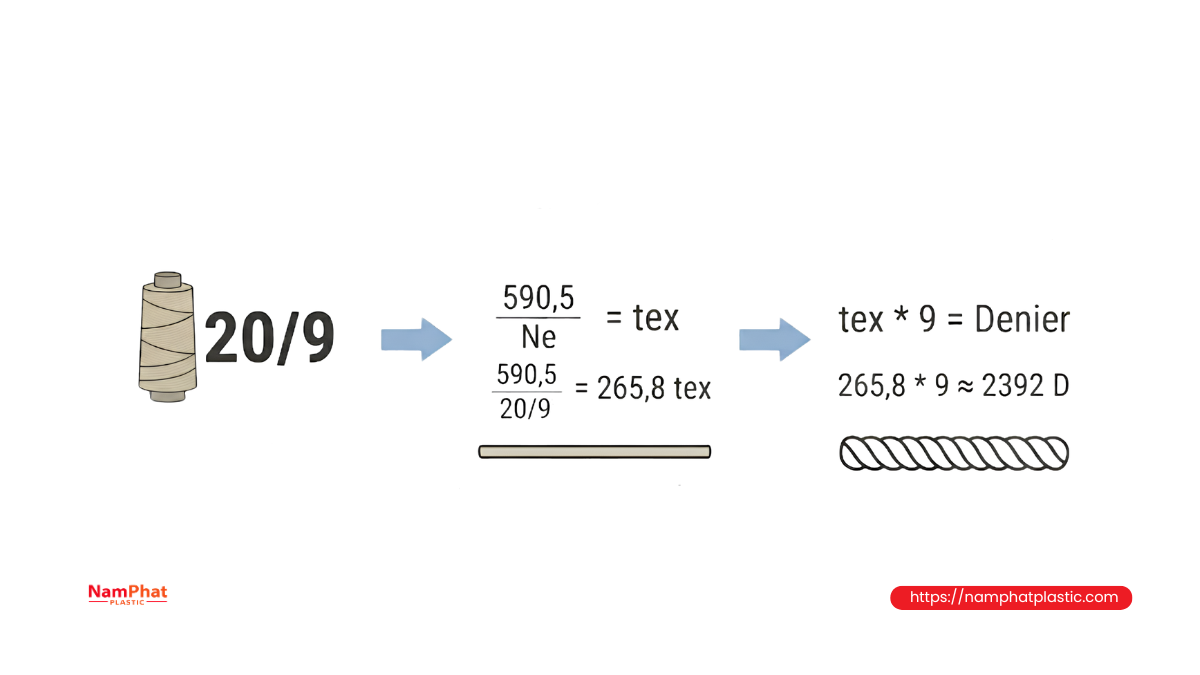
To compare the two systems, it is useful to convert both products to the same intermediate unit: tex.
Tex is the mass in grams of 1,000 meters of yarn. The conversion formulas are:
- Tex = 590.54 ÷ Ne
- Denier = Tex × 9
- Tex = Denier ÷ 9
These formulas are consistent with commonly used yarn-count conversion tables.
Step 1: Calculate the tex of one PE 20/1 strand
- Tex of PE 20/1 = 590.54 ÷ 20 ≈ 29.53 tex
Step 2: Calculate the total tex of nine strands
- Tex of PE 20/9 = 29.53 × 9 ≈ 265.8 tex
Step 3: Convert to denier
- Theoretical denier = 265.8 × 9 ≈ 2,392D
Therefore, PE 20/9 can be rounded to a nominal linear density of approximately 2,400D.
This is only a theoretical value. Actual tex may be higher or lower due to:
- The original single yarn not being exactly Ne 20.
- Mass variation between raw-material lots.
- Shrinkage after twisting.
- Twist level.
- Oil or finishing-agent content.
- Variation during plying and winding.
Therefore, the most reliable approach is still to measure a known length of thread, weigh it, and calculate the actual tex.
4. Conversion table for PE 20/9 and PP 900D–1200D
The table below uses theoretical values and does not account for shrinkage caused by twisting.
| Thread type | Nominal total denier | Nominal tex | Comparison with PE 20/9 |
| PE 20/9 | Approximately 2,392D | Approximately 265.8 tex | Reference |
| PP 900D/1 | 900D | 100 tex | PE 20/9 is approximately 2.66 times heavier |
| PP 1000D/1 | 1000D | 111.1 tex | PE 20/9 is approximately 2.39 times heavier |
| PP 1200D/1 | 1200D | 133.3 tex | PE 20/9 is nearly twice as heavy |
| PP 900D/2 | 1800D | 200 tex | Still finer than PE 20/9 |
| PP 1000D/2 | 2000D | 222.2 tex | Fairly close but still lighter |
| PP 1200D/2 | 2400D | 266.7 tex | Closest in terms of tex |
| PP 900D/3 | 2700D | 300 tex | Approximately 13% heavier than PE 20/9 |
The table shows that:
- Single-ply PP 900D–1200D is not equivalent to PE 20/9.
- PP 1200D/2 is close to PE 20/9 in terms of linear density.
- PP 900D/3 is also relatively close, but is larger than PE 20/9.
- PP 1000D/2 is approximately 16–17% finer than PE 20/9 by tex.
However, this is only a comparison of mass per unit length, not a complete functional equivalence.
5. Why can’t threads with approximately 2,400D be directly substituted?
Even if PP 1200D/2 has a total denier close to PE 20/9, the two thread types may still produce very different sewing results.
5.1. Differences in yarn construction
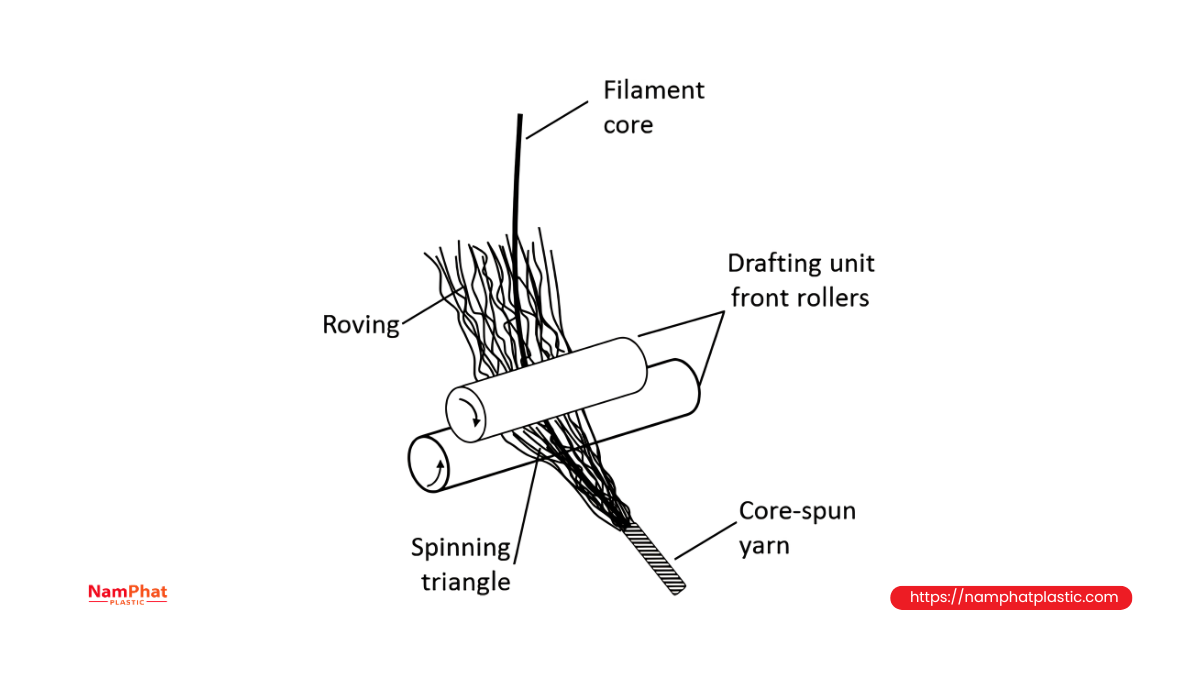
PE 20/9 is generally a spun construction made from staple fibers. Its surface has a certain degree of hairiness, and the thread body is relatively soft and compressible as it passes through the needle eye or sits within the seam.
PP multifilament is made from continuous filaments. The thread is generally more uniform along its length and has a different surface structure from spun thread.
For the same material and size, multifilament thread generally has higher strength than spun thread. Coats also notes significant differences in strength and performance between filament and spun constructions.
Therefore, two threads with the same tex do not necessarily have the same:
- Apparent diameter.
- Softness.
- Seam coverage.
- Grip on the bag surface.
- Knotting and stitch-locking behavior.
5.2. Denier is not diameter
Denier and tex measure mass per unit length rather than directly measuring physical diameter.
Two threads with the same 266 tex may have different diameters because of:
- Different material densities.
- Different levels of fiber-bundle compaction.
- Different numbers of filaments or fibers.
- Different twist levels.
- Different degrees of hairiness or smoothness.
- Different filament cross-sectional shapes.
Therefore, a simple diameter measurement should not be used alone to conclude that two thread types are equivalent. For soft and hairy thread, the measurement result can also depend on the pressure applied by the measuring instrument.
5.3. Breaking force does not depend only on size
Within the same material and similar construction, a larger yarn generally has a higher breaking force. However, when comparing spun PE with PP multifilament, it is important to distinguish between:
- Breaking force: the force required to break the entire thread, generally expressed in N, cN, or kgf.
- Tenacity: relative strength obtained by dividing breaking force by linear density, generally expressed in cN/tex.
ASTM D2256 identifies breaking force, elongation, and tenacity as fundamental parameters for evaluating yarn. The standard also indicates that when comparing yarns of different sizes, breaking force should be normalized to tenacity rather than relying only on absolute breaking force.
For example, a PP 1200D thread may be finer than PE 20/9 but still achieve relatively high breaking force if the filament has good tenacity. Conversely, high breaking force does not necessarily mean stable machine performance if the thread is too stiff, too smooth, has unbalanced twist, or has difficulty forming a stable loop.
5.4. Elongation directly affects stitch formation
On a bag sewing machine, thread is continuously subjected to tension, bending, friction, and changes in acceleration. Thread elongation affects the size of the loop formed below the needle.
Thread that stretches too much under tension can produce a smaller loop, making it more difficult for the hook or looper to catch the thread and potentially causing skipped stitches. On the other hand, thread with lower elongation generally forms a larger loop, but excessive stiffness can create other adjustment issues.
Coats identifies elongation as an important factor in loop formation, loop catching, and seam strength. Two thread types with similar breaking force can still perform differently if their force–elongation behavior is different.
5.5. Differences in friction and lubrication
Sewing thread must pass through multiple machine components:
- Thread guides.
- Tension assembly.
- Guide eyes.
- Needle eye.
- Bag material.
- Loop-forming components.
PE spun thread has a fibrous surface, while PP multifilament can be smoother. When changing from PE to PP while keeping the same machine settings, the following may occur:
- Actual thread tension changes.
- The thread slides through the tension discs more easily.
- The thread knot shifts from the desired position.
- The seam becomes too loose or too tight.
- Thread ends slip out more easily.
- Thread-loop formation becomes unstable.
- Random skipped stitches increase.
Uniformity, surface smoothness, abrasion resistance, and finishing are important factors in sewability, not just thread size.
5.6. Twist direction and twist balance
Two threads with the same tex but different twist directions or twists per meter may behave differently on the machine.
Thread with too little twist may separate into strands, fuzz, and wear more easily. Thread with excessive twist may develop reverse twisting, knots, or wrapping along the thread path.
Coats notes that unsuitable twist can lead to fiber fuzzing, breakage, twist loops, and knotting. Therefore, twist balance is an important part of sewing thread performance.
6. Can PP 1200D/2 replace PE 20/9?
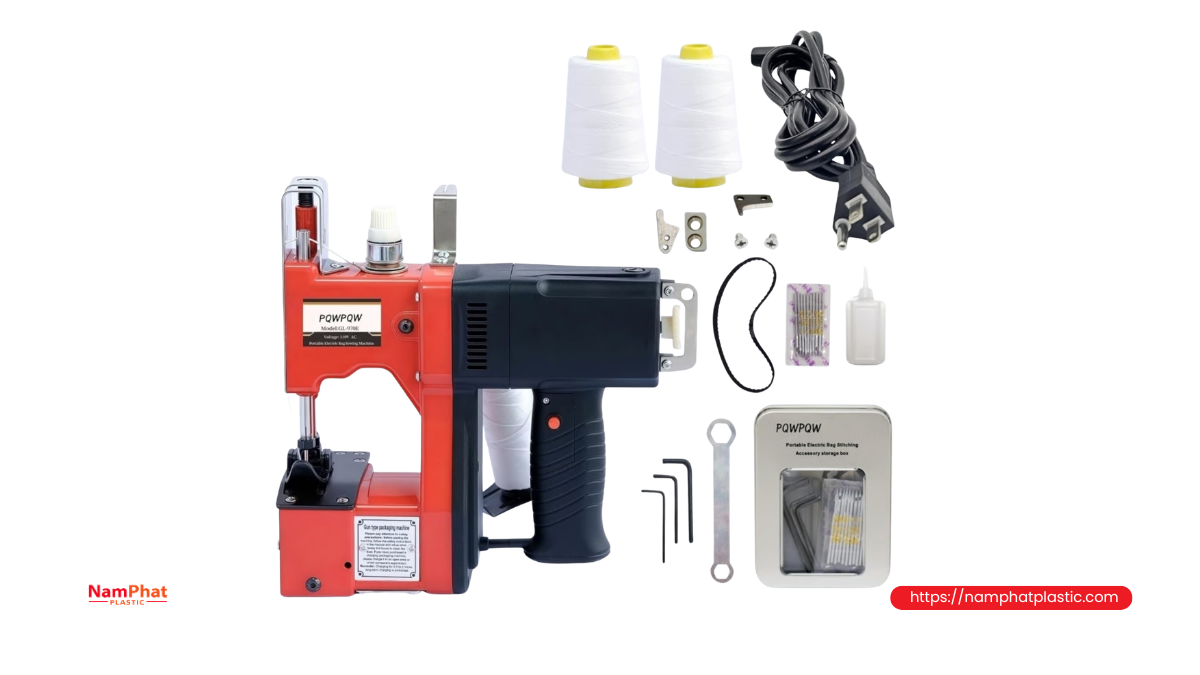
Looking only at linear density:
- Theoretical PE 20/9: approximately 265.8 tex.
- Theoretical PP 1200D/2: approximately 266.7 tex.
The two values are almost equivalent.
Therefore, PP 1200D/2 is one of the closest options to PE 20/9 in terms of mass per unit length among commonly encountered configurations.
However, actual substitution requires additional conditions:
- PP breaking force must meet the seam requirements.
- Elongation must be compatible with the machine's loop-forming mechanism.
- Twist direction must be compatible.
- The thread must not split into filaments or fibers when passing through the needle.
- Surface smoothness must be controlled through suitable finishing.
- Apparent diameter must not be excessive for the needle.
- The seam must pass tensile, impact, and drop testing under actual bag loads.
- The machine must run stably at actual production speed, not only at low speed during sample testing.
Therefore, PP 1200D/2 can be considered a candidate for substitution, but it should not be treated as an absolutely equivalent product before testing.
7. Can PP 900D or 1000D be as strong as PE 20/9?
This can occur in some cases, but it cannot be determined from denier alone.
If PP 900D or 1000D is a high-tenacity filament, its breaking force may be relatively high even though its linear density is lower than PE 20/9. However, the final seam performance also depends on:
- Number of load-bearing thread lines.
- Stitch type.
- Stitch density.
- Stitch length.
- Thread tension.
- Strength of the bag material around the needle hole.
- Thread-knot position.
- Dynamic load resistance.
- Vibration and impact during transportation.
A thread with high breaking force but a very low linear density may concentrate stress over a small area, causing the bag material to be cut or torn around the needle holes. Conversely, an excessively thick thread may require a larger needle, creating larger needle holes and reducing the strength of the seam area.
Therefore, the strength of the entire seam should be evaluated rather than only the breaking force of the thread spool.
8. Comparing length per kilogram
Converting to tex also helps estimate thread length per kilogram.
The theoretical formula is:
- Length, m/kg = 1,000,000 ÷ tex
| Thread type | Nominal tex | Theoretical length |
| PE 20/9 | 265.8 tex | Approximately 3,760 m/kg |
| PP 900D/1 | 100 tex | Approximately 10,000 m/kg |
| PP 1000D/1 | 111.1 tex | Approximately 9,000 m/kg |
| PP 1200D/1 | 133.3 tex | Approximately 7,500 m/kg |
| PP 900D/2 | 200 tex | Approximately 5,000 m/kg |
| PP 1000D/2 | 222.2 tex | Approximately 4,500 m/kg |
| PP 1200D/2 | 266.7 tex | Approximately 3,750 m/kg |
| PP 900D/3 | 300 tex | Approximately 3,330 m/kg |
PP 1200D/2 and PE 20/9 are therefore close not only in tex but also in theoretical length per kilogram.
However, actual length may be lower because of twist, shrinkage, and finishing agents. During inspection, it is advisable to measure the actual length of a spool or weigh a thread sample with a known length.
9. Do not compare selling prices only by kilogram
Two thread types with the same price per kilogram do not necessarily have the same sewing cost.
Actual cost should be calculated based on:
- Cost per bag = Thread consumption per bag × Thread price per meter
Where:
- Thread price per meter = Price per kilogram ÷ Actual meters per kilogram
In addition to thread cost, consider:
- Machine downtime caused by thread breakage.
- Time required to rethread the machine.
- Number of bags requiring seam repair.
- Scrap caused by skipped stitches.
- Complaints due to open bag mouths.
- Needle replacement or machine adjustment costs.
- Reduced output when machine speed must be lowered.
A PP product with a higher price per kilogram may still produce a lower sewing cost if it runs faster, breaks less frequently, and provides more usable length. Conversely, inexpensive but unstable thread can increase total production costs.
10. Specifications to request before conversion
When a supplier proposes replacing PE 20/9 with PP thread, the business should request at least the following specifications.
Actual linear density
It should be stated in tex or total denier of the finished thread.
Do not accept only “PP 1200D” without knowing whether it is 1200D/1, 1200D/2, or a finished thread with a total denier of 1200D.
Thread construction
The following should be specified:
- Spun or multifilament.
- Number of plies.
- Number of filaments.
- Whether it is twisted.
- S or Z twist direction.
- Twists per meter.
- Average and minimum breaking force.
Do not rely on only one average value. A thread lot with a good average value but high variation can still break randomly on the machine.
Tenacity
Tenacity helps compare yarn quality when samples have different tex values.
Formula:
- Tenacity = Breaking force ÷ Tex
Elongation at break
For demanding applications, elongation at a working load close to the actual machine tension should also be evaluated.
Uniformity and defects
Check for:
- Thick sections.
- Thin sections.
- Splices.
- Missing plies.
- Twist loops.
- Filament splitting.
- Abnormal surface fuzzing.
- Uneven finishing or lubrication.
ISO 2062 and ASTM D2256 are commonly used methods for evaluating breaking force and elongation of yarn taken from packages.
11. Trial procedure for replacing PE 20/9 with PP
Step 1: Keep the PE 20/9 sample currently running reliably
This is the control sample. Record:
- Lot number.
- Spool weight.
- Actual tex.
- Breaking force.
- Elongation.
- Needle type.
- Thread tension.
- Machine speed.
- Thread breakage rate.
- Skipped-stitch rate.
Step 2: Measure the PP thread before putting it on the machine
Do not rely entirely on the product label. At minimum, check:
- Actual tex.
- Breaking force.
- Elongation.
- Twist.
- Apparent diameter.
- Hairiness or filament splitting.
Step 3: Run a low-speed trial
Observe:
- Whether the thread moves steadily through the tension assembly.
- Whether the loop forms consistently.
- Whether the thread vibrates or wraps around the thread path.
- Whether the stitches are loose, too tight, or skipped.
- Whether the thread-locking position is correct.
Step 4: Adjust the needle and thread tension
Do not keep every PE 20/9 setting unchanged and then conclude that PP is unsuitable.
Adjustments may be required for:
- Needle size.
- Needle condition.
- Needle-thread tension.
- Looper-thread tension.
- Thread path.
- Hook/looper position.
- Stitch length.
- Machine speed.
Step 5: Run at production speed
Many threads run well at low speed but begin to break or skip stitches when machine speed increases.
Run continuously long enough to observe:
- Number of breaks over a defined period.
- Number of bags with skipped stitches.
- Needle temperature.
- Thread abrasion.
- Fiber or filament separation.
- Tension variation as the spool becomes smaller.
Step 6: Test on actual products
At least a small batch of 100–300 bags should be tested, including:
- Visual inspection of the seam.
- Bag-mouth pull test.
- Static load test.
- Drop test at the actual load.
- Transportation or vibration simulation.
- Monitoring of thread-end slippage.
Large-scale conversion should only be made after the new thread passes both machine-performance requirements and seam-strength requirements.
12. Common mistakes when converting thread sizes
Assuming PP 1200D is equivalent to PE 20/9
Single-ply PP 1200D is only about 133 tex, while PE 20/9 is approximately 266 tex. The two differ by nearly a factor of two in mass per unit length.
Not asking about the number of PP plies
PP 1200D/1 and PP 1200D/2 are very different products. If the label only states 1200D without the construction, there is not enough information for conversion.
Comparing only breaking force
Breaking force does not fully represent loop formation, tension stability, or abrasion resistance during sewing.
Assuming the same tex means the same diameter
Spun and multifilament yarns have different surface structures, compression, and fiber-bundle density. The same tex does not mean the same apparent diameter.
Testing on the machine for only a few minutes
Problems such as random thread breakage, skipped stitches, or filament splitting may only appear during continuous operation, at high speed, or as the spool diameter changes.
Not testing the seam under actual load
Successful machine running is not enough. The final objective is a seam that does not open, tear the bag edge, or fail under the loads encountered during packaging, handling, and transportation.
13. Substitution feasibility summary table
| Option | Direct replacement feasibility for PE 20/9 | Comments |
| PP 900D/1 | Very low | Approximately 2.66 times finer than PE 20/9 |
| PP 1000D/1 | Very low | Significantly finer |
| PP 1200D/1 | Low | Only about half the tex of PE 20/9 |
| PP 900D/2 | Low to moderate | Closer but still approximately 25% lighter |
| PP 1000D/2 | Moderate | Can be tested if breaking force is suitable |
| PP 1200D/2 | Highest in terms of size | Close to PE 20/9 in tex but still requires machine testing |
| PP 900D/3 | Testable | Slightly larger and may require different needle and tension settings |
Conclusion
PE 20/9 and PP 900D–1200D thread cannot be directly converted simply by looking at the product names.
If the 20/9 designation is based on a single yarn of Ne 20, PE 20/9 has a theoretical linear density of approximately:
- 265.8 tex
- 2,392D
- Approximately 2,400D when rounded
Therefore:
- Single-ply PP 900D–1200D is considerably finer than PE 20/9.
- PP 1200D/2 is the closest in terms of linear density.
- PP 1000D/2 and PP 900D/3 can also be considered for testing depending on seam requirements.
- The same tex does not mean the same breaking force, diameter, elongation, or machine performance.
To determine whether substitution is appropriate, actual tex, breaking force, tenacity, elongation, twist, friction, loop formation, and seam strength on loaded bags should all be evaluated.
Businesses should not simply ask, “How many D is PE 20/9?” A more useful question is:
- Which PP thread has the closest combination of total tex, breaking force, elongation, and machine performance to the PE 20/9 currently being used?
That is the more practical approach to thread conversion in actual production.
Frequently asked questions
1. Is PE 20/9 the same as 2400D thread?
If the single yarn is actually Ne 20 and the finished thread consists of nine strands, the theoretical linear density is approximately 2,392D, which can be rounded to about 2,400D. Actual tex still needs to be confirmed by measuring a known length and weighing it.
2. Can PP 1200D replace PE 20/9?
Single-ply PP 1200D is nearly half the linear density of PE 20/9, so it is not a direct equivalent. PP 1200D/2 is the configuration that is closest to PE 20/9 in total denier.
3. Can PP 1200D/2 definitely replace PE 20/9?
Not necessarily. The two are close in tex but differ in material, construction, surface characteristics, elongation, and friction. Machine trials and seam-strength testing are required.
4. Does higher denier always mean higher strength?
No. Denier only represents mass per unit length. Strength also depends on the material, filament quality, molecular orientation, twist, defects, and finishing process.
5. Should breaking force or tenacity be used for comparison?
Both should be considered. Breaking force indicates the actual force required to break the thread, while tenacity helps compare relative strength among threads with different linear densities.
6. Which specifications should be checked first when changing thread?
Check actual total tex, ply construction, breaking force, elongation, and twist direction first. Then perform machine trials and seam-strength tests on loaded bags.
Nam Phát Plastic supplies spun PE bag sewing thread and PP multifilament yarn for various industrial bag-closing applications. To select the appropriate specification, customers should provide the current thread sample, sewing machine type, bag material, packaging load, and actual operating speed.
Comparing the sample and conducting a direct machine trial will help identify the appropriate thread and reduce thread breakage, skipped stitches, and the risk of seam failure during transportation.
>>> See also:
- 0 Comment


