


 Phan Van Hoang
- 31/07/2026
- 155
When testing the quality of industrial bag sewing thread, buyers often care about one simple question: how much tensile force can the thread withstand before breaking?
To answer this, a laboratory may provide two parameters: breaking force and tenacity. Both relate to the tensile strength of the thread, but their meanings and applications are quite different.
- Breaking force indicates the absolute force required to break the thread sample.
- Tenacity indicates the tensile strength normalized according to the thread’s fineness or mass per unit length.
Therefore, a thread with a higher breaking force is not necessarily made from a stronger material. It may simply be a larger, heavier thread or contain more component plies.
Understanding these two parameters correctly helps businesses avoid incorrect comparisons between 20/6, 20/8, and 20/9 bag sewing thread, while also establishing more accurate raw-material testing standards.
Table of Contents [Hide]
1. What is breaking force?
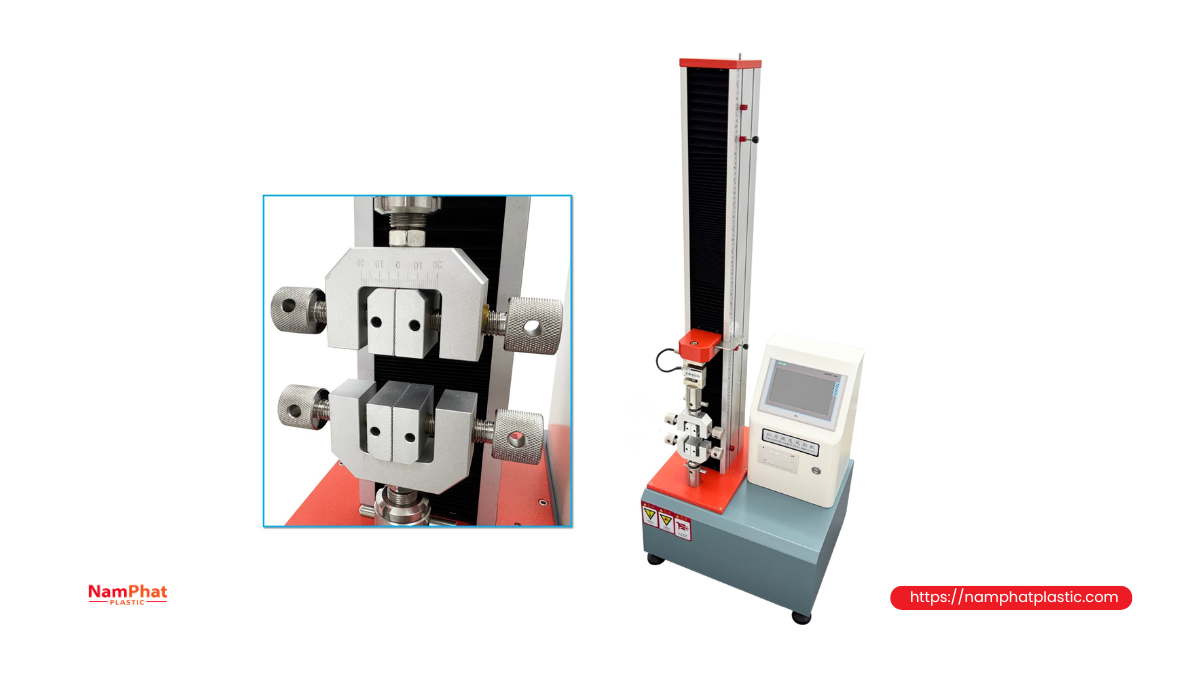
Breaking force, also known as breaking tensile force or breaking force, is the force applied to a thread sample at the moment the sample fails during a tensile test.
During testing, a length of thread is held at both ends by the clamps of a tensile tester. The machine pulls the two ends of the sample apart at a preset speed. The applied force increases gradually until the thread breaks.
The force recorded at the moment the thread fails is the breaking force.
Common units include:
- Newton, N;
- Centinewton, cN;
- Kilogram-force, kgf;
- Gram-force, gf.
Under the si system, force should be expressed in Newtons. Kilogram is a unit of mass, not force. When conversion is required, 1 kgf is exactly equal to 9.80665 N.
Example of breaking force
A sample of pe 20/9 bag sewing thread is placed on a tensile tester and breaks when the force reaches 88 N.
The result may be reported as:
- average breaking force: 88 N
This means that under the specified test conditions, the thread sample withstands an increasing tensile force of approximately 88 N before breaking.
Breaking force is a very intuitive parameter because it indicates the absolute load-bearing capability of the thread.
2. What is tenacity?
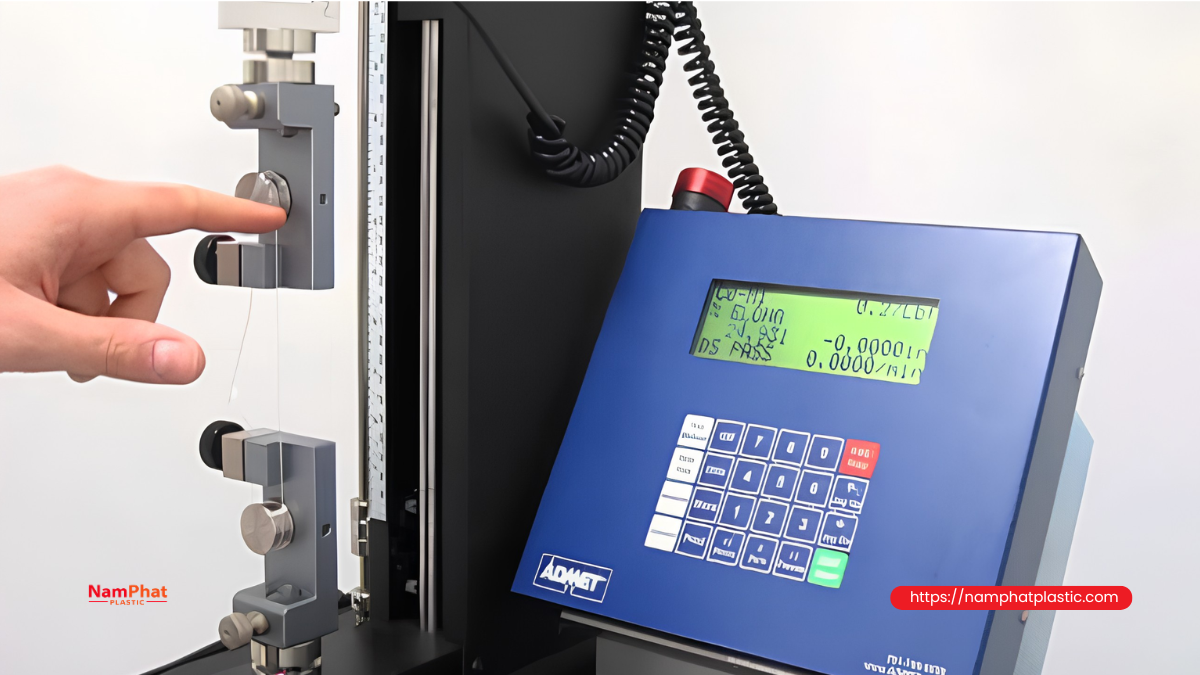
Tenacity is the ratio between the breaking force of a thread and its linear density.
Linear density indicates how much a given length of thread weighs. In the tex system:
- 1 tex = 1 gram per 1,000 meters of thread.
Tenacity is commonly expressed in:
- cN/tex
According to iso terminology, breaking tenacity is the ratio between the breaking force of a yarn and its linear density, generally expressed in centinewtons per tex.
The formula is:
- tenacity = breaking force ÷ linear density
When breaking force is expressed in cN and linear density in tex:
- tenacity (cN/tex) = breaking force (cN) ÷ actual linear density (tex)
Since 1 N = 100 cN:
- tenacity (cN/tex) = breaking force (N) × 100 ÷ tex
Tenacity calculation example
A thread has:
- breaking force: 72 N;
- actual linear density: 180 tex.
Convert the force:
- 72 N × 100 = 7,200 cN
Thread tenacity:
- 7,200 ÷ 180 = 40 cN/tex
Result:
- breaking tenacity: 40 cN/tex
This value indicates that for every 1 tex of linear density, the thread produces a tensile strength equivalent to 40 cN.
3. Key differences between breaking force and tenacity
| criterion | breaking force | tenacity |
| Vietnamese name | breaking tensile force, breaking force | specific strength, tensile strength by linear density |
| What it represents | absolute force required to break the thread | breaking force normalized by thread size |
| common units | N, cN, kgf | cN/tex, N/tex |
| Does it depend on thread size? | yes, strongly | largely normalized for linear density |
| main use | directly evaluating load-bearing capability | comparing material quality and structural efficiency |
| Can different thread sizes be compared directly? | not recommended | yes, when test conditions are the same |
| quality-control focus | minimum breaking force of the product | raw-material quality, spinning, plying, and twisting |
In simple terms:
- breaking force answers “how much force can the thread withstand before it breaks?”, while tenacity answers “how strong is the thread relative to its size?”
4. Why does a larger thread usually have a higher breaking force?
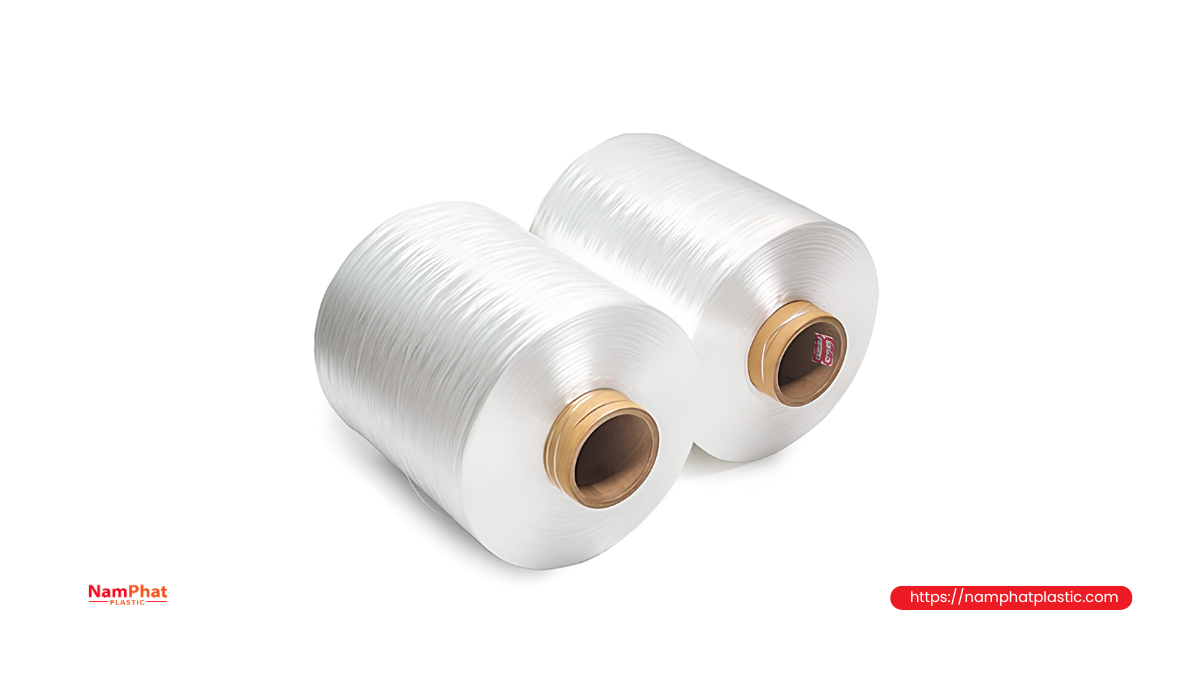
Assume two threads are made from the same type of fiber, with comparable raw-material quality and manufacturing technology:
- thread a has a linear density of 180 tex;
- thread b has a linear density of 270 tex.
If both have a tenacity of 35 cN/tex:
thread a
Breaking force:
- 35 × 180 = 6,300 cN = 63 N
thread b
Breaking force:
- 35 × 270 = 9,450 cN = 94.5 N
Although the material quality measured by tenacity is the same, thread b has a higher breaking force because it has a higher linear density.
This is why 20/9 thread will generally have a higher breaking force than 20/6 thread when they are made from the same raw material and have comparable manufacturing quality.
However, the 20/6 or 20/9 designation alone cannot determine the exact breaking force. Fiber quality, twist, plying uniformity, yarn damage during twisting, and actual linear density can all affect the final result.
5. A high breaking force does not necessarily mean high tenacity
Consider these two hypothetical thread samples:
| parameter | thread a | thread b |
| actual linear density | 180 tex | 270 tex |
| breaking force | 72 N | 90 N |
| tenacity | 40 cN/tex | 33.3 cN/tex |
If we look only at breaking force, thread b appears better because it withstands 90 N compared with 72 N for thread a.
However, after normalization by linear density:
- thread a reaches 40 cN/tex;
- thread b reaches only 33.3 cN/tex.
Thus, thread b has a higher absolute breaking force mainly because it is larger. When evaluated per unit of linear density, thread a has a higher tenacity.
This example shows why breaking force should not be used alone to determine which thread has better raw-material or manufacturing quality when the two samples have different sizes.
6. When should breaking force be used?
Breaking force is suitable when a business needs to know the actual load-bearing capability of a specific thread size.
6.1. Setting the minimum breaking force for each product code
A company can establish its own specifications, such as:
- pe 20/6 thread: minimum breaking force according to internal specifications;
- pe 20/8 thread: minimum breaking force according to internal specifications;
- pe 20/9 thread: minimum breaking force according to internal specifications.
The limits should be established from actual test results, customer requirements, and the operating conditions of the bag sewing machine.
6.2. Comparing batches with the same specifications
When two batches are both 20/9 thread, with comparable linear density and test methods, breaking force is a direct indicator for identifying an abnormally weak batch.
For example:
- a normal batch usually reaches 85–90 N;
- a new batch reaches only 68–72 N.
Such a decrease may indicate issues with raw materials, twist, plying quality, splice points, or mechanical damage during production.
6.3. Evaluating the load-bearing capability of thread in the seam
Breaking force helps estimate the load-bearing capability of a single thread. However, the strength of a completed seam also depends on factors such as stitch type, stitch density, bag material strength, thread tension, needle condition, and the degree of thread damage during sewing.
Therefore, thread breaking force cannot completely replace seam strength testing. ASTM also distinguishes standards for testing the tensile properties of yarns, standards for sewing thread, and standards for evaluating seam failure.
7. When should tenacity be used?
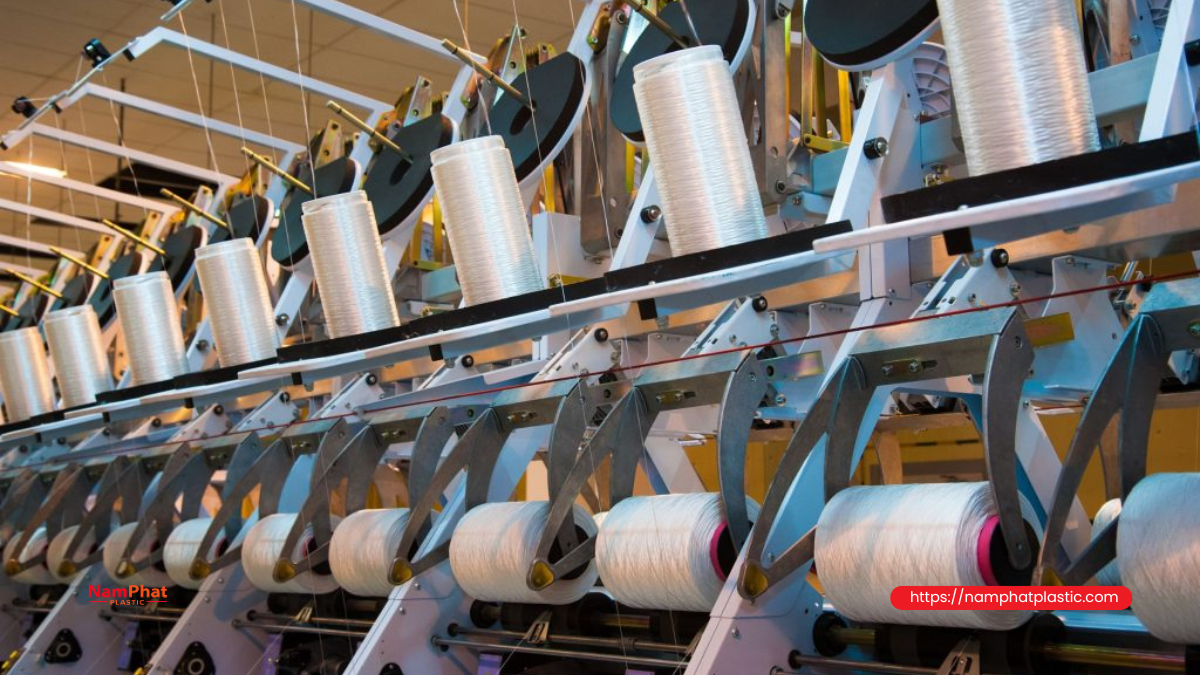
Tenacity is more suitable when evaluating material quality and comparing threads with different linear densities.
7.1. Comparing 20/6, 20/8, and 20/9 thread
The breaking force of 20/9 will generally tend to be higher than 20/6 because it contains more component plies and has a higher linear density, assuming other factors are comparable.
Therefore, comparing only breaking force does not fully reflect quality.
Tenacity normalizes the result by tex and helps answer the question:
- Which product produces greater strength from the same amount of material?
7.2. Evaluating the effectiveness of plying and twisting
During bag sewing thread production, fibers or single yarns can experience:
- abrasion while passing through guides;
- excessive tension;
- uneven tension between component yarns;
- damage from pulleys or thread guides;
- uneven plying;
- excessively low or high twist;
- abnormal friction and heat generation.
These problems can reduce the tenacity of the finished thread even when the thread size still meets specifications.
Therefore, tenacity is a useful parameter for evaluating how well strength is retained after plying and twisting.
7.3. Comparing suppliers or raw-material formulations
If two suppliers offer thread with the same breaking force but one product has a lower tex value, the product with the lower tex will have a higher tenacity.
This may indicate better raw materials or a more efficient yarn structure. However, purchasing decisions should also consider consistency, elongation, machine performance, and cost.
7.4. Monitoring long-term factory stability
Tenacity can be monitored by:
- production date;
- production shift;
- raw-material batch;
- twisting machine;
- spindle position;
- operator;
- twist level;
- machine speed.
If tex remains nearly unchanged while tenacity gradually decreases, the factory should inspect the machine condition, thread-guiding system, tension, and incoming raw-material quality.
8. Is breaking force or tenacity more important for bag sewing thread?
It is better not to choose one and ignore the other. The two parameters serve different purposes.
Breaking force is important for users
Users need to know whether the actual thread spool is strong enough to:
- run stably on the bag sewing machine;
- withstand temporary tension during stitch formation;
- reduce thread breakage during sewing;
- maintain seam strength during transportation and handling.
Tenacity is important for manufacturers and quality-control departments
Manufacturers need to know:
- whether material strength is stable;
- whether plying and twisting reduce strength;
- whether a high-breaking-force batch is actually higher quality or simply heavier;
- how efficiently raw material is being used across different formulations.
A suitable evaluation approach
For industrial bag sewing thread, the coa should ideally include at least:
- actual linear density, tex;
- average breaking force, N;
- minimum breaking force within the sample group, N;
- average tenacity, cN/tex;
- elongation at break, %;
- number of test specimens;
- test method and test conditions.
9. Why should actual linear density be used to calculate tenacity?
A common mistake is using nominal tex to calculate tenacity.
For example, a product is labeled as 180 tex, but actual measurements may be:
- 174 tex;
- 183 tex;
- 190 tex.
If all three samples have a breaking force of 72 N, their actual tenacity will be different:
- 174 tex: approximately 41.4 cN/tex;
- 183 tex: approximately 39.3 cN/tex;
- 190 tex: approximately 37.9 cN/tex.
If a fixed value of 180 tex is used for all calculations, differences in mass and material-use efficiency may be hidden.
Linear density should be measured using a clearly defined method. ASTM lists ASTM D1907/D1907M as a method for determining the linear density of yarn by the skein method, while ASTM D1059 covers determination of yarn number from short-length specimens.
10. How does the test method affect the results?
Breaking force and tenacity are not values independent of test conditions.
Results can vary depending on:
- gauge length;
- pulling speed;
- pretension;
- type of clamp;
- thread slippage in the clamps;
- temperature and humidity during conditioning;
- number of specimens;
- break location;
- sampling method from the spool.
ASTM D2256/D2256M-21 covers the single-strand tensile testing of yarns, including monofilament, multifilament, spun yarn, single yarn, plied yarn, and cordage. It covers the measurement of breaking force and elongation and provides guidance for calculating breaking tenacity and other tensile properties.
ISO 2062:2009 also specifies methods for determining breaking force and elongation at break of yarn taken from packages. Different methods are provided depending on whether the specimen is tested directly, automatically, in skein form after conditioning, or after wetting.
Therefore, two results should only be compared when:
- the test method is the same;
- gauge length is the same;
- pulling speed is the same;
- conditioning conditions are the same;
- tex calculation is the same;
- specimen size and sampling method are comparable.
Results from two laboratories using different test conditions should not be used immediately to conclude that one supplier is better than another.
11. Why breaking force and tenacity alone are not enough to evaluate bag sewing thread
A thread with high tenacity can still perform poorly on a sewing machine if other properties are unsuitable.
Elongation at break
Thread with very low elongation may have difficulty absorbing sudden loads. Thread with excessive elongation can cause unstable or deformed stitches under load.
ASTM D2256 and ISO 2062 both consider elongation at break an important part of yarn tensile testing, alongside breaking force.
Breaking-force uniformity
Two batches may have the same average breaking force but different levels of variation, resulting in different stability.
For example:
- batch a ranges from 82 to 88 N;
- batch b ranges from 60 to 105 N.
Although the averages may be similar, batch b contains more weak sections and may have a higher risk of random thread breakage.
Therefore, quality control should also monitor:
- minimum value;
- standard deviation;
- coefficient of variation, cv%;
- number of specimens below the allowable limit.
Abrasion resistance
Bag sewing thread passes through tensioners, guides, needles, and metal surfaces at high speed. A thread may have good initial breaking force but still break during machine operation if its surface is prone to fuzzing or abrasion.
Loop strength and knot strength
In a seam, thread does not always carry the load as a straight strand. It bends, tightens, and contacts other thread segments. Therefore, loop strength or knot strength may provide additional information for certain applications.
Twist and structural stability
Twist affects the cohesion between component yarns. Excessively low twist can cause the thread to separate and fuzz. Excessively high twist can make the thread stiff, cause excessive torque, and reduce part of its strength because of internal stress.
12. Common mistakes when reading a bag sewing thread coa
Mistake 1: Comparing the breaking force of 20/6 with 20/9
20/9 is larger and therefore generally has a higher breaking force. To evaluate material quality, tenacity should also be compared.
Mistake 2: Seeing a high breaking force and concluding that the quality is good
A high breaking force may result from a heavier thread or a higher linear density than the specification. Actual tex should be checked.
Mistake 3: Reporting “8 kg strength”
Kilogram is a unit of mass. A technical report should state 8 kgf or convert it to approximately 78.45 N.
Mistake 4: Reporting only tenacity without tex
Tenacity cannot be verified if the coa does not provide the corresponding actual linear density and breaking force.
Mistake 5: Reporting only the average value
A few very weak sections can cause random thread breakage even when the average value meets specifications. Minimum value and cv% should also be monitored.
Mistake 6: Assuming thread breaking force equals seam strength
Seam strength also depends on the bag material, stitch type, stitches per unit length, needle, tension, and the degree of thread damage during sewing.
13. Suggested coa format for bag sewing thread
| Parameter | Unit | Result | Limit |
| thread specification | – | pe 20/9 | according to order |
| actual linear density | tex | … | according to internal specification |
| average breaking force | N | … | ≥ … |
| minimum breaking force | N | … | ≥ … |
| breaking tenacity | cN/tex | … | ≥ … |
| elongation at break | % | … | … to … |
| breaking-force cv% | % | … | ≤ … |
| number of test specimens | specimens | … | ≥ … |
| test method | – | iso 2062 or astm d2256 | fixed |
| specimen conditioning | – | according to test method | fixed |
Specific limits should not simply be copied from another type of thread. The manufacturer should establish specifications based on its own test data, bag sewing machine performance, and actual customer requirements.
14. How to use breaking force and tenacity in quality control
An effective quality-control system can be divided into three levels.
level 1: pass/fail inspection
Use minimum breaking force to reject batches that do not meet the basic load-bearing requirement.
level 2: material-quality inspection
Use tenacity to determine whether a batch achieves the required strength per unit of linear density.
level 3: stability monitoring
Also monitor:
- breaking-force cv%;
- tex cv%;
- elongation;
- hairiness;
- twist;
- thread-breakage frequency during machine operation;
- number of bags sewn or meters sewn per thread break.
Combining laboratory data with actual machine-running results provides a more accurate picture of bag sewing thread quality.
Frequently asked questions
1. Does higher tenacity mean the bag sewing thread is always better?
High tenacity indicates that the thread has good breaking strength relative to its linear density. However, bag sewing thread also needs suitable elongation, stable twist, abrasion resistance, and good machine-running performance.
A thread with very high tenacity but excessive stiffness, high fuzzing, or unsuitable elongation can still cause problems during sewing.
2. Is 20/9 thread always stronger than 20/6 thread?
In terms of absolute breaking force, 20/9 thread will generally tend to be higher because it contains more component yarns and has a higher linear density.
However, in terms of tenacity, 20/9 is not necessarily higher. Well-produced 20/6 thread may have higher tenacity than a low-quality 20/9 thread.
3. Can tenacity be calculated without knowing tex?
No. Tenacity is breaking force divided by linear density, so actual tex or another reliably convertible yarn-count system is required.
For quality control, actual tex should be measured rather than relying only on the nominal value.
4. Are breaking strength and breaking force the same?
In commercial transactions, the two terms are sometimes used interchangeably. However, “breaking force” is clearer when the result is expressed in N, cN, or kgf.
The term “strength” can sometimes be confused with normalized strength based on area or linear density. Therefore, the coa should clearly state the property and its unit.
5. What parameters should be requested from a bag sewing thread supplier?
At minimum, request:
- actual tex;
- average breaking force;
- minimum breaking force;
- tenacity;
- elongation at break;
- test method;
- number of specimens;
- production date and batch number.
Conclusion
Breaking force and tenacity are both used to evaluate the tensile performance of bag sewing thread, but they are not interchangeable.
Breaking force represents the absolute force that the thread can withstand before breaking. It is suitable for evaluating the load-bearing capability of a specific thread specification and for checking batches of the same type.
Tenacity is breaking force normalized by linear density. It is suitable for comparing material quality, structural efficiency, and stability among 20/6, 20/8, 20/9, or other thread sizes.
For accurate evaluation of bag sewing thread, businesses should consider:
- actual linear density;
- breaking force;
- tenacity;
- elongation at break;
- uniformity;
- abrasion resistance;
- actual performance on the sewing machine.
A quality thread should not simply be “difficult to break.” It should also provide strength appropriate to the amount of material used, remain stable throughout its length, and perform reliably under industrial sewing conditions.
>>> See also:
- 0 Comment


