


 Phan Van Hoang
- 03/08/2026
- 161
Two thread cones can be identical in terms of raw material, specifications, diameter, and breaking force, yet produce completely different machine-running results. One cone may run steadily and produce consistent stitches, while the other quickly develops fuzz, separates into strands, skips stitches, or breaks right near the needle.
The cause sometimes does not lie in the thread strength, but in the final twist direction of the thread being unsuitable for the machine's stitch-forming mechanism.
Therefore, S and Z twist are not merely thread manufacturer specifications. They are also factors that directly affect loop formation, tension stability, thread fuzzing, and the operating efficiency of industrial bag sewing machines.
Key principle: Most common industrial single-needle sewing machines are designed to run with Z-twist thread. However, double-needle machines, machines with symmetrical hook mechanisms, or specialized machines may require different twist directions for each thread position.
Table of Contents [Hide]
1. What are S twist and Z twist?
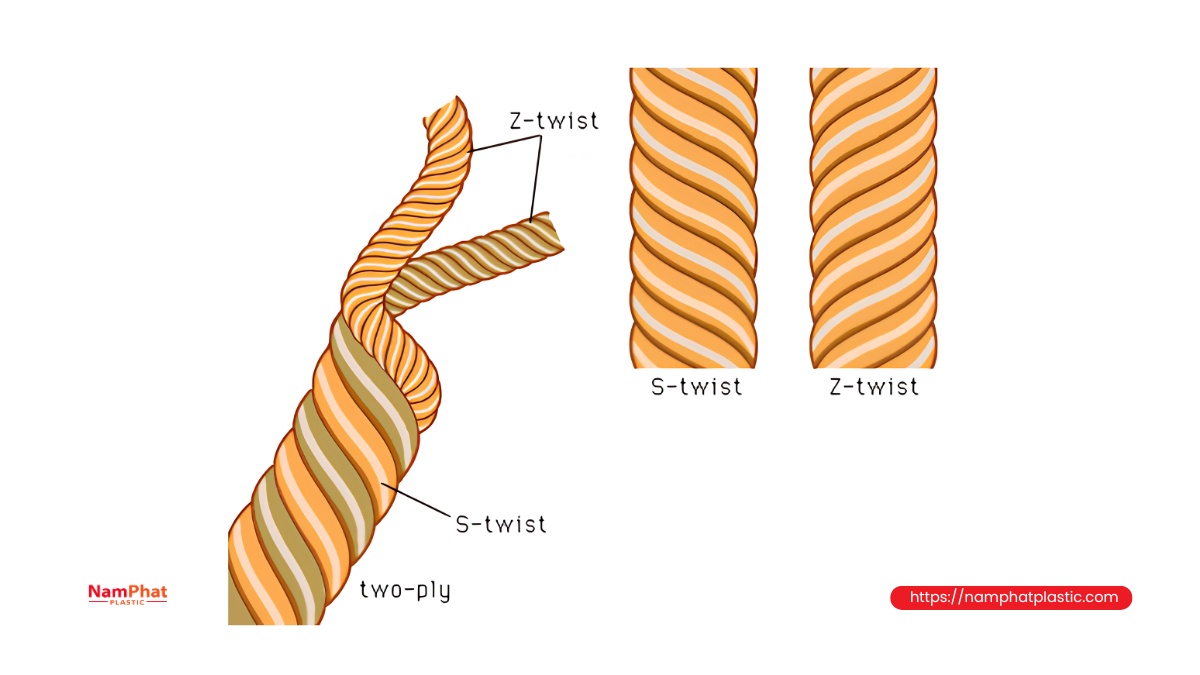
Twist direction indicates the direction in which the helical lines run along the thread body. Under the international designation system, twist direction is represented by the letter S or Z. ISO 2 is the standard specifically used to define the designation of twist direction for yarns and related products.
The distinction is relatively simple:
-
If the diagonal line on the thread body runs in the same direction as the middle stroke of the letter S, it is S twist.
-
If the diagonal line runs in the same direction as the diagonal stroke of the letter Z, it is Z twist.
Coats also uses this identification method and states that S twist is sometimes called “right twist,” while Z twist is sometimes called “left twist.” However, the terms left twist and right twist can cause confusion because they depend on the viewing direction. In technical documents, purchase orders, and quality inspection records, companies should state S or Z directly rather than simply using “left” or “right.”
2. Distinguishing single-yarn twist from final twist
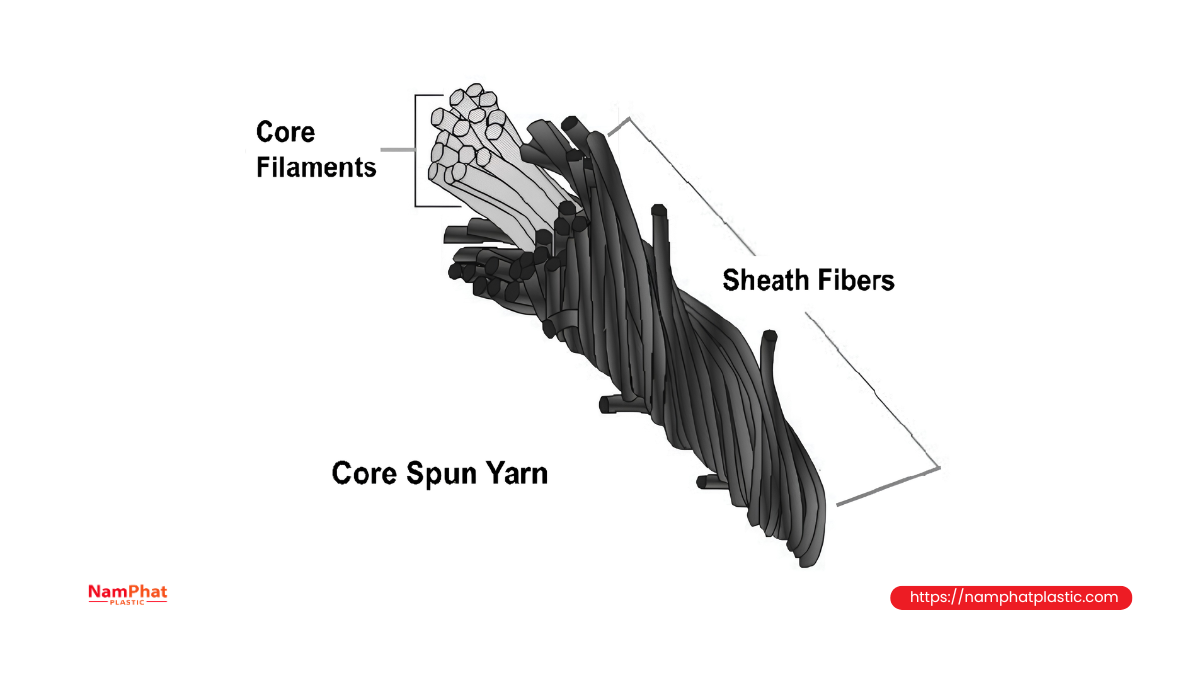
A multi-strand sewing thread usually undergoes at least two levels of twisting:
-
Twist used to form the single yarn.
-
Twist used to combine the single yarns into the finished thread.
In common sewing thread construction, the single yarn is often twisted in the S direction. Then two, three, or more single yarns are plied and twisted in the opposite direction, commonly Z, to create a finished sewing thread with better balance.
Therefore, when saying that a PE 20/6, 20/8, or 20/9 thread cone has S or Z twist, it is necessary to identify the outermost twist direction of the finished thread, not the internal twist direction of each PE 20/1 yarn.
This is particularly important for industrial bag sewing thread manufacturers. The sewing machine directly contacts and acts on the final plied structure, so the final twist direction determines whether the thread tends to:
-
Tighten further during sewing.
-
Maintain its existing structure.
-
Or untwist and separate its strands.
3. Why does machine configuration affect twist-direction selection?
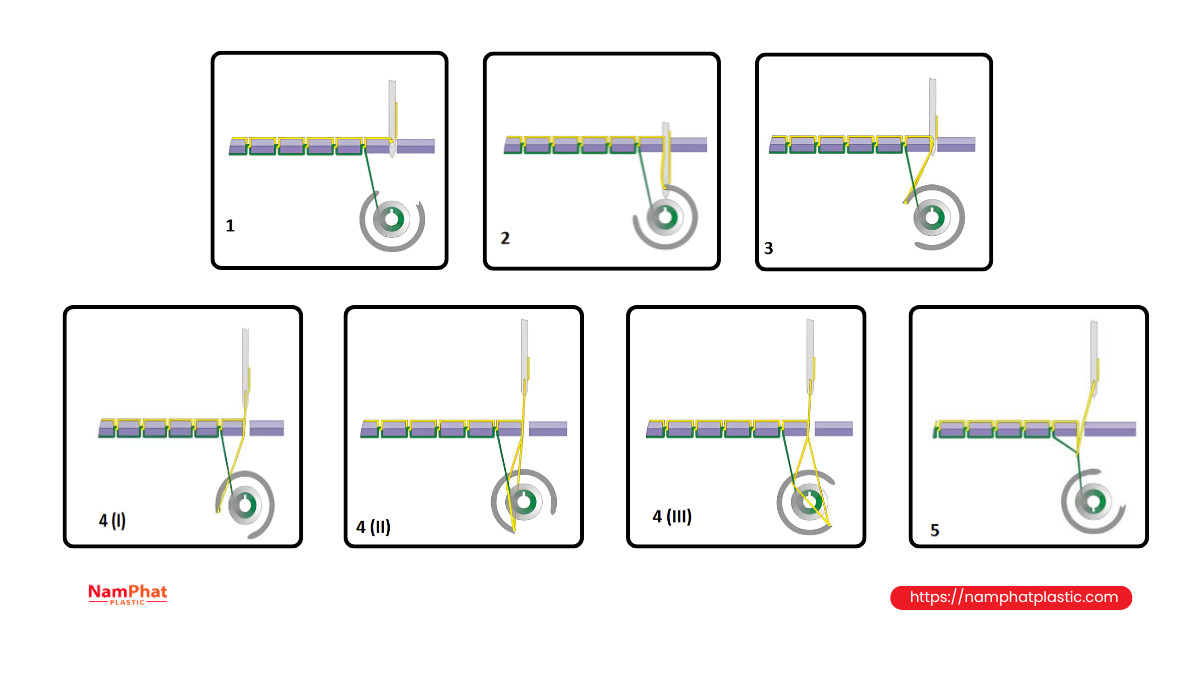
During each stitch-forming cycle, the needle thread passes through the tension assembly, thread guides, take-up lever, needle eye, and material. As the needle begins to rise, a thread loop forms behind or beside the needle. The hook, rotary hook, or looper enters this loop to form the stitch connection.
The movement of the loop-catching component creates a small twisting torque on the thread. This action is repeated continuously at high speed.
If the machine's direction of action tends to tighten the strands together, the thread maintains a stable structure. If the machine acts in the opposite direction, the thread strands may gradually open, causing surface fuzzing and making the thread loop less stable.
A&E states that most industrial sewing threads have a final Z twist because most stitch-forming mechanisms enter the needle-thread loop from the right side. In this configuration, Z twist helps prevent the thread strands from opening during sewing.
Therefore, S or Z selection should be based on stitch-forming geometry, rather than simply looking at:
-
Motor rotation direction.
-
Pulley rotation direction.
-
The direction in which the bag moves.
-
The position of the thread cone.
-
Whether the machine runs from right to left or left to right.
These factors may be related to the overall machine construction but are not sufficient to determine the appropriate twist direction.
4. Choosing the twist direction for standard single-needle sewing machines
For a single-needle machine with a standard stitch-forming mechanism, Z-twist thread is generally the most appropriate starting choice.
This group includes many types of machines:
-
Single-needle lockstitch machines.
-
Single-needle chainstitch machines.
-
Handheld bag-closing sewing machines.
-
Fixed industrial bag sewing machines.
-
Machines using one needle together with one lower hook.
The reason is that most of these machines use a loop-catching mechanism whose direction is compatible with Z-twist thread. When the correct direction is used, the thread tends to keep its strands tight rather than opening them.
For two-thread chainstitch bag sewing machines of type 401, Union Special technical documentation notes that thread twisting around the needle can be corrected by using “left twist thread.” Under the terminology used by Coats and A&E, “left twist” corresponds to Z twist.
Recommendation for single-needle bag sewing machines
For a single-needle bag sewing machine using PE 20/6, PE 20/8, or PE 20/9 thread, initial testing should use:
-
Thread with final Z twist.
-
Consistently controlled twist between lots.
-
Thread with good torque balance.
-
A surface finish suitable for the machine speed.
-
A thread cone with stable unwinding, without loop collapse or jerking.
Only after that should thread tension, needle, guide position, and hook timing be adjusted.
5. Does a double-needle sewing machine always use one S cone and one Z cone?
Not all double-needle machines have the same requirements.
Some double-needle lockstitch machines have two hooks arranged symmetrically. In this case, the two needle threads may be subjected to twisting forces in different directions.
In the operating instructions for Juki LU2-4400 and LU2-4420 double-needle machines, the manufacturer recommends:
-
Left needle, viewed from the front of the machine: use S-twist thread.
-
Right needle: use Z-twist thread.
-
When the two thread types cannot be separated or arranged independently, Z-twist thread may be used for both needles.
-
For bobbin thread, the documentation allows both S and Z twist.
This shows that the rule “a double-needle machine must use one S and one Z” cannot be applied to every machine.
It is necessary to determine which configuration the machine has:
-
Two symmetrically rotating hooks.
-
Two hooks rotating in the same direction.
-
Two needles sharing one loop-catching mechanism.
-
Two needles with separate hooks.
-
Lockstitch or chainstitch machine.
-
Two independent seams or two threads participating in the same stitch structure.
In particular, Juki's S-for-left-needle and Z-for-right-needle recommendation applies to specific machine configurations. It should not automatically be applied to every double-needle bag sewing machine or 401 stitch-forming machine.
6. Twist-direction selection table by machine configuration
| Machine configuration | Twist direction to test first | Notes |
| Standard single-needle machine | Z | Suitable for most loop-catching mechanisms entering from the right side |
| Single-needle chainstitch bag sewing machine | Z | Prioritize checking the needle-thread position |
| Two-thread bag sewing machine | Z for the needle thread first | Looper thread should be evaluated separately according to the machine manual |
| Double-needle machine with two symmetrical hooks | S on the left, Z on the right if specified in the documentation | Position is determined when viewed from the front of the machine |
| Double-needle machine with the same hook geometry | Z may be used for both | Do not infer the requirement solely from the number of needles |
| Overlock or multi-looper machine | According to each thread position | Needle, upper looper, and lower looper threads have different paths |
| Bobbin thread of a lockstitch machine | S or Z may both be usable on some machines | Needle thread is usually more sensitive to twist direction |
| Specialized or modified machine | According to documentation and practical testing | Recheck after replacing the hook, rotary hook, or modifying the mechanism |
The table above should be considered a starting point for selection. The machine manufacturer's official instructions should always take priority when clear information is available.
7. Do not choose thread twist direction based only on the stitch type
Knowing that the machine uses stitch 101, 301, or 401 is necessary but not sufficient. Two machines producing the same stitch type may still differ in:
-
The direction in which the hook enters the thread loop.
-
The position of the needle's long groove.
-
The direction in which the thread passes through the needle eye.
-
Take-up lever movement.
-
Thread-loop size.
-
Position of the needle guard.
-
Rotation direction and hook shape.
Therefore, the correct selection process should follow this order:
Machine model → stitch type → number of needles → hook type → loop-catching direction → position of each thread → practical testing.
8. How to determine the appropriate twist direction when machine documentation is unavailable
In practice, many factories use old machines, machines with replacement sewing heads, or equipment without technical documentation. In such cases, the appropriate direction can be determined through an in-factory procedure.
Step 1: Identify the correct twist direction of the finished thread
Take a thread segment approximately 20–30 cm long, hold it straight under good lighting, and observe the outermost diagonal lines.
Do not simply unwind several turns by hand and make a judgment because:
-
The thread may contain residual torque.
-
Internal strands may have the opposite direction from the final ply.
-
Thread fuzzing can make the twist pattern difficult to observe.
-
Holding both ends can unintentionally add more twist.
For formal inspection, the company can use a twist-measuring instrument and direct-counting method. ISO 2061 and ASTM D1423/D1423M both address the determination of twist and twist direction in single yarns, plied yarns, or cordage.
Step 2: Observe the loop-catching mechanism at low speed
Disconnect the power, rotate the handwheel in the correct operating direction, and observe:
-
The needle reaches its lowest point.
-
The needle begins to rise.
-
The thread loop appears.
-
From which side the hook or rotary hook approaches the thread loop.
-
The direction in which the thread loop is pulled.
The objective is not simply to determine whether the hook rotates clockwise or counterclockwise, but to see the direction of interaction between the hook and the needle-thread loop.
Step 3: Test two thread samples with equivalent specifications
Prepare two cones:
-
Same raw material.
-
Same number of plied strands.
-
Same fineness.
-
Approximately the same twist level.
-
Same oil or surface finish.
-
The only difference is S and Z twist direction.
Do not compare two cones that simultaneously differ in material, twist level, and lubricant because it will not be possible to determine which factor caused the difference.
Step 4: Run at actual production speed
A thread may run well when the machine is turned by hand or operated slowly but develop problems when the machine reaches production speed. Therefore, each sample should run long enough to evaluate:
-
Number of thread breaks.
-
Number of skipped stitches.
-
Fuzzing level after the needle eye.
-
Stability of the chain as the thread exits the bag.
-
Tension fluctuation.
-
Shape of the thread end after breakage.
-
Needle temperature and surface melting condition.
-
Seam opening behavior for quick-opening seams.
Step 5: Lock the parameters for each machine model
After selecting the appropriate direction, the information should be added to the operating standard:
| Item | Information to record |
| Machine model | Machine code and sewing-head number |
| Stitch type | Single-thread, two-thread, chainstitch, or lockstitch |
| Thread position | Left needle, right needle, upper looper, lower looper, or bobbin thread |
| Thread specification | PE 20/6, PE 20/8, PE 20/9, or another specification |
| Final twist direction | S or Z |
| Twist level | Turns per meter and allowable range |
| Needle used | Needle system and size |
| Test speed | Actual operating speed |
| Result | Thread breaks, skipped stitches, fuzzing, and seam quality |
This management method is more effective than simply recording “this machine uses PE 20/9 thread.”
9. Signs that the thread may be running with the wrong twist direction
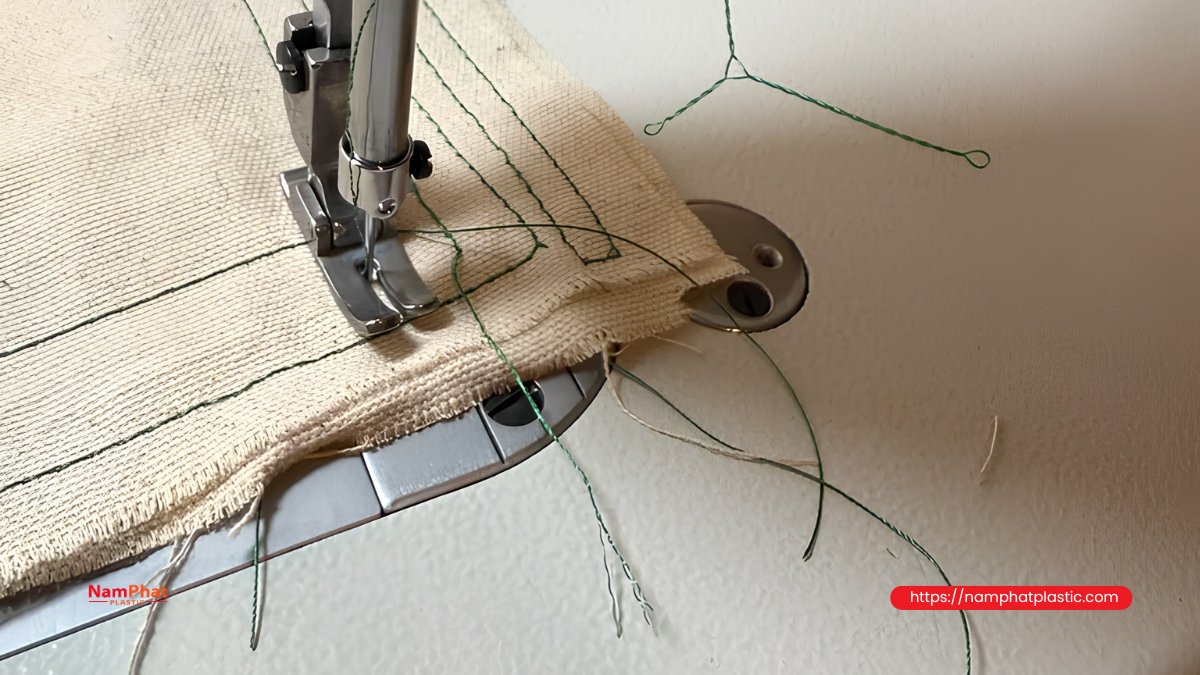
9.1. Thread strands open up immediately above the needle eye
This is a typical sign. The thread body may remain relatively normal as it passes through the tension assembly but begins separating into multiple branches after passing through the final guides or needle eye.
9.2. The broken thread end has a long brush-like appearance
If the broken end has many long fibers, with the strands pulled apart rather than a clean break surface, the twist direction should be checked along with other causes such as burrs on the needle eye, a scratched hook, or excessive tension.
9.3. The thread twists around the needle shaft
Union Special documentation lists thread twisting around the needle among the causes of skipped stitches and recommends using the appropriate twist direction, while keeping the thread loop small and needle-thread tension at the lowest necessary level.
9.4. The machine randomly skips stitches when accelerating
When the thread strands open, the loop behind the needle no longer maintains a stable shape. The hook may catch the loop at low speed but miss it when the speed increases.
9.5. Thread tension changes even though the adjustment knob does not move
A separated thread has an inconsistent instantaneous diameter. When passing through the tension discs, it creates changing resistance, causing the stitch to be tight at one point and loose at another.
9.6. The thread produces a large amount of fiber dust around the guides and needle
Friction not only wears the surface but also continues to loosen the thread strands. Over time, fiber dust accumulates around the tension discs, final thread guide, and needle eye.
9.7. Do not attribute every fuzzing or thread-breakage problem to twist direction
Incorrect twist direction is only one of many possible causes. Similar symptoms may also result from:
-
Needle too small for the thread diameter.
-
Sharp or worn needle eye.
-
Burr on the hook tip.
-
Incorrect threading path.
-
Excessive tension.
-
Needle heating that softens or melts synthetic fibers.
-
Incorrect hook-and-needle timing.
-
Thread with excessively low twist.
-
Thread with excessively high twist and high residual torque.
-
Unsuitable finishing lubricant.
-
Uneven thread unwinding.
Coats notes that thread with excessively low twist may untwist, fuzz, and break; conversely, excessively high twist may make the thread lively, form knots or loops, or spring off the cone.
Therefore, when troubleshooting, two concepts must be distinguished:
-
Twist direction: S or Z.
-
Twist level: number of turns per meter.
The direction may be correct while the twist level is still unsuitable.
10. Application to PE 20/6, PE 20/8, and PE 20/9 thread
In the designation 20/6, 20/8, or 20/9, the number after the slash generally indicates the number of single strands plied together. It does not indicate how many turns per meter the thread has.
Therefore:
-
PE 20/9 does not automatically have a higher twist level than PE 20/6.
-
Increasing the number of strands does not necessarily mean greater resistance to untwisting.
-
A multi-strand thread with insufficient ply twist can still separate when passing through the needle.
-
Each specification requires its own twist level based on diameter, softness, and machine-running requirements.
For most standard single-needle bag sewing machines, the manufacturer can establish Z as the initial standard final twist direction. However, the specific twist level of PE 20/6, 20/8, and 20/9 should be tested separately. The same twisting spindle speed should not be used for all three products with the assumption that they will have equivalent properties.
11. Specifications that should be included in industrial bag sewing thread standards
A complete technical specification should include:
-
Fiber raw material.
-
Single-yarn specification.
-
Number of plied strands.
-
Final twist direction, S or Z.
-
Average twist level, in turns per meter.
-
Twist tolerance.
-
Non-uniformity between positions on the cone.
-
Breaking force.
-
Elongation at break.
-
Cone weight or thread length.
-
Finishing oil content.
-
Reference machine-running results.
-
Machine model and needle size tested.
Simply stating “PE 20/9, 1 kg cone” is not enough to predict machine-running performance.
12. Why should S and Z cones not be mixed in the same shipment?
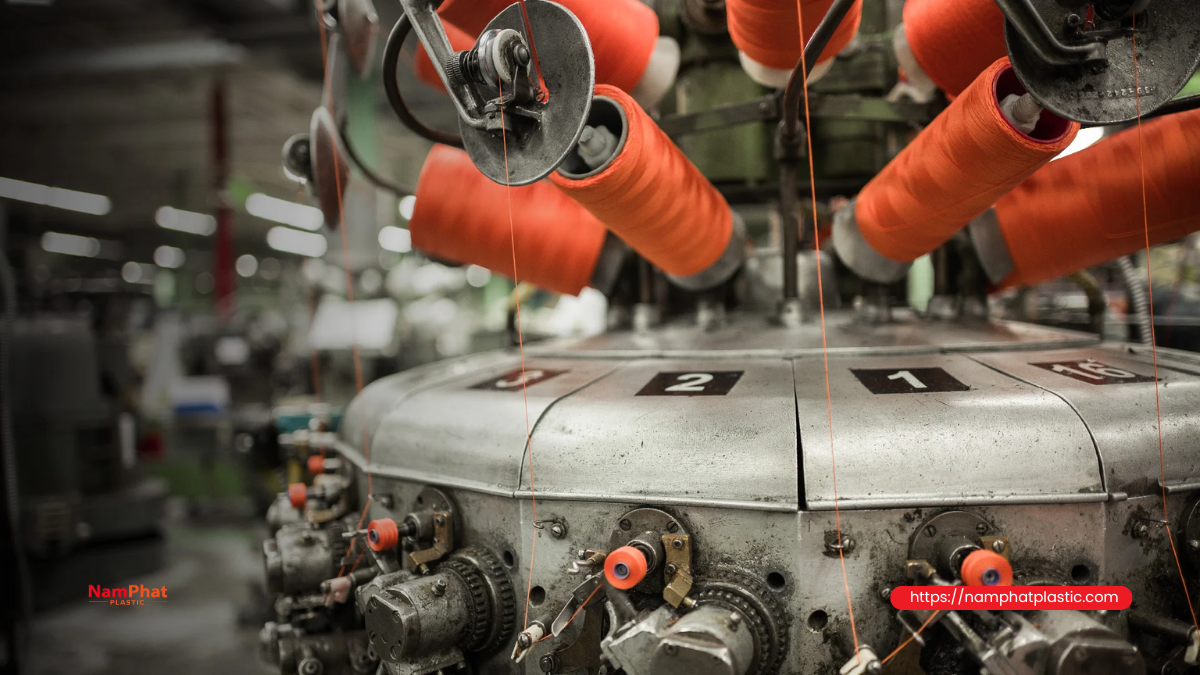
Two cones with opposite twist directions can create different user experiences on the same machine. If they are mixed in one shipment, the customer may experience:
-
The first cone runs steadily.
-
The next cone develops fuzzing or skips stitches.
-
After adjusting the machine for the problematic cone, another cone becomes excessively tight.
-
Seam quality changes between production shifts.
This problem can easily be mistaken for inconsistent thread strength, while the actual cause may be mixed twist directions.
The manufacturer should control this by:
-
Defining one twist direction for each product code.
-
Separating S-twist and Z-twist twisting machines.
-
Marking the rotation direction at the operating position.
-
Recording S or Z on lot tracking documents.
-
Rechecking after replacing belts, motors, or rewiring.
-
Not releasing the product to inventory before confirming the final twist direction.
-
Marking the twist direction on the packaging or COA when requested by the customer.
13. Does the unwinding direction of the thread cone change the twist direction?
The structural twist direction of the thread does not change simply because the cone is placed upright or horizontally. However, the unwinding method can introduce a temporary amount of additional twist into the running thread section.
When thread is pulled from the cone tip, each turn leaving the cone can add or reduce an apparent twist. The effect becomes more noticeable when:
-
The distance from the cone to the first guide is too short.
-
The cone is large but the thread take-off point is low.
-
The thread has high residual torque.
-
The thread unwinds jerkily.
-
The cone opening catches or releases loops.
-
Machine speed changes continuously.
Therefore, when testing S and Z, the cone position, cone orientation, and threading path should all remain unchanged. If the unwinding method is also changed, the test results will not be sufficiently reliable.
14. Quick inspection procedure at an industrial bag sewing thread factory
For each PE 20/6, 20/8, or 20/9 product code, the following procedure can be applied:
-
Sample A: Z final twist.
-
Sample B: S final twist.
The two samples should have approximately equivalent twist level, raw material, oil, and cone weight.
Run them sequentially on the same machine, with the same needle, same bag type, and same speed. Record the results over 100 bags or a fixed production period:
| Criterion | Sample S | Sample Z |
| Number of thread breaks | ||
| Number of skipped stitches | ||
| Number of times the thread must be rethreaded | ||
| Fuzzing level around the needle eye | ||
| Chain uniformity | ||
| Thread-tension fluctuation | ||
| Seam appearance | ||
| Operator comments |
The appropriate twist direction is not necessarily the sample with the higher laboratory breaking force. The better sample is the one that maintains its structure and produces fewer machine stoppages under actual operating conditions.
15. Common misconceptions about S and Z twist
“The more strands the thread has, the harder it is to untwist.”
Not necessarily. A multi-strand thread may have greater load capacity, but if the twist direction is unsuitable or the ply twist is too low, the strands can still open when passing through the needle.
“A machine rotating in one direction uses Z, while a machine rotating in the opposite direction uses S.”
This is an oversimplified conclusion. The direction in which the hook enters the thread loop must be observed rather than simply looking at the motor or handwheel rotation direction.
“A double-needle machine always requires one S and one Z.”
This is only true for some configurations with two hooks or two symmetrical threading paths. Juki documentation recommends S for the left needle and Z for the right needle on specific models, but also permits Z on both needles when the two thread types cannot be separated.
“Increasing thread tension can correct an incorrect twist direction.”
Increasing tension may sometimes make the thread loop smaller and temporarily reduce skipped stitches, but it also increases friction at the needle. It is not a sustainable solution if the thread strands are continuously being untwisted.
“Bobbin thread and needle thread must have the same twist direction.”
This is not always necessary. In the Juki instructions mentioned above, both S and Z can be used for bobbin thread, while needle thread is recommended according to its specific position.
Frequently Asked Questions
1. Is Z twist the standard for industrial bag sewing thread?
Z twist is a common choice and is generally suitable for standard single-needle bag sewing machines. However, it should be confirmed using the sewing-head documentation or practical testing, especially for double-needle and modified machines.
2. Can twist direction be identified by allowing the thread to twist back on itself?
This method is only useful as a reference. The thread may contain residual torque or multiple twist levels. Observing the outermost diagonal lines or measuring with a twist-testing instrument is more reliable.
3. If the thread runs but frequently becomes fuzzy near the needle, could the twist direction be wrong?
Possibly, but this is not enough to reach a conclusion. Needle size, burrs, tension, needle temperature, threading path, and finishing quality should also be checked.
4. Does a two-thread bag sewing machine require two different twist directions?
Not necessarily. Needle thread and looper thread have different paths, but the specific requirement depends on the machine design. Do not automatically apply the rule for a double-needle lockstitch machine to a chainstitch bag sewing machine.
5. How should twist direction be stated on a quotation?
It can be written as:
-
PE 20/9 – final twist Z – twist level according to the agreed technical standard.
For customers using special machines, the machine model, thread position, and approved sample should also be specified.
Conclusion
The choice between S and Z twist should not be based on habit or the general name of the machine. The determining factor is how the hook, rotary hook, or looper interacts with the thread loop at each position.
In actual production:
-
Standard single-needle machines generally favor Z-twist thread.
-
Single-needle bag sewing machines should generally start testing with Z-twist thread.
-
Some symmetrical double-needle machines may require S for the left needle and Z for the right needle.
-
The rule for one machine model must not be applied to every double-needle machine.
-
Twist direction must be controlled together with twist level, breaking force, elongation, finishing oil, and cone stability.
For PE 20/6, 20/8, and 20/9 thread, controlling the correct final twist direction helps reduce strand separation, fuzzing, skipped stitches, and thread breakage near the needle. It is a small specification on a technical sheet but can make a significant difference in machine stoppages and bagging productivity.
>>> See more:
- 0 Comment


