


 Phan Van Hoang
- 04/08/2026
- 126
During the production and use of industrial bag sewing thread, a thread spool may contain irregular sections such as:
-
Knots formed by tying two thread ends together.
-
Splices made by doubling, twisting, or bonding.
-
Sections where fibers overlap.
-
Abnormal thick spots caused by variations during plying and twisting.
-
Sections that are fuzzy, tangled, or clumped.
-
Locations where the diameter is significantly larger than that of the normal thread body.
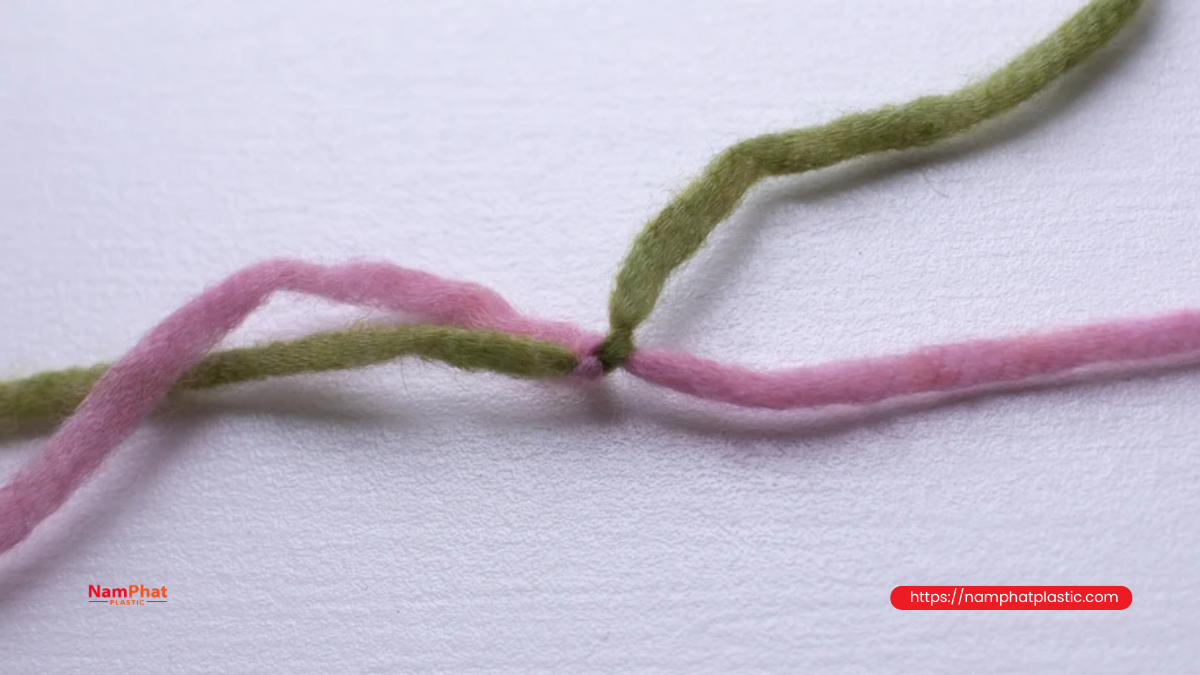
To the naked eye, these irregularities may be very small and occur only a few times on a spool. However, when passing through a bag sewing machine at high speed, they can cause sudden changes in thread tension, friction, and thread movement.
The consequences are not limited to thread breakage. An abnormal thick spot can also cause skipped stitches, unstable seams, needle damage, thread-guide jamming, and sections of the seam with lower-than-normal strength.
Therefore, knots and splices should be considered important quality-control indicators, especially for thread used on continuously operating bag sewing machines.
Table of Contents [Hide]
1. What are knots, splices, and abnormal thick spots?
1.1. Knots in a thread spool
A knot is a point where two thread ends are directly tied together. This is often the simplest method of joining thread when:
-
Raw material runs out during plying or twisting.
-
Broken thread needs to be repaired during production.
-
Remaining thread from two different spools is joined.
-
Thread ends are joined during winding or rewinding.
A knot usually creates a section whose diameter is several times larger than that of the normal thread body. Excess thread ends around the knot can also form small protrusions, increasing the risk of catching on guide holes or gaps in the tension assembly.
1.2. Thread splices
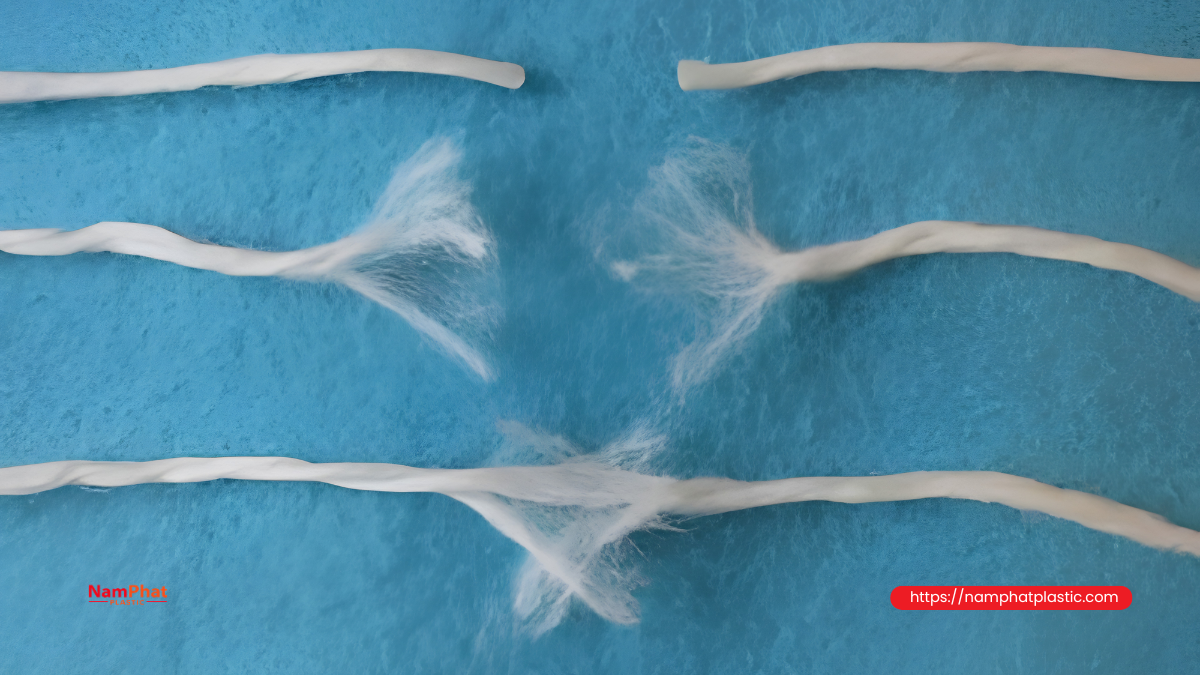
A splice is a point where two sections of thread are connected using a particular method, such as:
-
Tying a knot.
-
Doubling and twisting the ends together.
-
Pneumatic splicing.
-
Thermal splicing.
-
Bonding with adhesive or bonding materials.
-
Overlapping two thread ends over a certain length.
A good splice must have adequate strength without creating an excessive increase in diameter. If the splice is strong but too thick, it may still be unsuitable for high-speed sewing machines.
1.3. Abnormal thick spots
An abnormal thick spot is a section of thread with a larger cross-section than normal, without necessarily having a clearly visible knot.
Possible causes include:
-
More component fibers at that location than specified.
-
One or more component yarns looping around the thread body.
-
Fiber overlap during plying.
-
Thread tangling before entering the twisting zone.
-
Uneven tension among component yarns.
-
Fuzzy fibers forming a clump.
-
Localized finish oil or contaminants.
-
Thread compression, melting, or deformation during production.
These thick spots can sometimes be more difficult to detect than knots because they may extend from a few millimeters to several centimeters.
2. Why can a small thick spot cause major problems on a bag sewing machine?
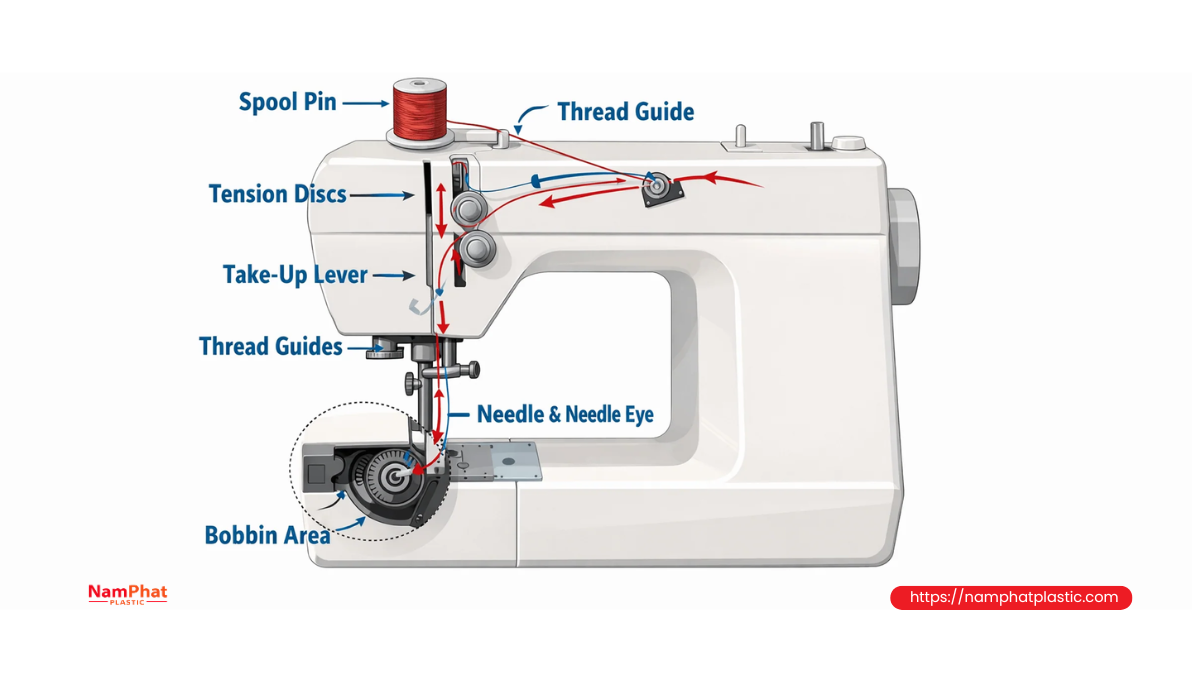
Sewing thread does not travel directly from the spool to the needle. Before forming a stitch, it passes through multiple components:
-
Spool holder or spindle.
-
Thread guide eyes.
-
Tension discs.
-
Tension-control spring.
-
Thread take-up lever.
-
Bars and guide holes near the machine head.
-
Needle eye.
-
Interaction zone between the needle, thread, and loop-forming mechanism.
Each position is designed for a certain thread-diameter range. When a knot or thick spot passes through, resistance can suddenly increase.
Uneven resistance disrupts the balance of the thread-feed system. Depending on the size, stiffness, and shape of the defect, the machine may experience one or more of the following:
-
The thread is briefly restrained.
-
A sudden tension spike.
-
Insufficient thread delivery for one stitch cycle.
-
Incorrect loop size.
-
A knot becoming trapped in a guide eye.
-
A thick spot failing to pass through the needle eye.
-
Severe cutting or abrasion of the thread against the needle edge.
-
Localized tightening or loosening of the seam.
At high machine speeds, these events occur within a very short period, so operators often see only the final result: thread breakage or skipped stitches.
3. Risk 1: Sudden thread breakage
Thread breakage is the most common consequence when a knot or thick section passes through the guiding system.
How breakage occurs
When a thick spot enters the tension discs or guide eye, friction increases rapidly. The thread ahead continues to be pulled by the needle and take-up mechanism, while the section behind is restrained.
The pulling force therefore becomes concentrated over a very short section. If the instantaneous tensile force exceeds the thread's load capacity, the thread breaks.
The break may occur:
-
Directly at the knot.
-
Close to the splice.
-
Near the needle.
-
At a guide eye with a scratched surface.
-
After the tension discs.
-
At a section already damaged by friction.
Why can good-strength thread still break?
Tensile strength is measured under stable test conditions. On a sewing machine, the thread is simultaneously exposed to:
-
Cyclic pulling.
-
Continuous bending through guide eyes.
-
Friction against tension discs.
-
Friction against the needle eye.
-
Heat generated around the needle.
-
Contact with the bag edge and stitch-forming components.
A knot adds sudden resistance. Therefore, a spool with acceptable average tensile strength can still break if its diameter uniformity is poor.
4. Risk 2: Machine skips stitches or produces incomplete stitches
A thick spot does not always break the thread immediately. In many cases, it simply causes the thread feed to slow down for one or two stitch cycles.
When insufficient thread is supplied, the loop behind the needle may become too small or form in the wrong position. The loop-forming mechanism then fails to catch it, resulting in:
-
A single skipped stitch.
-
Multiple consecutive skipped stitches.
-
Interrupted seams.
-
Improperly locked chain stitches.
-
Seams that can easily pull apart under load.
-
One side of the seam appearing normal while the other side contains defects.
This type of risk is particularly dangerous because the product may still pass a visual inspection if the inspection speed is high.
When the bag is loaded, transported, or dropped during handling, the skipped-stitch area can become the starting point for seam opening.
5. Risk 3: Thread jamming at the guides and tension assembly
A knot does not have a perfectly round shape. Excess thread ends or loops around the knot can catch on:
-
Ceramic thread guides.
-
Guide hooks.
-
Tension-disc gaps.
-
Tension springs.
-
Thread take-up levers.
-
Protective slots or machine covers.
-
Needle eyes.
When the thread becomes trapped, the spool may continue rotating while thread is no longer properly supplied to the needle. The operator may lose time identifying the cause because the jam is located inside the guiding or tension assembly and may not be immediately visible.
In some cases, the thread is stretched and then suddenly released from the trapped position. The machine may not stop immediately, but seam tension changes abruptly, creating a section that is unusually tight or loose.
6. Risk 4: Failure to pass through the needle eye
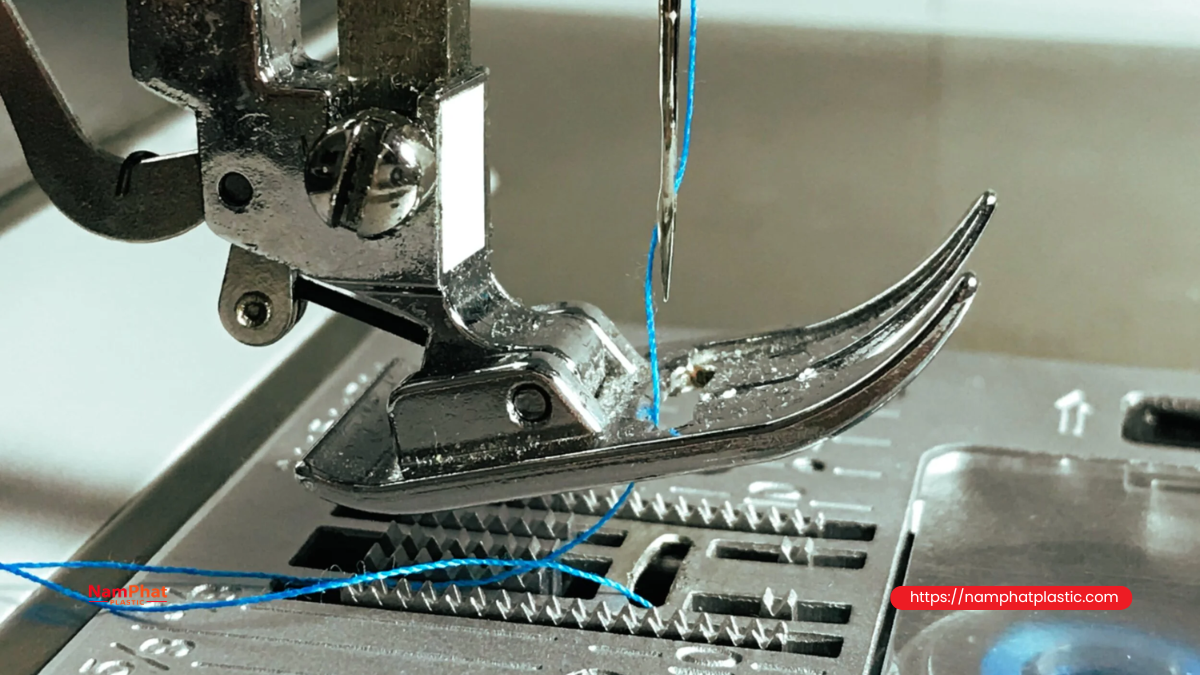
The needle eye is one of the smallest cross-sections along the thread path.
The needle must be selected according to:
-
Thread size.
-
Number of plied strands.
-
Twist level.
-
Actual thread diameter.
-
Bag material.
-
Operating speed.
If the normal thread body already occupies most of the needle-eye opening, a knot may not be able to pass through.
When the thick spot reaches the needle eye, three situations may occur:
-
The knot is blocked: The thread breaks immediately above the needle.
-
The knot is forced through: The thread surface is scraped, frayed, or weakened.
-
The knot pulls the needle out of alignment: The needle vibrates, bends, or contacts the stitch-forming mechanism.
Frequent thread breakage directly near the needle is not always caused by an undersized needle. A spool with knots or large diameter variation should also be investigated.
7. Risk 5: Bent needles, broken needles, and machine component damage
When a thick spot becomes trapped at the needle eye while the machine mechanism continues moving, the pulling force can be transferred directly to the needle.
If the force is high enough, the needle may:
-
Be pulled out of its intended path.
-
Bend slightly without being immediately noticed.
-
Strike the needle plate or stitch-forming component.
-
Become chipped at the tip.
-
Break during operation.
A slightly bent needle can create a chain of subsequent problems:
-
Random skipped stitches.
-
Incorrect penetration near the bag edge.
-
Damage to the loop-forming mechanism.
-
Abnormal impact noise.
-
Increased thread breakage even after the knot has been removed.
Therefore, after a serious thread jam, the operator should not simply reconnect the thread and continue running. The needle, thread guides, and stitch-forming components should also be inspected.
8. Risk 6: Localized changes in seam tension
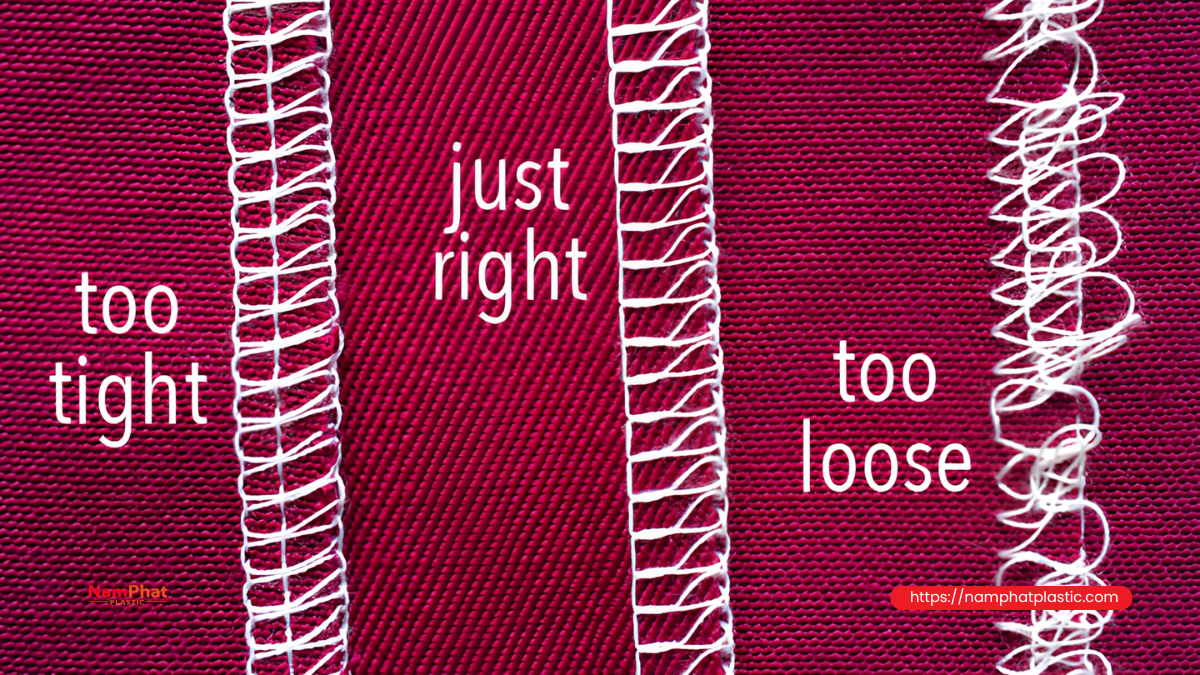
For a stable seam, the amount of thread supplied during each cycle must remain relatively consistent. Knots and thick spots change friction and can cause tension to increase or decrease temporarily.
If tension increases locally:
-
The bag mouth may wrinkle.
-
The seam may become excessively tight.
-
The bag edge may be cut or torn.
-
The thread is loaded immediately after stitch formation.
-
The seam's reserve elongation is reduced.
If tension drops suddenly after the thick spot passes:
-
The stitch may become loose.
-
The thread loop may protrude from the surface.
-
The chain stitch may not grip the bag edge properly.
-
The seam may catch on other objects.
-
The risk of stitch opening increases.
A spool with many thick spots can cause the seam to continuously alternate between tighter and looser conditions even though the operator does not adjust the machine.
9. Risk 7: Reduced actual seam strength
Seam strength does not depend solely on the tensile strength of the thread. It also depends on:
-
Stitch uniformity.
-
Number of stitches per unit length.
-
Stitch-locking performance.
-
Tension balance.
-
Bag-edge condition.
-
Stability of loop formation.
-
The degree of thread damage caused by the needle.
A thick spot may scrape the thread surface without immediately breaking it. That damaged section remains in the seam with lower load capacity.
When the bag experiences vibration, pulling, or impact during transportation, the damaged section may break before other parts of the seam.
This explains why some bags appear complete immediately after sewing but later open at the mouth during stacking, transportation, or drop testing.
10. Risk 8: Increased fuzz, fiber dust, and machine contamination
When a knot or thick spot is forced through guiding components, the thread surface can be heavily scraped. As a result:
-
Individual fibers separate from the thread body.
-
The thread surface becomes fuzzy.
-
Fiber dust accumulates around the tension discs.
-
Guide eyes and the needle area become dirty more quickly.
-
Lubricating oil mixes with dust and forms deposits.
-
Friction continues to increase during subsequent operation.
Therefore, a single defect can have effects beyond the moment when it passes through the machine. Loose fibers can contaminate the thread path and create additional problems for the thread that follows.
11. Risk 9: Machine downtime and reduced actual productivity
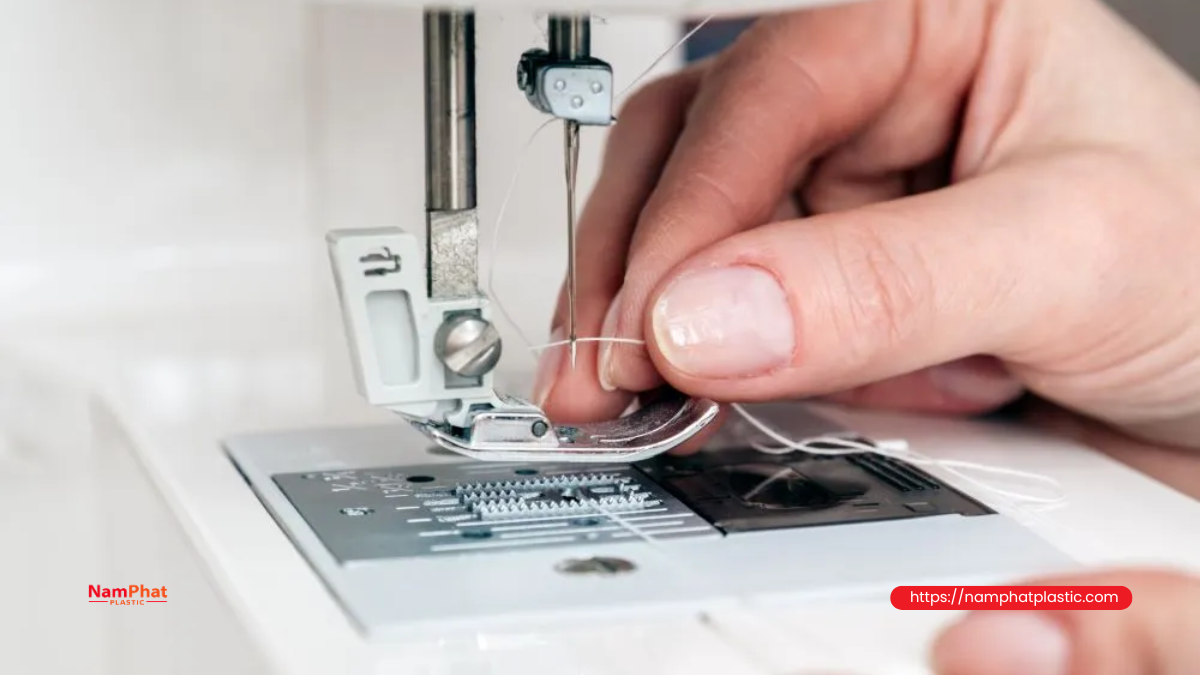
Every thread breakage or jam requires the operator to perform several tasks:
-
Stop the machine.
-
Locate the break.
-
Rethread the entire path.
-
Inspect the needle eye.
-
Remove the defective section.
-
Reseal or re-sew the interrupted bag.
-
Inspect recently produced bags before the defect is discovered.
A single stop may not take long, but when repeated throughout a shift, the total loss can become significant.
In addition to direct machine downtime, the company may incur:
-
Bags requiring rework.
-
Products held for inspection.
-
Additional sorting labor.
-
Delayed packaging schedules.
-
Higher thread consumption.
-
Increased scrap rate.
-
Lower hourly output.
-
Customer complaints.
Therefore, a lower purchase price does not necessarily mean a lower cost of use if the thread spool contains many knots and thick spots.
12. Risk 10: Splice failure and formation of free thread ends
A weak splice may pass through the thread guides but come apart under tensile loading.
When the splice fails:
-
The thread breaks unexpectedly.
-
A free thread end may wrap around a shaft or moving component.
-
The machine creates a section of seam without thread.
-
The thread behind the splice may leave the thread path.
-
The operator must rethread the machine from the beginning.
A splice therefore needs to meet two requirements simultaneously:
-
Sufficient strength to avoid failure during machine operation.
-
Small and smooth enough to pass through the thread-guiding system.
Focusing only on splice strength while ignoring diameter and shape is not sufficient.
13. Which types of thick spots present the highest risk?
Not all thick spots have the same consequences. Risk depends on the shape and structure of the defect.
| Irregularity type | Characteristics | Main risk |
| Large knot with long loose ends | Protruding edges and strands | Guide-eye jamming, tension-disc blockage |
| Hard knot with large diameter | Cannot compress when passing through the needle eye | Thread breakage, bent needle |
| Long but soft splice | Diameter increases over a section | Tension variation, skipped stitches |
| Section with overlapping fibers | Unstable cross-section | High friction, fuzzing |
| Fiber clump or tangled fibers | Rough, irregular surface | Guide contamination, fiber dust |
| Weak splice | Easily separates under tension | Thread breakage and loss of thread path |
| Thick spot with insufficient twist | Component fibers are not securely held | Fiber separation, fuzzing, reduced strength |
| Thick spot with excessive twist | Stiff and prone to forming loops | Thread tangling, reverse twisting, skipped stitches |
A hard knot with loose ends is generally more likely to cause problems than a long, smooth splice. However, a long splice can also cause tension to vary over several stitch cycles.
14. How to identify a thread spool with knots or thick spots
Because knots can be located deep inside a spool, they cannot always be detected by inspecting the outer surface. They can also be identified through machine-operation symptoms.
Signs on the thread spool
-
Abnormal bumps on the spool surface.
-
Uneven winding layers.
-
Sections with different color or gloss.
-
Loose thread ends visible on the surface.
-
Multiple tangled areas or crossed loops.
-
Thread sticking together in sections.
Signs on the machine
-
Sudden thread breakage while the machine is otherwise running normally.
-
Thread frequently breaking near the needle.
-
Tension changing without machine adjustment.
-
Random skipped stitches.
-
A slight snapping sound when a thick spot passes through the tension discs.
-
Thread jerking along the thread path.
-
Unstable movement of the thread take-up lever.
-
Abnormally rapid accumulation of fiber dust.
Signs on the seam
-
One section is tighter.
-
One section has loose stitches.
-
Uneven stitch spacing.
-
Unlocked stitches.
-
Thread appears fuzzy or crushed at one location.
-
Brief interruptions in the seam.
15. How to determine whether a knot is the cause of thread breakage
When the machine breaks thread, do not immediately discard the broken section. Keep it for inspection.
Step 1: Examine both broken ends
If the break is close to a knot or splice, there is a high probability that it contributed directly to the failure.
If the thread end is heavily frayed, the thread may have been abraded at the needle eye or guide before breaking.
Step 2: Inspect the sections before and after the break
Pull out additional thread and check:
-
Whether another thick spot is present.
-
Whether the diameter is uniform.
-
Whether the thread has localized twisting.
-
Whether component fibers are separating.
-
Whether the surface contains oil or contaminants.
Step 3: Inspect the thread path
A knot may scratch or misalign machine components. Check:
-
Ceramic guide eyes.
-
Tension discs.
-
Guide bars.
-
Needle eye.
-
Needle plate.
-
Loop-forming mechanism.
Step 4: Install a control spool
Install a spool that has already been confirmed to have good quality while keeping all machine settings unchanged.
If thread breakage is significantly reduced, the cause is more likely related to the original spool than to the machine settings.
16. Should knots be allowed in industrial bag sewing thread spools?
From a quality-control perspective, thread spools intended for high-speed industrial sewing should minimize knots as much as possible.
However, acceptance requirements also depend on:
-
Machine configuration.
-
Needle size.
-
Thread diameter.
-
Operating speed.
-
Level of automation.
-
Value of the packaged product.
-
Customer requirements.
-
Ability to detect and remove splices.
For continuous packaging lines, a single knot can stop an entire operation. Therefore, internal specifications should be based on actual risk cost rather than thread-spool appearance alone.
A company may define:
-
Maximum number of splices per spool.
-
Acceptable splice types.
-
Maximum splice dimensions.
-
Tensile-strength requirements at the splice.
-
Methods for marking splice locations.
-
Procedures for handling detected knots.
-
Production-lot traceability requirements.
Specific limits should be confirmed through testing on the actual machine, needle, and production speed used by the customer.
17. Why is marking splices a necessary solution?
When current production technology cannot completely eliminate splices, the manufacturer should mark them so users can identify them before they enter the machine.
Possible marking methods include:
-
Applying a small label near the splice.
-
Using temporary marking thread.
-
Recording the number of splices on the spool label.
-
Separating spliced spools from splice-free spools.
-
Restricting spliced spools to testing or secondary processes.
Marking does not eliminate the risk, but it allows operators to take preventive action:
-
Reduce machine speed.
-
Cut out the splice.
-
Reconnect the thread using an approved method.
-
Replace the spool before running critical orders.
Without marking, a knot becomes a hidden defect that may only be discovered after causing machine downtime or a defective seam.
18. Process for controlling thick spots at a thread manufacturing plant
18.1. Control of single-yarn raw materials
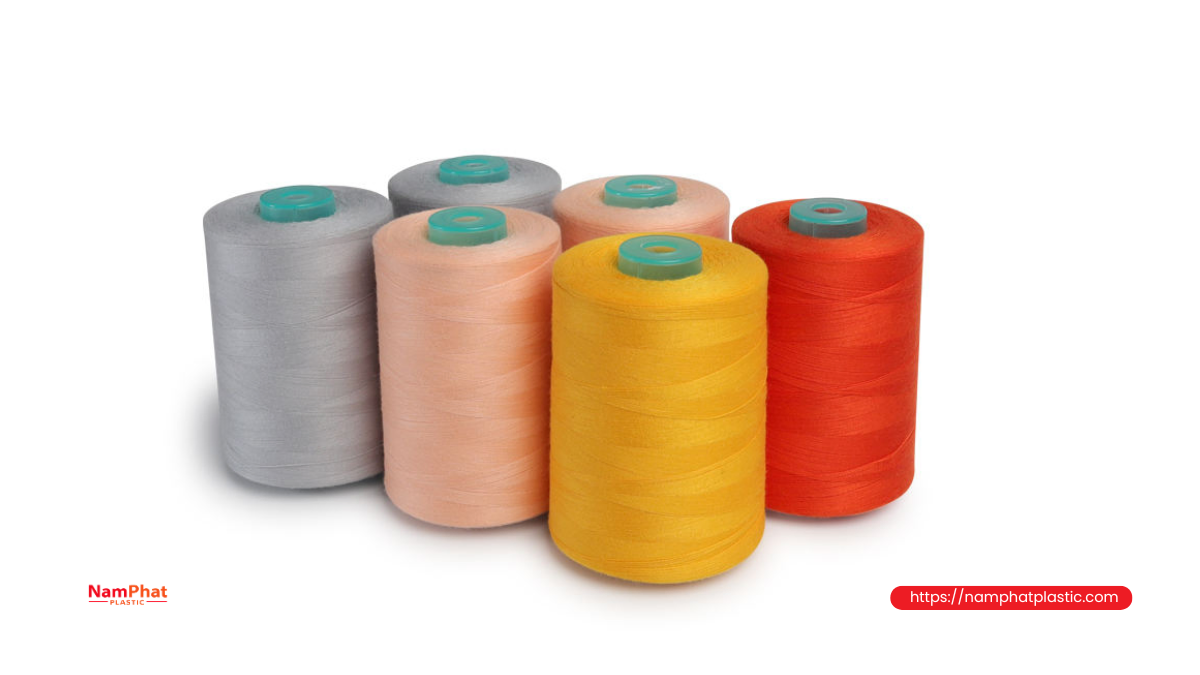
Before plying, inspect:
-
Linear density uniformity.
-
Tangled or clumped yarn.
-
Splices in the raw-material package.
-
Fuzz level.
-
Moisture and cleanliness.
-
Package condition.
Uneven incoming material increases the likelihood of thick spots forming in subsequent processes.
18.2. Control of the plying process
The plying process should ensure:
-
The correct number of yarn ends according to specification.
-
No excess yarn ends.
-
No individual yarn wrapping around the bundle.
-
Relatively balanced tension among component yarns.
-
Clean guides free of fiber buildup.
-
Effective yarn-break detection and stop functions.
If a yarn breaks and then wraps around the bundle instead of being removed, it can create a long thick section.
18.3. Control of the twisting process
At the twisting machine, monitor:
-
Actual twist level.
-
Spindle speed.
-
Input tension.
-
Stability of the feed package.
-
Yarn ballooning or contact.
-
Tangled sections before the twisting zone.
A thick spot entering the twisting zone may be compressed into a hard lump, increasing its severity.
18.4. Control of the winding process
Winding is the final opportunity to detect and remove defects before shipment.
Control:
-
Winding tension.
-
Surface uniformity.
-
Package edges.
-
Package hardness.
-
Splices.
-
Loose thread ends.
-
Tangled or crossed thread layers.
Where possible, sensors or thickness-detection systems can be used to identify points exceeding the specified limit.
19. Thread spool inspection procedure at the user’s plant
A bag manufacturer does not necessarily need to inspect the entire length of every spool. A sampling procedure can be established by production lot.
Visual inspection
Check:
-
Whether the spool surface is smooth.
-
Whether there are abnormal protrusions.
-
Whether the spool is deformed.
-
Whether thread layers cross abnormally.
-
Whether loose ends or visible splices are present.
-
Whether color and gloss are uniform.
Manual unwinding check
Pull out a section of thread at a steady speed and feel:
-
Whether the thread jerks.
-
Whether unwinding resistance is stable.
-
Whether there are sticking points.
-
Whether there are thick or hard sections.
-
Whether the thread twists backward or forms loops.
Gauge or limit-slot inspection
A gauge appropriate for the thread size can be developed. The normal thread body should pass through consistently, while an excessively thick section should be retained.
The gauge should be designed based on the actual product dimensions and the ability of the machine's thread path to accommodate the thread. It should not be selected arbitrarily.
Machine trial
Run the sample spool under conditions close to actual production:
-
Correct machine type.
-
Correct needle size.
-
Correct bag material.
-
Correct speed.
-
Correct tension.
-
Correct stitch length.
Monitor the number of:
-
Thread breaks.
-
Skipped stitches.
-
Thread jams.
-
Rethreading events.
-
Tension adjustments.
-
Detected thick spots.
Actual machine trials often provide more useful information than tensile-strength testing alone.
20. What to do when a knot is detected entering the machine
When a knot is visible on the section of thread being fed, it should not be allowed to pass through the machine at normal operating speed.
The recommended procedure is:
-
Stop the machine safely.
-
Pull the knotted section out of the thread path.
-
Cut out the knot and the damaged thread around it.
-
Reconnect the thread using an approved and tested method.
-
Rethread the correct path.
-
Inspect the needle and tension assembly.
-
Sew a test bag.
-
Inspect both sides of the seam before resuming production.
Do not simply cut close to the knot and tie another knot of similar size. This only replaces one risk point with another.
21. Can increasing the needle size solve the problem?
Using a needle with a larger eye may make it easier for the thread and some thick spots to pass through. However, this is not the primary solution for a spool containing many knots.
An excessively large needle can cause:
-
Larger needle holes in the bag.
-
Increased risk of tearing the bag edge.
-
Damage to coatings or liners.
-
Changes in loop formation.
-
Changes in seam appearance.
-
Increased penetration force.
Needle size must be selected according to the normal thread diameter and bag material. The needle should not be selected simply to allow knots to pass through.
The proper solution is still to control thread uniformity and eliminate excessively large splices.
22. Can reducing thread tension solve the problem?
Reducing tension may help a knot pass through the tension discs more easily in some cases. However, excessively low tension can cause:
-
Loose stitches.
-
Protruding thread loops.
-
Unstable stitch locking.
-
Increased thread tangling.
-
Seams that are more likely to open.
If the machine is correctly set for compliant thread, its settings should not be changed simply to compensate for a spool with poor diameter uniformity.
The cause should first be identified as relating to:
-
The thread spool.
-
Needle size.
-
Thread path.
-
Machine-component surface condition.
-
Tension setting.
-
Operating speed.
Only then should an appropriate adjustment be selected.
23. What information should a thread supplier provide?
For industrial customers, quality documentation should not be limited to average tensile strength. Suppliers should control and provide information such as:
-
Thread specification.
-
Material.
-
Linear density.
-
Number of plied strands.
-
Twist direction and twist level.
-
Tensile strength.
-
Elongation.
-
Uniformity.
-
Thread-splicing method.
-
Splice-count requirements.
-
Net spool weight.
-
Lot code and production date.
-
Trial-run results when required.
For critical orders, both parties should agree on splice-acceptance criteria from the beginning to avoid disputes during use.
24. The true cost of a thread spool with many knots
When comparing two types of thread, many companies look only at the price per kilogram. However, actual usage cost also includes:
-
Machine downtime.
-
Labor for rethreading.
-
Bags requiring rework.
-
Discarded thread.
-
Damaged needles and components.
-
Products requiring reinspection.
-
Risk of delayed delivery.
-
Complaint risk.
-
Losses if bags open during transportation.
The total usage cost can be considered as:
Actual usage cost = Thread purchase price + Machine downtime cost + Seam-defect cost + Scrap cost + Complaint cost
Therefore, a low-priced spool with many splice points can cost more than a stable spool with fewer defects and more continuous machine operation.
25. Checklist for controlling knots and thick spots in thread spools
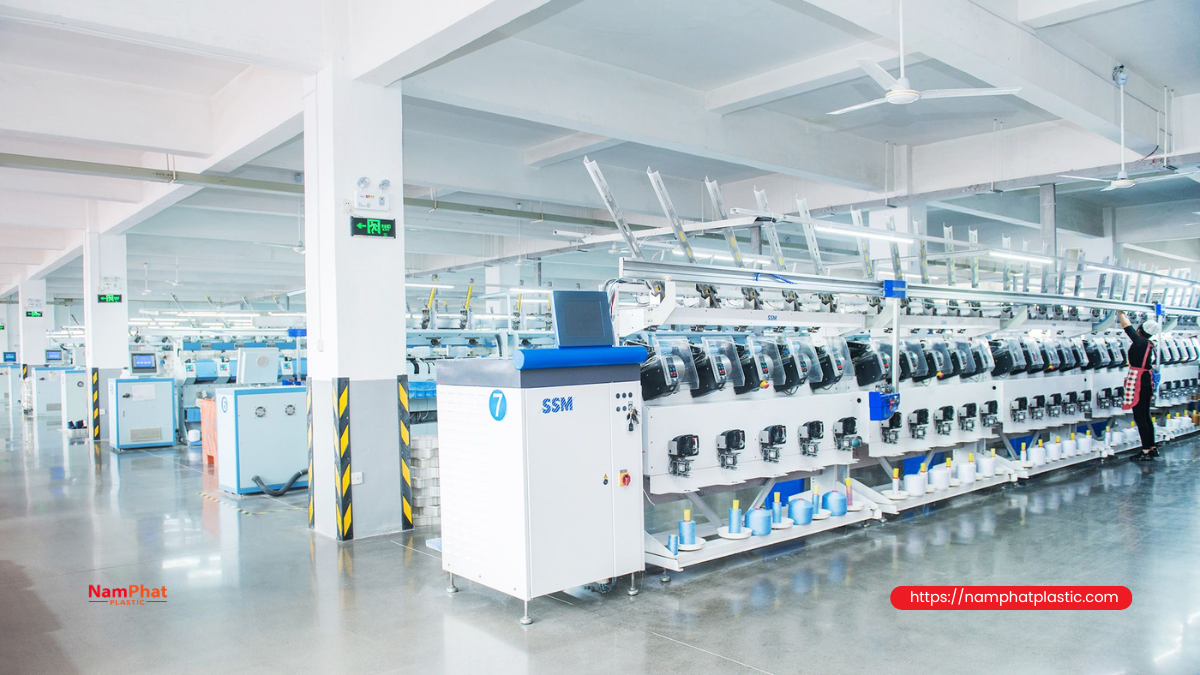
For thread manufacturers
-
Inspect single-yarn raw-material quality.
-
Monitor the number of yarn ends during plying.
-
Prevent broken yarn from wrapping around the yarn bundle.
-
Standardize the splicing method.
-
Remove tangled sections before twisting.
-
Control tension among component yarns.
-
Inspect finished-spool surfaces.
-
Record the number of splices on each spool.
-
Mark spliced spools.
-
Retain samples by production lot.
-
Conduct periodic trials on actual sewing machines.
For thread users
-
Inspect incoming spools visually.
-
Maintain clear lot identification.
-
Record spools associated with thread breakage.
-
Retain defective thread sections for analysis.
-
Do not automatically increase tension when thread breaks.
-
Inspect the needle after a jam.
-
Use a control spool to identify the cause.
-
Track machine stoppages by thread lot.
-
Provide suppliers with photos and actual samples.
-
Establish internal acceptance limits.
Frequently asked questions
1. Can a small knot pass through a bag sewing machine?
Some small knots may pass through the thread guides and needle eye, but that does not mean they are safe. A knot can still cause a sudden tension increase, scrape the thread surface, or cause skipped stitches.
2. Why does the thread break near the needle when no knot is visible?
The thick spot may have been restrained farther up the thread path while the weakest point was near the needle. The knot may also have opened or been cut during the break, making it difficult to identify afterward.
3. Is a stronger splice always better?
Not necessarily. A splice must be strong enough while also being small, flexible, smooth, and uniform in shape. A very strong but excessively hard or thick splice can still cause machine jams.
4. Can the entire spool be checked manually?
Sampling or checking suspected sections is possible, but manually controlling the entire length of a large production lot is difficult. Manufacturers should control defects during plying, twisting, and winding.
5. Do knots reduce seam strength?
Yes. Knots can cause skipped stitches, change tension, or damage the thread before it becomes part of the seam. These factors can reduce actual seam strength.
6. Does a spool with only one knot need to be rejected?
This depends on the production requirements. On continuous production lines or for high-risk products, even one knot can cause machine downtime and product defects. A safer approach is to mark and remove the splice before feeding the thread into the machine.
Conclusion
Knots, splices, and abnormal thick spots in thread spools are defects that can have consequences far greater than their physical size suggests.
They can cause sudden tension increases, thread-guide jamming, failure to pass through the needle eye, thread breakage, skipped stitches, bent needles, and reduced seam strength. In continuous bag-mouth sewing lines, these problems can also increase machine downtime, rework rates, and the risk of customer complaints.
To minimize these risks, control is required from raw materials through plying, twisting, winding, and actual machine trials. Thread manufacturers should also establish clear requirements for the number, dimensions, and marking of splices.
A quality industrial bag sewing thread spool must provide more than adequate tensile strength. It must also maintain uniform diameter, a stable surface, minimal thick spots, and consistent unwinding throughout machine operation.
Nam Phát Plastic supplies PE and PP bag sewing threads for rice bags, animal-feed bags, fertilizer bags, chemical bags, and various industrial packaging applications. The products are controlled from plying and twisting through winding to improve uniformity and machine-running performance.
>>> See more:
- 0 Comment


