


 Phan Van Hoang
- 11/08/2026
- 159
When evaluating the quality of bag sewing thread, users often focus on thread size, tensile strength, twist, or spool weight. However, one less noticeable factor that has a very clear impact on machine sewability is found right on the surface of the thread: finish oil.
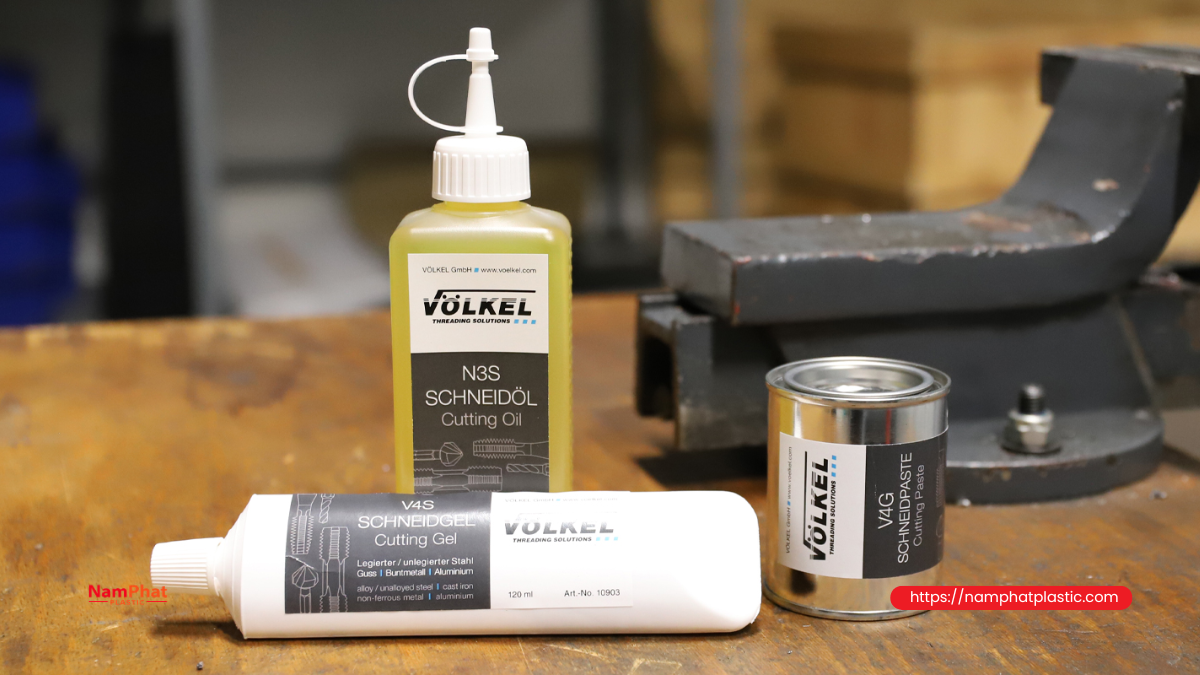
Finish oil on bag sewing thread is a surface treatment applied to the thread during production or finishing. Its purpose is not simply to make the thread “smoother”, but to control the contact conditions between the thread and numerous components of the sewing machine, such as:
-
Thread guides.
-
Thread tensioning systems.
-
Springs and tension discs.
-
Needle eye.
-
Needle surface.
-
Direction-changing points along the thread path.
-
Areas where the thread rubs against itself during unwinding.
Especially for PE, PP, or other threads used on industrial bag-closing machines, the thread is continuously exposed to friction at high speed. Therefore, an appropriate finish can determine whether a spool runs stably or frequently experiences fraying, heating, tension fluctuation, or thread breakage.
The important point to understand is:
Finish oil does not replace the inherent strength of the thread. It helps the thread make more effective use of its existing strength under actual sewing conditions.
Table of Contents [Hide]
1. The most important function of finish oil: friction control
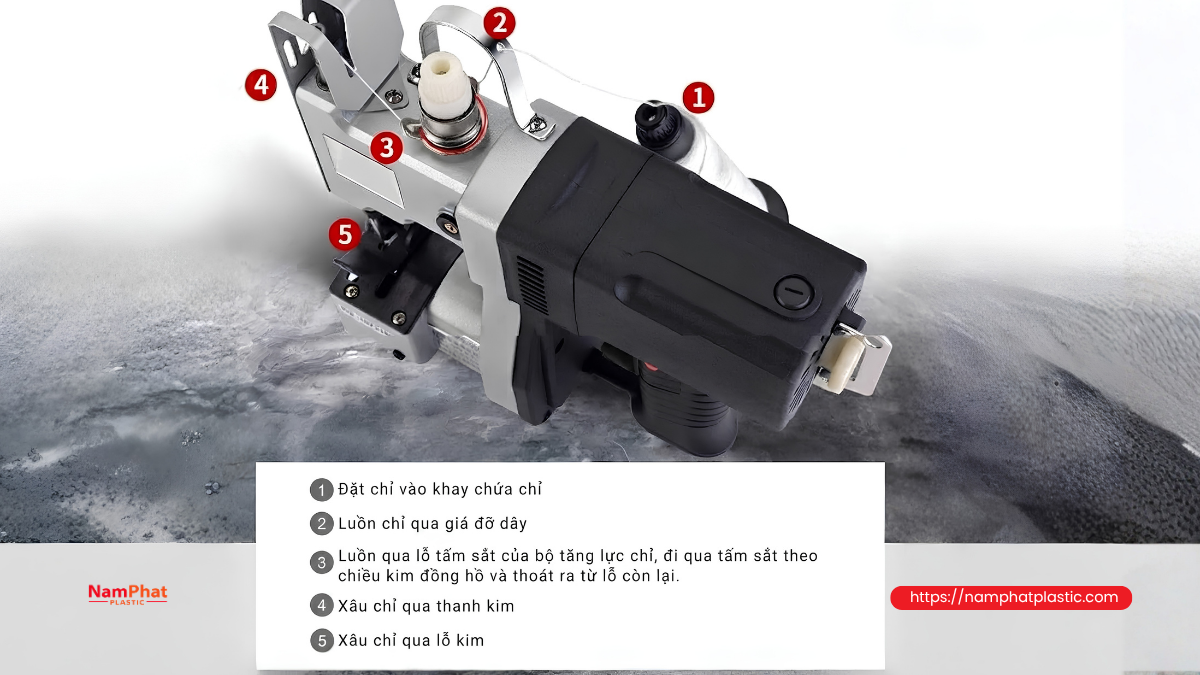
During sewing, the thread does not travel directly from the spool to the seam.
Before forming a stitch, the thread passes through multiple contact points. Every change in direction or contact with metal creates a certain amount of friction.
If the coefficient of friction between the thread and machine components is too high, the machine requires greater force to pull the thread through the system.
This can result in:
-
Increased thread tension.
-
Thread tension fluctuations.
-
Jerking of the thread.
-
Scratching of the thread surface.
-
Progressive thread fraying before reaching the needle.
-
Thread breakage when the machine accelerates.
The finish creates a surface with more suitable friction characteristics, allowing the thread to pass through the guides more consistently.
It is important to note that lower friction is not always better.
If the thread surface is excessively slippery, the thread may become more difficult to control in the tension system or its loop-forming characteristics may change. Therefore, the purpose of finishing is not to make the thread completely frictionless, but to provide an appropriate and stable level of friction.
2. Reducing friction between the thread and the needle eye
The needle eye is one of the most demanding working points for bag sewing thread.
During each stitch, a section of thread must:
-
Pass through the needle eye.
-
Change its direction of movement.
-
Withstand tension.
-
Rub against the wall of the needle eye.
-
Pass through multiple layers of bag material.
This process is repeated continuously at a very high frequency.
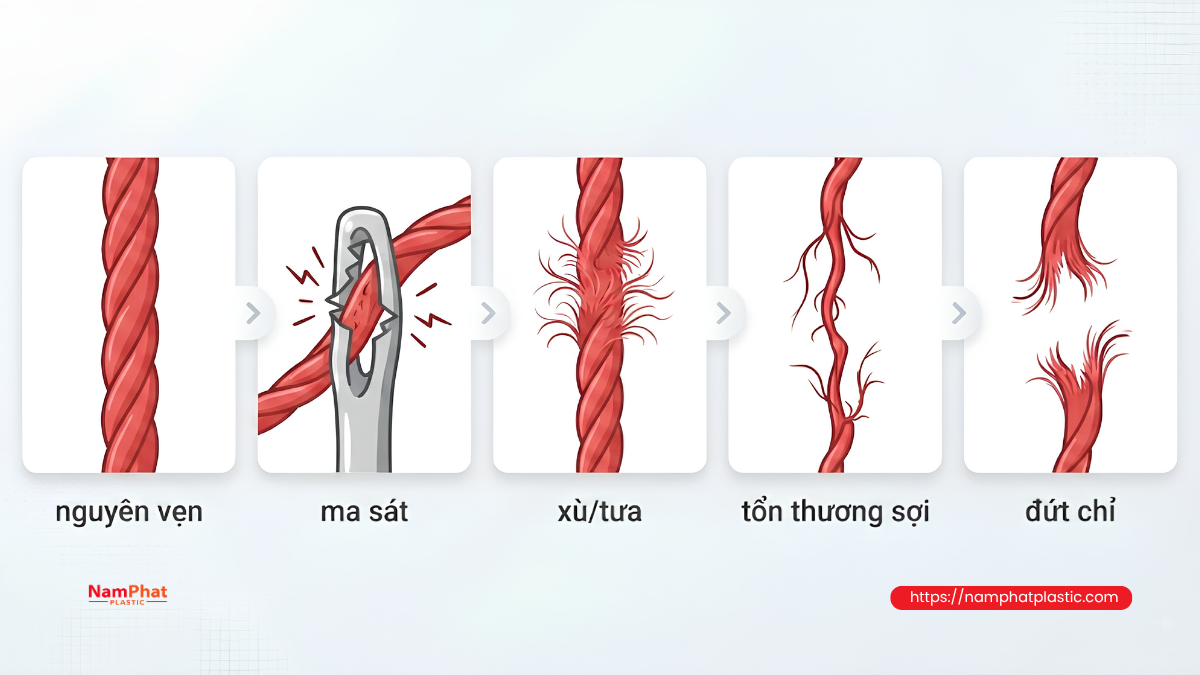
If the thread surface has high friction, the filaments or fibers on the surface can gradually wear.
The thread does not necessarily break immediately.
The operator may observe:
-
Intact thread → surface begins to become fuzzy → some fiber components are damaged → load-bearing cross-section decreases → thread breaks.
This explains why some threads may pass static tensile-strength testing but frequently break when installed on a machine.
The problem is not necessarily the initial tensile strength. It may instead be the thread’s ability to withstand dynamic friction throughout the thread path.
A suitable finish helps limit this wear process.
3. Limiting heat generated around the needle
When a sewing machine operates continuously, the needle can become hot due to friction with the bag material and high-speed movement.
At the same time, the thread continuously rubs against the needle eye.
These two sources of friction combine to make the needle area a relatively demanding working zone.
For polymer-based threads, an increase in surface temperature can alter the mechanical and friction characteristics of the thread.
A suitable finish helps reduce friction between the thread and needle, thereby contributing to:
-
Limiting heat generated by thread–needle friction.
-
Reducing surface damage to the thread.
-
Limiting localized softening or deformation caused by heat.
-
Improving continuous machine operation.
However, if the needle becomes abnormally hot, the solution should not simply be to change the finish on the thread.
The following should also be checked:
-
Is the needle size correct?
-
Is the needle eye too small for the thread diameter?
-
Is the needle bent or dull?
-
Are there burrs or scratches inside the needle eye?
-
Is the machine operating at excessive speed?
-
Is the bag mouth too thick or does it contain too many layers?
Finish oil is part of the system, not a solution to every cause of needle overheating.
4. How finish oil helps limit fraying and fiber separation
For some threads made from multiple fiber components, surface fraying or fiber separation can occur before the thread actually breaks.
When the outer fibers are continuously exposed to friction from:
-
Thread guides.
-
Tension discs.
-
Metal edges.
-
Needle eye.
the outermost components are often damaged first.
Finish oil helps reduce direct rubbing between the thread surface and metal components.
As a result, the thread can maintain its structure more effectively as it travels from the spool to the stitch-forming point.
This is particularly important when the machine operates at relatively high speed, because a small friction point repeated thousands of times can quickly become a cause of thread fraying.
5. Helping maintain more stable thread tension
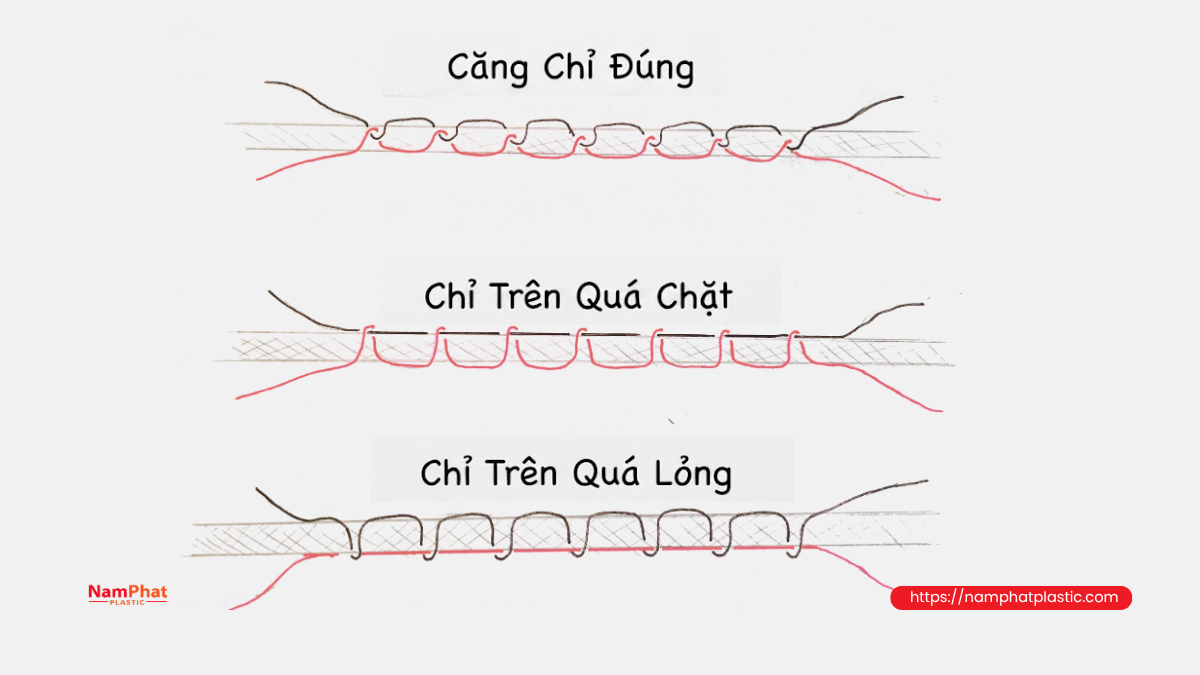
A well-performing spool requires not only high strength but also relatively stable thread tension throughout the unwinding process.
Imagine the machine continuously pulling the thread.
If the thread passes through one guide with little resistance but suddenly encounters higher friction at another point, the tension in the section near the needle also changes.
This can affect:
-
Stitch consistency.
-
Loop formation.
-
Seam tightness.
-
Thread-breakage frequency.
-
High-speed machine operation.
Uniform finish helps make the surface characteristics of the thread more consistent.
Therefore, the important issue is not simply whether the thread has oil, but also:
Whether the finish is distributed evenly along the entire length of the spool.
A spool with very dry sections and very slippery sections can still cause unstable operation even if the average oil content of the spool is not particularly low.
6. Supporting thread unwinding from the spool
Before passing through the tension system and needle, the thread must unwind continuously from the spool.
Unwinding performance is affected by:
-
Winding method.
-
Cone angle.
-
Spool hardness.
-
Consistency of spool diameter.
-
Twist direction.
-
Surface fuzziness.
-
Thread friction characteristics.
Finish oil directly affects the last factor.
When the thread surface is excessively dry or has a high coefficient of friction, thread layers can rub against each other more strongly during unwinding.
As unwinding speed increases, small differences in surface characteristics can become more noticeable.
Therefore, to determine whether a spool is suitable for a bag sewing machine, it should not be tested simply by pulling the thread by hand.
It should be tested on the actual machine system at production speed.
7. Reducing static electricity buildup under certain conditions
Polymer threads can generate electrical charges through friction.
The level of static electricity depends on factors such as:
-
Raw material type.
-
Ambient humidity.
-
Machine speed.
-
Thread-path design.
-
Surface condition of machine components.
-
Surface-treatment formulation.
A suitably designed finish system can help control charge accumulation on the thread surface.
This may help the thread:
-
Avoid abnormal adhesion to certain surfaces.
-
Pass through the thread-guiding system more consistently.
-
Reduce certain friction-related fluctuations in dry environments.
However, finish oil should not be considered the only solution to static-electricity problems. If a factory experiences serious static buildup, ambient humidity, machine grounding, and equipment configuration should also be checked.
8. Does finish oil increase the tensile strength of thread?
This is an easy point to misunderstand.
Normally, finish oil does not change the inherent strength of the polymer in the same way as increasing the number of plies or thread cross-section.
Its main role is to protect the thread during use.
For example, assume two spools have similar initial tensile strength.
Spool A
The surface has a suitable finish and stable friction.
During machine operation, the thread experiences less wear before reaching the needle, so most of its initial strength is maintained.
Spool B
The surface is dry and friction is high.
The thread passes through multiple guides and gradually becomes damaged. By the time it reaches the point of maximum load, its actual load-bearing capability has already decreased.
As a result, the operator may feel:
“Spool A is stronger than spool B.”
In reality, the difference may be that spool A retains its strength better during machine operation, rather than having significantly higher initial tensile strength.
This is the difference between:
Thread strength under laboratory testing and the thread’s actual performance on the sewing machine.
9. Why should bag sewing thread not be too dry?
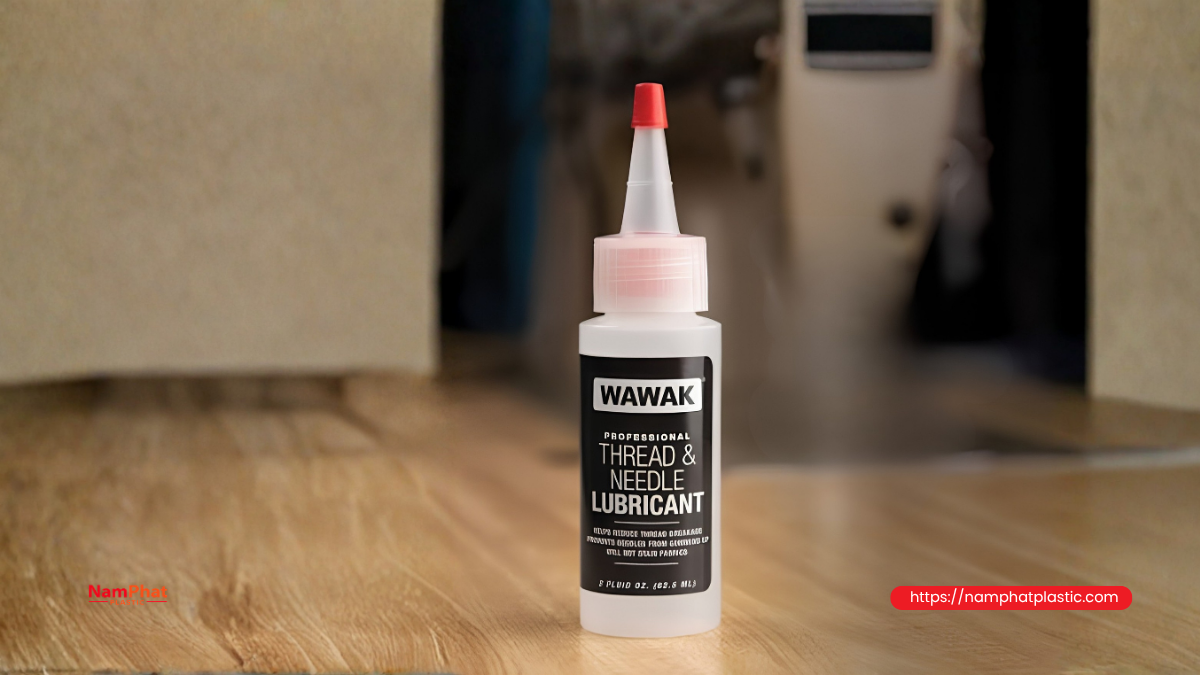
An excessively dry spool generally tends to have higher surface friction.
Depending on the thread, machine, and operating conditions, users may experience:
-
Heavier thread movement through the tension system.
-
Increased surface fraying.
-
Heating around the needle.
-
Thread breakage during acceleration.
-
More dust/fibers appearing along the thread path.
-
Unstable thread-pulling force.
When the machine runs slowly, the problem may not be obvious.
However, when speed increases to actual production levels, accumulated friction increases and problems begin to appear.
That is why a simple hand-pulling test is not sufficient to evaluate machine sewability.
10. But more oil does not necessarily mean better performance
Another misconception should also be avoided:
If oil reduces friction, then adding more oil will make the thread run better.
Not necessarily.
If the finish is excessive or unsuitable, depending on the formulation and application, it may cause:
-
An excessively slippery thread surface.
-
Changes in tension control.
-
Oil accumulation on certain machine components.
-
Increased ability to attract or retain dust.
-
An overly greasy feel during handling.
-
Reduced cleanliness around the sewing area.
-
Changes in operating characteristics over time.
Therefore, the correct target is:
-
Sufficient – uniform – stable – suitable for the thread structure and machine.
Not simply “the more, the better.”
11. Oil uniformity is more important than the feeling of being “smooth” to the touch
This is an important point in bag sewing thread quality control.
Users sometimes evaluate the amount of oil by touching the thread.
This method is only for reference.
Two threads may both feel smooth to the touch but behave completely differently on the machine because of:
-
Different oil formulations.
-
Different dynamic coefficients of friction.
-
Different finish distribution.
-
Different oil-retention characteristics.
-
Different thread-surface structures.
-
Different twist levels.
In particular, the sewing machine does not need the “smoothest” thread. It needs:
A thread with stable friction characteristics throughout operation.
Therefore, finish control should combine material inspection with actual machine testing.
12. Are finish oil and thread twist related?
These two factors have different functions but both affect machine performance.
Twist
Helps bind the fiber components together and create the appropriate thread structure.
Finish oil
Controls surface characteristics and the friction interaction of the thread.
A spool can have good twist but still experience wear during machine operation if the surface is excessively dry.
Conversely, a well-finished surface cannot completely solve fiber separation or instability caused by an unsuitable twist structure.
Therefore, the quality of bag sewing thread should be evaluated as a system consisting of:
-
Raw material + number of plies + twist + uniformity + surface finish + spool structure.
13. Can finish oil hide poor-quality thread defects?
No.
A good finishing system cannot fully compensate for basic defects such as:
-
Low-strength raw material.
-
Uneven thread.
-
Excessively large splices.
-
Incorrect twist.
-
Abnormally thick or thin sections.
-
Spools that are too hard or too soft.
-
Unstable winding.
-
Defects during plying or twisting.
Finish oil should be considered part of the overall product quality design.
If the basic thread structure does not meet requirements, increasing the amount of oil is not the correct solution.
14. Why can two threads with the same specifications have different machine performance?
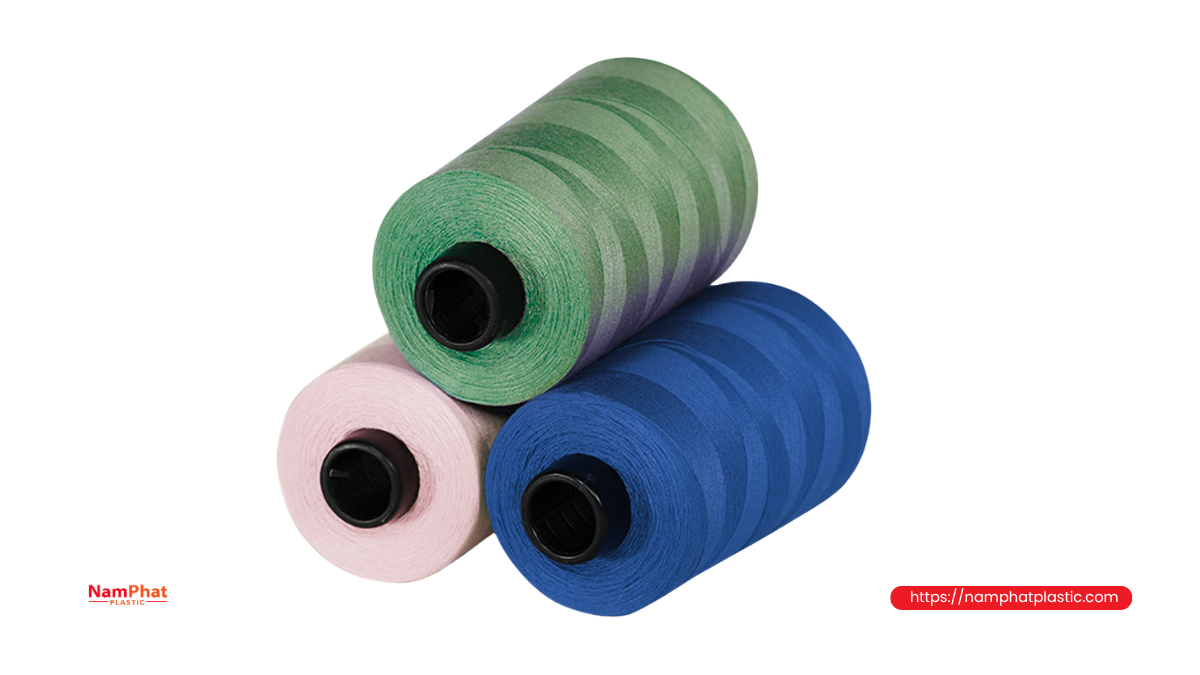
This is a fairly common situation.
For example, two suppliers may both label their product:
-
PE 20/9
but when used on the same machine, one spool may run more stably than the other.
The reasons may include:
-
Quality of the original single thread.
-
Uniformity among component fibers.
-
Twist.
-
Twist direction.
-
Actual diameter.
-
Surface fuzziness.
-
Splices.
-
Winding structure.
-
Spool core.
-
Unwinding angle.
-
Finish formulation.
-
Finish uniformity.
Therefore, the specification printed on the label only describes part of the product.
For customers operating bag sewing machines continuously, stable machine performance can be just as important as tensile strength.
15. Why finish oil is especially important at high machine speeds
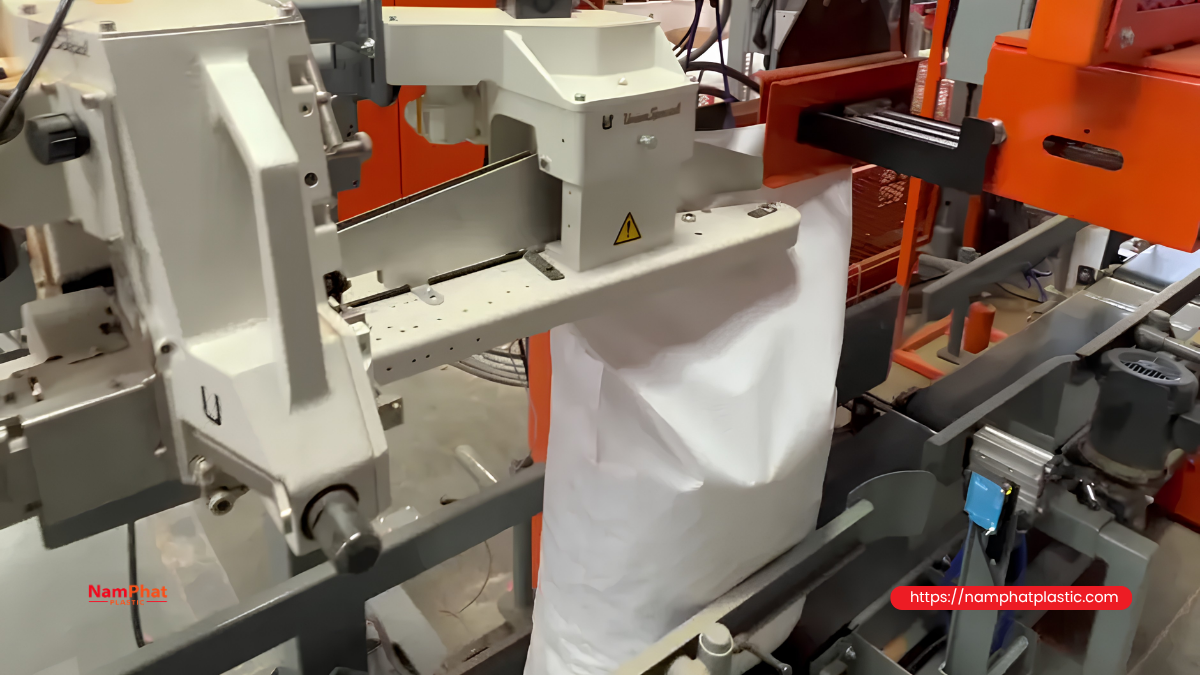
At low speed, many thread irregularities may not be obvious.
As machine speed increases, the number of friction events per unit of time increases significantly.
At this point:
-
Heat is generated more quickly.
-
The thread passes through the guides faster.
-
Thread-tension fluctuations may become more pronounced.
-
Small burrs on machine components have a greater effect.
-
Surface defects in the thread are more likely to cause breakage.
Therefore, a thread that performs well at low speed may not necessarily perform well on a high-output bagging line.
For factories requiring continuous operation, testing should be conducted under conditions as close as possible to actual production.
16. Why should machine tension be checked when changing thread suppliers?
Even when two threads have the same nominal specification, their surface friction characteristics may differ.
If the tension settings are kept exactly the same, a new thread may:
-
Run with excessive tension.
-
Run too loosely.
-
Form a different thread loop.
-
Break at certain points.
-
Produce a seam different from the previous thread.
This does not necessarily mean the new thread is poor quality.
In some cases, the thread characteristics and machine settings simply have not been properly matched.
When changing thread, especially on high-speed production lines, the following should be checked again:
-
Thread path.
-
Tension system.
-
Needle size.
-
Needle-eye condition.
-
Machine speed.
-
Unwinding performance.
-
Actual seam quality.
17. How to evaluate the effectiveness of finish oil on bag sewing thread
It should not be evaluated only by visual inspection or touch.
A more practical method is to monitor the entire behavior of the spool during operation.
17.1. Inspection before running the machine
Check:
-
Thread surface.
-
Fraying.
-
Thread uniformity.
-
Abnormally thick sections.
-
Splices.
-
Winding condition.
17.2. Observation at low machine speed
Monitor unwinding and movement through the tension system.
17.3. Increase to production speed
This is the most important stage.
Monitor:
-
Whether the thread vibrates excessively.
-
Whether tension remains stable.
-
Whether fibers accumulate at the guides.
-
Whether the thread frays near the needle.
-
Whether the needle becomes abnormally hot.
-
Thread-breakage frequency.
-
Stitch quality.
17.4. Inspection after a period of continuous operation
A good thread should maintain stable operating performance, not just run well for the first few minutes.
18. When the thread breaks, do not immediately conclude that the cause is insufficient oil
Bag sewing thread breakage can have multiple causes.
Before concluding that the problem is related to finish oil, check the following in sequence:
Spool
Is it wound too tightly, collapsed, or tangled?
Thread path
Are any guides worn, scratched, or burred?
Tension system
Is the thread being compressed too strongly?
Needle
Is it bent, dull, scratched, or does it have an excessively small eye?
Thread
Does it fray before reaching the needle, or does it break cleanly?
Bag material
Is the bag mouth too thick, too stiff, or made from material that creates high friction?
Speed
Does the problem occur at all speeds or only when the machine accelerates?
This approach helps prevent unnecessary changes to the thread when the actual cause lies in the equipment.
19. Finish oil is part of the thread’s “sewability”
In industrial thread production, tensile strength alone is not enough.
A product may have high tensile strength but frequently experience:
-
Fraying.
-
Problems along the thread path.
-
Tension fluctuations.
-
Needle heating.
-
Breakage during acceleration.
In that case, actual production efficiency can still be low.
The sewability of a thread should be understood as a combination of:
-
Strength + uniformity + twist structure + surface friction + unwinding performance + compatibility with the needle and machine.
Finish oil directly affects friction-related characteristics and indirectly influences several other factors.
This is why a very thin layer of finish on the thread surface can make a significant difference when the thread is used in mass production.
20. What should bag sewing thread buyers consider instead of simply asking “does the thread have enough oil?”
A better question is:
“Will this thread run stably on my machine?”
The amount of oil is only one of many factors.
When selecting bag sewing thread for a production line, businesses should consider:
-
Whether the thread specification is suitable for the bag.
-
Whether the strength meets seam requirements.
-
Whether the needle size is compatible.
-
Surface fraying.
-
Unwinding performance.
-
Stability at high machine speed.
-
Actual thread-breakage frequency.
-
Stitch quality.
-
Consistency between production lots.
For industrial production, consistency between spools and between lots is often more important than a single sample spool achieving exceptionally high specifications.
21. Is finish oil on bag sewing thread really important?
Yes.
Although finish oil is present only in a small amount on the thread surface, it can directly affect:
-
Thread–machine friction.
-
Thread–needle friction.
-
Thread fraying.
-
Heat generated during sewing.
-
Thread-tension stability.
-
Thread unwinding.
-
High-speed machine performance.
-
Frequency of thread breakage.
However, finish oil cannot be evaluated separately.
A high-quality bag sewing thread requires a balance between raw material, fiber structure, twist, uniformity, surface finish, and spool structure.
The ultimate goal is not to produce the thread that feels the smoothest, but a spool that:
-
Runs stably – minimizes fraying – minimizes breakage – maintains uniform tension – and is compatible with the actual machine and bag material.
Frequently asked questions about finish oil on bag sewing thread
1. Is finish oil the same as ordinary lubricating oil?
Not exactly. It is a surface-treatment system selected for the production and use of the thread, with the purpose of controlling friction and other surface characteristics.
2. Does more oil always make the thread run better?
No. The finish level must be appropriate. Too little can increase friction, while too much or an unsuitable formulation can affect thread control and machine cleanliness.
3. Why does the thread run well at low speed but break when the machine speeds up?
As speed increases, friction, heat, and thread-tension fluctuations also increase. Small problems in the thread, needle, or thread path can become more apparent.
4. If the thread frays near the needle, is it caused by insufficient oil?
It may be related, but this cannot be concluded immediately. The needle eye, needle size, burrs, thread path, tension system, and other friction points should also be checked.
5. Does finish oil make PE 20/9 stronger than PE 20/8?
It cannot be compared that way. 20/8 and 20/9 differ in their ply structure. Finish oil mainly affects surface characteristics and machine performance; it does not replace the thread’s structure or mechanical strength.
6. Can finish oil be evaluated by touching the thread?
Only as a reference. A smooth feel does not fully reflect the dynamic coefficient of friction or actual machine performance. Actual machine testing remains more important.
Conclusion
In industrial bag sewing thread, a very small amount of finish on the thread surface can have a significant effect on operating performance.
Finish oil helps control friction, limit surface damage, and support stable thread movement through the thread guides, tension system, and needle.
For businesses using bag sewing machines continuously, the key question should not only be “Is the thread strong?” but also:
-
“After passing through the entire machine, how much of its strength and stability does the thread retain?”
This is one of the most important values provided by the surface-finishing process for bag sewing thread.
>>> Xem thêm:
- 0 Comment


