


 Phan Van Hoang
- 03/09/2026
- 93
Pallet covers, pallet stretch film, and shrink film all create an outer plastic layer around goods, but they do not serve the same purpose. Pallet covers are mainly used for coverage; pallet stretch film is mainly used to stabilize packaged loads; and shrink film uses heat to create a tight-fitting layer around the load.
Because the finished appearance can be quite similar, many businesses compare only film thickness or price per kilogram. This is not enough. A solution that uses less film but requires more labor may not actually be cheaper; a fully covered layer may not keep a pallet stable when a truck brakes; and tightly wrapped film may still not protect the top surface from dust or falling water.
This article compares the three solutions based on the practical questions faced in warehousing and logistics: do you need to cover the goods, secure the load, or create a tightly enclosed unit using heat?
Table of Contents [Hide]
1. First, separate the three packaging objectives
There are three main packaging objectives:
-
Surface protection: Prevent dust, splashes, dirt, and environmental exposure from directly contacting the goods.
-
Load stabilization: Prevent cartons, bags, or products from shifting, leaning, or falling during handling and transportation.
-
Uniform enclosing: Create a compact, consistent package with film tension and higher overall coverage.
A pallet cover mainly addresses surface protection. Stretch film mainly addresses load stabilization. Shrink film can provide both coverage and tightening, but it requires suitable film, equipment, and heating conditions.
2. Quick comparison of pallet covers, pallet stretch film, and shrink film
| Criteria | PE pallet cover | Pallet stretch film | Shrink film |
| Form | Large bag or tubular film, usually closed at the top and open at the bottom | Film roll stretched and wrapped around the load multiple times | Bag, tube, or film that shrinks when heated |
| Principle | Cover the pallet from the top | Stretch and wrap around the load to create holding force | Heat causes the film to shrink tightly around the load |
| Main purpose | Coverage and surface protection | Load stabilization | Tight-fitting coverage and load enclosing |
| Top coverage | Good | Limited unless separately covered | Good |
| Load stabilization | Limited | Good | Can be good when properly designed |
| Equipment | Usually no heating equipment required | Manual wrapping or wrapping machine | Heat gun, shrink tunnel, or industrial shrink system |
| Different load sizes | Best when dimensions are known in advance | Flexible for different sizes and heights | Works best with standardized load dimensions |
| Main risks | Loose cover may not stabilize the load | Excessive tension can damage cartons; sharp edges can puncture film | Heat can damage goods or create safety risks |
| Initial investment | Low | Low to moderate | Higher depending on equipment |
| Removal | Fast and simple | Requires cutting and removing film | Requires cutting/removing the film |
3. Pallet cover: the solution focused on coverage
.png "Nhân viên trùm túi PE lên pallet hàng")
A pallet cover is essentially a large PE bag placed over the pallet from the top. Depending on the application, it can be made from LDPE, LLDPE, or a suitable blend.
3.1. Strengths of pallet covers
The main advantage is direct coverage of the top and sides of the pallet. The cover can be manufactured to the required dimensions, thickness, and color, allowing businesses to standardize packaging specifications.
It is also quick to install and remove and does not require heat. This makes it suitable for warehouses that mainly need to protect goods from dust, dirt, or light splashes.
3.2. Limitations that need to be understood correctly
A loose pallet cover does not provide the same load restraint as stretch film. If the cartons or bags inside the pallet are already unstable, simply placing a cover over them does not solve the underlying problem.
Many pallet covers are also open at the bottom. Therefore, the term “waterproof” should be evaluated based on the actual design and installation rather than the material name alone.
3.3. When should you prioritize a pallet cover?
A pallet cover is suitable when:
-
The pallet is already stable.
-
The main requirement is protection from dust, dirt, or splashes.
-
The cover needs to be installed and removed quickly.
-
Heat cannot or should not be used.
-
Different cover sizes or thicknesses are required for different loads.
4. Pallet stretch film: the solution focused on load stability
Stretch film is pulled and stretched during wrapping. Its elastic recovery creates holding force around the load. Multiple layers of film bind cartons, bags, or products together and help reduce movement.
4.1. Strengths of pallet stretch film
Stretch film can adapt to different load sizes and heights. It can be applied manually or with an automatic wrapping machine.
The wrapping force can also be concentrated at specific areas such as the base, middle, or top of the pallet, depending on the packaging requirement.
4.2. Limitations that need to be understood correctly
Stretch film is not a roof. It does not automatically provide complete protection for the top surface of the pallet.
Excessive wrapping tension can crush cartons or deform products. Sharp corners and protruding points can puncture the film. At the same time, simply adding more layers without sufficient wrapping force does not necessarily guarantee better load stability.
4.3. When should you prioritize pallet stretch film?
Stretch film is suitable when:
-
Cartons or bags are prone to shifting.
-
The load needs to be stabilized during handling and transportation.
-
Pallet sizes vary.
-
Manual or automatic wrapping is required.
-
The main priority is load stability rather than complete top coverage.
5. Shrink film: using heat to tightly enclose the load

Shrink film shrinks when exposed to heat. It is commonly placed around a pallet as a hood or tube and then heated so that the film contracts tightly around the load.
An important distinction is that shrink film is not stretch hood. Stretch hood uses mechanical stretching and does not require heat.
5.1. Strengths of shrink film
Shrink film can create a close-fitting and uniform package with good coverage of both the top and sides.
When the system is properly designed, it can also contribute to load stabilization. It is particularly suitable for high-volume production lines with standardized pallet dimensions.
5.2. Limitations and safety requirements
Heat introduces additional variables that must be controlled. Businesses need to consider the heat sensitivity of the goods, airflow, ventilation, fire risks, and appropriate personal protective equipment.
Using a heat gun manually can also result in uneven shrinkage, burns, or holes in the film.
For industrial applications, shrink packaging should be considered as a complete system involving the film, machine, temperature, and load rather than simply a type of plastic film.
5.3. When should you consider shrink film?
Shrink film may be appropriate when:
-
A tight and uniform package is required.
-
Pallet dimensions are relatively standardized.
-
Packaging volume is high enough to justify the equipment.
-
The goods can tolerate the required heating conditions.
-
The business can properly control heat and safety requirements.
6. Which one should you choose for each practical situation?
| Situation | Recommended approach |
| Stable cartons stored indoors where dust is the main concern | Pallet cover |
| Many raw-material bags that tend to slide | Stretch film |
| Need both load stability and a clean top surface | Stretch film + top sheet or pallet cover |
| Sharp corners, dust protection, and no long-distance transportation | Properly oversized pallet cover + corner protection if needed |
| High-volume production with standardized packaging | Shrink film or stretch hood |
| Outdoor storage | Do not choose based on material name alone; evaluate UV resistance, rain, pallet bottom protection, storage time, and condensation/moisture |
| Heat-sensitive or heat-restricted goods | Pallet cover or stretch film |
7. Three common misunderstandings that lead to the wrong choice
7.1. A more tightly covered load is always more stable
Not necessarily. Coverage and load restraint are two different functions.
A pallet can be completely covered while the cartons inside are still able to shift. Conversely, a pallet can be very stable with stretch film but have insufficient protection on the top surface.
7.2. Thicker film always means better performance
Not necessarily. Film performance depends on material properties, thickness, elasticity, puncture resistance, wrapping force, and the actual load.
Using thicker film without addressing the real packaging problem can increase material consumption without delivering a proportional improvement.
7.3. The lowest price per kilogram means the lowest total cost
The total packaging cost includes more than material price:
Total pallet packaging cost = material + labor + equipment depreciation + energy + waste + damage losses
A cheaper film may require more layers, more labor, or more frequent replacement. Therefore, the appropriate comparison should be based on the cost of completing and protecting each pallet, not only the price per kilogram.
8. How to evaluate a sample before placing a large order
Before mass production, evaluate the packaging sample based on at least five factors:
-
Dimensions and load shape: Measure the pallet and the actual dimensions after stacking.
-
Mechanical weak points: Check corners, protruding points, unstable areas, and areas prone to puncture.
-
Stability after packaging: Check whether the load shifts, leans, or moves during handling.
-
Environmental protection: Evaluate dust, splashes, rain, UV exposure, and storage conditions.
-
Time and material consumption: Record the amount of material, labor time, and equipment requirements per pallet.
9. Should you combine a pallet cover with stretch film?
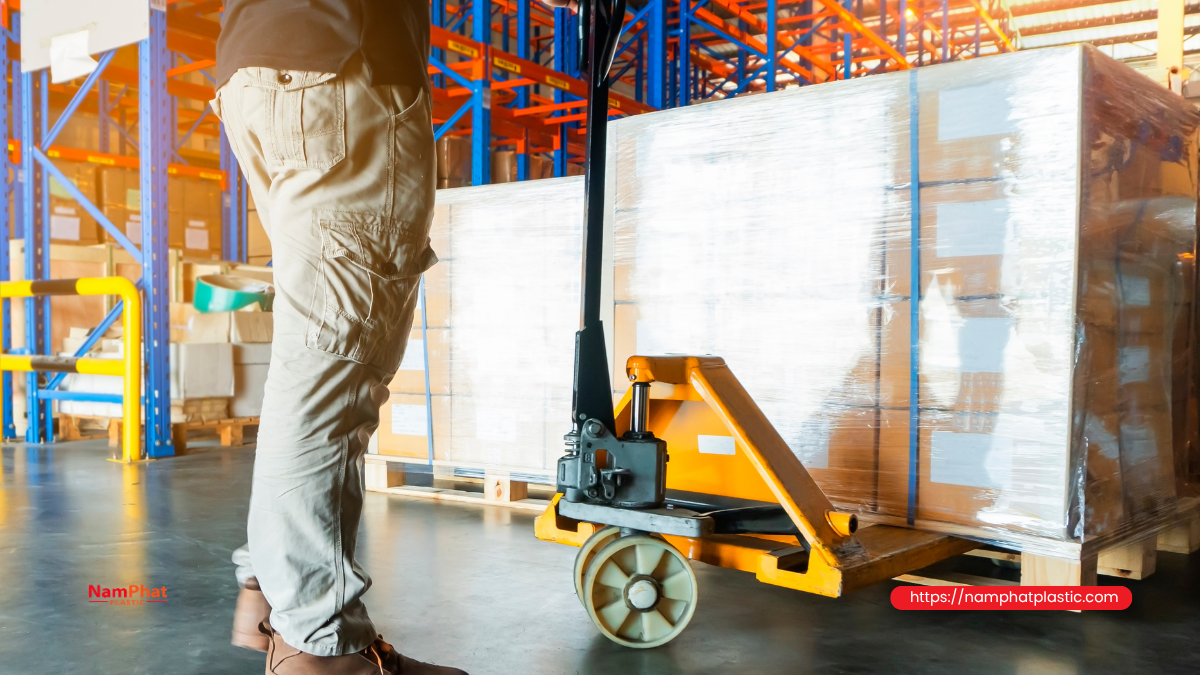
Yes, when the packaging requirements justify it.
One common approach is to wrap the pallet with stretch film first and then place the pallet cover over it. Another option is to place a top sheet over the load before wrapping.
This combination can provide both load stabilization and additional surface protection. However, it is not necessary for every pallet. The additional material cost should be justified by the actual protection requirements and potential damage or complaint risks.
10. A five-question process for choosing the right solution
Before selecting the packaging method, ask:
-
Is the main goal protection from dust and splashes, or prevention of load movement?
-
Are pallet dimensions consistent?
-
Does the load have sharp edges, carton deformation risks, sliding risks, or heat sensitivity?
-
Will the pallet be stored indoors or outdoors, and for how long?
-
Is the packaging volume high enough to justify a machine?
As a general principle:
-
Choose a pallet cover when surface coverage is the priority.
-
Choose stretch film when load restraint is the priority.
-
Consider shrink film or stretch hood for high-volume automated packaging where the packaging system is properly designed.
Conclusion
Pallet covers, stretch film, and shrink film solve different packaging problems.
A pallet cover mainly protects the outer surface of the load but is not a primary load-restraint solution. Stretch film creates holding force around the load but may require a top cover for better surface protection. Shrink film uses heat to create a tight-fitting package and requires suitable film, equipment, and safety controls.
Nam Phát Plastic produces PE pallet covers according to customer requirements for dimensions and specifications, helping businesses select packaging solutions that match their actual storage, handling, and transportation conditions.
Hotline: 0911 904 968
Email: contact.namphat@gmail.com
Website: namphatplastic.com
Frequently Asked Questions
1. Can a pallet cover replace stretch film?
Not always. A pallet cover mainly provides coverage and surface protection, while stretch film is designed to create holding force and stabilize the load.
2. Does stretch film protect against water?
Stretch film can limit direct exposure to water on covered surfaces, but overlaps, the top, the pallet base, and punctured areas can still allow water to enter.
3. Can a normal PE pallet cover shrink when heated with a heat gun?
Do not assume so. Shrink film must have suitable shrink properties. Ordinary PE pallet covers should not automatically be treated as shrink film.
4. What is the difference between shrink film and stretch hood?
They are different technologies. Shrink film uses heat to shrink around the load, while stretch hood uses mechanical stretching and does not require heat.
5. For cartons, should I use a pallet cover or stretch film?
Use a pallet cover when the cartons are already stable and the main concern is dust or surface protection. Use stretch film when carton movement is the main concern. A combination can be considered when both requirements are important.
6. What information should I provide when requesting a quotation?
Provide the pallet dimensions after stacking, type and weight of goods, corner characteristics, required thickness or sample, color, quantity, storage conditions, and packaging requirements. Photos can also help suppliers assess the actual application.
See also
- 0 Comment


