


 Phan Van Hoang
- 03/09/2026
- 98
Each pallet load has a different “packaging geometry”: base dimensions, loaded height, bulges from bags or cartons, corners and edges, and the way the load is secured. Therefore, ready-made pallet covers in a standard size may be too tight to handle, too loose and cumbersome, or too short to fold and tie. For many factories, a more suitable solution is to have pallet covers produced in Dong Nai according to the actual dimensions of the load, while also determining the appropriate thickness, material and packaging method.
Nam Phát Plastic accepts custom PE pallet cover requirements for storage, internal transportation and product protection throughout the supply chain. The key is not simply choosing a bag that is “as thick as possible,” but understanding the actual conditions of use and approving the specifications through a sample or reliable measurement data before mass production.
Table of Contents [Hide]
1. Why do businesses in Dong Nai often need custom pallet covers?
Dong Nai is home to many manufacturing plants, distribution warehouses and industrial parks. Although they use pallets, packaging configurations vary greatly: square cartons, bulging material bags, rolls of supplies, metal components, packaged food or finished goods awaiting shipment. A difference of just a few centimeters at the base or in the protruding parts of the load can significantly affect the covering process.
Ordering according to actual dimensions helps businesses control three practical issues. First, the opening must be large enough for workers to pull the cover over the load without excessive stretching. Second, the body should not have excessive material that interferes with forklifts or creates excessive folds. Third, the height must be sufficient for the intended application: dust protection, folding under the pallet, tying the opening or combining with stretch wrapping.
Ordering principle: Do not provide only the dimensions of the wooden pallet. Measure the entire load after it has been fully stacked, including the largest protruding points and the additional height needed for folding, tying or sealing.
2. What is a pallet cover and what should be understood about its construction before ordering?
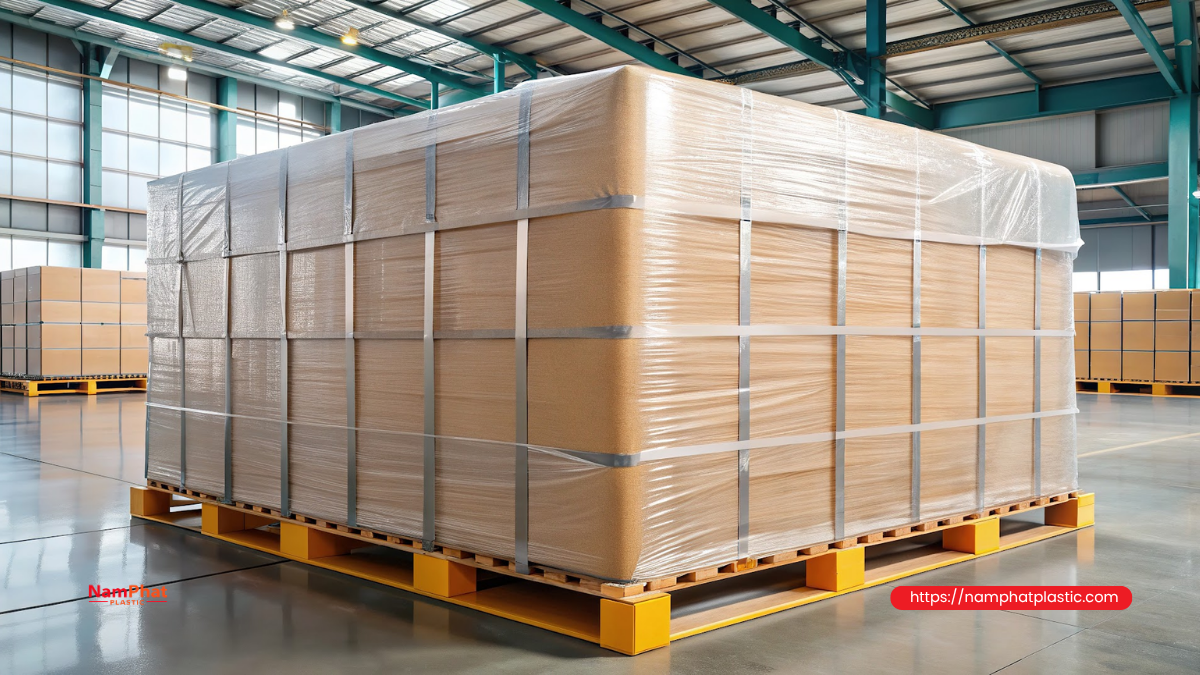
A pallet cover is a large plastic film packaging product, typically designed to cover a fully loaded pallet from the top. The cover can be made flat or with gusseted sides that allow it to expand into a box-like shape. Depending on the construction, the opening is usually left at the bottom for covering the load, while the opposite end is sealed to form the top.
In industrial applications, PE film is selected for its flexibility, ability to conform to the load and surface moisture resistance. However, a pallet cover does not automatically make the load completely sealed. If the opening is not properly sealed or tied, moisture and dust can still enter from below. For extended outdoor storage, UV exposure, standing water, wind and load stability must also be considered—factors that a thin cover designed for indoor use may not be suitable for.
2.1. Gusseted sides and the ability to fit the load
Gusseted sides allow the cover to expand according to the depth of the pallet instead of remaining as two flat layers of film. When ordering, customers should provide the required length, width and height; the manufacturer can then convert these specifications into the appropriate film width, gusset depth and cutting length for the cover construction. Converting the “layflat width” independently before the construction method has been agreed upon can easily lead to misunderstandings between the buyer and manufacturer.
2.2. Clear film, colored film or functional requirements
Clear film makes it easier to inspect labels and the condition of the goods. Colored film can help conceal products or distinguish batches, but the level of opacity depends on the color and thickness. Certain applications may require antistatic properties, UV resistance or identification printing. These requirements should be stated from the beginning so feasibility, minimum order quantities and testing methods can be evaluated. Not every PE cover should be assumed to have these functions by default.
3. How to measure pallet cover dimensions to avoid ordering errors
Dimensions should be taken from a pallet loaded under actual operating conditions. Do not measure an empty pallet or rely solely on nominal dimensions from a drawing when products normally bulge or shift. Measure across the largest points and take photos of all four sides so the manufacturer can see corners, protruding areas and the intended covering method.
Step 1: Measure the maximum length of the load
Measure the longest side after the goods have been stacked, including bags or cartons extending beyond the pallet edge. If the load has straps, corner boards or stretch film, determine whether the cover will be applied before or after these materials, as the external dimensions may change.
Step 2: Measure the width at the largest bulging point
For bags containing powder, grains or raw materials, the middle section of the load may be wider than the pallet surface. Measure at several heights, especially around the lower and middle sections. The largest measurement should be used as the basis for designing the cover opening.
Step 3: Measure the height and determine the functional allowance
Height is measured from the point where the cover begins to cover the top of the load to the desired end point. If the cover needs to be folded under the pallet, tied or sealed after covering, additional material must be allowed for that operation. There is no single fixed allowance for every order because it depends on the packaging method and the customer's equipment.
Step 4: Agree on finished dimensions and tolerances
The purchase specification should clearly state whether the dimensions refer to internal usable dimensions, finished dimensions measured flat, or the dimensions of the loaded pallet. The acceptable tolerance for each dimension and thickness should also be agreed upon. This small step prevents common disputes caused by different interpretations of the same measurements.
Example of how to provide specifications
A loaded pallet has external dimensions of 1,100 × 1,100 × 1,500 mm. The customer needs the cover to extend over the pallet base with additional material for folding. Instead of specifying an arbitrary cover size, provide the actual load dimensions, pallet photos, protruding points, required folding length, whether the cover is applied manually or with equipment, and whether it will be used indoors or outdoors. The manufacturer can then recommend the finished dimensions and produce a sample for approval. This example illustrates the communication process and is not a universal formula for calculating every pallet cover size.
4. Choose thickness based on usage risks, not just habit
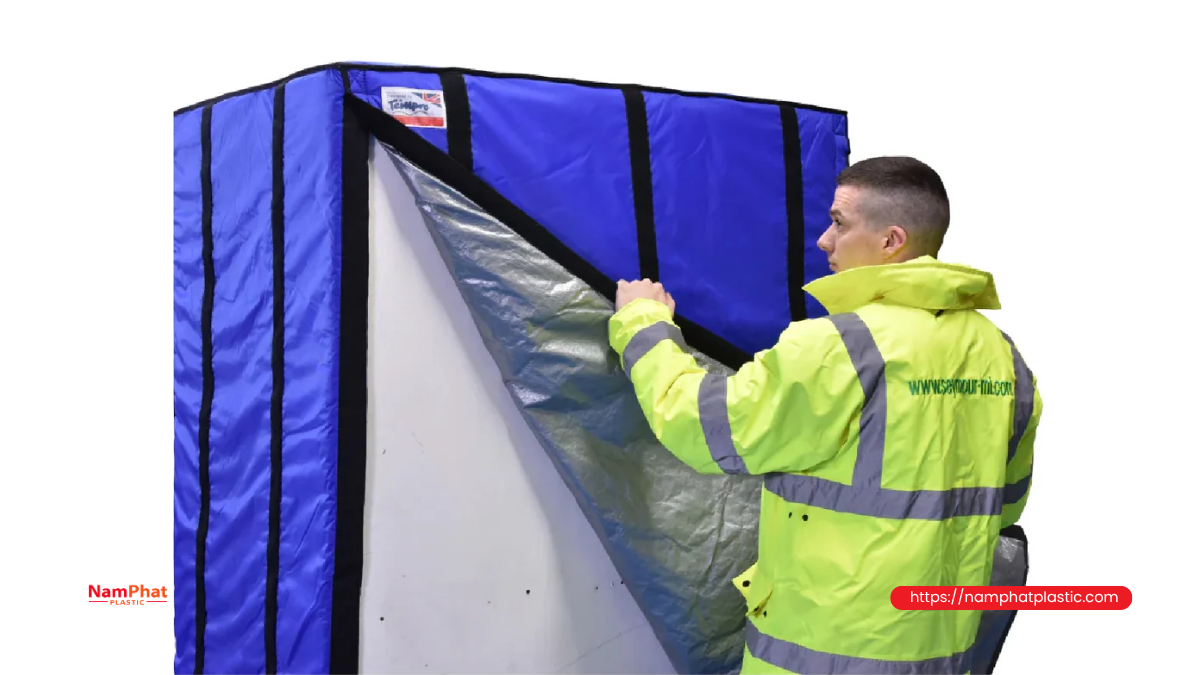
Thickness is commonly expressed in micrometers (microns, µm). When comparing quotations, make sure both parties are using the same unit and measurement method. Increasing thickness generally increases material consumption, but actual performance also depends on the material formulation, film uniformity, load edges, sealing quality and handling method.
The table below is only a starting point for discussion. Final specifications should be confirmed using an actual load, especially when pallets have sharp edges, heavy loads, outdoor storage conditions or require reuse.
| Criteria | Pallet cover | Stretch film |
| Form | Large cover applied from the top | Roll film wrapped around the pallet |
| Packaging speed | Fast when the cover size is standardized | Requires multiple wrapping turns |
| Top coverage | Good | Depends on wrapping method |
| Load securing | Moderate | Good |
| Dust protection | Good | Good |
| Suitable for uneven pallets | Requires correct size design | More flexible |
| Handling | Direct covering | Manual or machine wrapping |
Why can two covers with the same thickness perform differently?
A micron value does not fully describe performance. Film can differ in flexibility, tear resistance, cross-web uniformity, sealing quality and recycled material content. Therefore, the purchase specification should connect thickness with actual performance criteria: the cover must be applied without tearing, seals must not fail during normal handling, dimensions must remain within tolerance, and the surface must meet the agreed appearance requirements.
5. LDPE, LLDPE and recycled materials: what should be discussed?
LDPE generally provides soft, easily processed film; LLDPE can be blended to improve certain mechanical properties depending on the formulation and equipment. However, the resin name alone is not enough to conclude that one cover will be “better” than another. What matters is designing the material according to the intended application and maintaining consistency between production batches.
With recycled materials, the benefits may include cost considerations and resource utilization, but color, odor, contaminants and consistency may differ from virgin materials. Products requiring high appearance standards, contact with sensitive goods or specific compliance requirements should be discussed clearly. Buyers should not assume that every material grade is suitable for every application. A representative sample should be requested, with acceptance criteria stated in the purchase order.
6. Process for ordering custom-size pallet covers in Dong Nai
6.1. Provide pallet data and protection requirements
Customers provide the three largest dimensions, load photos, product type, surface shape and usage environment. If a cover is already in use, it is helpful to provide a sample together with specific feedback: where it is too tight, where it is too loose, where it tears and whether it is difficult to handle.
6.2. Recommend construction and specifications
The manufacturer determines the cover type, finished dimensions, recommended thickness, color, packaging method and any functional requirements that need evaluation. At this stage, both parties should agree on how dimensions are stated to avoid confusion between load dimensions and layflat film width.
6.3. Approve the sample or technical specifications
For new orders or pallets with complex shapes, testing a sample on the actual load is an effective way to reduce risk. The sample should be tested according to the actual packaging sequence and by the workers who will operate it. If a physical sample is not possible, both parties should approve a specification sheet with clear illustrations, tolerances and inspection criteria.
6.4. Production, inspection and batch packaging
After approval, the production batch is inspected according to agreed criteria such as dimensions, thickness, appearance and seals. Packaging specifications should also match warehouse distribution practices, including pieces per bundle, batch labeling, storage conditions and measures to prevent puncturing during transportation.
6.5. Evaluation after the first batch
Feedback should be based on specific situations rather than general statements such as “the cover is weak” or “the cover is too large.” Recording defect rates, tear locations, pallet types, operating shifts and site photos helps identify the correct adjustment for the next order instead of simply increasing thickness without evidence.
7. Factors that affect pallet cover pricing
Price does not depend on length alone. Material consumption is affected by length, width, height, gusset construction and thickness. As dimensions or micron thickness increase, the amount of plastic used per cover generally increases. Other factors include material type, color, functional additives, printing, tolerances, order quantity, packaging method and production complexity.
For a fair comparison between quotations, businesses should compare the same specification set: finished dimensions and measurement method, thickness and tolerance, material type, color, sealing construction, quantity, packaging method and sample acceptance criteria. A lower unit price may result in higher overall costs if covers have to be discarded because they are too tight, tear easily or are difficult to handle.
8. Information to provide for accurate consultation and quotation
| Information | Recommended details | Why it is needed |
| Dimensions | Maximum length × width × height of the fully loaded pallet | Determine opening and usable length |
| Actual photos | Four sides, top surface and protruding/sharp areas | Identify abrasion risks or measurement gaps |
| Covering method | Manual or equipment; before or after stretch film/strapping | Calculate operating allowance and packaging sequence |
| Environment | Indoor/outdoor, storage duration, water/UV exposure | Assess thickness and functional requirements |
| Purpose | Dust protection, surface moisture protection, load grouping, concealment or other purposes | Avoid over- or under-specifying the cover |
| Material | Virgin, recycled or consultation required; color, odor and appearance requirements | Control expectations and cost |
| Thickness | Current micron thickness or desired range, plus issues with the current cover | Recommend based on actual risks |
| Quantity | Pieces per order and expected purchasing frequency | Calculate production, packaging and pricing options |
| Packaging | Pieces per bundle, labels and warehouse distribution method | Facilitate counting and batch traceability |
| Reference sample | Existing cover or approved drawing, if available | Shorten specification approval time |
9. Common mistakes when buying large pallet covers
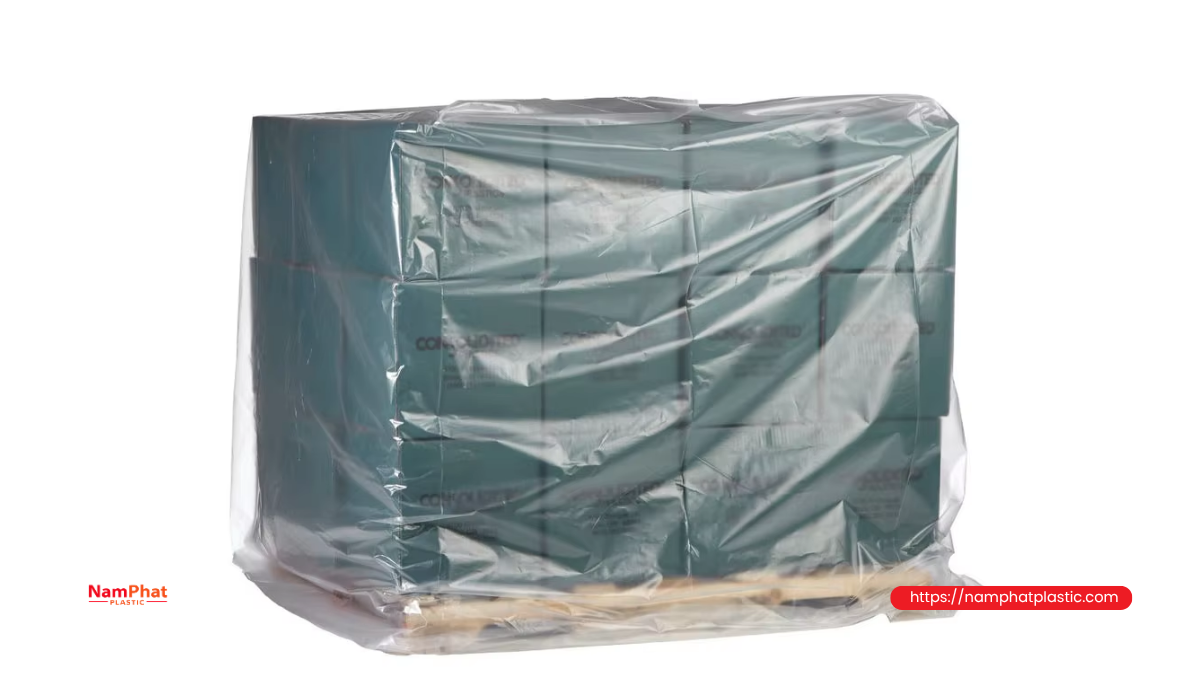
Using only the dimensions of the empty pallet
Goods may extend beyond the pallet or bulge when stacked in multiple layers. A cover made tightly to the pallet dimensions will become stretched around the sides and corners, forcing workers to pull harder and increasing the risk of tearing.
Adding excessive allowance “just to be safe”
An oversized cover creates excessive folds, makes securing more difficult and may interfere with forklifts. Additional material should serve a specific purpose—covering operation, load tolerance, folding or tying—not be added arbitrarily in every direction.
Choosing thickness while ignoring sharp edges
A metal edge, strap end or sharp carton corner can concentrate force on a very small area. Simply increasing micron thickness may not fully solve the problem. Corner protection, packaging sequence changes or adjustments to the pulling method may sometimes be more effective.
Failing to define measurement methods and tolerances
If the buyer measures the loaded pallet while the supplier quotes flat film width, the same series of numbers may have two different meanings. The approved specification should include a diagram, clearly labeled dimensions and the position of the cover opening.
Using an indoor cover for outdoor storage
Sunlight, heat, wind and standing water can significantly change usage conditions. For outdoor applications, the expected duration and method of securing the cover should be specified so the manufacturer can evaluate materials, additives and usage limits. A pallet cover also does not replace proper load securing.
10. Inspecting pallet covers before use
A short inspection procedure can identify deviations before the entire batch is distributed. Samples should be taken from several different bundles, spread on a clean surface and measured according to the agreed method. The cover should then be tested on a representative pallet, checking tension at the four corners, the top seal and the amount of material remaining around the pallet base.
| Inspection item | Practical inspection method | Signs requiring attention |
| Dimensions | Measure according to the specification drawing and compare with tolerances | Cannot cover the load, excessive material or incorrect gusset position |
| Thickness | Measure multiple points with suitable equipment and compare with specifications | Large variation between areas or outside tolerance |
| Seals | Inspect continuously and test on a representative load | Open seams, brittle burns, abnormal wrinkles or failure during covering |
| Appearance | Check color, odor, contaminants and holes against the approved sample | Significant deviation from agreed criteria |
| Handling | Have operators apply the cover according to the actual process | Requires excessive pulling, takes too long or easily catches on corners |
11. Benefits of working with a manufacturer in Dong Nai
For customers operating in Bien Hoa, Trang Bom, Long Thanh, Nhon Trach and surrounding areas, proximity can make sample exchanges, load inspections and specification adjustments more convenient. The main value is not only delivery distance but also technical coordination: measuring correctly, understanding the actual application and retaining approved specifications for future orders.
Nam Phát Plastic focuses on a data-based approach to the actual load. Customers can start with basic information including pallet photos, maximum external dimensions, current thickness, issues that need to be resolved and expected quantity. Both parties can then select a suitable solution instead of starting with an arbitrary cover size or micron value.
12. When is a pallet cover not the only solution?
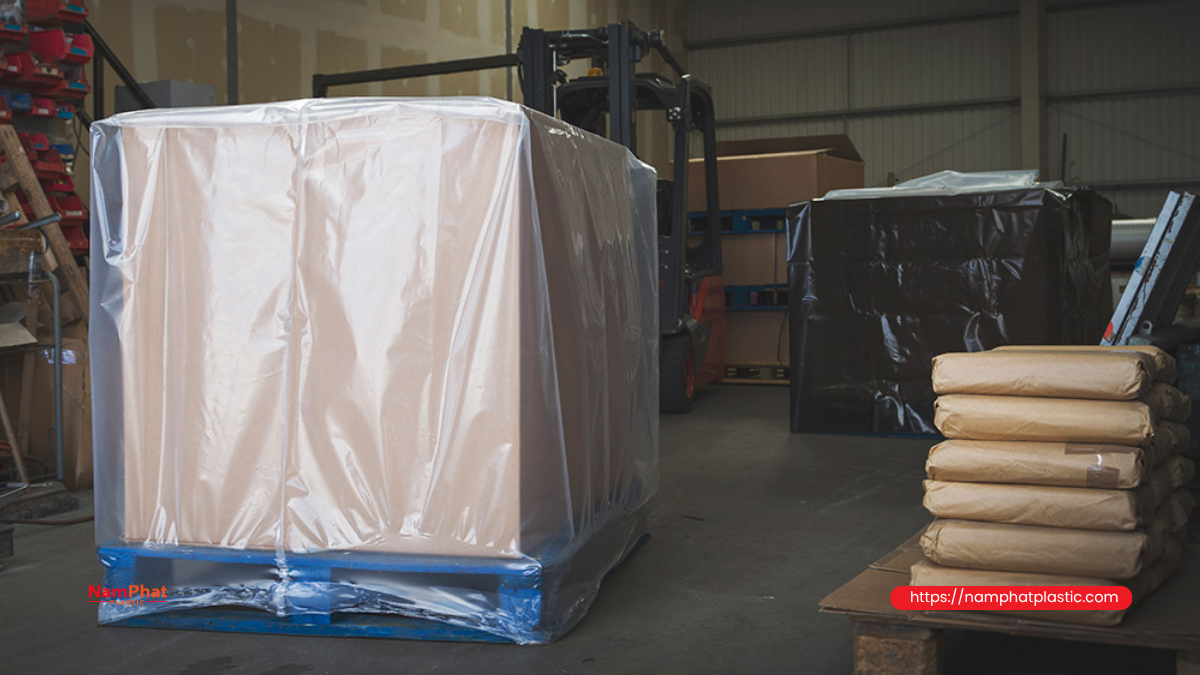
If the main objective is to secure the load against shifting, stretch film and strapping may play a more important role. If complete water protection is required during long-distance transportation, the entire packaging system must be designed together, including the method of closing the opening, preventing water accumulation and controlling internal moisture. If the product has sharp edges, additional corner protection may be required. A pallet cover works best as one layer of a complete packaging system rather than as a replacement for every other packaging material.
13. Request consultation for custom-size pallet covers
Businesses looking for custom pallet cover production in Dong Nai can provide Nam Phát Plastic with the actual load dimensions—length × width × height—along with load photos, usage conditions, current thickness or sample, material and color requirements, and quantity. Based on the information provided, the team can discuss the construction, sample specifications and suitable quotation options.
Information to provide: Maximum length × width × height + pallet photos + indoor/outdoor use + protection purpose + current thickness + expected quantity.
Frequently asked questions about custom pallet covers
1. Can pallet covers be produced in custom sizes?
Yes. Specifications should be based on the external dimensions of the fully loaded pallet, the covering method and the additional height required for folding or tying. For a new pallet configuration, a sample or specification drawing should be approved before mass production.
2. Are length × width × height dimensions enough?
These three dimensions are essential but may not always be sufficient. Load photos, protruding areas, sharp edges, storage conditions, covering method and the existing cover sample help the manufacturer assess the requirements more accurately.
3. Is a thicker pallet cover always better?
Not necessarily. Increasing thickness generally increases material consumption and cost. Performance also depends on dimensions, film uniformity, sealing, load edges and handling. Thickness should be selected according to actual usage risks and confirmed through practical testing.
4. Are PE pallet covers completely waterproof?
PE film helps limit water and surface moisture, but the packaging system is only effectively sealed when the opening, seals and securing method are properly designed. An open cover or standing water can still affect the goods.
5. Can pallet covers be used outdoors?
Outdoor use can be considered, but the expected exposure time, sunlight, wind, water and securing method should be specified. UV resistance and usage limits should be evaluated rather than automatically using an indoor specification outdoors.
6. Can the covers be made in color or printed?
Depending on the specifications, quantity and technical requirements, color or printing options can be discussed. Customers should provide a color reference, printing content, position and approval criteria for evaluation.
7. What factors determine pallet cover pricing?
Key factors include dimensions, gusset construction, thickness, material, color or additives, printing, quantity, tolerances and packaging. Quotations should be compared using the same specification set.
8. Should a sample be made before ordering a large quantity?
It is recommended, especially when the pallet has bulging loads, sharp edges, significant height or when the company is replacing an existing cover. Testing on the actual pallet helps identify handling and dimensional issues before mass production.
>> See also:
- 0 Comment


