


 Phan Van Hoang
- 13/08/2026
- 344
During storage and transportation, palletized goods are often exposed to factors that can affect product quality, such as dust, moisture, rainwater, friction, and environmental contamination. Especially for palletized goods that must be stored for extended periods or pass through multiple handling stages, wrapping film alone may not provide complete protection.
One of the most commonly used solutions in industrial packaging is the pallet cover bag, also known as a Pallet Cover.
In principle, this is a large plastic packaging solution designed to cover an entire pallet load from top to bottom. Although its structure is relatively simple, selecting the correct size, material, and thickness can significantly improve product protection during warehousing, handling, and transportation.
Table of Contents [Hide]
1. What is a pallet cover bag?
A pallet cover bag is a large PE plastic bag or film used to cover palletized goods in order to reduce exposure to dust, moisture, water, and other environmental factors.
Common English terms include:
- Pallet Cover
- PE Pallet Cover
- Plastic Pallet Cover
- Polyethylene Pallet Cover
- Pallet Cover Bag
Unlike ordinary PE bags, pallet covers are manufactured in very large dimensions based on the actual pallet size and total load height.
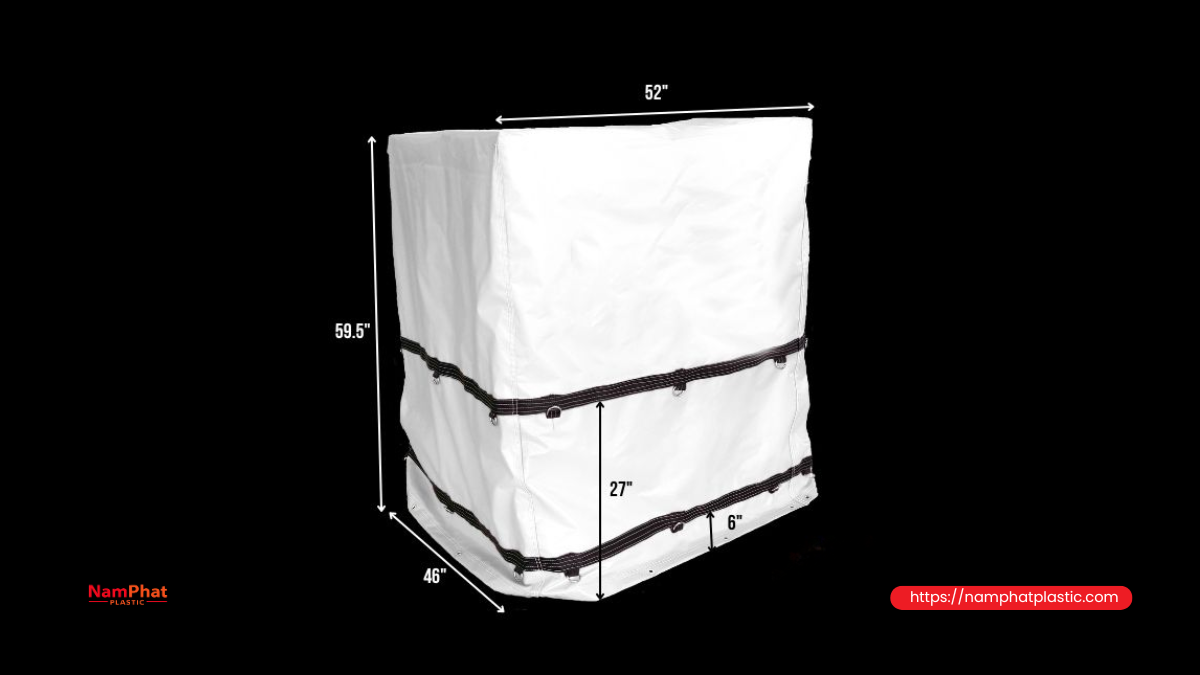
For example, if a pallet measures:
- 1,100 × 1,100 × 1,200 mm
the cover must be designed with sufficient width, depth, and length to fully cover the load without excessive stretching.
Pallet covers may be produced in several forms:
- Flat bags
- Gusseted bags
- Tubular covers
- Bottom-sealed bags
- Open-end bags for direct pallet covering
In industrial applications, gusseted PE pallet covers are particularly popular because they expand easily to fit pallet depth and provide a better fit around box-shaped loads.
2. Structure of a pallet cover bag
Although pallet covers appear simple, their actual quality depends on several factors, including resin selection, film extrusion technology, thickness uniformity, seal quality, and dimensional design.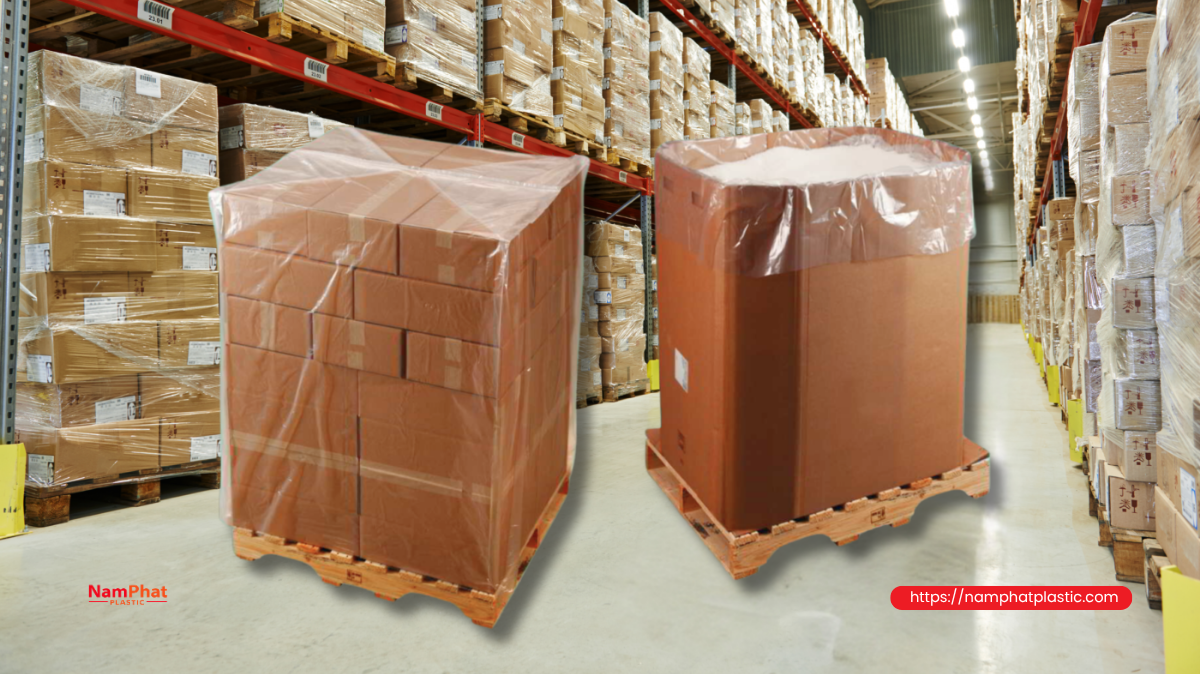
2.1. PE plastic film layer
The primary component of the cover is polyethylene film.
Different resin types may be blended depending on product requirements.
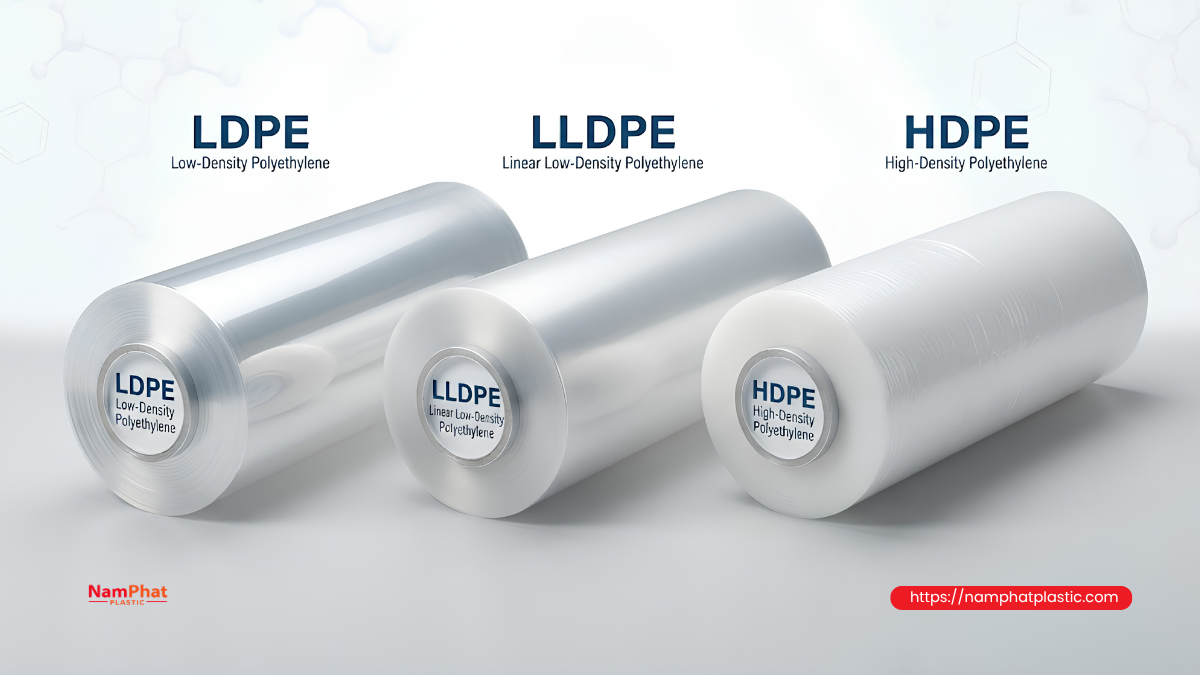
LDPE
LDPE is relatively soft and flexible and offers excellent film-forming properties.
Advantages include:
- Soft film texture
- Good flexibility
- Relatively high clarity
- Excellent heat-sealing properties
- Suitable for large-size bag production
LLDPE
LLDPE is often incorporated to improve tensile strength and tear resistance.
For pallets with sharp edges or loads that may puncture the film, mechanical strength becomes particularly important.
HDPE
Some formulations may include HDPE to adjust stiffness, durability, and production cost.
The resin blending ratio depends on customer requirements.
Therefore, when evaluating a pallet cover, businesses should not only ask:
- "How thick is the bag?"
but also:
- "What materials are used and what is the actual performance of the film?"
Two bags with the same thickness may have very different strength characteristics depending on resin formulation and manufacturing quality.
2.2. Gusseted side panels
For box-shaped pallet loads, gusseted designs provide significant advantages.
The side panels are folded inward during manufacturing. During use, they expand outward to create three-dimensional volume.
The structure can be visualized as:
- Front width + depth created by two gussets + bag length
This design helps:
- Simplify pallet covering
- Fit box-shaped loads more effectively
- Reduce excess film at the sides
- Minimize stress at pallet corners
- Improve overall appearance after packaging
For these reasons, gusseted covers are often preferred over extremely large flat bags.
2.3. Bag bottom
One end of the bag is typically sealed to form the bottom.
During use, operators open the bag and place it over the pallet from above.
The bottom seal is a critical area because weak seals can fail during handling or when stretched around sharp pallet corners.
Seal quality depends on:
- Sealing temperature
- Sealing time
- Sealing pressure
- Film thickness
- Resin type
- Film uniformity
The larger the cover, the more important seal strength becomes.
2.4. Bag opening
The bag opening remains unsealed to allow easy application over the pallet.
After installation, the opening may be:
- Left open
- Folded beneath the pallet
- Secured with adhesive tape
- Secured with straps
- Combined with stretch film
In many packaging systems, pallet covers do not replace stretch film entirely but are used together to provide additional protection.
3. What are the functions of a pallet cover bag?
3.1. Dust protection
One of the most common applications is dust prevention.
Warehouse and production environments may expose palletized goods to:
- Industrial dust
- Forklift dust
- Paper dust
- Plastic dust
- Raw material dust
- General warehouse contaminants
Covering the entire pallet with PE film creates a barrier between the product and its surroundings.
This is especially valuable in industries requiring clean product surfaces.
3.2. Protection against water and moisture
Polyethylene provides excellent water resistance.
As a result, pallet covers create a protective layer between products and environmental moisture.
This is particularly useful when:
- Goods are awaiting shipment
- Pallets are transferred between facilities
- Forklifts travel through outdoor areas
- Warehouses have high humidity
- Products are transported in containers
However, it is important to understand:
Pallet covers help reduce external moisture exposure but do not completely eliminate internal condensation.
If products are still warm or trapped air contains significant humidity, condensation may still form inside the cover due to temperature fluctuations.
This issue is especially important in long-distance container shipping.
3.3. Product protection during storage
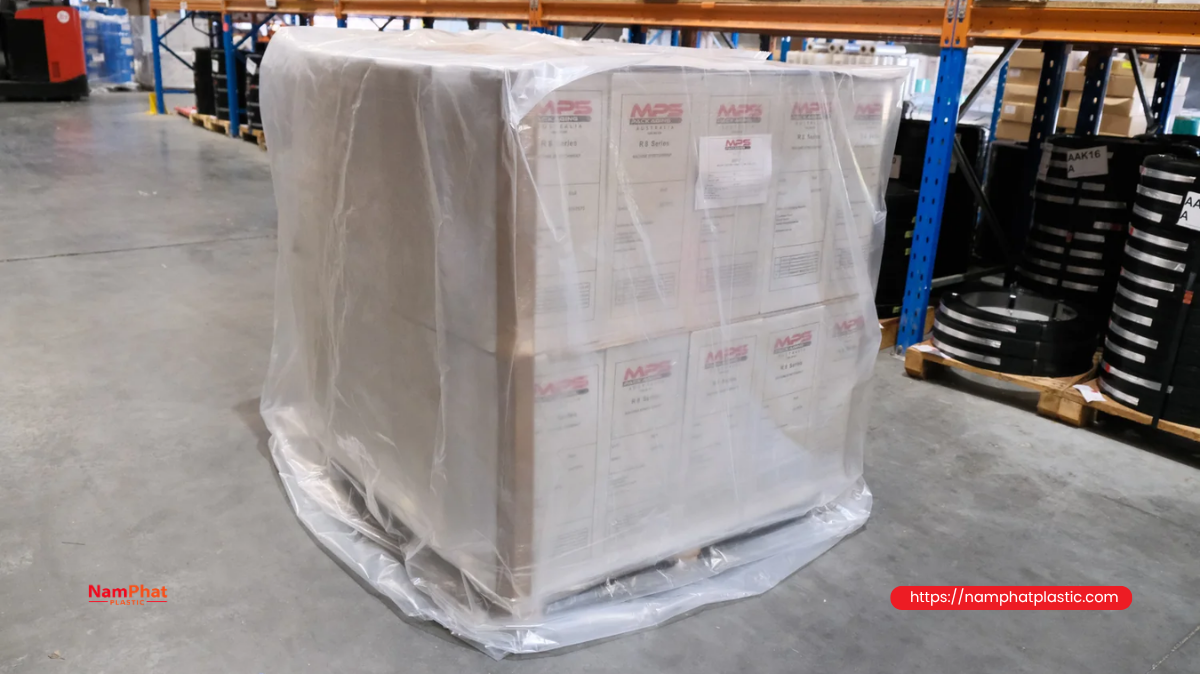
A pallet may remain in storage for days, weeks, or even longer before shipment.
During this period, pallet covers help reduce exposure to:
- Dust
- Insects
- Moisture
- Water
- Oil and grease
- Industrial contaminants
For products that must maintain clean packaging before delivery, pallet covers provide valuable additional protection.
3.4. Reduction of cross-contamination
In facilities handling multiple products or raw materials, contaminants may move between storage areas.
For example:
- Pallets containing Material A may be stored near Material B. Dust generated during forklift movement or production activities may transfer between products.
- Pallet covers create a physical barrier that helps reduce this risk.
3.5. Maintaining clean packaging for delivery
For B2B shipments, pallet appearance can influence customer perceptions of quality.
A clean, fully covered pallet generally creates a more professional impression than a dusty pallet stored for long periods.
This is particularly important for:
- Food packaging
- Components
- Manufacturing materials
- Plastic packaging products
- Cartons
- Export products
3.6. Protection during distribution
Palletized goods often pass through multiple stages:
- Factory → Distribution center → Truck → Port → Container → Customer warehouse
Each handling stage increases exposure to environmental conditions.
A pallet cover serves as an external protective layer throughout this process.
4. Industries that commonly use pallet covers
Food industry
Palletized products such as:
- Food ingredients
- Food packaging
- Cartons
- Bulk bags
- Bottled or canned products
often require protection from dust and warehouse contamination.
Animal feed industry
Animal feed bags stacked on pallets may use pallet covers to reduce dust and moisture exposure during storage and transportation.
Chemical and fertilizer industry
Many industrial chemicals are packaged in:
- Bags
- Containers
- Drums
- Barrels
before being palletized.
Pallet covers can provide additional protection during storage and shipping.
For specialty chemicals, appropriate film selection is essential rather than relying solely on standard PE film.
Plastics industry
This is one of the most common application sectors.
Pallet covers are frequently used for:
- Plastic resin
- Plastic bags
- Plastic film
- Plastic components
- Film rolls
- Plastic yarns
- Polymer semi-finished products
Textile and yarn industry
Palletized products such as:
- Yarn
- Fabric
- Raw material rolls
- Bulk material bags
often require protection against dust and moisture.
Electronics industry
Electronic components and finished products frequently require stricter packaging standards.
Pallet covers may be used as an external protective layer.
However, static-sensitive products may require anti-static film rather than conventional PE film.
Logistics industry
Distribution centers and logistics warehouses process large volumes of palletized goods.
Pallet covers help protect products:
- Awaiting shipment
- Awaiting inspection
- In temporary storage
- Being transferred between facilities
5. How to determine pallet cover dimensions
This is one of the most important considerations, yet it is often overlooked.
A pallet cover should not be specified solely based on pallet footprint dimensions.
At minimum, three measurements are required:
- Pallet length × Pallet width × Total load height
For example:
Pallet size:
- 1,100 × 1,100 mm
Loaded pallet height:
- 1,300 mm
Based on these dimensions, the manufacturer can calculate:
- Bag width
- Gusset size
- Bag length
- Additional allowance required for covering and handling
Avoid selecting a cover that is too tight
If the cover is too tight:
- Installation becomes difficult
- Pallet corners are more likely to puncture the film
- Seal areas experience greater stress
- The cover may tear during handling
- Packaging time increases
Avoid selecting a cover that is too large
Conversely, if the cover is excessively oversized:
- More material is consumed
- Packaging costs increase
- Excess film remains around the pallet
- The finished pallet looks untidy
- Securing the cover becomes more difficult
Therefore, the ideal size is not necessarily the largest one, but rather a size that provides sufficient installation clearance while maintaining a relatively close fit around the pallet.
6. What thickness should you choose?
There is no single thickness suitable for every pallet application.
The required thickness depends on factors such as:
- Product weight
- Load configuration
- Sharpness of corners and edges
- Pallet height
- Number of handling cycles
- Storage conditions
- Transportation method
- Reusability requirements
- Packaging budget
Pallets with relatively smooth surfaces
If the primary objective is dust protection and the load does not contain sharp edges, thinner films may be sufficient.
Pallets with sharp corners
If cartons or products create concentrated stress points, tear resistance and puncture resistance become more important.
Pallets used in demanding environments
If pallets must:
- Be handled repeatedly
- Remain in storage for long periods
- Travel in export containers
- Be exposed to outdoor environments
then thicker films or stronger resin formulations may be necessary.
7. Thickness is not the only factor determining strength
This is an important consideration when comparing pallet cover prices.
A thicker cover is not always a better cover if:
- Thickness distribution is inconsistent
- Low-quality materials are used
- The film splits easily
- Seal strength is poor
- Additives are poorly dispersed
On the other hand, a well-designed film can achieve the required performance at a lower thickness, reducing plastic consumption per pallet.
For this reason, pallet cover evaluations should include:
- Thickness
- Bag weight
- Tensile strength
- Tear resistance
- Puncture resistance
- Seal strength
rather than focusing solely on thickness.
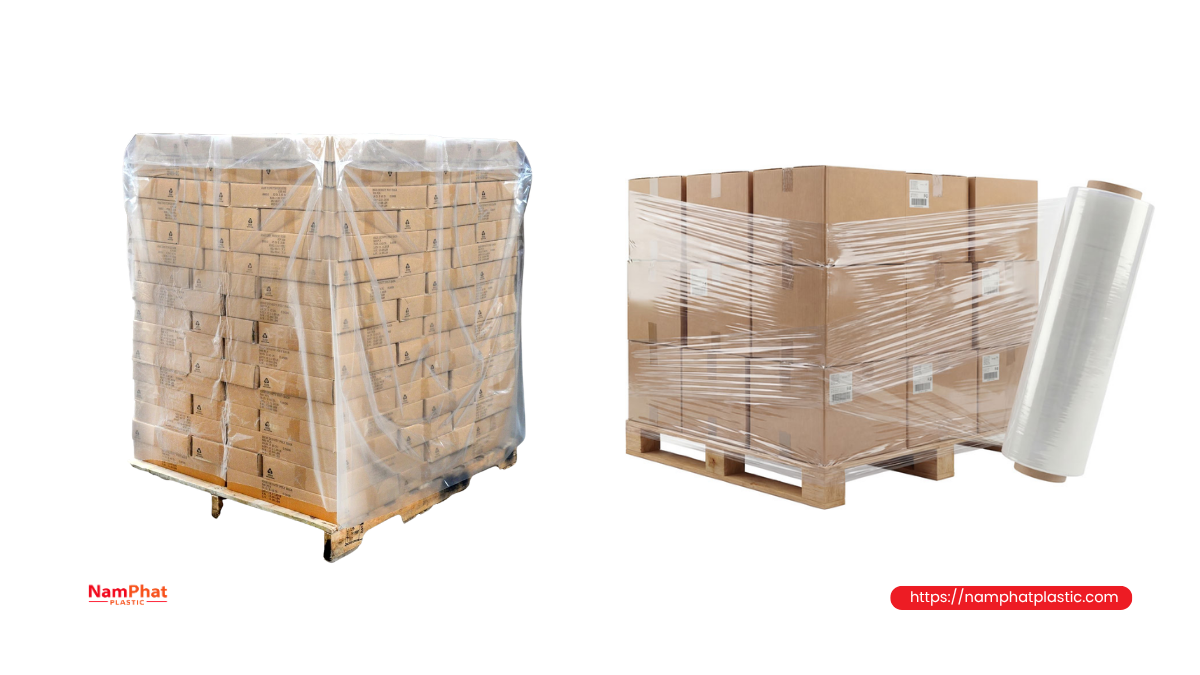
8. Differences between pallet covers and stretch film
These two packaging products are often confused.
| Criteria | Pallet cover | Stretch film |
| Form | Large cover placed over pallet | Film wrapped around pallet |
| Packaging speed | Fast if correctly sized | Requires multiple wrapping cycles |
| Top coverage | Excellent | Depends on wrapping method |
| Load stabilization | Moderate | Excellent |
| Dust protection | Excellent | Excellent |
| Flexibility for irregular loads | Requires proper sizing | More flexible |
| Application method | Direct covering | Manual or machine wrapping |
These products are not direct replacements for one another.
In many applications:
Stretch film stabilizes the load, while pallet covers provide surface protection and environmental shielding.
Many companies use both solutions together.
9. Is a pallet cover the same as shrink hood film?
Not necessarily.
This is one of the most common misconceptions.
Standard pallet covers
A standard pallet cover is simply placed over the pallet and remains in its original shape.
No heating process is required.
Shrink hood film
Shrink hood film is placed over the pallet and then heated so that the film shrinks tightly around the load.
These two packaging methods serve different purposes and require different equipment.
Therefore, businesses should clearly specify whether they require:
Standard PE pallet covers
or
Shrink hood film systems.
10. Transparent or colored pallet covers?
Transparent covers
Transparent covers are suitable when businesses need to:
- View products inside the pallet
- Verify product codes
- Count packages
- Inspect pallet conditions without removing the cover
This is one of the most commonly used options.
Colored covers
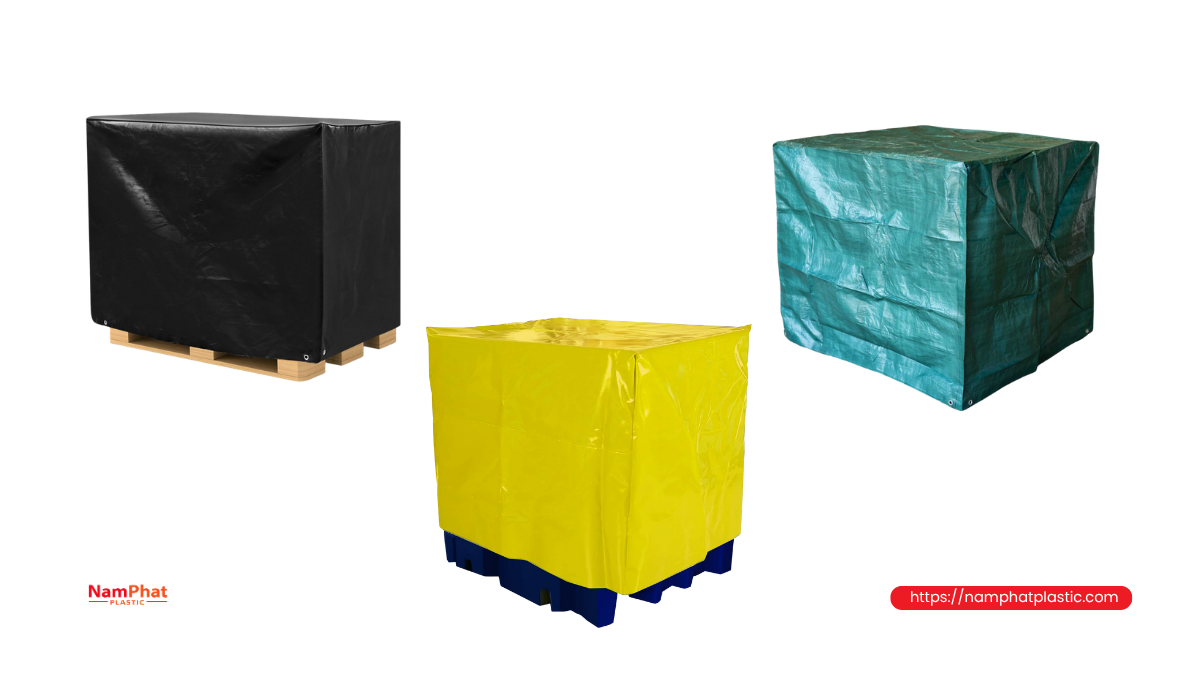
Film can be produced in various colors according to customer requirements.
Examples include:
- White
- Blue
- Black
- Custom identification colors
Colored covers may also be used for pallet classification, warehouse zoning, or inventory management.
11. Can UV-resistant pallet covers be produced?
Yes.
If pallets are stored outdoors or exposed to sunlight, UV stabilizers can be incorporated into the film formulation.
However, UV performance depends on more than simply adding UV additives.
Key factors include:
- Type of UV additive
- Additive concentration
- Film thickness
- Outdoor exposure duration
- UV intensity
- Expected service life
For this reason, businesses should provide estimated outdoor exposure conditions so the manufacturer can recommend an appropriate formulation.
12. Can pallet covers be reused?
Technically, many pallet covers can be reused provided that:
- The cover is not torn
- The cover is not contaminated
- No hazardous chemicals have contacted the film
- Mechanical performance remains acceptable
However, reusability also depends on company procedures.
Industries with strict hygiene or contamination-control requirements often establish their own criteria before reusing packaging materials.
13. Common mistakes when purchasing pallet covers
Providing pallet dimensions without load height
Dimensions such as:
- 1,100 × 1,100 mm
are not sufficient for manufacturing a pallet cover.
The supplier must also know the final pallet height after loading.
Selecting covers that are too tight
This increases the likelihood of tearing during installation.
Comparing products only by quantity
Two covers with identical dimensions may differ significantly in:
- Thickness
- Weight
- Resin quality
- Film formulation
As a result, comparing prices without comparing technical specifications can lead to misleading conclusions.
Skipping trial samples
For new pallet configurations, businesses should test covers on actual pallet loads.
A simple trial can reveal issues such as:
- Insufficient length
- Excessive tightness
- Incorrect gusset dimensions
- Film that is too thin
- Sharp corners causing punctures
This reduces the risk of problems during large-scale production orders.
14. Criteria for evaluating a good pallet cover
A suitable pallet cover is not necessarily the thickest one.
An effective pallet cover should provide a balance between the following factors:
Dimensions
Easy to install while minimizing unnecessary excess material.
Strength
Resistant to tearing during handling and transportation.
Seal quality
The seals should be strong and stable, without separating when the cover is pulled or stretched.
Film consistency
The film should have uniform thickness without unusually thin or thick areas.
Weight consistency
Product weight should remain consistent between production batches.
Ease of use
The bag opening should be easy to access, and the gussets should be manufactured according to specification.
Cost per pallet
Businesses should evaluate the overall packaging cost rather than focusing only on the price per kilogram of plastic material.
15. Process for selecting pallet covers for your business
A practical selection process may include the following five steps.
Step 1: Measure the completed pallet
Measure:
- Length × Width × Height
after the pallet has been fully loaded.
Step 2: Determine the operating environment
Consider where the pallet will be used:
- Indoor warehouse
- Outdoor storage
- Truck transportation
- Container shipment
- Long-term storage
Step 3: Define the protection objectives
Determine whether you need:
- Dust protection
- Water protection
- Moisture control
- UV resistance
- Full pallet coverage
- Color-coded pallet identification
Step 4: Select film thickness and resin formulation
The manufacturer can recommend an appropriate specification based on the operating conditions.
Step 5: Conduct a practical trial
This step is strongly recommended before placing a large production order.
16. How to reduce pallet cover costs
Reducing costs does not necessarily mean choosing the cheapest plastic material.
Businesses can optimize costs through the following approaches:
Optimize dimensions
Reducing unnecessary excess film can significantly lower material consumption.
Optimize thickness
Do not use excessively thick film if the application only requires basic dust protection.
Standardize pallet sizes
If a facility uses many different pallet dimensions, multiple cover sizes must be stocked.
Standardizing pallet dimensions can help reduce packaging SKUs.
Evaluate cost per pallet
Instead of asking:
- “How much does the cover cost per kilogram?”
consider calculating:
- “How much does the cover cost per completed pallet?”
This provides a more accurate picture of actual packaging expenses.
17. Trends in pallet cover optimization
The packaging industry is no longer focused solely on increasing thickness to improve performance.
Current trends emphasize:
- Reducing plastic consumption while maintaining the required level of protection and performance.
Achieving this requires optimization of:
- Resin formulation
- Cover dimensions
- Film thickness
- Mechanical strength
- Packaging processes
- Reusability and material recovery
A pallet cover that uses less material while still performing its protective function can often provide better economic value than an unnecessarily thick cover.
18. When should businesses use pallet covers?
Pallet covers are particularly suitable in the following situations:
- Products frequently accumulate dust during storage
- Pallets remain in storage for extended periods
- Outer packaging must remain clean before delivery
- Pallets are moved between multiple locations
- Products are shipped in containers
- Warehouses have relatively high humidity levels
- The load requires full top-to-bottom coverage
- Stretch film alone cannot adequately protect the top surface of the pallet
Frequently asked questions about pallet covers
1. What type of plastic is commonly used for pallet covers?
Polyethylene is the most common material, typically using LDPE, LLDPE, or customized blends designed to achieve the required balance of strength and flexibility.
2. Are pallet covers waterproof?
PE film provides excellent water resistance and helps prevent direct contact between water and the packaged products. However, the overall level of protection also depends on how the cover is installed and sealed around the pallet.
3. Can all pallets use the same cover size?
No.
The cover size should be determined based on both the pallet footprint and the actual loaded height.
4. Can pallet covers replace stretch film?
It depends on the application.
If the primary objective is load stabilization, stretch film is generally more effective.
If the primary objective is environmental protection and dust prevention, pallet covers offer significant advantages.
In many cases, both products are used together.
5. Can pallet covers be manufactured in custom sizes?
Yes.
Pallet covers are commonly produced according to the actual pallet dimensions specified by each customer.
6. Is thicker always better?
No.
The thickness should match the application requirements.
Excessive thickness increases material consumption and packaging costs without necessarily providing proportional benefits.
Conclusion
A pallet cover is a large-format PE packaging solution designed to cover and protect palletized goods during storage, handling, and transportation.
An effective pallet cover should be designed based on multiple factors, including:
- Pallet dimensions
- Load height
- Cover structure
- Material selection
- Film strength
- Storage conditions
- Transportation methods
For businesses handling large volumes of palletized products, optimizing cover dimensions and film thickness can significantly reduce plastic consumption and packaging costs.
Therefore, before placing a large order, companies should provide complete information regarding pallet dimensions, operating conditions, and protection requirements so that the manufacturer can recommend the most suitable specification and conduct practical trials on actual pallets.
- 0 Comment


