


 Phan Van Hoang
- 12/08/2026
- 168
Pallet covers, or Pallet Covers, are primarily made from Polyethylene (PE), with LDPE and LLDPE being the most common types. Depending on requirements for softness, tensile strength, puncture resistance, transparency, and cost, manufacturers may use a single type of plastic or blend multiple types of PE materials.
In actual production, a pallet cover formulation does not necessarily contain only LDPE or LLDPE. Manufacturers can adjust the LDPE–LLDPE ratio, combine virgin resin with recycled resin, and add certain additives to achieve properties suitable for specific applications.
For example:
-
Pallets containing products with many sharp edges require film with good puncture resistance.
-
Pallets where the products inside need to remain visible should prioritize highly transparent film.
-
Goods stored for long periods require good dust and moisture protection.
-
Goods stored outdoors may require additional UV stabilizers.
-
Pallets used internally within a factory may prioritize a more economical material solution.
Therefore, the important question is not only “What plastic are pallet covers made from?” but also “Which plastic formulation is most suitable for the actual conditions of use?”
Table of Contents [Hide]
1. PE plastic – the main material for producing pallet covers
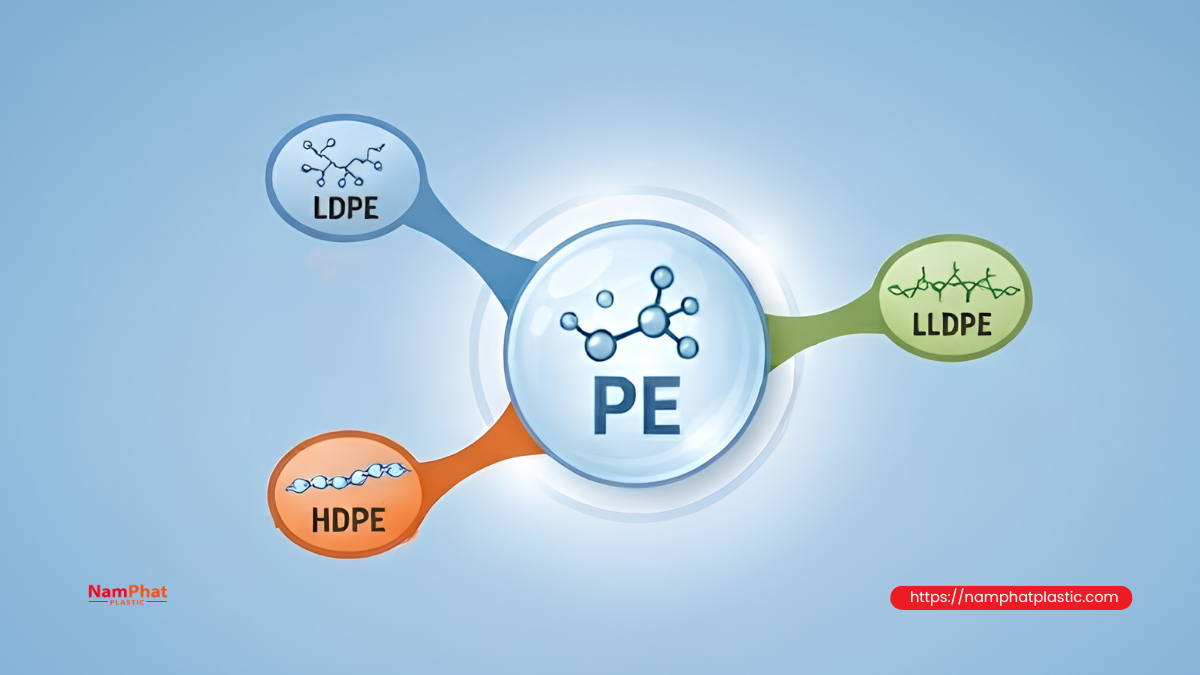
PE stands for Polyethylene, one of the most widely used groups of thermoplastic materials in packaging.
PE materials have many properties suitable for pallet covers, including:
-
Relatively good moisture resistance.
-
Water resistance under normal use conditions.
-
Can be produced as thin film.
-
Lightweight.
-
Heat-sealable.
-
Easy to process using blown-film technology.
-
Can be produced in various thicknesses.
-
Additives can be blended in to modify film properties.
-
Can be produced as clear, milky-white, or colored film.
There are several different materials within the PE group. For pallet covers, the three types most commonly mentioned are:
-
LDPE – Low Density Polyethylene
-
LLDPE – Linear Low Density Polyethylene
-
HDPE – High Density Polyethylene
However, LDPE and LLDPE are generally more suitable for softer pallet covers than HDPE.
2. Pallet covers made from LDPE
2.1. What is LDPE?
LDPE is low-density polyethylene. It is a widely used material in the production of PE film and many types of flexible plastic packaging.
One of the main advantages of LDPE is its softness and good processability.
2.2. Characteristics of LDPE film
Depending on the formulation and production conditions, LDPE film typically has:
-
A relatively soft surface.
-
Good flexibility.
-
Good heat-sealing properties.
-
Stable film-forming performance.
-
Relatively good transparency when suitable raw materials are used.
-
Easy processing into large-sized bags.
-
Moisture resistance suitable for many industrial packaging applications.
For these reasons, LDPE is one of the materials well suited for producing large PE pallet covers.
3. Why is LDPE suitable for pallet covers?
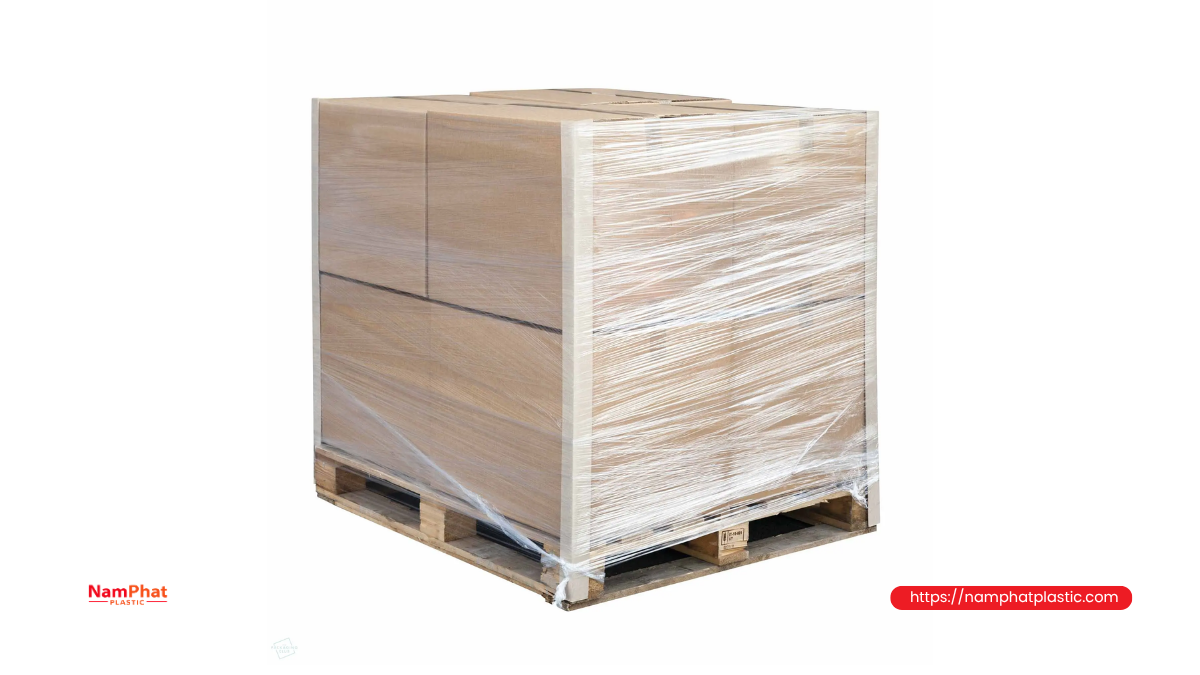
An industrial pallet is usually large and does not have a completely flat shape. When a cover is placed over the pallet, the film must pass over the corners of cartons, bags, or product bundles.
If the film is too rigid, brittle, or has poor deformation capability, the cover may tear more easily at stressed areas.
LDPE has relatively good softness, helping the cover to:
-
Be easier to handle when covering a pallet.
-
Conform to the shape of the load.
-
Feel less rigid during use.
-
Be easier to seal at the bottom or sides.
-
Suit large-sized pallet covers.
However, LDPE is not always used alone. In many cases, manufacturers add LLDPE to improve certain mechanical properties of the film.
4. Pallet covers made from LLDPE
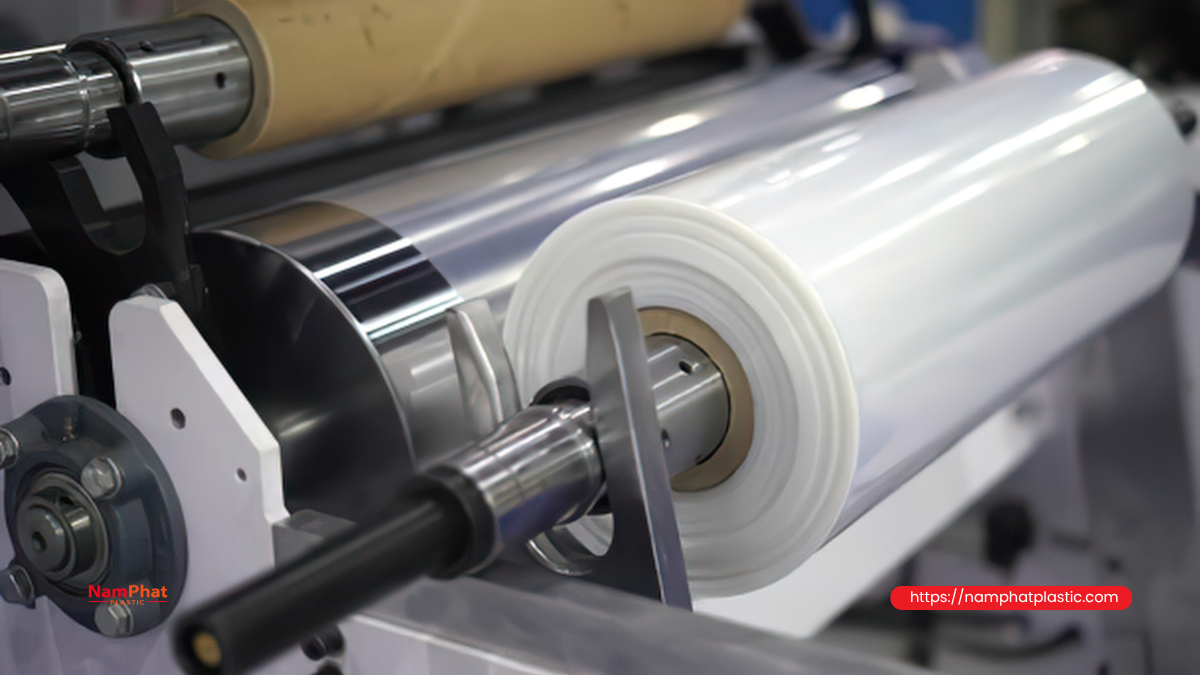
LLDPE stands for Linear Low Density Polyethylene.
LLDPE is particularly important in packaging-film production because it can improve the mechanical strength of the film.
Some notable properties of LLDPE include:
-
Good tensile strength.
-
Good tear resistance.
-
Good puncture resistance.
-
High flexibility.
-
Can help reduce the risk of film tearing when contacting sharp edges of packaged goods.
These properties are highly useful for pallet covers.
For example, pallets containing:
-
Cartons with sharp corners.
-
Bags of raw materials.
-
Mechanical products.
-
Components.
-
Goods with uneven surfaces.
In these cases, puncture resistance becomes a particularly important factor.
5. LDPE and LLDPE can be blended together
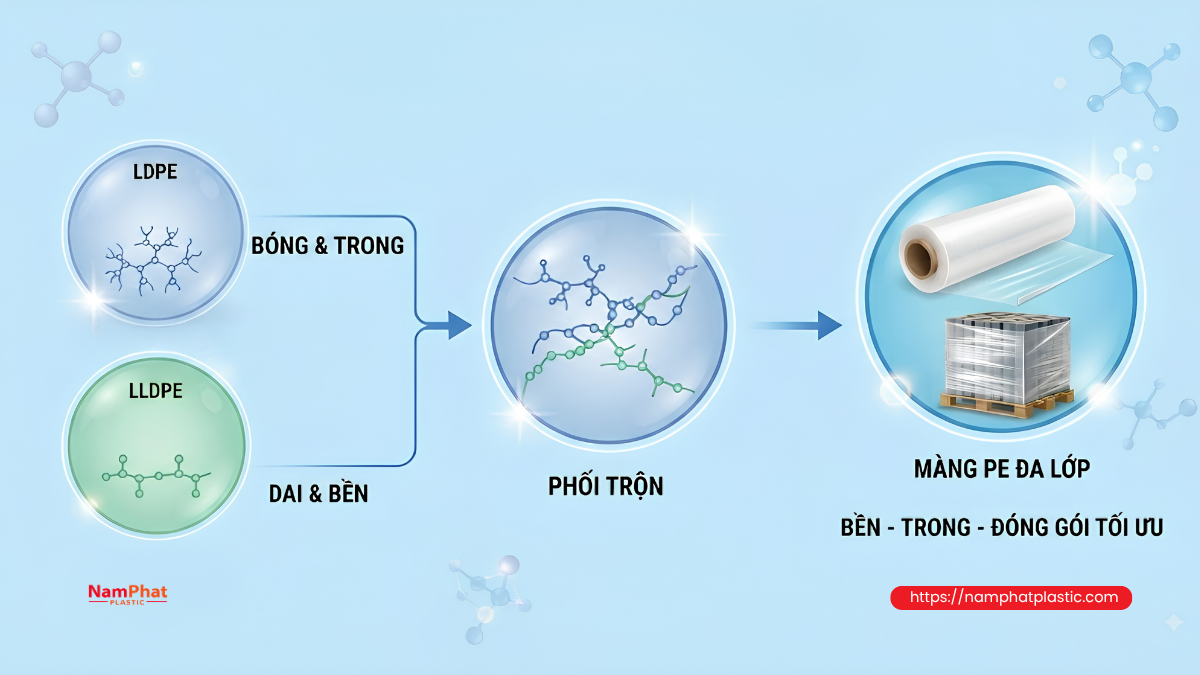
This is something businesses purchasing pallet covers should understand.
Pallet covers do not necessarily have to be made from 100% LDPE or 100% LLDPE.
In PE film production, blending LDPE and LLDPE is common because the two materials can complement each other's properties.
In simple terms:
-
LDPE → supports softness, processability, and blown-film processing.
-
LLDPE → supports tensile strength, toughness, and puncture resistance.
Manufacturers develop formulations depending on:
-
Cover thickness.
-
Cover dimensions.
-
Pallet weight.
-
Shape of the goods.
-
Transparency requirements.
-
Transportation conditions.
-
Storage conditions.
-
Target cost.
Therefore, two pallet covers with the same dimensions and thickness may not necessarily have the same quality if their material formulations are different.
6. Is HDPE used to make pallet covers?
HDPE stands for High Density Polyethylene.
HDPE is also widely used in plastic packaging. However, HDPE film has noticeably different characteristics from LDPE film.
HDPE film is generally:
-
More rigid.
-
More brittle in feel and produces a more pronounced crinkling sound.
-
Capable of being produced at relatively low thicknesses.
-
Less soft and less conformable to the load than LDPE.
For this reason, for soft, large-sized pallet covers requiring flexibility, LDPE and LLDPE are generally more suitable.
HDPE may still be used in certain formulations or special applications, but it should not be assumed that every pallet cover is made from HDPE.
7. Comparing LDPE, LLDPE, and HDPE for pallet cover production
| Criterion | LDPE | LLDPE | HDPE |
| Softness | High | High | Lower |
| Flexibility | Good | Very good | Lower |
| Tensile strength | Good | Very good | Good |
| Puncture resistance | Good | Very good | Depends on film structure |
| Film processability | Good | Good | Good |
| Film stiffness | Low | Medium | High |
| Suitability for soft pallet covers | Very suitable | Very suitable | Less common |
| Blending capability | Yes | Yes | Yes |
In practice, pallet cover quality cannot be assessed solely by the name of the plastic resin.
The final quality also depends on:
-
Specific resin grade.
-
Blending ratio.
-
Blown-film technology.
-
Processing temperature.
-
Film draw ratio.
-
Thickness uniformity.
-
Seal quality.
-
Additive content.
8. Virgin and recycled resin in pallet covers
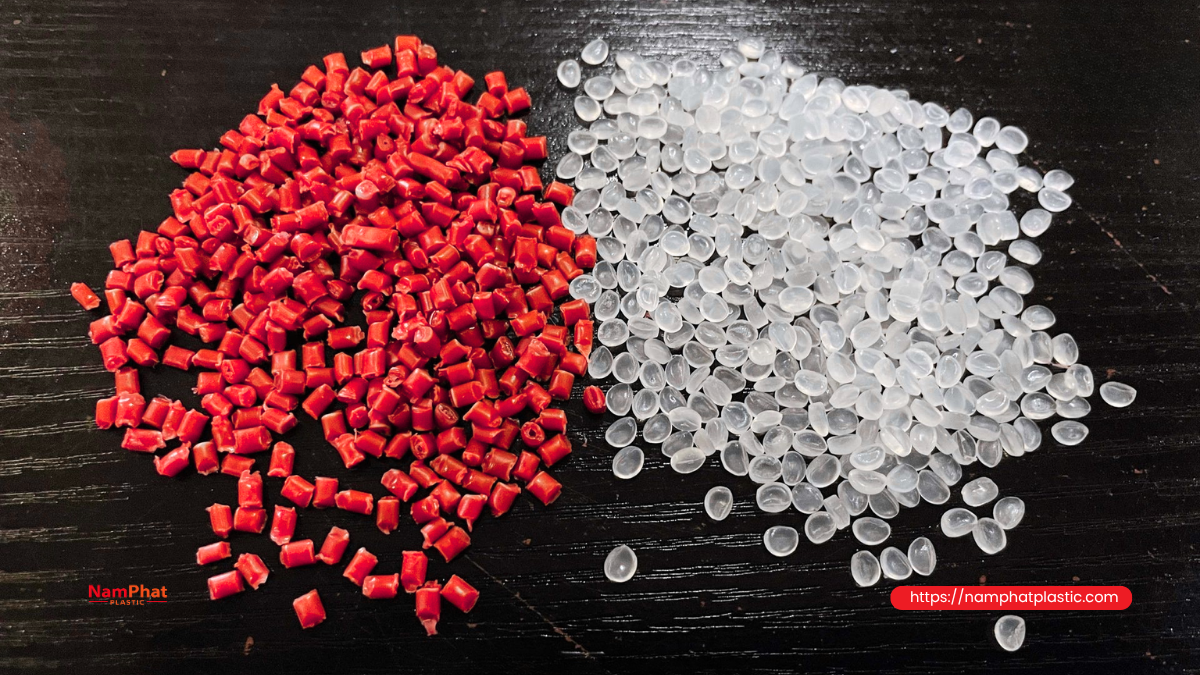
In addition to distinguishing between LDPE and LLDPE, another factor to consider is whether the raw material is virgin or recycled.
Virgin PE
Virgin resin is material that has not previously gone through a use cycle.
Common advantages include:
-
More stable color and transparency.
-
Fewer contaminants.
-
Easier quality control.
-
More stable mechanical properties when the appropriate grade is used.
-
Suitable for customers with high appearance requirements or strict raw-material control.
For pallet covers requiring high transparency to identify the goods inside, virgin resin is often a suitable choice.
9. Can pallet covers use recycled plastic?
Yes.
For certain industrial applications that do not require high transparency or direct food contact, recycled materials may be considered to optimize costs and use resources more efficiently.
However, the proportion of recycled material needs to be controlled.
When the recycled content is too high or the raw-material source is unstable, the film may develop:
-
More contaminants.
-
Gel particles.
-
Uneven coloration.
-
Reduced transparency.
-
Raw-material odor.
-
Fluctuating mechanical strength.
-
Inconsistent sealing performance.
Therefore, using recycled plastic does not automatically mean that the cover is low quality. What matters is the recycled-material source, blending ratio, and production quality-control system.
10. Is virgin or recycled resin better for pallet covers?
There is no single formulation suitable for every business.
The choice can be based on the application:
Virgin resin should be prioritized when:
-
High transparency is required.
-
Product identification through the cover is needed.
-
High uniformity is required.
-
Export goods require raw-material control.
-
The business has its own technical standards.
-
Relatively high requirements for odor or cleanliness apply.
Recycled material can be considered when:
-
Pallets are used only for internal storage.
-
High transparency is not required.
-
Cost optimization is an important objective.
-
The cover does not come into direct contact with sensitive products.
-
The manufacturer can consistently control recycled raw materials.
11. What plastic are black pallet covers made from?
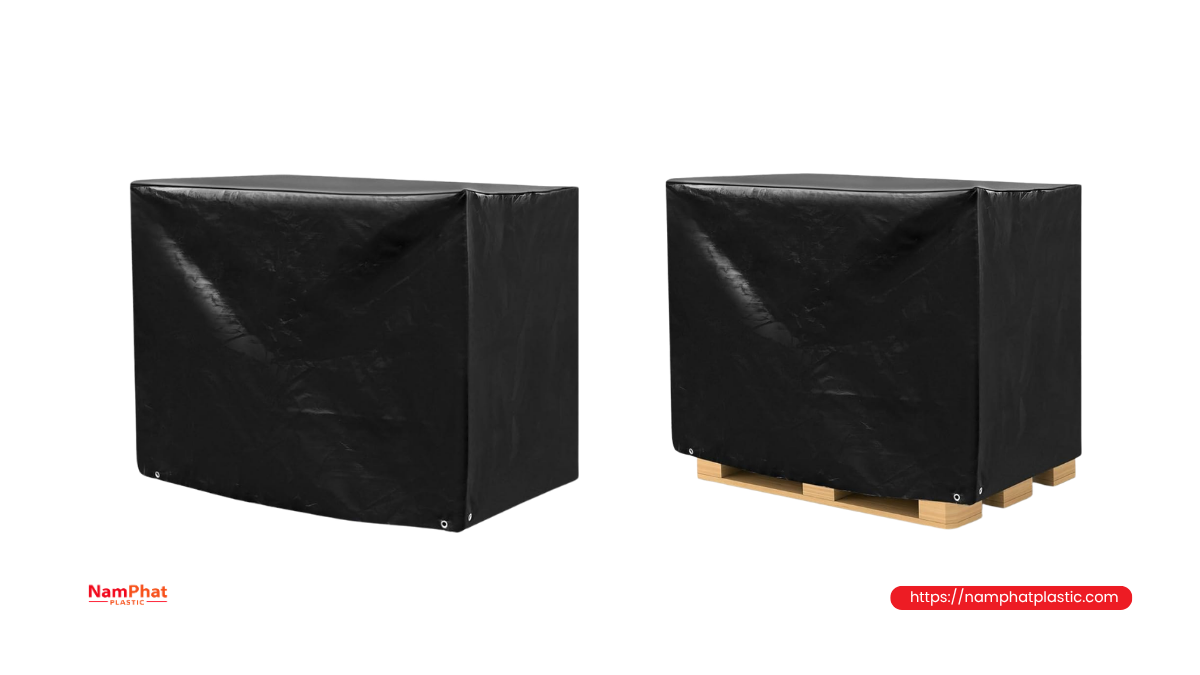
Black pallet covers are still typically based on PE materials.
The black color is produced by adding black color masterbatch to the formulation.
Black pallet covers are commonly selected when businesses want to:
-
Conceal the goods inside.
-
Increase privacy.
-
Limit light transmission through the film.
-
Identify a specific group of goods.
Black PE covers should not be automatically equated with recycled plastic. Black pallet covers can be produced entirely from virgin resin combined with black masterbatch.
12. What material is used for white or milky-white pallet covers?
Similar to black covers, the base material can still be LDPE or LLDPE.
To create a white color, manufacturers can use white masterbatch or suitable additive systems.
White covers are commonly used when businesses:
-
Want to partially conceal the products.
-
Need to distinguish production areas.
-
Want improved appearance.
-
Do not need complete visibility of the goods inside.
13. How are UV-resistant pallet covers produced?
Conventional PE can be affected by sunlight during prolonged use.
If pallets need to be stored outdoors or exposed regularly to sunlight, manufacturers may add UV stabilizers to the formulation.
UV additives help slow the degradation of polymer properties caused by ultraviolet radiation.
However, it is important to note:
“Contains UV additives” does not mean “can be used outdoors indefinitely.”
Protection effectiveness depends on:
-
Type of additive.
-
Additive concentration.
-
Film thickness.
-
Base resin.
-
Solar radiation intensity.
-
Exposure time.
-
Climate conditions.
If pallets must be stored outdoors for a specific period, buyers should clearly communicate this requirement when placing the order.
14. What additives can be used in pallet covers?
In addition to PE resin, the film formulation may contain small amounts of masterbatch or additives depending on product requirements.
Common groups include:
Color masterbatch
Used to create:
-
Black.
-
White.
-
Blue.
-
Other identification colors.
UV additives
Used when improved outdoor light resistance is required.
Antistatic additives
In certain specialized applications, PE film may need to control static buildup.
Antiblock additives
Can help make bags easier to open and handle in certain formulations.
Slip additives
Can be adjusted to control the surface coefficient of friction.
Additive selection should be based on the actual application rather than simply adding as much as possible.
15. Does a thicker pallet cover mean greater strength?
Not necessarily.
Thickness is an important factor, but pallet cover strength does not depend only on the micron or gauge.
For example, two covers may both have a thickness of 100 microns, but:
-
Cover A uses a suitable LDPE/LLDPE formulation.
-
Cover B uses lower-quality raw materials or an unstable recycled-material ratio.
Their actual tear resistance may differ significantly.
Pallet cover quality should be evaluated based on:
-
Raw material + formulation + thickness + blown-film process + sealing.
This is why businesses should not select covers based solely on thickness.
16. Film uniformity is just as important as the raw material
A cover made from good-quality raw materials can still tear if the film is not uniform.
For example, a cover with a nominal thickness of 100 microns may have some areas measuring only around 80 microns. These thin areas can become weak points when the cover is subjected to stress.
Therefore, production should control:
-
Average thickness.
-
Thickness variation.
-
Cross-web thickness uniformity.
-
Stability along the roll length.
-
Film surface.
-
Gel particles or contaminants.
-
Seal quality.
This is particularly important for large-sized pallet covers.
17. Sealing also determines pallet cover quality
In many cases, the cover does not tear through the film body but instead opens at the seal.
Possible causes include:
-
Incorrect sealing temperature.
-
Insufficient sealing time.
-
Contaminated film surface.
-
Resin formulation affecting sealability.
-
Uneven film thickness.
-
Unstable sealing equipment.
Therefore, pallet cover evaluation should check both:
-
Film strength and seal strength.
18. How to choose pallet cover materials based on the application
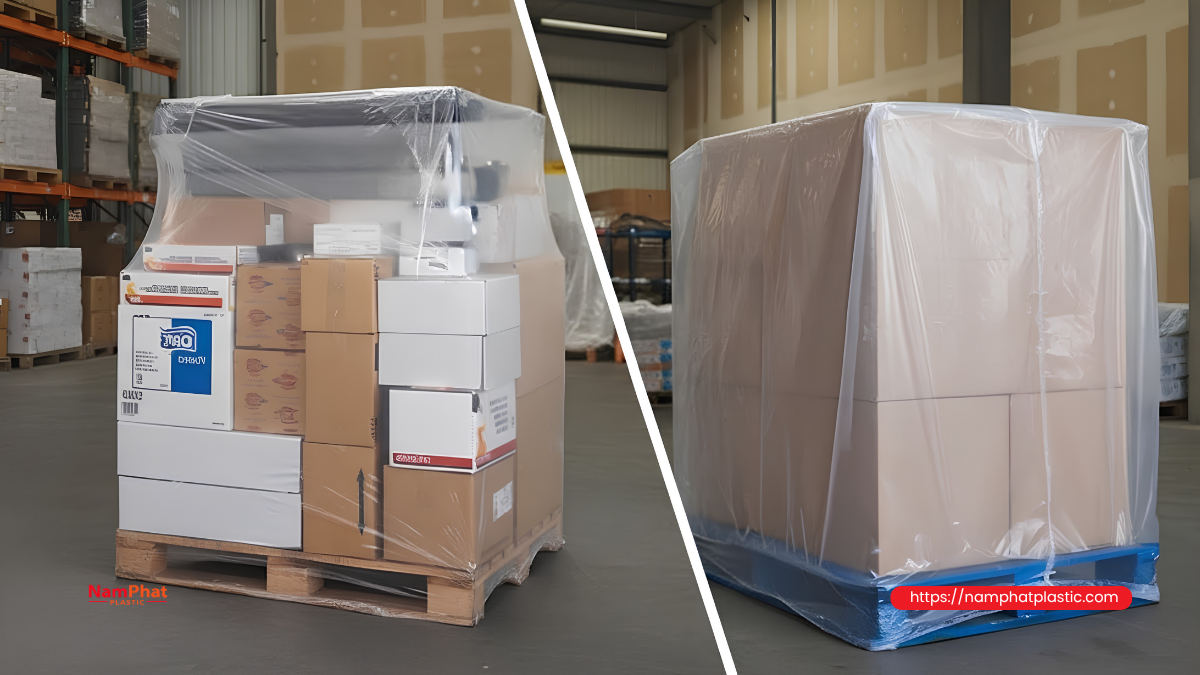
Standard carton pallets
PE film based on LDPE/LLDPE can be used with a formulation balancing softness and strength.
Pallets with many sharp edges
Puncture and tear resistance should be prioritized, with LLDPE potentially playing an important role in the formulation.
Pallets where product visibility is required
Prioritize:
-
Clean raw materials.
-
Good transparency.
-
Control of gels and contaminants.
Pallets stored outdoors
Consider:
-
UV additives.
-
Thickness.
-
Film color.
-
Intended outdoor service life.
Pallets used internally
If high transparency is not required, businesses can consider more economical formulations.
19. What information should be provided when ordering pallet covers?
To help the manufacturer select suitable materials, businesses should provide as much information as possible.
19.1. Pallet dimensions
Including:
-
Length.
-
Width.
-
Height.
19.2. Desired cover dimensions
Typically including:
-
Width.
-
Length.
-
Thickness.
19.3. Type of goods
For example:
-
Cartons.
-
Bags of raw materials.
-
Plastic resin.
-
Components.
-
Bagged chemicals.
-
Industrial finished products.
19.4. Conditions of use
-
Indoor or outdoor.
19.5. Storage period
-
Several days, weeks, or months.
19.6. Transparency requirements
-
Clear, milky-white, or colored.
19.7. Material requirements
-
Virgin, recycled blend, or according to the company's own standards.
19.8. Special requirements
For example:
-
UV resistance.
-
Antistatic properties.
-
Identification colors.
-
Logo or information printing.
These details help prevent the use of one standard pallet cover for every application.
20. How to check the quality of pallet cover materials
Not every business has a laboratory for polymer analysis. However, users can still check several practical factors.
Inspect the film
Check:
-
Uniformity.
-
Contaminants.
-
Gel particles.
-
Pinholes.
-
Scratches.
Check the seals
Apply tensile force to the sealed area to identify weak or inconsistent seals.
Test directly on the actual pallet
This is a very important test.
The cover should be tested using the actual:
-
Pallet dimensions.
-
Products.
-
Handling process.
Check resistance to sharp edges
This is particularly important for pallets containing cartons or objects that create stress concentration points.
Monitor during transportation
A cover may perform well in storage but tear when the pallet is moved, vibrated, or rubbed during transportation.
Therefore, real-world testing always provides valuable information.
21. Should suppliers be required to specify the type of plastic?
Yes.
For businesses purchasing pallet covers in large quantities, material specifications should be agreed upon in:
-
Specification Sheets.
-
Purchasing standards.
-
COA, if required.
-
Specification drawings.
-
Contracts or POs.
For example, the specification may state:
-
Material: PE
Or in more detail:
-
Material: LDPE/LLDPE blend
If the customer requires 100% virgin resin or has a limit on the recycled-material ratio, this requirement should also be clearly specified.
This helps both the supplier and buyer work according to the same quality-control standard.
22. Do not choose pallet covers based only on resin price
In industrial purchasing, reducing the cover price while increasing the tear rate can result in a higher total cost.
Hidden costs may include:
-
Replacing covers.
-
Repacking labor.
-
Dust contamination of goods.
-
Moisture damage.
-
Delivery delays.
-
Customer complaints.
-
Production interruptions.
Therefore, a more appropriate approach is:
The cost per successfully protected pallet, rather than simply comparing the price per kilogram of the cover.
23. LDPE or LLDPE: which is better for pallet covers?
LDPE and LLDPE should not be viewed as two completely opposite materials where one must be chosen over the other.
In many pallet cover formulations, the two materials can be combined to take advantage of their respective strengths.
If you need:
Softness + good processability
→ LDPE has advantages.
If you need:
Toughness + puncture resistance
→ LLDPE has advantages.
If you want to balance multiple properties:
→ An LDPE/LLDPE blend may be a suitable solution.
The specific ratio should be determined through production trials and testing on actual pallets.
24. What factors should a good pallet cover meet?
A suitable pallet cover is not determined by material alone. Multiple factors need to be controlled simultaneously:
-
Cover dimensions suitable for the pallet.
-
Appropriate thickness.
-
Suitable PE formulation.
-
Good film uniformity.
-
Appropriate tear resistance.
-
Appropriate puncture resistance.
-
Stable seals.
-
Film surface with minimal defects.
-
Additives suitable for the operating environment.
-
Consistent quality between production lots.
Therefore, businesses purchasing pallet covers in large quantities should combine technical specifications with real-world testing before standardizing the product.
Frequently asked questions about pallet cover materials
1. Are pallet covers made from PE plastic?
Most common soft pallet covers are produced using PE-based materials, particularly LDPE and LLDPE.
2. Which is more suitable, LDPE or LLDPE?
Both have their own advantages. LDPE supports softness and processability, while LLDPE can improve toughness, tensile strength, and puncture resistance.
3. Can pallet covers be made from 100% LLDPE?
Technically, formulations with a high proportion of LLDPE are possible, but the formulation depends on the equipment, resin grade, and required film properties. LDPE/LLDPE blends are a commonly considered solution.
4. Can pallet covers use recycled plastic?
Yes, particularly for industrial applications that do not require high transparency or very strict raw-material standards. However, the quality of the recycled material and blending ratio must be controlled.
5. Is clear PE film always made from virgin resin?
No. The raw-material source cannot be accurately determined simply by visual inspection. It should be based on the material specification and documentation from the manufacturer.
6. Are black covers made from recycled plastic?
Not necessarily. Virgin resin can be combined with black masterbatch to produce black pallet covers.
7. Do outdoor pallet covers require special plastic?
In general, UV stabilizer systems should be considered along with film thickness and the intended service life.
Conclusion
Pallet covers are primarily made from PE plastic, with LDPE and LLDPE being the two most important material groups.
LDPE has advantages in softness, processability, and heat sealing, while LLDPE can improve toughness, tensile strength, and puncture resistance. In actual production, manufacturers can combine different types of PE to create formulations suitable for specific applications.
In addition to the plastic type, pallet cover quality also depends on:
-
raw-material source, blending ratio, thickness, film uniformity, additives, blown-film technology, and seal quality.
Therefore, businesses should not simply choose between “LDPE or LLDPE.” Instead, they should first determine the conditions of use, type of goods, storage period, and technical requirements.
For industrial pallets, the most suitable solution is often to choose a film structure that provides the required strength without using excessive thickness or more expensive raw materials than necessary.
Nam Phát Plastic – pallet covers manufactured to business specifications
Nam Phát Plastic supplies PE pallet covers for packaging, storage, and protection of goods in industrial production.
Covers can be manufactured according to requirements for:
-
Width.
-
Length.
-
Thickness.
-
Pallet specifications.
-
Color.
-
Material type.
-
Virgin resin requirements or application-specific formulations.
-
Certain special additive requirements.
For businesses purchasing pallet covers in large quantities, providing information about pallet dimensions, type of goods, and conditions of use will help determine a more suitable specification and optimize the cost of use.
>>> See more:
- 0 Comment


