


 Phan Van Hoang
- 03/09/2026
- 102
Two pallets with the same dimensions and weight do not necessarily use the same type of pallet cover. Carton pallets typically have square corners; pallets of raw material bags have bulging surfaces and are prone to shifting; while mechanical products or wooden crates may create very small contact points with highly concentrated force. Therefore, selecting a pallet cover should start by identifying where the film will be subjected to stress, rather than simply asking, “How many microns thick should the bag be?”
The basic principles are:
-
Flat, stable loads: Prioritize a proper fit, dust protection, and resistance to splashing water.
-
Soft loads or uneven surfaces: Prioritize toughness, elongation, and tear resistance when the pallet shifts.
-
Loads with hard edges or protruding ends: Protect sharp points first, then increase film strength if necessary.
This article explains how to assess three common load categories, with a preliminary selection table, sample testing methods, and common mistakes that can cause pallet covers to tear even after their thickness has been increased.
Table of Contents [Hide]
1. Before selecting a pallet cover: distinguish four types of PE film damage
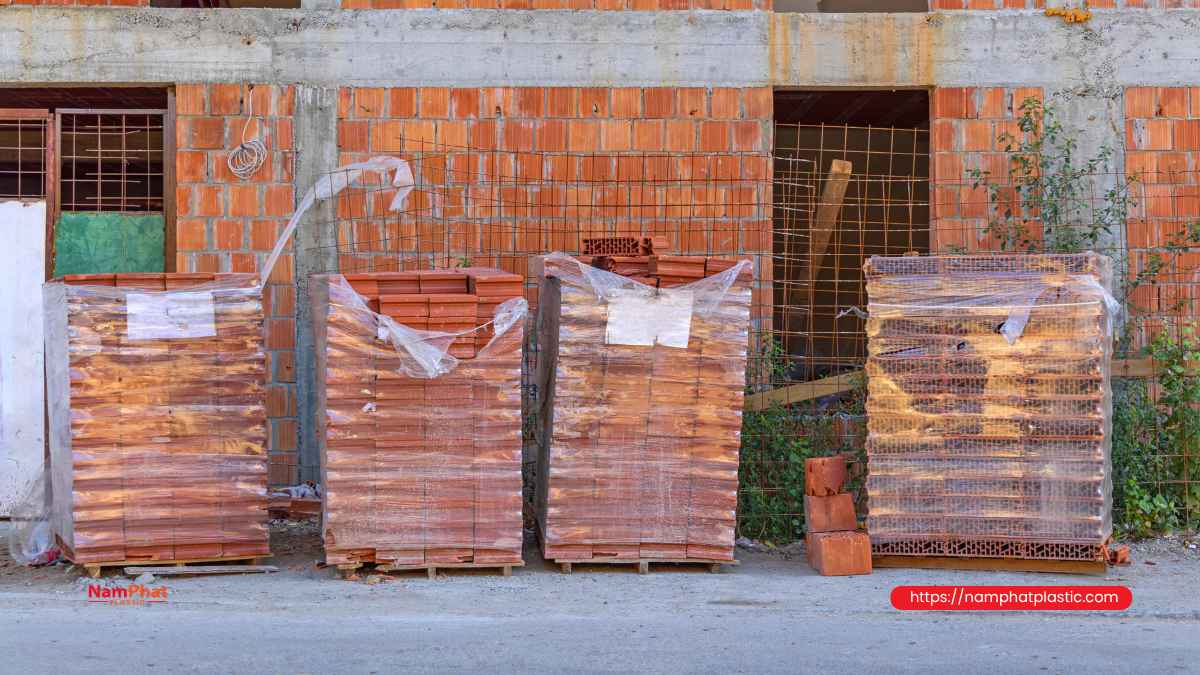
In actual packaging operations, the term “torn bag” can describe several different failure mechanisms. Misidentifying the cause often leads to higher plastic consumption without solving the problem.
Puncture at a single point
Screw tips, sharp steel corners, wood splinters, strap edges, or protruding carton corners concentrate force over a very small area. The film may be punctured during installation or after the pallet vibrates and shifts. In these cases, toughness, puncture resistance, and corner protection are important.
Tear propagation from a small defect
A small hole does not necessarily make the bag unusable immediately. The greater risk is that the hole develops into a longer tear when workers pull the cover, forklifts move the pallet, or the bags inside slide downward. Tear resistance and handling methods are therefore just as important as thickness.
Seal failure
If a bag is too short, too tight, or pulled too forcefully, the load can place excessive stress on the top sealing seam. The film itself may remain intact while the seam separates. Increasing thickness may not solve the problem if the main cause is incorrect sizing or a seal that is unsuitable for the film structure.
Abrasion caused by friction
During truck transport, container shipping, or repeated handling, the film may rub against cartons, straps, wood, or the surface of the goods. Damage appears after a period of use rather than immediately after installation. This is why a sample should be evaluated after a representative transport cycle, not only immediately after the cover is fitted.
2. Quick selection table by load type
The thickness ranges below are starting points for sample testing, not guaranteed specifications for every pallet. Actual performance also depends on bag dimensions, film quality and structure, thickness uniformity, ambient temperature, the number of handling operations, and the way the load is stacked.
| Load category | Main risks | Suggested starting thickness for testing | Preferred film structure / protective measures |
| Light carton boxes, evenly stacked and stored indoors | Pressure at the four upper corners; snagging during installation | Approximately 40–70 microns | Properly sized bag; soft, easy-to-open film; round or protect sharp carton corners |
| Heavy or tall carton pallets, or shipments involving multiple transport stages | Stretching, vibration, abrasion, and tearing from corners | Approximately 60–100 microns | Tough film; adequate handling allowance; corner boards and stretch film to stabilize the load |
| Stable raw material bags with relatively soft surfaces | Bulging bags, seam abrasion, and shifting layers | Approximately 60–100 microns | Prioritize toughness and tear resistance; stabilize the pallet before covering |
| Heavy bags, rough surfaces, or container shipments | Load shifting, dynamic forces, and abrasion around seams or bag openings | Approximately 80–120 microns | Film with suitable tensile and puncture resistance; combine with stretch film or appropriate strapping |
| Components or wooden crates with hard edges that have been protected | Localized pressure points, punctures, and tear propagation | Approximately 100–150 microns, or test a thicker specification | Corner protection is essential; select tough film; test the most challenging load |
| Items with exposed sharp metal ends, nails, or cut edges | Very high puncture risk | Do not select by thickness alone | Cover or seal sharp points first; consider cushioning or alternative technical packaging |
If the buyer and supplier interpret “thickness” differently, quotations can vary significantly. Specify that the micron value refers to the thickness of one film layer, and agree on the tolerance and measurement method. Avoid ambiguous descriptions such as “8 zem” without confirming whether this means 80 microns for one layer or another calculation method.
3. How to choose pallet covers for carton boxes
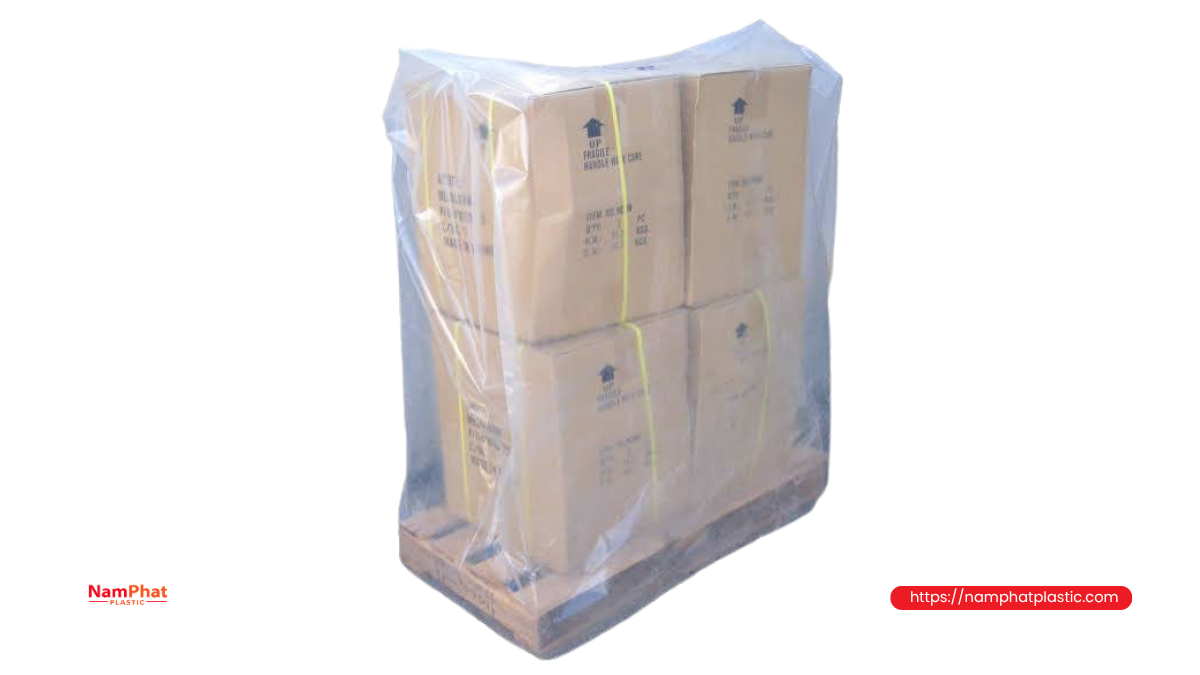
Carton boxes may appear relatively smooth, but the four upper corners of the load are often the points where the film experiences the greatest stress. If the boxes are not aligned, a protruding corner can become the starting point of a tear.
3.1. Lightweight carton pallets stored indoors and requiring only cleanliness
For lightweight boxes stacked squarely and moved infrequently, the main goal is usually to limit dust, splashing water, and surface contamination. In this case, excessive thickness can increase the cost per pallet without providing a proportionate improvement in protection.
Prioritize the following:
-
Measure the fully stacked load rather than using only the pallet's dimensions.
-
Allow sufficient width for the cover to pass over all four corners without forceful pulling.
-
Ensure the bag is long enough to cover the required area without excessive material hanging below the pallet.
-
Check whether the bag opening can be separated and opened easily during handling.
-
Inspect film uniformity, especially around gussets and near the sealing seam.
3.2. Tall, heavy carton pallets or shipments involving multiple transport stages
The taller the pallet, the farther the film must be stretched, the greater the potential friction area, and the more difficult installation becomes. For heavy loads or shipments passing through multiple distribution points, also consider vibration, strapping, corner boards, and the risk of the pallet tilting.
In these situations, the pallet cover should be treated as a protective covering, not as a load-securing device. The goods should be stabilized through proper stacking and, where appropriate, by using pallet stretch film, corner boards, anti-slip sheets, or suitable straps before the cover is fitted. If the load already tends to tip or slide, thicker film will not address the root cause.
3.3. Moisture considerations for carton boxes
PE film helps limit direct contact between cartons and external water or moisture, but it does not remove moisture already present in the goods, wooden pallets, or the air inside the cover. If the load is covered while still hot or the cartons are damp, temperature differences can cause condensation inside.
Businesses should control the following:
-
The dryness of cartons and pallets before packaging.
-
The temperature of the goods when the cover is fitted.
-
Storage duration and day-to-night temperature fluctuations.
-
The need for ventilation, desiccants, or a separate moisture-control solution.
Ordinary PE covers should not be described as providing “absolute moisture protection” for cartons. Protection also depends on how securely the bag opening is closed and on the performance of the entire packaging system.
4. How to choose pallet covers for raw material bags
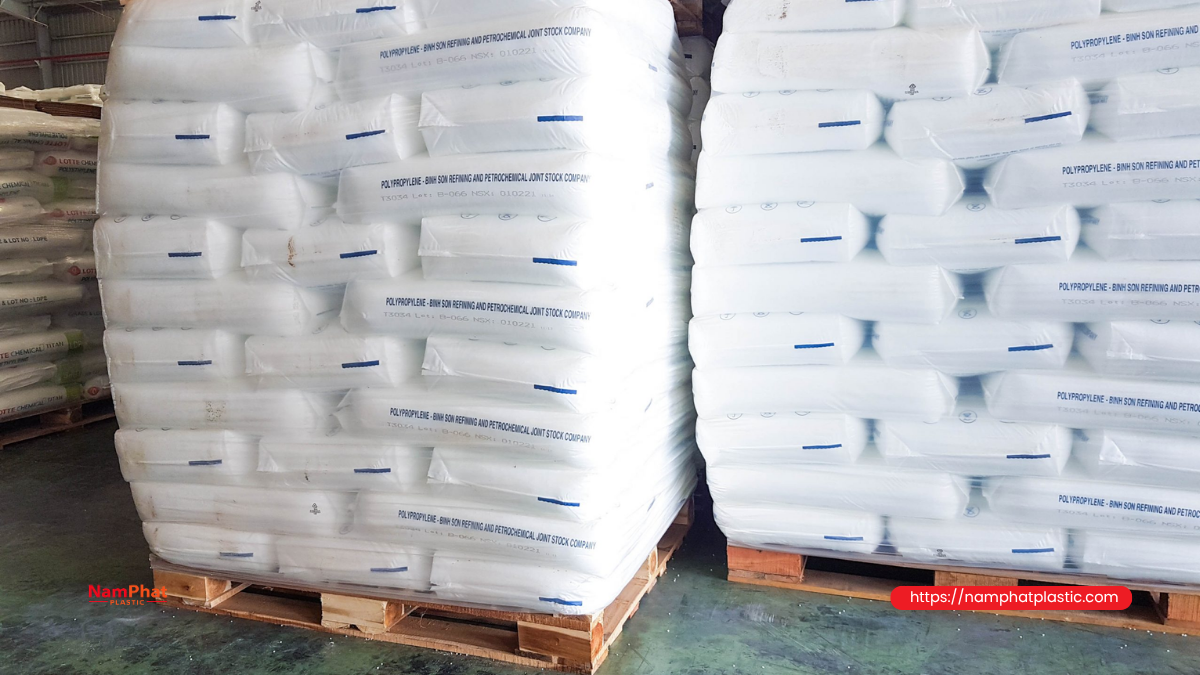
Bags containing plastic resin, powders, additives, animal feed, fertilizers, or industrial materials often form a flexible but unstable load. The bag surfaces may bulge, while seams or folded openings can rub directly against the film.
Do not evaluate raw material bags based only on total weight
A pallet cover is not designed to lift the entire pallet load, so the total weight in kilograms does not fully reflect the risk of tearing. Also consider:
-
Whether the bags slide against one another.
-
Whether each layer is staggered and securely interlocked.
-
Whether seams, drawstrings, or bag openings have hard protruding ends.
-
Whether the load extends beyond the pallet edges or sags in the middle.
-
Whether the goods settle and change shape after several days.
-
How many times the pallet is moved by forklift.
A securely stacked pallet of bags may pose less risk to the cover than a lighter pallet whose bags continually shift.
Prioritize toughness and the ability to withstand deformation
On uneven surfaces, the film must deform with the load without easily developing tears. LDPE/LLDPE film structures can be adjusted to suit the application: LDPE often supports softness and processability, while LLDPE is commonly considered for improved toughness, tensile performance, and puncture resistance. However, quality cannot be determined by resin name alone. Resin grade, formulation, equipment, and film uniformity all affect the final result.
Buyers should describe their requirements in terms of actual performance, for example:
-
The bag must not tear when two workers fit it over a fully loaded pallet.
-
The film must withstand the expected number of internal handling operations.
-
The sealing seam must remain intact when the cover is pulled over the highest protruding bag.
-
After a representative transport cycle, no tear should compromise the protective function.
This is more useful than simply requesting “an additional 20 microns.”
When should pallet stretch film be used as well?
If the goal is to prevent bags from sliding, stretch film or an appropriate load-securing system must perform that function. The outer cover helps protect the top and sides. These materials can complement each other, but their functions should not be confused.
A commonly suitable sequence is: stack and stabilize the load → address protruding points → apply stretch film or strapping if necessary → fit the cover → secure the lower portion of the cover according to the warehouse's safe operating procedures.
5. How to choose covers for loads with sharp edges
This category should not be selected using a thickness table alone. Although all may be described as “sharp-edged,” a carton corner, a wooden edge, a bolt end, and the edge of a metal sheet create very different levels of stress concentration.
Classify the edges before selecting the film
For practical purposes, edges can be divided into three levels:
-
Blunt edges: Carton corners or rounded components that do not scratch the hand or snag the film when it slides over them.
-
Hard edges: Metal corner boards, wooden ends, rigid plastic edges, or strap edges that can create visible pressure marks.
-
Sharp points: Nails, burrs, screw tips, cut wire ends, sheet-metal edges, or components that can puncture the film under light pressure.
For blunt edges, bag dimensions and film toughness may be sufficient to optimize performance. For hard edges, add corner boards, liners, or localized cushioning. For sharp points, remove, wrap, or cover them before installation; increasing thickness is not a reliable control measure on its own.
Why can a thick bag still be punctured?
When a sharp point presses against the film, the force is concentrated in a very small area. If the cover is also too tight, the film is already under high tension before the pallet starts moving. Even a small movement can create a hole and then extend it into a tear.
Therefore, four measures often need to be applied together:
-
Reduce or cover sharp points.
-
Allow reasonable dimensional tolerance to avoid excessive film tension.
-
Select a film structure with suitable toughness and puncture resistance.
-
Test samples under conditions close to actual transportation.
When is an ordinary PE pallet cover unsuitable?
A standard pallet cover should not be used as the sole protective barrier when a load has exposed sharp metal ends, untreated wood splinters, hot components, chemicals that may be incompatible with PE, or specialized antistatic requirements. These cases require an assessment of technical packaging, cushioning materials, or a suitable functional film.
6. Five specifications that must be selected together
6.1. Bag dimensions
Measure the maximum length, width, and height of the fully loaded pallet, including protrusions, corner boards, stretch film, or cushioning that will be used. If you provide only the wooden pallet dimensions, the cover may not fit over goods extending beyond its edges.
A bag that is too tight increases pulling force and the risk of tearing. An oversized bag wastes material, complicates handling, and may leave excess film that becomes caught during transportation.
6.2. Single-layer thickness
The micron is a commonly used unit, with 1 micron = 0.001 mm. Thickness should be measured at multiple points because a satisfactory average does not rule out localized thin spots. When ordering, agree on nominal thickness, tolerance, and the sampling method.
6.3. Film structure and thickness uniformity
Two bags with the same dimensions and nominal thickness can still perform differently. Differences may arise from the resin, resin grade, blend ratio, blown-film process, film orientation, and thickness uniformity across the width of the film.
6.4. Bag design and sealing seams
Gusseted bags provide additional depth for covering large loads, but the folds must open correctly during handling. The sealing seam must be suitable for the film and the stress generated during installation. Buyers should inspect both the film and the seam rather than measuring only the thickness of the bag body.
6.5. Operating environment
Indoor storage differs from a sunny outdoor yard; local delivery differs from container shipping; and single-use packaging differs from a requirement for reuse. If UV resistance, antistatic properties, light-blocking color, warning labels, or direct contact with sensitive goods are required, these must be specified from the outset to ensure appropriate material selection and documentation.
7. How to estimate weight for quotation comparisons
A price quoted “per piece” can be misleading if two quotations involve different dimensions or thicknesses. For a box-shaped cover open at the bottom, a preliminary estimate is:
-
Film weight ≈ covered area × thickness × film density
The approximate area covering five faces is:
-
S ≈ (Length × Width) + 2 × Height × (Length + Width)
For example, for a load measuring 1.1 × 1.1 × 1.2 m, using 80-micron film and an assumed PE density of approximately 920 kg/m³:
-
Approximate covered area: 1.1 × 1.1 + 2 × 1.2 × (1.1 + 1.1) = 6.49 m².
-
Theoretical weight: 6.49 × 0.00008 × 920 ≈ 0.48 kg.
The actual weight may differ because of gussets, handling allowances, sealing seams, bag design, dimensional tolerances, and thickness variations. This formula is for an initial reasonableness check only; it does not replace a bag drawing or weighing a finished sample.
8. Sample testing procedure before placing a bulk order
Step 1: Select the most challenging pallet, not just the best-looking one
The sample should include the tallest load, the largest protrusion, the hardest corner, and the route involving the most handling. Testing only a perfectly stacked pallet may produce results that are more favorable than actual operating conditions.
Step 2: Record the handling method
Test with the expected number of workers, bag pickup position, and installation method. Observe where workers need to pull hard, where the film catches on the load, and how easily the bag opening can be separated.
Step 3: Inspect immediately after installation
Assess four areas: the film body, the four upper corners, the gussets, and the sealing seam. Mark stress whitening, pinholes, pressure marks, or areas where the film is excessively tight.
Step 4: Run the pallet through a representative cycle
Move it by forklift, store it, and transport it along a route similar to actual operations. Then inspect for abrasion, tear propagation, seal failure, and movement of the load inside.
Step 5: Change only one variable at a time
If the sample fails, determine whether the problem requires a dimensional adjustment, corner protection, greater toughness, increased thickness, or improved pallet stabilization. Changing too many variables at once makes it difficult to identify what actually improves performance and complicates cost optimization for future orders.
9. Ordering mistakes that cause tearing or unnecessary costs
-
Providing the wooden pallet dimensions without the dimensions of the fully stacked load.
-
Selecting thickness based on an old product without confirming whether the measurement refers to one layer or two.
-
Increasing thickness to compensate for uncovered nails, burrs, or metal corners.
-
Using a pallet cover as a substitute for load-securing stretch film or strapping.
-
Testing the cover only on-site without checking it after vibration and handling.
-
Comparing prices per bag while ignoring weight, specifications, and tolerances.
-
Assuming PE film will remove moisture already trapped inside the pallet load.
-
Ordering one specification for pallets with widely different heights and edge conditions.
10. Information to send Nam Phát Plastic for specification recommendations
To reduce the number of sample revisions, businesses should prepare the following:
-
Maximum length × width × height of the fully loaded pallet.
-
Photos of all four sides and the top of the pallet.
-
Load type: cartons, raw material bags, wooden crates, components, or other products.
-
Locations of corners, seams, straps, or protruding parts.
-
Main objective: dust protection, splash resistance, light blocking, identification, or another requirement.
-
Storage conditions: indoors or outdoors, expected duration, and temperature fluctuations.
-
Transportation method and number of handling operations.
-
Current bag specifications, if available: dimensions, single-layer thickness, and existing problems.
-
Requirements for transparency, color, printing, gussets, or functional additives.
-
Estimated order quantity and sample-testing requirements.
Nam Phát Plastic can manufacture PE pallet covers to customer-specified dimensions. Recommendations should be based on the actual pallet and its protection requirements, followed by sample approval before mass production.
Conclusion
Choosing an effective pallet cover does not mean assigning one fixed micron value to every load. For carton boxes, control the upper corners, bag tightness, and condensation risk. For raw material bags, focus on film toughness and load stability. For products with sharp edges, protecting or removing sharp points must come before increasing thickness.
A suitable specification must balance five factors: dimensions, single-layer thickness, film structure, sealing seams, and operating conditions. Testing samples on the most challenging pallet is a reliable way to determine a specification that provides sufficient durability without unnecessary plastic consumption.
If your business is experiencing punctures at corners, tears during installation, or seal failures, send Nam Phát Plastic photos of the pallet, its fully loaded dimensions, and the current bag sample. The more specific the information, the easier it is to identify the cause and recommend a practical sample for testing.
Frequently asked questions
1. How thick should a pallet cover for carton boxes be?
For lightweight cartons stacked evenly and stored indoors, approximately 40–70 microns can serve as a starting point for sample testing. Tall, heavy pallets, multi-stage shipments, or loads with protruding corners may require a higher range. These are not guaranteed specifications; they must be verified on the actual pallet, with single-layer thickness clearly defined.
2. Do raw material bags require thicker covers than carton boxes?
Not necessarily. Raw material bags may be soft but can shift, bulge, and rub against the film at their seams. If the pallet is stable, moderate specifications may be sufficient. Heavy bags, rough surfaces, or container shipments may require tougher film and additional load-securing measures.
3. Can increasing thickness prevent nails or metal edges from puncturing the cover?
Thickness alone should not be relied on as the only protective measure. Nails, burrs, screw tips, and metal edges should be removed or covered with suitable caps, corner boards, or cushioning before the bag is fitted.
4. Can a pallet cover prevent bags from falling over?
A pallet cover primarily protects against dust, splashing water, and contamination. If the load may slide or fall, use appropriate stacking methods, stretch film, strapping, anti-slip sheets, or another suitable load-securing solution.
5. Why does a bag split at the top even though the film is not punctured?
Possible causes include a bag that is too short or tight, forceful pulling during installation, excessive stress on the sealing seam, or an incompatibility between the sealing conditions and the film structure. Check dimensions, handling, and seam quality instead of simply increasing thickness.
6. Is it advisable to use one bag size for multiple pallet types?
This may work if the pallets have similar dimensions and sample testing confirms easy installation. However, using an oversized bag for many specifications can waste film and increase costs, while a bag fitted tightly to the largest pallet may have a higher risk of tearing.
7. Can PE covers provide absolute moisture protection for carton boxes?
No. PE film helps limit external water and moisture, but the bag opening, securing method, initial carton moisture, and internal condensation all affect performance. Moisture-sensitive goods require an overall moisture-control solution.
>> See also:
- 0 Comment


