


 Phan Van Hoang
- 23/07/2026
- 167
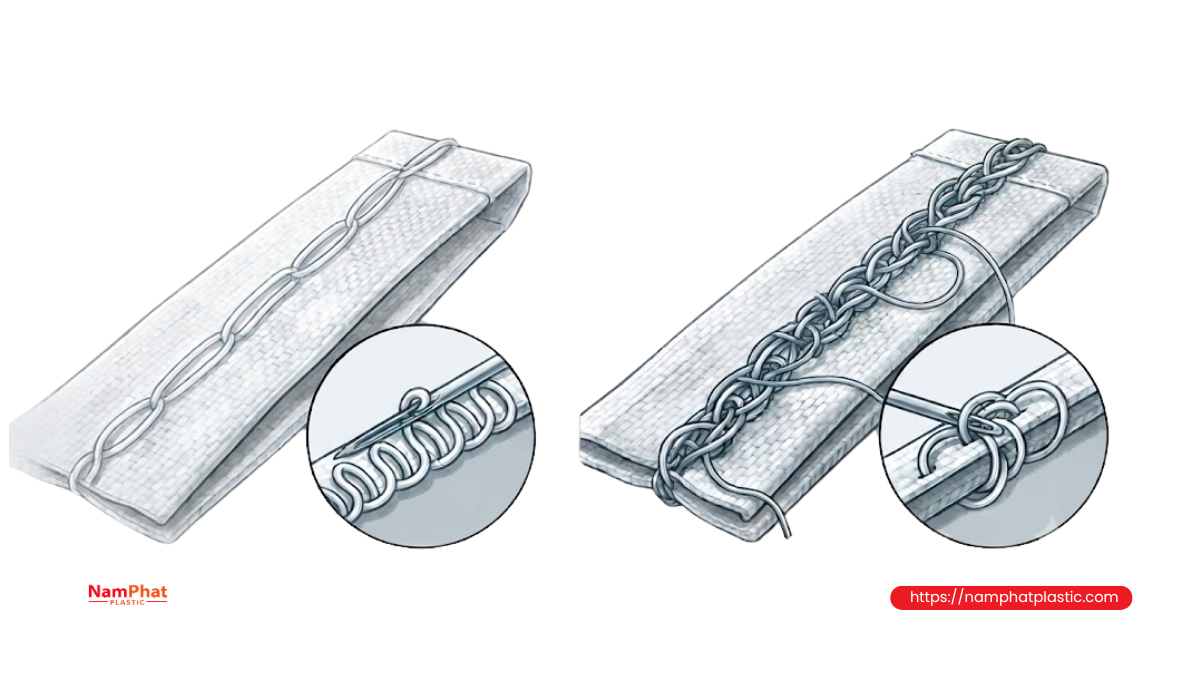
During the closing of rice bags, animal feed bags, fertilizer bags, or raw material bags, operators commonly encounter two popular types of stitching: single-thread chain stitch and double-thread chain stitch. Viewed from the outside of the bag, the two seams can look quite similar. However, the interlocking structure on the underside, thread consumption, resistance to vibration, and the way the seam is opened are significantly different.
The easiest point to misunderstand is that “single-thread” and “double-thread” refer to the number of threads involved in forming the stitch, not the number of needles. The double-thread chain stitch commonly used for closing bags can still use only one needle, but with an additional looper thread underneath. According to the ISO stitch classification system, the single-thread chain stitch is commonly called stitch 101, while the double-thread chain stitch generally corresponds to stitch 401.
Quick conclusion: Should you choose single-thread or double-thread chain stitch?
It can be understood simply as follows:
- Single-thread chain stitch is suitable when a simple machine, low thread consumption, easy operation, and quick bag opening are required.
- Double-thread chain stitch is suitable when seam stability is prioritized, or when bags are frequently subjected to vibration or must undergo repeated transportation and handling.
Do not choose solely based on bag weight. The machine type, bag material, mouth-folding method, stitch length, thread tension, and transportation conditions should all be considered together.
Double-thread does not mean that the seam cannot be opened. Stitch 401 can still be opened by following the correct thread end and using the proper procedure.
Table of Contents [Hide]
1. What is a single-thread chain stitch?
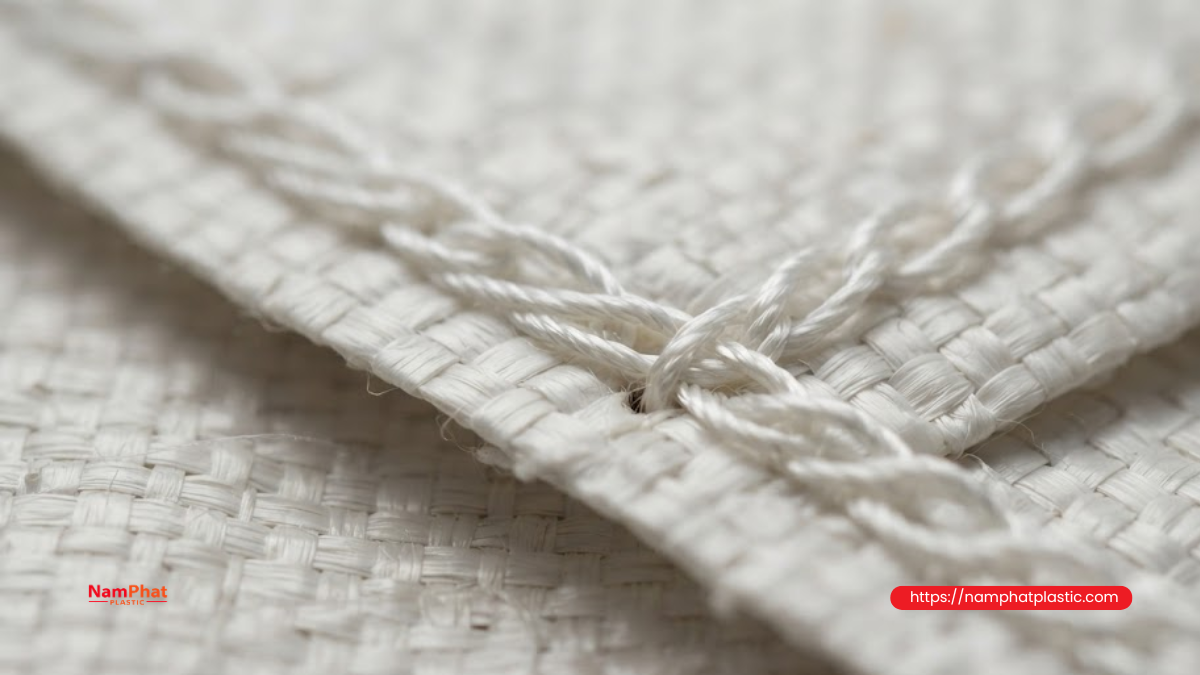
A single-thread chain stitch, commonly designated as stitch type 101, uses one thread from the needle. As the needle passes through the material, the thread forms consecutive loops that interlock with itself on the underside of the seam.
Viewed from the outside of the bag, the seam is usually a single row of straight stitches. On the opposite side, the thread forms a continuous chain of connected loops resembling chain links. The American & Efird stitch classification identifies stitch 101 as a single-thread stitch used for bag closing.
Key characteristics of the single-thread chain stitch
The single-thread stitch has a relatively simple structure. The machine does not need to simultaneously control two thread sources, so threading, tension adjustment, and troubleshooting are generally easier.
Because only one thread participates in forming the stitch, total thread consumption is generally lower than that of a double-thread stitch under the same seam length and stitch density. This is a notable advantage for facilities sewing large quantities of bags without requiring an exceptionally high level of seam protection.
Stitch 101 can also be opened quickly. When the correct end of the chain is identified, the locking section is cut and the thread is pulled in the correct direction, allowing the bag mouth to be opened without cutting the body of the bag.
However, the ability to open quickly is also a point that requires control. If the thread tail is too short, gets caught during transportation, or the beginning of the seam is not properly handled, the chain stitch may gradually unravel from one end.
2. What is a double-thread chain stitch?
The double-thread chain stitch used for bag sewing generally corresponds to stitch type 401, also known as a two-thread chain stitch or double-thread chain stitch.
The seam is formed from:
- One needle thread passing through the material.
- One looper thread interlocking with the needle thread underneath.
Therefore, a double-thread stitch does not necessarily use two needles. The machine generally still creates one row of needle holes, but two thread systems interlock to form the chain underneath. Union Special documentation describes stitch 401 as a two-thread chain stitch; Newlong also distinguishes its single-thread NP-7 machines from double-thread models designed to create stronger and more stable seams.
Key characteristics of the double-thread chain stitch
Compared with stitch 101, the structure of stitch 401 contains an additional interlocking thread. When the seam is subjected to pulling, vibration, or localized deformation, the load is not concentrated solely on a self-interlocking chain of loops but is distributed between the needle thread and looper thread.
The double-thread stitch is therefore commonly selected for situations such as:
- Heavy bags.
- Thick bag mouths or mouths folded into multiple layers.
- Bags that must be transported over long distances.
- Bags passing through conveyors, pressing equipment, mouth-folding units, or automated production lines.
- Situations where the damage caused by a bag mouth opening is more costly than the additional thread cost.
Stitch 401 can still be opened. However, the operator needs to identify the correct side and correct thread end. Union Special instructions show that both stitches 101 and 401 have procedures for opening the seam, but with the double-thread stitch, the user generally needs to cut the chain end and loosen the correct thread before pulling.
Comparison table of single-thread and double-thread chain stitches in bag sewing
| Criteria | Single-thread chain stitch | Double-thread chain stitch |
| Common designation | Stitch 101 | Stitch 401 |
| Number of thread sources | One | Two |
| Common number of needles | One needle | One needle |
| Stitch structure | Needle thread forms loops and interlocks with itself | Needle thread interlocks with looper thread |
| Top-side appearance | One row of straight stitches | One row of straight stitches |
| Underside appearance | Single chain | Denser chain with two interlocking threads |
| Stability under vibration | Basic level | Generally more stable |
| Risk of unraveling from the thread end | Requires careful control | Lower when the seam is properly set |
| Thread consumption | Lower | Higher |
| Threading and adjustment | Simpler | More complex |
| Thread tension balancing requirement | One thread system | Needle thread and looper thread must be balanced |
| Bag mouth opening capability | Fast, easy to open | Still openable but requires the correct procedure |
| Operating cost | Generally lower | Generally higher due to additional thread |
| Suitable applications | Conventional bag closing, flexible operation | Heavy-load bags, repeated transportation, or stable production lines |
3. The most important difference lies on the underside of the seam
If you only look at the front of the bag, it is very easy to confuse a single-thread stitch with a double-thread stitch. Both can form a relatively similar straight row of stitches.
A more accurate way to identify them is to observe the underside:
Underside of the single-thread stitch
The loops are connected continuously by the same thread. The chain is generally compact and has a simple structure. When one loop is pulled backward in the correct opening direction, the following loops can gradually unravel.
Underside of the double-thread stitch
The needle thread and looper thread can be seen interlocking continuously. If two different thread colors are used, this structure becomes even easier to identify. The chain underneath is generally fuller and thicker than that of a single-thread stitch.
During actual factory inspection, visual observation alone should not be relied upon. A sample seam approximately 20–30 cm long can be cut and tested by pulling both ends and attempting to open it from each side to correctly identify the stitch type.
4. Is the double-thread stitch twice as strong as the single-thread stitch?
It should not be understood that way.
Using two threads does not automatically mean that seam strength doubles. The strength of the bag mouth seam also depends on many factors:
- Tensile strength of each thread.
- Thread elongation under load.
- Thread twist and uniformity.
- Needle-thread and looper-thread tension.
- Stitch length.
- Distance between the seam and bag edge.
- Number of material layers at the folded mouth.
- Condition of the needle, looper, feed dog, and throat plate.
- Weaving or coating quality of the bag.
- How the bag is handled and transported.
Under conditions where both seams are properly set, stitch 401 generally has better ability to maintain its interconnection when subjected to vibration or changing loads. However, a double-thread seam with incorrect tension, skipped stitches, or an improperly engaged looper thread can still be less reliable than a well-adjusted single-thread seam.
Therefore, the correct way to evaluate them is not “single thread is weak, double thread is strong,” but rather:
- The double-thread stitch has a more complex interlocking structure, but its practical effectiveness is achieved only when the machine, thread, and bag material are properly matched.
5. How does thread consumption differ?
A single-thread chain stitch uses only one thread source, so it is generally more economical. A double-thread stitch uses both needle thread and looper thread, so total thread consumption per meter of seam will be higher.
However, a fixed ratio cannot be applied to every machine. Actual thread consumption depends on:
- Stitch length.
- Thickness of the bag mouth.
- Tension of each thread.
- Size of the chain loop underneath.
- Excess thread at the beginning and end of the bag.
- Rate of defective seams that must be opened and resewn.
- Distance between bags on the production line.
- How the machine forms the thread chain when no bag is being sewn.
For example, a well-adjusted double-thread production line may use more thread per bag but reduce the number of bags that need to be resewn. Conversely, a single-thread machine may save material, but if the bag mouth frequently opens, product losses and labor costs can exceed the savings in thread.
Businesses should calculate the complete closing cost per 1,000 bags rather than simply comparing the price of one kilogram of thread.
6. Is the single-thread stitch always faster to sew than the double-thread stitch?
Not necessarily.
Sewing speed depends primarily on machine design, motor capacity, material feeding mechanism, material type, and thread delivery capability. Within the same machine series, manufacturers may offer both single-thread and double-thread versions with similar operating speed ranges.
For example, the Union Special 2200 series has versions using stitches 101 and 401, with published speeds of approximately 1,200–1,700 stitches per minute depending on the material. Some machines in this series can also be converted between single-thread and double-thread configurations by qualified technicians. This shows that the number of threads is not the only factor determining productivity.
In practice, productivity is also affected by the time required for:
- Rethreading after thread breakage.
- Replacing thread cones.
- Adjusting tension.
- Correcting skipped stitches.
- Cutting the thread chain between bags.
- Stopping the machine for cleaning dust.
- Resewing defective bags.
A machine that runs fast but frequently breaks thread does not necessarily achieve higher output than a machine with a lower nominal speed but more stable operation.
7. Seam opening capability of the two stitch types
Single-thread stitch
A major advantage of the single-thread stitch is quick opening. When the operator finds the correct chain end, cuts the locking section, and pulls in the correct direction, the seam can be continuously opened.
This characteristic is suitable for raw-material bags or agricultural-product bags that need to be opened frequently at factories, warehouses, or distribution points.
The disadvantage is that the thread tail needs to be sufficiently long and properly handled. If the chain thread is cut too close, gets caught on a pallet, or is pulled during transportation, the seam may unintentionally unravel.
Double-thread stitch
A double-thread stitch can also be designed for quick opening, but the procedure is generally more precise. The operator needs to identify the correct end and the correct thread to loosen.
Because two interlocking threads are present, the seam is generally less sensitive to an accidental pulling force on a single chain loop. However, stitch 401 should not be considered a tamper-proof sealing method. If a business needs to prevent bag opening or detect whether a bag has been opened, additional solutions such as paper tape, seals, sealing cords, or specialized seam designs should be used.
8. When should a single-thread chain stitch be chosen?
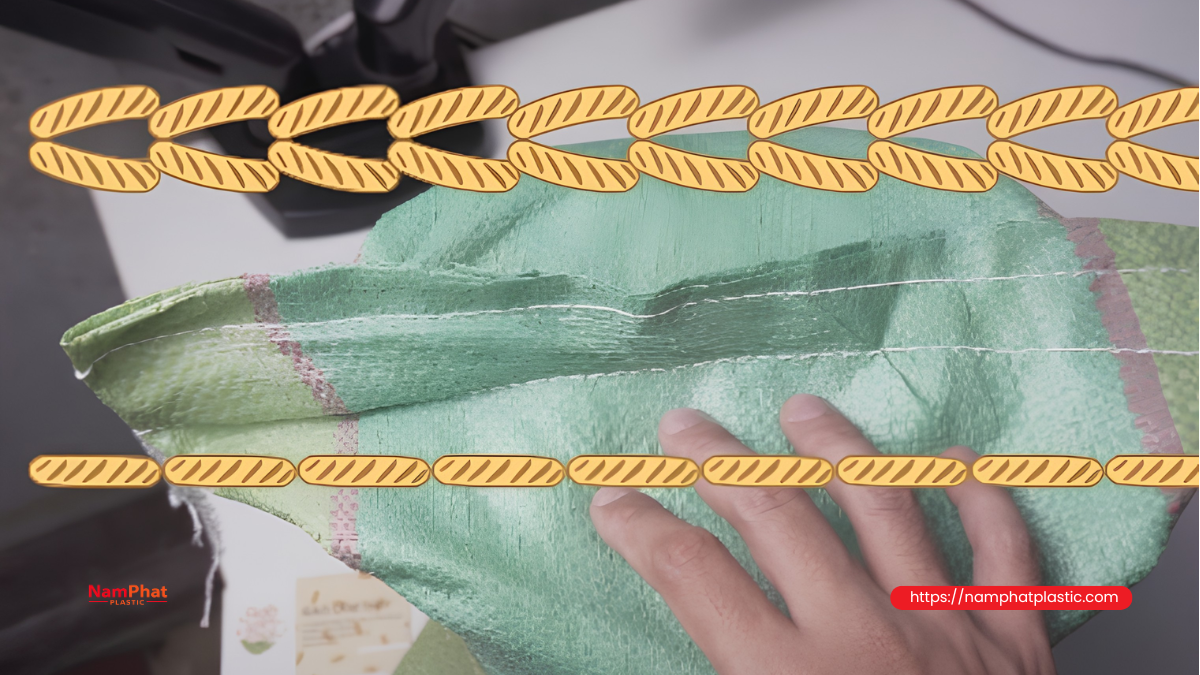
A single-thread stitch is generally a reasonable choice when the following conditions occur together:
The existing machine is designed for single-thread stitching
This is the first factor to check. Do not try to add another thread cone or change the threading path when the machine does not have the appropriate looper mechanism.
The bag is not subjected to severe vibration
If the bag is mainly closed in a warehouse, placed directly on a pallet, and transported under stable conditions, a single-thread stitch may perform well after testing.
Fast bag opening is prioritized
Factories that frequently pour raw materials from bags into hoppers may prefer an easily removable seam, reducing the need to cut the bag body with a knife.
Thread consumption needs to be reduced
For large production volumes, the difference in thread consumption can become significant. However, this option should only be selected after calculating the defect rate and losses caused by bag-mouth opening.
Operators have limited experience
Single-thread machines are generally easier to thread and easier to troubleshoot when the seam behaves abnormally than double-thread machines.
9. When should a double-thread chain stitch be chosen?
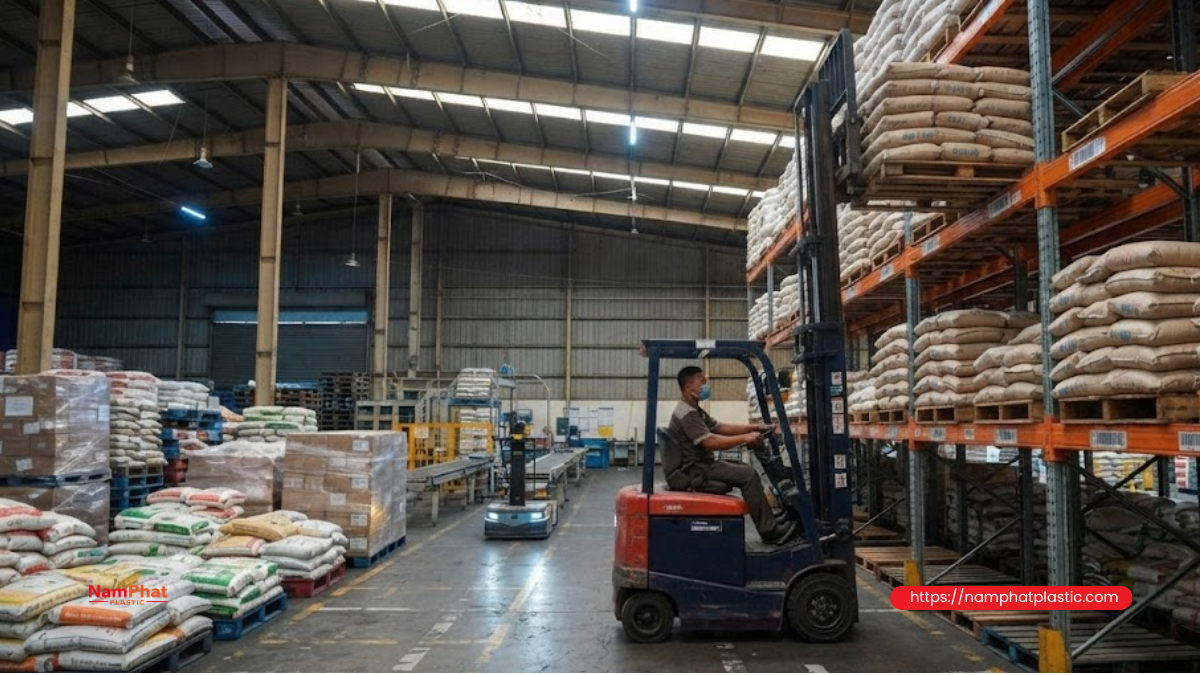
A double-thread stitch should be considered in the following situations:
The bag passes through multiple transportation stages
Bags passing through long conveyors, pressing machines, robotic bag stacking, palletizing, or repeated handling are often subjected to continuous vibration and changing pulling forces.
The product can leak or has high value
For powdered or small-granule materials, or products where even a single bag opening can cause significant losses, seam stability should be prioritized over the additional thread consumption.
The bag mouth has multiple layers
Bags with PE liners, paper tape, thick folded edges, or multilayer structures create complex loads on each stitch. A double-thread stitch may help distribute the load more effectively when the machine is properly adjusted.
The production line operates continuously
In an automated line, the important requirement is not only strength but also repeatability. A double-thread stitch is suitable when the thread feeding system, sensors, cutting knife, and tension are maintained consistently.
The customer requires a specific seam type
Some customers or factories have standardized their equipment around stitch 401. In that case, the supplier only needs to select a product compatible with the machine configuration rather than arbitrarily switching to another stitch type.
10. How should thread be selected for single-thread and double-thread stitches?
Do not look only at designations such as PE 20/6, PE 20/8, PE 20/9, PP 900D, or PP 1200D. Two threads with the same nominal specification may still differ in twist, elongation, fuzziness, and unwinding performance.
10.1. For single-thread chain stitch
The single thread must perform the entire process of forming loops and maintaining the interconnection. Therefore, the thread should have:
- Appropriate tensile strength.
- Stable twist.
- Resistance to fiber separation when passing through the needle.
- Good loop-forming capability.
- Appropriate smoothness.
- Even unwinding without jerking.
- Few and neat joints.
If the thread is too stiff, the loop may not form consistently. If the thread is too soft or has insufficient twist, it may become fuzzy, fray, and get caught at the needle eye or looper.
10.2. For double-thread chain stitch
Both the needle thread and looper thread need to be controlled. The two threads may use the same specification or different specifications depending on the machine design and seam requirements.
The following factors should be checked:
- Whether both thread cones unwind evenly.
- Whether needle-thread and looper-thread tension are balanced.
- Whether the looper thread forms a complete loop underneath.
- Whether the needle thread is pulled too deeply underneath.
- Whether the two threads have excessively different elongation.
- Whether thread size is compatible with the needle, looper, and thread guides.
Do not assume that using a larger thread automatically makes the seam stronger. A thread that is too large for the needle eye can increase friction, heat the needle, cause thread breakage, and create larger holes in the bag.
11. Procedure for testing single-thread and double-thread stitches before mass production
Businesses can apply the following practical testing procedure:
Step 1: Record the initial configuration
Record:
-
Machine name and model.
-
Stitch type currently being used.
-
Needle size.
-
Thread specification.
-
Stitch length.
-
Position of the seam relative to the bag edge.
-
Number of material layers at the bag mouth.
-
Thread tension or tension-control setting.
Recording these details helps prevent repeated testing without knowing which change improved or worsened the seam.
Step 2: Sew a test batch
A sufficiently large batch should be sewn so that the machine reaches actual operating conditions rather than testing only one or two bags. During testing, observe:
-
Thread breakage frequency.
-
Skipped stitches.
-
Uniformity of the chain.
-
Stability when starting and ending the bag.
-
Thread-cutting performance.
-
Needle and thread-guide temperature.
-
Dust or fiber accumulation.
Step 3: Visually inspect the seam
An acceptable seam should not only look good on the top side. The underside must also be inspected to detect:
-
Loose chain loops.
-
Misaligned needle thread.
-
Insufficient looper-thread interlocking.
-
Stitches that are too long or too short.
-
Needle holes damaging the woven fibers of the bag.
-
Seam positioned too close to the edge.
Step 4: Conduct simulated transportation testing
Test bags should be stacked, lifted, handled, vibrated, or moved under conditions close to actual operations. In particular, both ends of the seam should be inspected because these are often the locations where thread unraveling begins.
Step 5: Test opening the bag
A good seam must not only remain closed during transportation but also open according to the customer's requirements. Check:
- Whether the operator can correctly identify the opening end.
- Whether the seam can be continuously opened.
- Whether the thread breaks midway.
- Whether the bag edge tears when the thread is pulled.
- Whether a knife is required to cut open the bag body.
12. Common problems with single-thread chain stitches
The seam automatically unravels from the bag end
Possible causes include a thread tail that is too short, incorrect cutting, or insufficient control of the chain at the beginning or end.
The solution is to adjust the excess thread length, check the cutting knife, and train workers to handle the correct seam end properly.
The underside chain loops are too loose
Thread tension may be too low, the threading path may be incorrect, or the looper may not be catching the loop consistently.
Do not simply tighten the tension knob immediately. Check the threading path, needle, looper, needle hole, and smoothness of the thread cone in sequence.
The seam looks good but breaks easily
Possible causes include thread strength degradation due to friction, a needle that is too small, sharp edges on thread guides, or excessive thread tension.
13. Common problems with double-thread chain stitches
Needle thread and looper thread are unbalanced
If the needle thread is too tight, the interconnection may be pulled too deeply toward the underside. If the looper thread is too tight, the top side may deform or the material may contract.
Each system should be adjusted separately, making small changes each time and sewing another test sample.
The machine still forms stitches but one thread is missing
In some cases, the seam may still look relatively normal from the top even though the looper thread is not properly interlocking. Therefore, checking the underside is mandatory.
The two thread cones do not unwind evenly
A cone that jerks or catches can cause sudden tension changes, resulting in skipped stitches or thread breakage. Thread cones used on production lines should have an even winding surface and stable unwinding performance.
14. Common mistakes when choosing a bag stitching type
Confusing double-thread with two-needle stitching
Double-thread chain stitch 401 normally uses one needle, one needle thread, and one looper thread. A two-needle machine is a different concept and generally creates two parallel seam rows or a specialized stitch structure.
Only comparing thread strength
A strong thread does not necessarily create a strong seam if the tension is incorrect, the stitch is too long, or the needle damages the bag material.
Assuming that a 50 kg bag must use two threads
Bag weight is an important factor but not the only one. A 50 kg bag that is palletized and transported under stable conditions may have different requirements from a lighter bag that is thrown, dragged, or continuously vibrated.
Assuming a double-thread machine is always better
A double-thread machine only provides its advantages when both threads are fed evenly and adjusted correctly. If operators cannot properly control the looper thread, the machine may generate more problems than a single-thread machine.
Choosing the largest thread to increase strength
An excessively large thread may not pass smoothly through the needle, create high friction, and make the seam unstable. Thread specification must match the entire system, not just the bag weight.
15. How to choose the appropriate option for each business
The following decision table can be used:
| Actual condition | Preferred option |
| Current machine only supports stitch 101 | Single-thread stitch |
| Fast bag opening is required at the point of use | Single-thread stitch |
| Reduced thread consumption is prioritized | Single-thread stitch |
| Short-distance transportation with little vibration | Single-thread can be used after testing |
| Bags pass through multiple conveyors and handling stages | Test double-thread stitch |
| High losses would occur if the bag mouth opens | Prioritize double-thread stitch |
| Bags have multiple layers or thick folded mouths | Test double-thread stitch |
| Production line is standardized for stitch 401 | Double-thread stitch |
| Operators frequently misthread the looper | Train operators before using double-thread |
| Unsure which type is suitable | Sew samples and conduct actual transportation testing |
Frequently Asked Questions
1. Is a double-thread chain stitch the same as a two-needle bag sewing machine?
No. Double-thread chain stitch 401 normally uses one needle, one needle thread, and one looper thread. A two-needle machine is a different concept and generally creates two seam rows or a specialized stitch structure.
2. Can single-thread and double-thread stitches be distinguished by looking at the outside of the bag?
It is difficult to distinguish them accurately by looking only at the top side. The underside of the seam should be inspected to observe the chain structure.
3. Can a double-thread stitch be opened quickly?
Yes. Stitch 401 can still be opened by cutting and pulling the correct thread end. However, the procedure is generally more complicated than with a single-thread stitch.
4. Can a single-thread stitch be used for a 50 kg rice bag?
It can, but the decision should not be based solely on weight. Testing should be performed using the actual bag, machine, thread specification, and transportation conditions.
5. Does using a double-thread stitch double thread consumption?
It cannot be concluded that way. Total thread consumption increases because of the additional looper thread, but the increase depends on stitch length, bag thickness, tension, and chain-loop size.
6. Can a single-thread machine be converted to a double-thread machine?
Some machine models can be converted when the necessary components are available and the work is performed by a qualified technician. For example, Union Special documentation states that some machines in the 2200 series can be converted between stitches 101 and 401. Do not modify the machine yourself before checking the documentation for the exact model.
7. Can PE 20/8 and 20/9 sewing threads be used for double-thread stitching?
Their suitability depends on the machine model, needle size, looper, and thread-path configuration. Both the needle-thread and looper-thread positions should be tested rather than checking only one thread cone on the machine.
8. Why does the same thread run well on a single-thread machine but frequently break on a double-thread machine?
A double-thread machine has additional thread guides, tension systems, and contact points for the looper thread. The thread may experience friction, catching, or unsuitable tension at one of these points. Each thread path should be checked separately.
Conclusion
The main difference between single-thread and double-thread chain stitches in bag sewing lies in their stitch-forming structure.
Stitch 101 uses a single thread to form a chain of self-interlocking loops, with the advantages of simplicity, lower thread consumption, and easy opening. Stitch 401 uses a needle thread combined with a looper thread, creating a fuller interconnection that is generally more stable under vibration, transportation, or complex loading conditions.
There is no single best choice for every type of bag. Businesses should consider:
- The machine model currently in use.
- The material and structure of the bag mouth.
- The weight of the packaged goods.
- Handling and transportation conditions.
- Customer requirements for opening the bag.
- The ability to control thread tension and maintain the machine.
- Total cost per 1,000 acceptable bags.
Before switching from single-thread to double-thread stitching or changing thread specifications, the safest approach is to sew samples on the actual machine, inspect both sides of the seam, and test under actual transportation conditions.
>>> See more:
- 0 Comment


