


 Phan Van Hoang
- 10/08/2026
- 153
A thread spool that has been fully wound usually has a fairly solid shape. The thread loops lie close together and are held in place by winding force and friction between the layers. However, a thread spool is not a completely solid block. There are still many small gaps between the thread loops and around the core.
This means that a thread spool has different load-bearing characteristics from a solid object such as metal or solid plastic.
When a spool is placed on a pallet, its weight is transferred from the spool body to the supporting surface. If additional layers of spools are placed above it, the load gradually increases. When the force is evenly distributed, the spool can maintain its shape relatively well. However, if the force is concentrated in a small area, that area may be compressed.
During transportation, the situation becomes more complicated. Continuous vehicle movement creates vibration. During acceleration or braking, the load is subjected to inertial forces. When the vehicle turns, lateral forces occur. During loading and unloading, even a single impact can create a large force within a very short period.
Therefore, a thread spool may leave the factory in good condition but still become deformed after:
-
Being stacked too high in storage.
-
Being placed on an uneven pallet.
-
Being compressed by strapping.
-
Being subjected to prolonged vibration.
-
Being hit by a forklift.
-
Being dragged or rolled without proper control.
-
Being supported by materials that create small contact points.
-
Being stored in the same position for too long.
The important point is to treat storage and transportation as part of the thread-spool quality-control process rather than focusing only on quality immediately after winding.
1. What types of damage commonly occur after stacking or transportation?
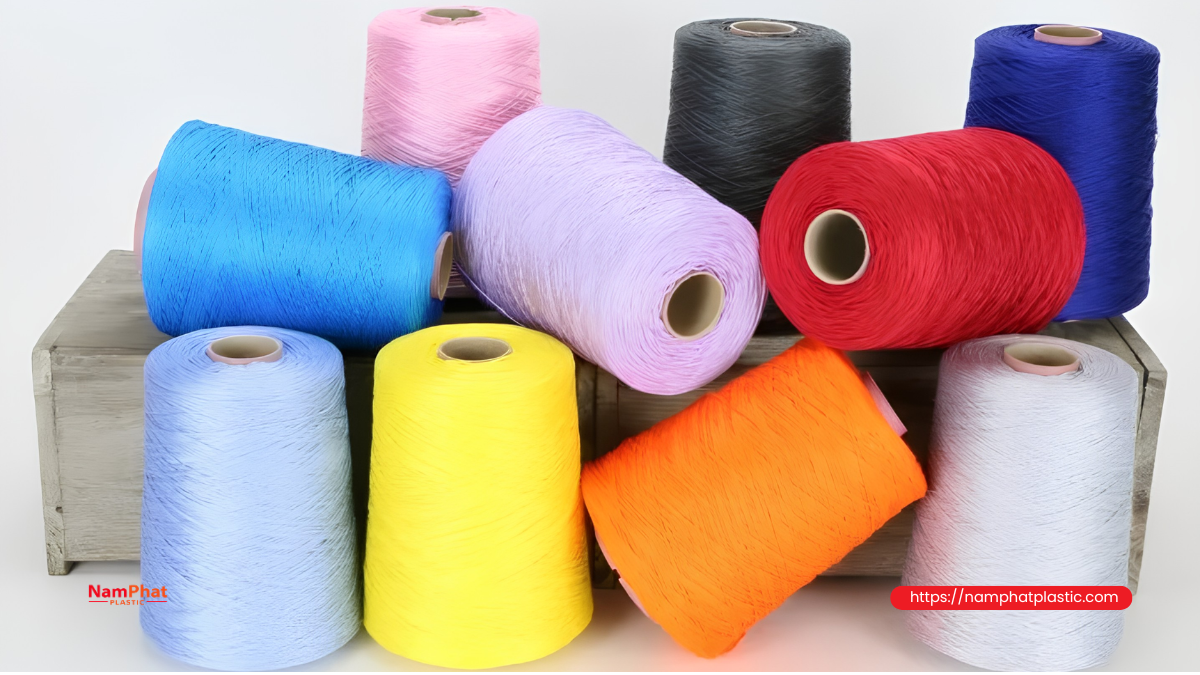
Not all spool deformation has the same cause. The location of the damage can provide clues about where the applied force came from.
| Condition | Appearance | Common causes | Possible effects |
| Edge denting | Part of the edge becomes flattened | Compression, impact | Uneven unwinding |
| Body indentation | Surface is pressed inward | Localized contact point | Thread layers shift |
| Core deformation | Core loses its round shape | Uneven compression, impact | Off-center rotation |
| Layer slippage | Thread loops slide sideways | Vibration, tilting | Outer layers unwind |
| Layer loosening | Outer loops come away from the body | Impact, inadequate securing | Increased risk of thread tangling |
| Edge crushing | Edge is heavily compressed | Strapping or contact point | Spool deformation |
| Loop displacement | Some loops protrude outward | Repeated vibration | Thread snagging during unwinding |
| Core cracking | A crack appears in the core | Excessive load or impact | Possible loss of spool stability |
A spool can experience several types of damage at the same time. For example, when the core becomes dented, the rotating shaft is no longer concentric. During vehicle vibration, the spool continues to oscillate, creating conditions for the outer thread layers to shift. Over time, core deformation and layer slippage may occur together.
Therefore, spool inspection should not rely only on the question, “Is it dented?” The roundness, core, edges, winding layers, and stability of the outer thread loops should all be checked.
2. How do spool structure and material properties affect load-bearing capacity?
Not all thread spools have the same compression resistance. One spool may withstand a particular stacking arrangement while another spool of the same size may deform because its winding structure or material is different.
The first factor is winding tightness. When thread loops are wound evenly with an appropriate winding force, the spool structure is more stable. If some areas are wound more loosely, those areas may be more easily compressed or displaced under load.
Spool diameter also affects how force is distributed. A large spool has a different mass and contact area from a small spool. It should not be assumed that all spool sizes can be stacked in the same way simply because they contain the same type of thread.
The spool core is particularly important. Paper cores, plastic cores, and cores with different levels of stiffness respond differently to compression. A weak core may collapse before obvious deformation appears in the outer thread layers.
The characteristics of the thread itself should also be considered. Smoothness, stiffness, fuzziness, elasticity, and the ability of adjacent layers to slide against each other can affect the stability of the outer layers.
Environmental conditions can also change load-bearing behavior. High humidity may affect certain cores or wrapping materials. High temperatures may soften some materials, making them more susceptible to deformation under load.
Therefore, before establishing a fixed stacking rule for the entire warehouse, consider spool dimensions, weight, core type, winding structure, storage duration, and environmental conditions.
3. How should thread spools be stacked to reduce dents and deformation?
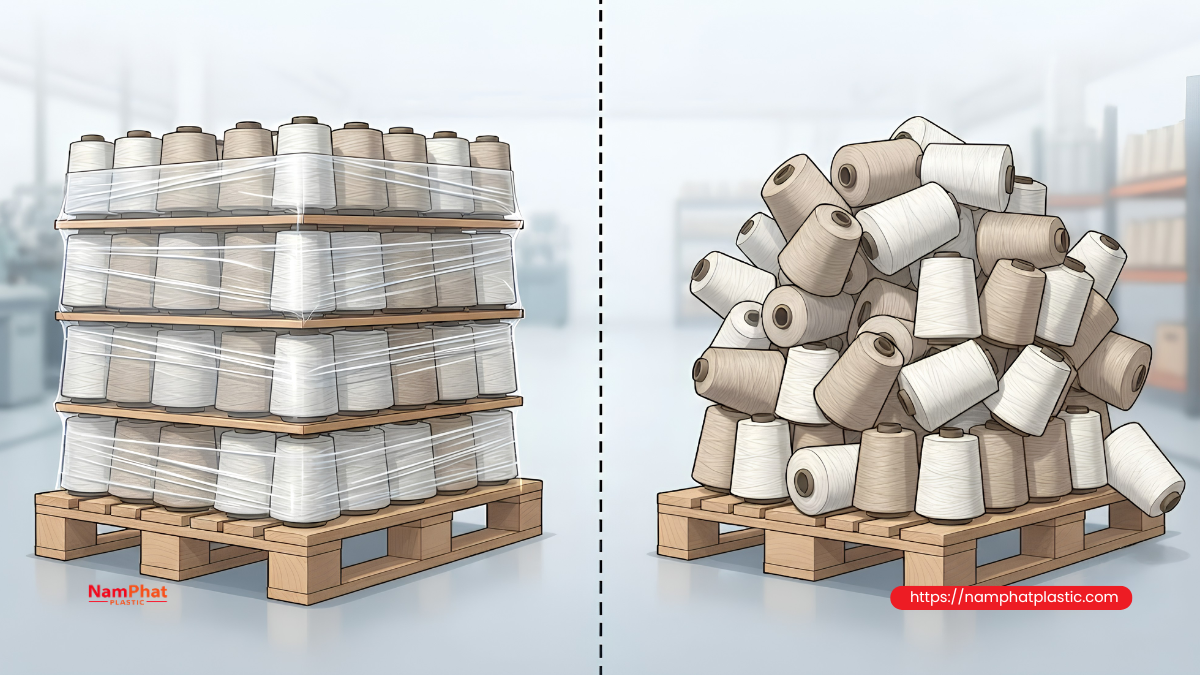
Stacking is the stage that creates direct compressive loads on the spools. It is also one of the causes that can easily be overlooked because deformation may not appear immediately after stacking.
A stable stack is not simply a matter of placing spools neatly on top of one another. The way the load is transferred from the upper layers to the lower layers, the degree of misalignment between spools, and the contact area must all be controlled.
3.1. Do not determine the number of layers based only on warehouse space
One of the quickest ways to save warehouse space is to increase stacking height. However, every additional layer increases the compressive load on the layers below.
If the spools in the lower layers have a softer structure, prolonged loading may gradually flatten the spool body. This problem may not appear on the first day. After several days or weeks, the loaded area may begin to show visible deformation.
Therefore, the number of layers should be determined based on the actual load-bearing capacity of the spool and core rather than simply the maximum height available in the warehouse.
If lower-layer spools are frequently dented while the upper layers remain unaffected, this is a sign that the stacking height or load distribution should be reviewed.
When specific technical data are not yet available, it is safer to begin with a lower stacking height, monitor deformation during storage, and then gradually increase the number of layers.
3.2. Align the centers of the spools so the load is evenly distributed
Center alignment between layers is not just about making the stack look neat. More importantly, it helps transfer the load from the upper spools to the lower spools in a relatively stable manner.
If a spool is misaligned, its weight may be concentrated on part of the edge of the spool below. A small offset may not cause immediate deformation. However, when combined with the weight of multiple layers and long storage periods, the compressed area can become a weak point.
This is especially likely when the upper and lower spools have different diameters. A small spool placed incorrectly on a larger spool can create a very narrow contact area, increasing localized pressure.
When stacking, check the spool center, edge, and contact area simultaneously. If a layer is already visibly misaligned, correct it before placing the next layer.
In particular, do not try to “fill every gap” by placing differently sized spools into empty spaces without evaluating the load distribution. Saving a few centimeters of warehouse space may not justify the cost of handling a deformed pallet.
3.3. Avoid creating small contact points beneath the spool body
A spool placed on a flat surface distributes force very differently from a spool that contacts only an edge or a small object.
For example, if a wooden strip protrudes beneath the spool, the entire weight may be concentrated on that small area. As additional layers are added, the force at the contact point increases further.
Small contact points can create distinctive dents. If a spool is removed from the load and the dent corresponds to the shape of a wooden strip, pallet edge, or blocking material, the supporting surface is a likely cause.
Therefore, pallets and support sheets should be inspected before stacking. Sharp objects, hard edges, and protruding parts should be removed.
If a support sheet is used to distribute the load, it should be sufficiently rigid and large enough for the application. Do not use material that is too soft because it may sag under load and create unstable contact areas.
3.4. Do not arbitrarily mix different spool sizes
In a warehouse, it may be necessary to place different spool sizes on the same pallet. However, different sizes mean different contact areas and load-transfer characteristics.
Placing a small spool on a large spool is not necessarily a problem, but its position and load distribution must be considered. If the small spool rests only on part of the edge of the larger spool, the force may become concentrated in an outer area that is more susceptible to deformation.
Conversely, placing a large spool on several small spools can also create uneven loading if the support points are not on the same plane.
If multiple sizes must be stacked together, they should preferably be grouped by size or arranged so that the contact points remain stable.
For lots that require long-term storage, this becomes even more important because the effects of loading accumulate over time.
3.5. Consider storage time when deciding how to stack the spools
The same stack may show no problem after one day but begin to deform after several weeks. This is why spools should not be inspected only immediately after stacking.
Prolonged loading can gradually change the outer layers and core. If the material can deform over time, continuous compression will create cumulative deformation.
For fast-moving inventory, the risk may be lower. For long-term storage, however, the load should be reduced or the stacking arrangement changed when necessary.
The warehouse should also track inventory age. Pallets that have been stored for a long time should be inspected periodically rather than only when they are about to be dispatched.
3.6. Inspect the lower layers instead of only looking at the top layer
The upper layers are usually the easiest to inspect, but the lower layers are the ones carrying the greatest load.
A simple inspection method is to sample several spools from the lower layers and check:
-
Whether the diameter remains uniform.
-
Whether the edges have flattened.
-
Whether the core has been compressed.
-
Whether the outer layers have shifted.
-
Whether the spool still rotates smoothly.
If many lower-layer spools show the same type of deformation, the problem is more likely related to the stacking method than to random defects in individual spools.
4. Pallets and support sheets can determine whether the spool becomes dented
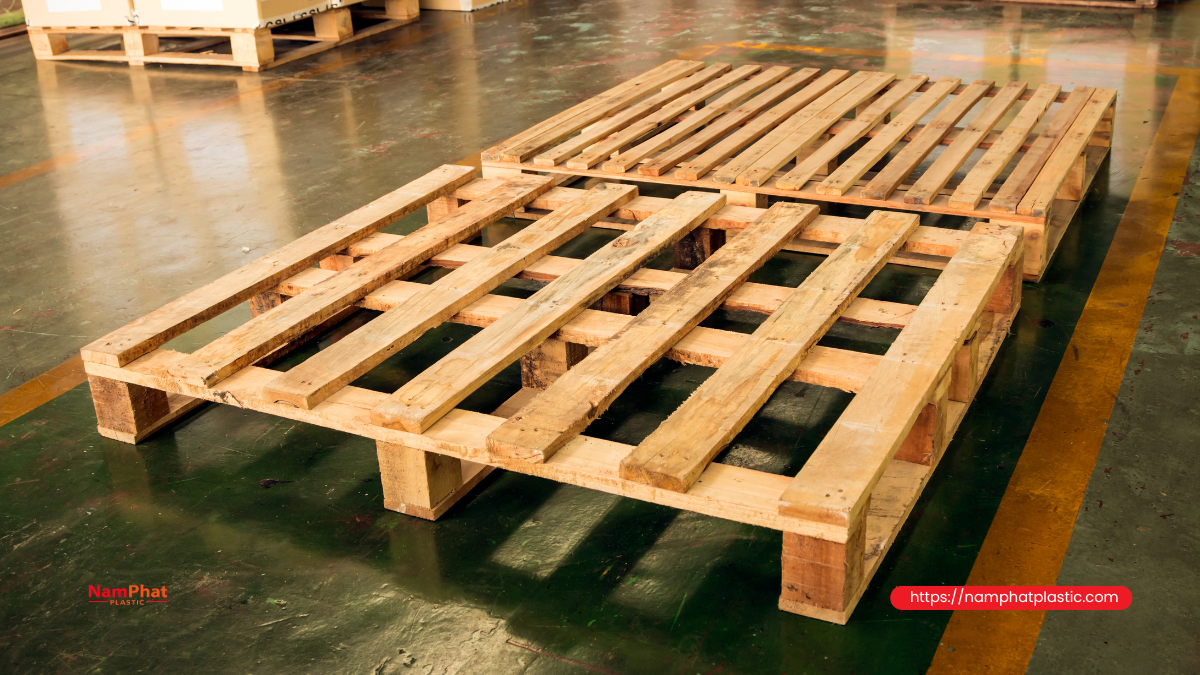
The pallet transfers the load of the entire stack to the floor. Therefore, pallet condition can directly affect spool shape.
A pallet with a bent, cracked, or protruding board can create uneven contact. If a spool is placed directly on that point, the force will be concentrated over a small area.
A support sheet used to increase the contact area can help improve this condition. However, the sheet must be sufficiently rigid to prevent excessive sagging under load.
Adding another layer of material does not automatically make the load safer. If the material is too soft, it may deform and create another pressure point.
Before stacking, warehouse personnel should quickly check:
-
Whether the pallet surface is flat.
-
Whether nails or sharp edges are protruding.
-
Whether pallet boards are cracked.
-
Whether the support sheet is bent or sagging.
-
Whether the pallet can support the total load.
If a pallet shows signs of deterioration, it should be replaced rather than reused for a valuable shipment.
5. Why can vibration during transportation cause thread layers to shift?
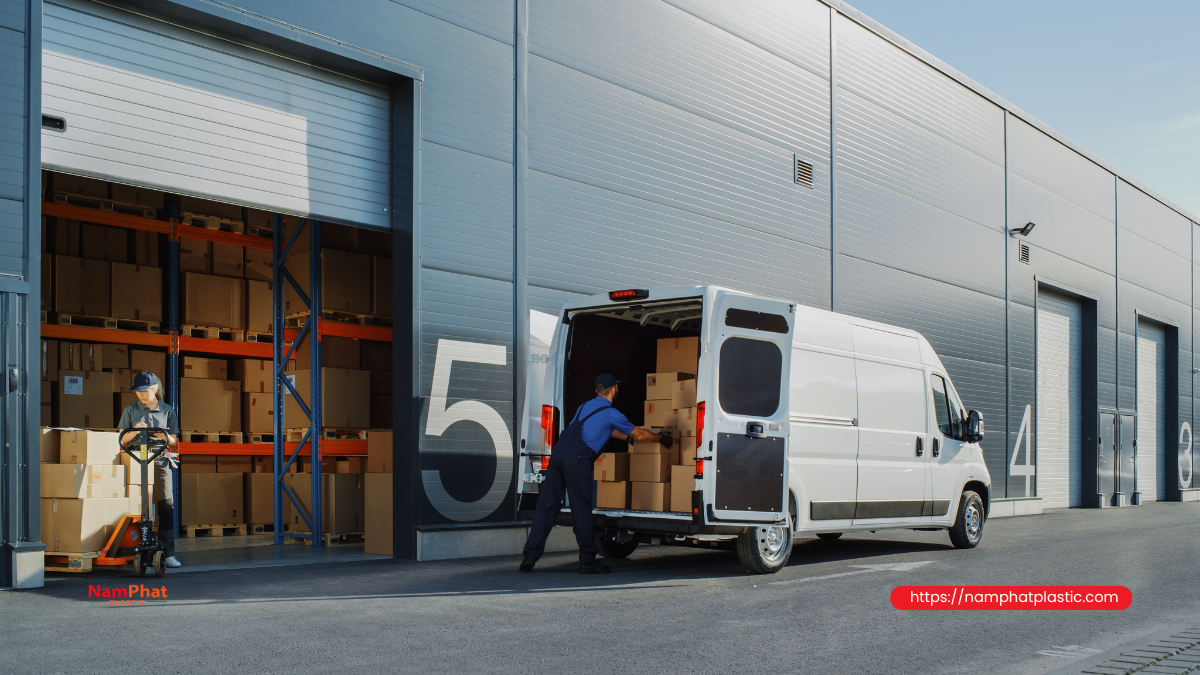
Vibration is a special type of stress because it does not necessarily cause immediate damage. A spool may withstand one mild vibration but not thousands of repeated vibrations.
When a vehicle travels over uneven roads, the pallet and spools move up and down and from side to side. If there are gaps between the spools, they may shift slightly with every vibration.
The outer thread loops can experience friction and relative sliding against one another. At first, the displacement may be very small and almost invisible. After a long journey, however, some loops may move away from the main spool body.
If the spool already has slight layer slippage, vibration can accelerate the problem.
Therefore, load securing is not only intended to prevent major impacts. It is also intended to minimize repeated movement throughout the journey.
6. How should thread spools be secured during transportation to limit movement?
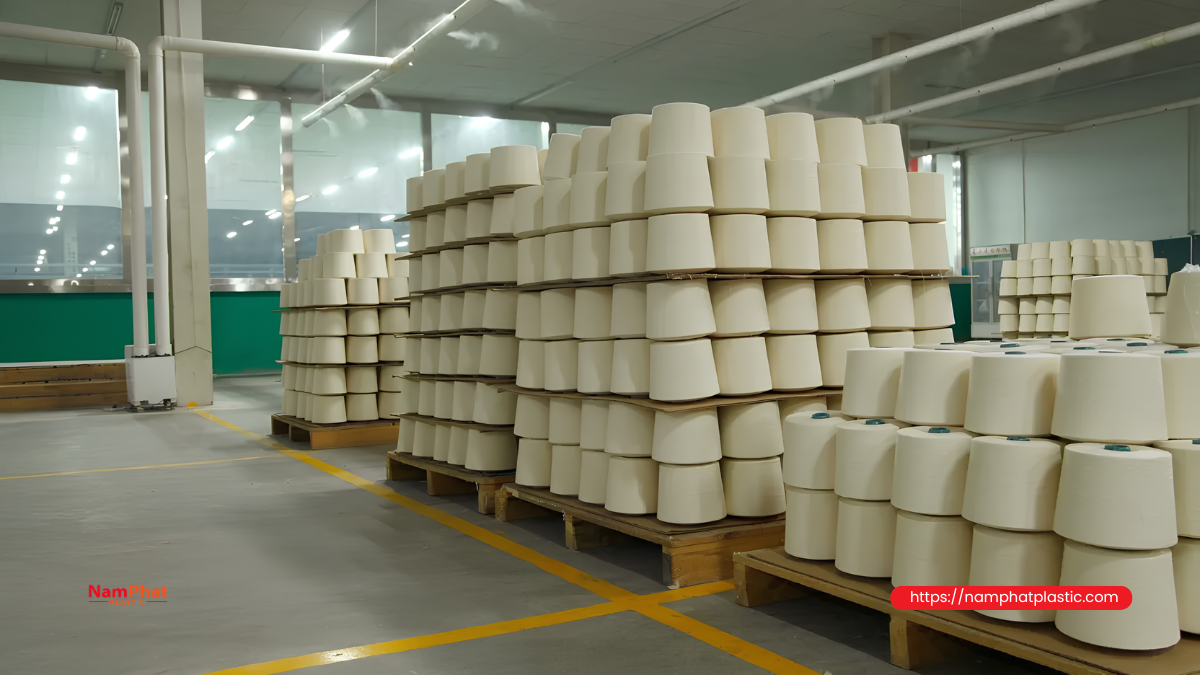
This is one of the most important stages after stacking. The load needs to be stable enough to prevent movement without excessive compression of the spools.
6.1. Straps should secure the load rather than directly compress the spool
Straps are intended to connect the products into a stable load. If a strap is placed directly over the thread and tightened excessively, the force becomes concentrated along the contact line.
Deep strap marks on the spool are often a sign that the strap is applying excessive force to a small area.
Protective materials or load-distribution bars can be used at strap contact points when the load structure permits. The goal is to increase the contact area and reduce localized pressure.
During post-transport inspection, if strap marks appear clearly on multiple spools at the same position, the strap tension and placement should be reviewed.
6.2. Stretch film should be tight enough to hold the load without compressing the spools
Stretch film is commonly used to keep spools together as one load. However, increasing the number of wraps does not provide unlimited additional safety.
If the film tension is too high, it can compress the outer layers. For spools with lower structural stiffness, this pressure may deform the edge or body.
When using stretch film, the focus should be on limiting movement between the spools and between the load and pallet. The film should not become a “compression shell” around each spool.
If the outer layers are visibly compressed after the film is removed, or uniform marks appear in the wrapping direction, the film tension should be reviewed.
6.3. Use protective materials at contact points
When straps or securing devices come into direct contact with the spool, an intermediate protective material should be considered if the force may become concentrated.
The material should be sufficiently rigid to distribute the force but must not have sharp edges. A protective pad that is too soft may become compressed and lose its effectiveness.
Size is also important. If the protective piece is too small, pressure will remain concentrated. If it is too large but poorly secured, it may shift during transportation.
Therefore, protective materials should be selected based on the actual contact position rather than simply because an extra cushioning layer is available.
6.4. Prevent lateral movement of the pallet
In many cases, the load is secured vertically but can still move sideways.
When the vehicle turns, lateral forces can cause the pallet to shift. If one side is not restrained, the entire load may tilt or strike the vehicle wall.
This is particularly important for spools with a high center of gravity.
The blocking method should stabilize the pallet without creating direct pressure on the spool edges.
6.5. Minimize gaps between loads
The larger the gap, the farther the load can move before hitting a restraint or another load.
A small movement repeated many times can cause vibration and impact.
If gaps cannot be eliminated, suitable blocking materials should be used to reduce movement. However, the blocking material must be positioned so that it does not create a direct pressure point on the spool.
6.6. Do not overtighten the restraints simply to make the load “secure”
A common mistake when preparing a load is to keep increasing strap tension when the load appears slightly loose.
This may reduce movement but simultaneously creates additional compressive loading on the spool.
The correct approach is to determine why the load is loose. The pallet may be poorly aligned, the gaps may be too large, the number of spools may be unsuitable, or the arrangement may not provide sufficient structural stability.
Changing the load structure is often more effective than simply increasing strap tension.
7. How should cushioning and blocking materials be selected and positioned?
Blocking materials play an important role in limiting movement, but they can also become an overlooked source of localized pressure.
A small wooden strip, pallet edge, or block with a sharp corner can create very high pressure over a narrow area. During vehicle vibration, the force at this point changes repeatedly and can cause the outer spool layer to become indented.
Blocking materials should have a sufficiently large contact surface and no sharp edges. If wood is used, check for splinters, cracked edges, or remaining nails.
If soft material is used, its compression resistance must be considered. A cushion that is too soft may collapse over time, allowing gaps to reappear.
Good blocking material should provide three things:
-
Reduced movement.
-
No excessively small pressure points.
-
Stable positioning throughout transportation.
Blocking materials should not be selected simply because they are readily available. For long-distance shipments, testing a blocking arrangement in advance can significantly reduce deformation rates.
8. How does a deformed spool core affect use?
The core is located inside the spool but directly affects its ability to rotate.
A round and stable core allows the spool to rotate relatively evenly around its axis. If the core is flattened on one side, the rotation axis may shift away from the spool's geometric center.
When mounted on a machine, this misalignment can cause the spool to oscillate. The higher the speed, the more noticeable the oscillation may become. Operators may notice changing thread pull force or spool vibration during unwinding.
Paper cores also need protection from excessive humidity and prolonged loading. As core strength decreases, the same load can cause greater deformation.
Plastic cores generally have better moisture resistance but still require consideration of stiffness and load-bearing capacity at different temperatures.
If the core shows signs of:
-
Flattening on one side.
-
Loss of roundness.
-
Cracking.
-
Deep compression marks.
-
Inability to fit properly onto the shaft.
-
Wobbling during rotation.
the spool should be segregated and inspected before being used in production.
9. What needs to be controlled when handling spools with a forklift?
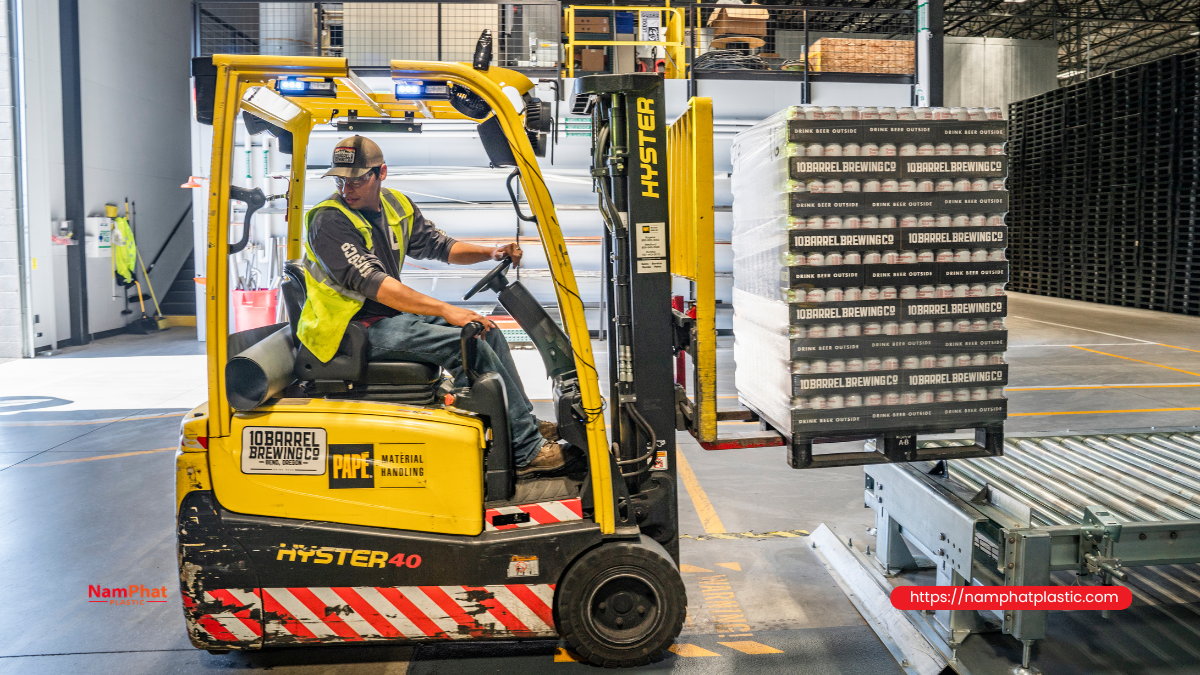
A spool can be stacked and secured perfectly but still be damaged within minutes during handling.
The forklift forks should enter the correct pallet position. The fork tips should not be used to push directly against the spools to adjust their position.
When lifting the pallet, make sure the load is properly distributed across both forks. If the pallet is misaligned or insufficiently rigid, lifting may cause it to flex and transfer uneven forces to the spools.
When lowering the load, the pallet should not be dropped from a height that causes a strong impact against the floor. Such an impact can affect both the core and thread layers simultaneously.
The pallet should also not be dragged into position. Friction between the pallet and floor can create jerky movement, causing the spools within the load to shift.
The areas most vulnerable to impact are the pallet edges, load corners, and outermost spools. After handling, these areas should be inspected before the load is moved into storage.
10. How should thread spools be inspected before dispatch?
Pre-dispatch inspection provides an important reference condition. Without knowing the initial condition, it is difficult for a company to determine whether deformation occurred in the warehouse or during transportation.
First, inspect the overall shape. The spool should retain relatively uniform roundness without deep localized indentations.
Next, inspect the edges. Flattened edges or protruding thread loops should be recorded.
Then inspect the core. This is particularly important when the spool will be used at high rotational speeds.
The outer thread layers should also be checked. If layer slippage or loosening has already occurred before dispatch, it should not be ignored because transportation vibration may cause the problem to develop more rapidly.
For large shipments, photographs should be taken of:
-
The condition of each pallet.
-
The stacking arrangement.
-
Straps.
-
Stretch film.
-
Any abnormal areas.
Pre-dispatch photographs are particularly useful when comparing the condition before and after delivery.
11. How should spools be inspected after transportation and how should deformed spools be handled?
This final inspection stage should be carried out carefully because not every dented spool needs to be discarded.
11.1. Inspect the external shape
Observe the spool's circular profile from multiple angles. A small indentation in the outer layer is very different from a deep deformation extending into the spool structure.
If possible, compare the spool with pre-dispatch photographs to determine when the deformation occurred.
11.2. Inspect the edge and outer thread layer
The edge is particularly vulnerable to impact and is also where layer loosening can begin.
Use gentle handling to check whether the outer loops remain stable. If several loops continue to shift with only a light pull, the spool should not immediately be run at high unwinding speed.
11.3. Inspect the core
Check its roundness and whether it can properly fit onto the shaft. If the core is deformed, inspecting only the outer layer is not enough to evaluate the spool.
A spool may appear almost normal but still produce significant wobbling during rotation if the core is misaligned.
11.4. Test unwinding at low speed
For a questionable spool, perform a low-speed unwinding test. Observe pull force, vibration, and layer stability.
If the spool operates normally, the deformation may not have a significant practical effect.
If the pull force changes sharply or the outer layers continue to shift, stop the test and segregate the spool.
11.5. Classify rather than treating all spools the same
Spools can be classified into groups:
-
Group A: Only the outer packaging is deformed; the spool structure remains stable.
-
Group B: The edge or outer layer is affected but the spool can undergo a controlled test.
-
Group C: Clear layer slippage, core deformation, or unstable rotation.
-
Group D: Multiple loops have come loose, the core is damaged, or the spool cannot be considered reliable for use.
Classification helps reduce unnecessary scrap while ensuring that high-risk spools are not sent directly into production.
12. Common mistakes when storing and transporting thread spools
One of the most common mistakes is stacking too high to save space. This increases compressive loading on the lower layers and may cause deformation over a long period.
Another mistake is reusing deteriorated pallets. A pallet may still support the total weight while its surface is no longer sufficiently flat to distribute the load.
Another common problem is overtightening the straps. Load handlers often want the shipment to be as secure as possible, but excessive compression can create marks and crush the outer layers.
Leaving large gaps is also undesirable. During transportation, the load may gain momentum and hit a restraint or the vehicle wall.
Conversely, excessively rigid blocking against the spool body can also create localized pressure.
Another mistake is failing to inspect the goods after transportation. If the spools are placed directly into the machine and unwinding problems occur, the company may incorrectly assume that the cause is thread quality or the machine.
Finally, failing to record conditions before and after transportation makes it difficult to identify the cause when a dispute occurs. Without photographs, pallet identification, or records of the initial condition, determining the source of deformation becomes much more difficult.
13. A practical process to minimize dents, deformation, and layer slippage
An effective control process should include multiple inspection points rather than relying only on a final inspection.
Before stacking
Inspect the spool, core, and edges. Spools that already show deformation should be separately identified.
During stacking
Control the number of layers, alignment, and pallet condition. Do not allow hard objects to create direct contact points.
After stacking
Check the stability of the entire load. If the stack is leaning or any spool is misaligned, correct it immediately.
During securing
Inspect straps, stretch film, and blocking materials. The goal is to limit movement rather than compress the spools.
During handling
Use the forklift at the correct pallet positions and avoid impacts, dragging, or excessive pallet drops.
After receiving
Compare photographs and inspect spools at load edges, outer layers, and other impact-prone positions.
Before production
Spools showing abnormalities should be tested at low unwinding speed before being introduced into the production line.
When the same procedure is followed across shifts, the company can more easily identify differences and determine which stage is causing the problem.
Frequently asked questions
1. Can thread spools be stacked directly on top of one another?
They can be if the spool structure, core, weight, and number of layers have been evaluated as suitable. A single fixed rule should not be applied to all spool types because load-bearing capacity can vary.
2. Is fewer stacking layers always safer?
Reducing the number of layers reduces compressive loading but does not completely eliminate deformation risks. Spools can still be damaged by uneven pallets, blocking materials, straps, or handling impacts.
3. Why can a spool look normal when dispatched but arrive dented?
The damage may have occurred during transportation or handling. Pre-dispatch and post-delivery photographs should be compared to identify when the deformation occurred.
4. Should straps be tightened as much as possible to prevent movement?
No. Straps should provide enough force to stabilize the load without applying excessive pressure to the spool body or edges. If the load is too loose, first investigate the arrangement and blocking method before increasing strap tension.
5. Does a deformed core affect thread unwinding?
It can. A deformed core can cause off-center rotation, vibration, and changes in pull force. This should be checked carefully for spools used on high-speed machines.
6. Should spools be rolled to move them around the warehouse?
This should not be done casually. Rolling can cause edge impacts or make the spool difficult to control. Suitable handling equipment should be used according to the spool and load structure.
Conclusion
A thread spool can be manufactured and wound to specification yet still develop problems if storage and transportation are not properly controlled. Deformation such as edge denting, body indentation, core deformation, layer slippage, or thread-loop loosening usually results from a combination of loading, vibration, impact, and securing methods.
-
During stacking, attention should be paid to the number of layers, center alignment, contact area, and pallet condition. Do not look only at the total weight while ignoring how the load is transferred to each spool.
-
During load preparation, straps and stretch film should be sufficient to limit movement without becoming sources of excessive pressure. Blocking materials should have suitable contact areas, no sharp edges, and good resistance to displacement.
-
During transportation, vibration should also be treated as a potential source of damage. A small force repeated many times can gradually shift the outer thread layers, especially when the spool already contains a weak point.
-
After receiving the goods, do not simply inspect the exterior and immediately place the spools into production. Spools showing abnormalities should be checked for edge condition, thread layers, core condition, and rotational stability. If necessary, they should be tested at low unwinding speed.
Most importantly, establish a continuous process covering production → pallet stacking → load preparation → storage → transportation → receiving → pre-production inspection. When every stage has defined inspection criteria, the company can identify causes more easily and reduce subjective troubleshooting.
A well-stored thread spool is not simply one that still looks good externally. A conforming spool should maintain a stable shape, have an undamaged core, keep its thread layers free from slippage or loosening, and unwind normally when installed on the machine.
That is the ultimate goal of controlling thread-spool stacking and transportation: reducing material loss, minimizing production problems, and maintaining stable quality from the warehouse to the production line.
>>> See also:
- 0 Comment


