


 Phan Van Hoang
- 06/08/2026
- 226
When selecting bag sewing thread, many businesses focus only on thread size, tensile strength, or the material type such as PE, PP, and polyester. However, the same type of thread may run smoothly on one machine but continuously tangle, slip off, or break on another simply because the spool specifications do not match the machine’s thread-feeding configuration.
Handheld bag sewing machines and stationary bag sewing machines operate under very different conditions. Handheld machines are frequently moved, vibrated, tilted, and have limited space for mounting the thread spool. Stationary machines, meanwhile, typically operate at high speed, use a separate thread stand, and need to run continuously for long periods.
Therefore, thread spools designed for these two machine groups differ in more than just weight. They may also differ in:
-
Core size.
-
Spool diameter and height.
-
Cone angle.
-
Spool hardness.
-
Thread unwinding direction.
-
Winding pattern.
-
Stability of the thread layers.
-
Resistance to loop slippage.
-
Thread weight per spool.
-
Position and quality of thread splices.
Understanding these factors helps reduce thread breakage, minimize tangling, stabilize thread tension, and improve bag-mouth sewing productivity.
1. Why should handheld and stationary machines not use the same thread spool specifications?
The difference starts with how the thread spool is held and how the thread leaves the spool.
Handheld bag sewing machines
On handheld machines, the thread spool is usually mounted directly on the machine body or on a small thread-holding spindle. When the operator works, the entire machine and spool move together.
The spool may be:
-
Vibrated while the motor is running.
-
Tilted according to the operator’s grip.
-
Jolted when the operator starts or stops sewing.
-
Exposed to contact with bags or surrounding equipment.
-
Subjected to continuously changing thread-feeding angles.
-
Subjected to acceleration when the machine is lifted or set down.
If the spool is too large, too heavy, or poorly wound, the thread pulling force can vary significantly. This can make the machine more prone to thread tangling, skipped stitches, or thread breakage when starting a seam.
Stationary bag sewing machines
Stationary machines are usually installed on conveyors or sewing tables. The thread spool can be placed on a separate stand behind or above the machine head.
Thread feeding is more stable because:
-
The spool does not move with the machine head.
-
Thread guides remain fixed.
-
Larger spools can be used.
-
The distance from the spool to the tension unit is longer and more stable.
-
The machine typically runs continuously at high speed.
Changing a spool during production can directly affect line productivity.
Therefore, stationary machines prioritize high-capacity spools with good uniformity and stable unwinding throughout operation.
2. Comparison table of thread spool specifications for handheld and stationary machines
| Criteria | Handheld bag sewing machine | Stationary bag sewing machine |
| Spool weight | Small to medium | Medium to large |
| Outer dimensions | Compact, without interfering with operation | Can be larger if the thread stand allows |
| Spool core | Must fit the spindle mounted directly on the machine | Must match the thread post or thread stand |
| Spool hardness | Moderate, not excessively loose | Can be wound more tightly but must unwind smoothly |
| Resistance to loop slippage | Very important | Important, especially at high speed |
| Thread unwinding direction | Suitable for short thread paths and changing angles | Usually end-unwound from a spool on a fixed stand |
| Thread capacity | Lightweight and easy to handle | Long operating time with fewer spool changes |
| Shape stability | Must withstand vibration and tilting | Must retain its shape during long operation |
| Splices | Should be minimized | Should also be minimized, especially on automated lines |
| Balance requirements | High because the spool is mounted directly on the machine | Less affected by machine-head movement |
These are general principles. Specific dimensions must still be confirmed according to the machine model, spindle length, and actual installation space.
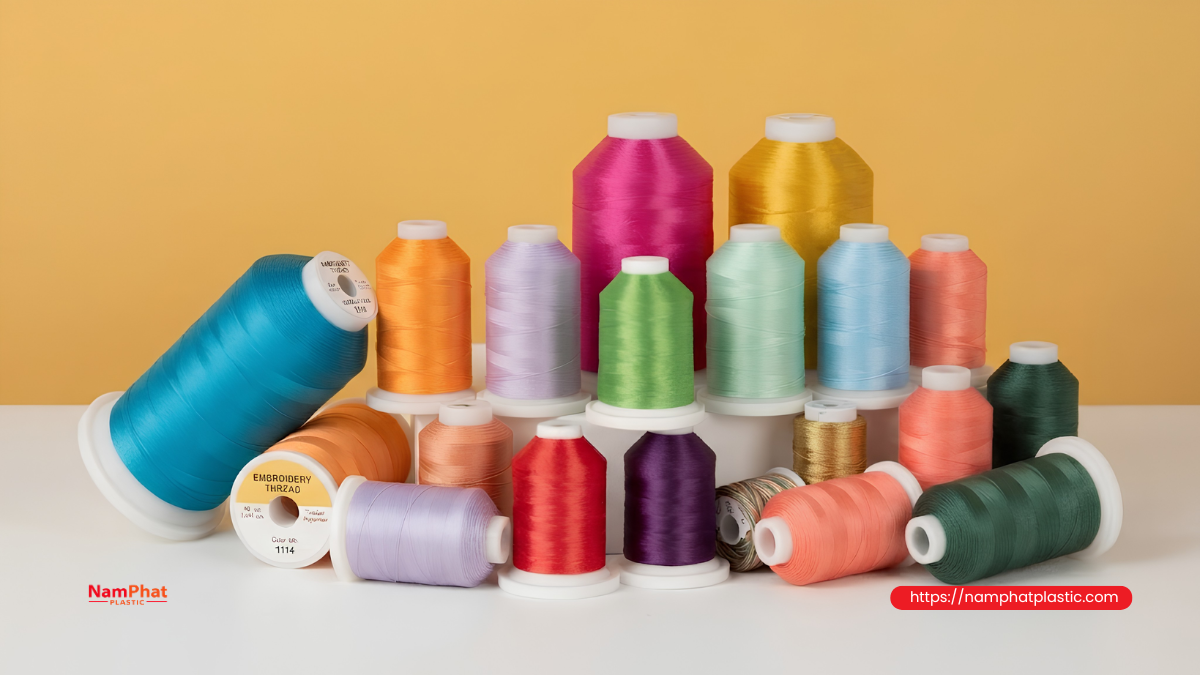
3. How does thread spool weight affect handheld machines?
Weight is one of the clearest differences between the two machine types.
3.1. An excessively heavy spool makes handheld machines harder to operate
When the thread spool is mounted directly on the machine, its entire weight is added to the equipment. A large spool can cause:
-
Faster operator fatigue.
-
Greater difficulty keeping the seam straight.
-
Machine imbalance.
-
Stronger spool vibration while the motor is running.
-
Higher load on the thread spindle.
-
Thread slipping from the outer layers when the machine is tilted.
-
Operators placing or dragging the machine incorrectly.
In particular, when the spool is full, its moment of inertia is greater than when it is nearly empty. The force required to pull thread from the spool can therefore change during use if the thread-feeding structure is unsuitable.
3.2. A spool that is too small is not necessarily optimal
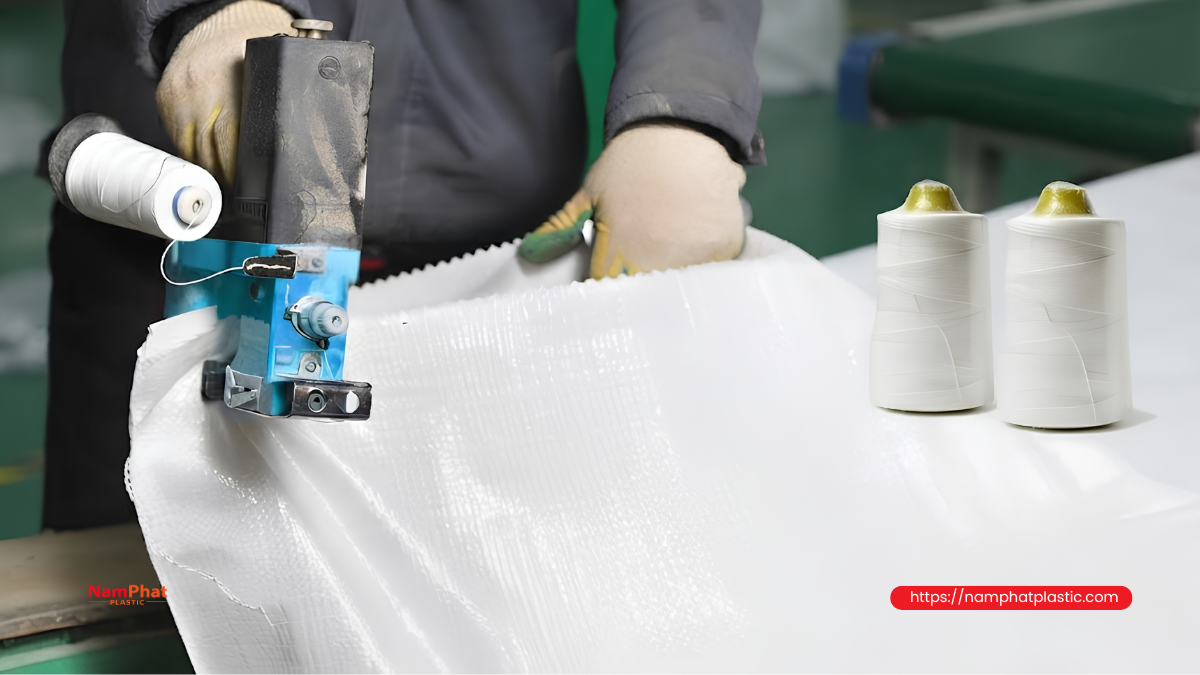
A small spool makes the machine lighter but requires more frequent spool changes. If each change takes significant time or the operator joins the thread incorrectly, total machine downtime may increase.
Therefore, a handheld-machine spool needs to balance three factors:
-
Light enough for convenient operation.
-
Enough thread to avoid excessively frequent changes.
-
Stable enough to prevent tangling when the machine vibrates and tilts.
Spool weight should not be selected solely based on habit or cost per spool. It should be tested directly on the machine with a full spool, half-full spool, and nearly empty spool.
4. How large a thread spool can a stationary machine use?
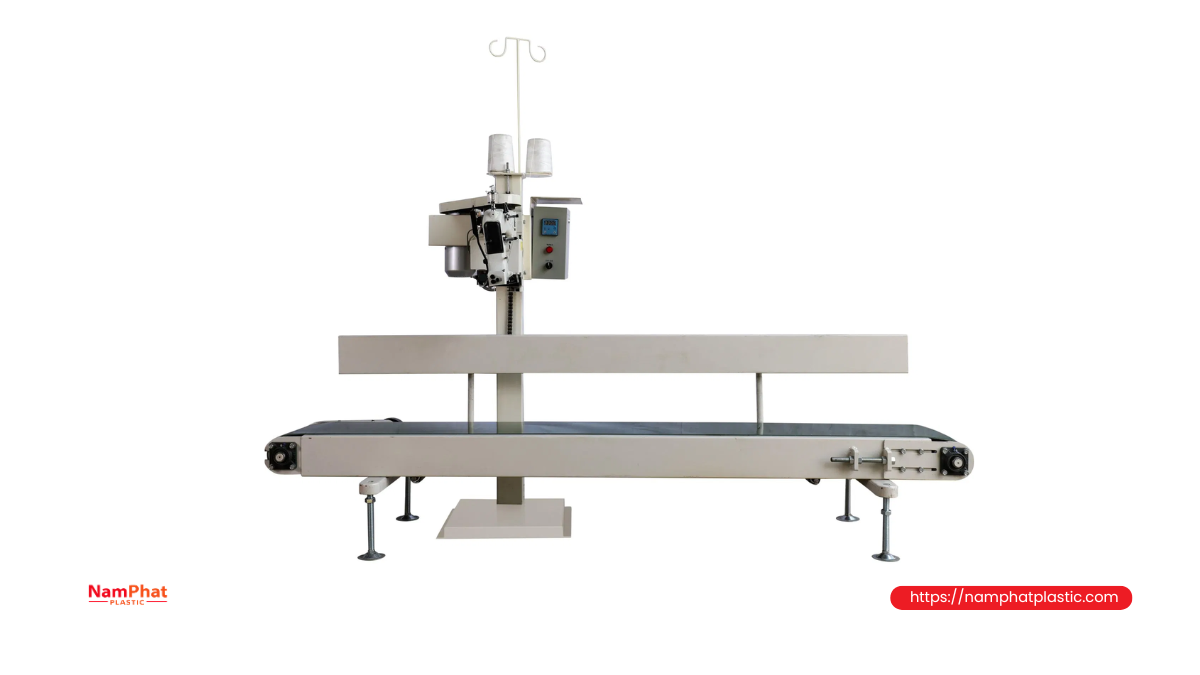
Stationary machines generally have the advantage of more space and a dedicated thread-stand system. Because the spool is not mounted directly on the machine head, businesses can use larger spools to extend continuous operating time.
However, a larger spool is not always better.
An excessively large spool can cause:
-
Significant changes in the unwinding angle from full to nearly empty.
-
Thread loops slipping toward the bottom of the spool.
-
Thread wrapping around the holding post.
-
Fluctuation in incoming thread tension.
-
Spool surfaces becoming compressed or deformed during storage.
-
Difficulty fitting the spool onto the existing thread stand.
-
Thread rubbing against the spool edge or machine frame.
When selecting a large spool for a stationary machine, check:
-
Distance between thread posts.
-
Maximum height of the thread stand.
-
Spool-base diameter.
-
Distance from the top of the spool to the first thread guide.
-
End-unwinding capability.
-
Machine thread consumption rate.
-
Desired operating time between spool changes.
The goal is not to use the largest possible spool, but to find a specification that allows the machine to run for the longest possible time while maintaining stable thread tension.
5. The spool core size must match the thread-holding mechanism
The spool core is often overlooked when ordering. Two spools with the same weight but different core diameters can behave completely differently.
For handheld machines
The core must match:
-
Thread spindle diameter.
-
Usable spindle length.
-
Spool stopper mechanism.
-
Depth of the thread holder.
-
Clearance from the machine housing.
-
Spool rotation or unwinding direction.
If the core hole is too large for the spindle, the spool may wobble laterally. When the machine vibrates, the spool can move against the spindle, causing unstable thread feeding.
If the core is too small, the spool may not fit or may become stuck. Forcing the spool onto the spindle can deform the core, crack a plastic core, or distort the spool base.
For stationary machines
Stationary machines often use thread stands and therefore may accommodate a wider range of core specifications. However, the core must still remain stable on the thread post.
For end-unwinding spools, the post mainly positions the spool. If the core is too wide or the spool is off-center, the thread may slide toward the bottom and wrap around the post.
When the spool must rotate to release thread, the fit between the core and spindle and the smoothness of rotation become more important. The mechanism must control spool inertia to prevent the spool from continuing to rotate after the machine stops.
6. How spool shape and cone angle affect thread unwinding
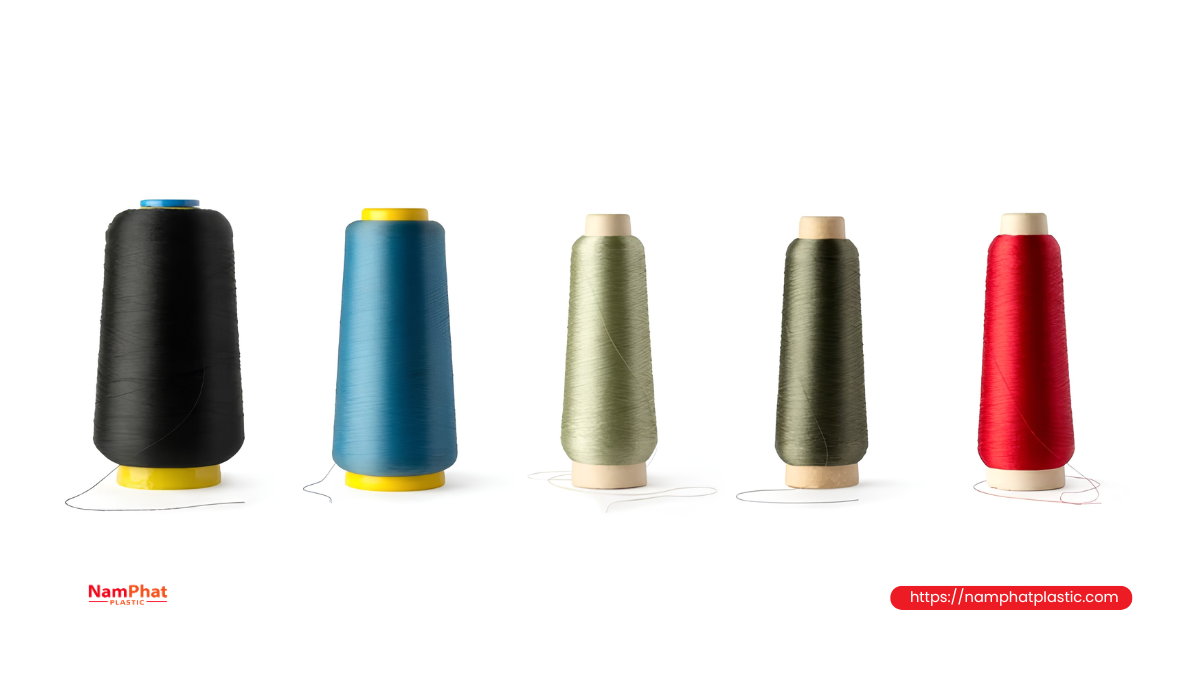
Bag sewing thread spools can be wound in cylindrical, lightly tapered, or strongly tapered forms. Each shape creates a different unwinding behavior.
Cone-shaped spools
Cone-shaped spools are often suitable for end unwinding. The cone angle helps the thread loops leave the spool in a controlled direction and reduces the risk of rubbing against the spool edge.
However, if the cone angle is too large or the winding pattern is unsuitable, the outer thread layers may slide toward the smaller end or the base of the spool.
Cylindrical spools
Cylindrical spools make efficient use of volume but may require a more suitable thread path and thread-guide position. During end unwinding, the thread may rub against the edge if the spool is too tall or the guide is misaligned.
Requirements for handheld machines
Spools for handheld machines should be compact and stable when tilted. The spool base must be firm, and the outer thread layers must not be excessively loose.
If the spool has a protruding shoulder or an uneven top, thread loops may catch when the operator changes the machine angle.
Requirements for stationary machines
Stationary machines can use taller and larger spools, but the distance between the top of the spool and the thread guide must be properly designed.
A guide positioned too low may pull the thread horizontally across the spool edge. A guide positioned too far off-center can cause uneven unwinding from different sides of the spool.
7. Is spool hardness the same for both machine types?
Spool hardness depends on winding tension, layer density, thread type, finishing lubricant, and core shape.
7.1. Spools that are too soft
A soft spool may show:
-
Deformation when lightly squeezed.
-
Compressed thread layers.
-
Thread sliding toward the bottom.
-
Loops entering the underlying layer.
-
Spool deformation when stacked.
-
Sudden changes in unwinding tension.
-
Thread becoming trapped between layers.
For handheld machines, soft spools are particularly prone to tangling because the machine frequently vibrates and tilts.
7.2. Spools that are too hard
An excessively hard spool can also cause problems:
-
Thread becomes compressed and loses its natural loft.
-
Finish/lubricant distribution becomes uneven.
-
Thread loops adhere too tightly to each other.
-
Initial unwinding force becomes high.
-
Thread is pulled in jerks.
-
Paper cores may deform under compression.
-
Thread may become flattened or develop surface fuzz at crossover points.
Stationary machines may use more tightly wound spools to maintain their shape during long operation, but the spool must still unwind smoothly at high speed.
Therefore, the correct requirement is not “the harder, the better,” but firm enough to retain its shape without locking the thread layers together.
8. How winding patterns directly affect thread tangling
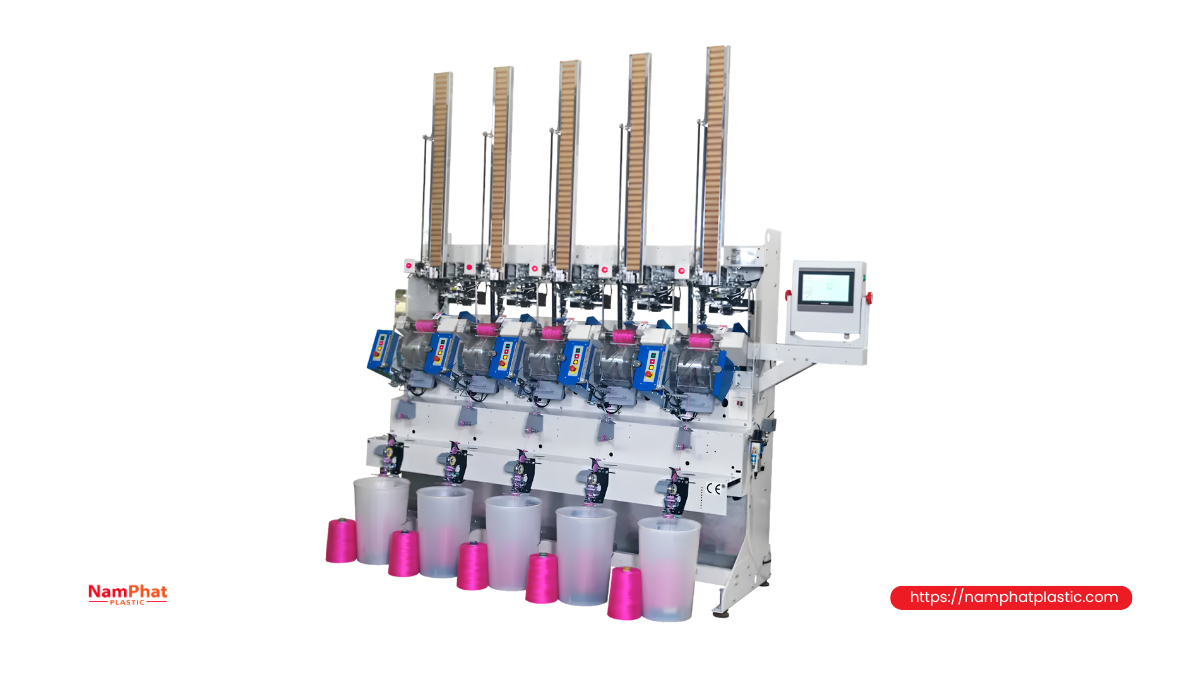
The winding pattern determines how thread loops intersect on the spool surface. A spool that looks good visually may not necessarily run well.
Common winding defects include:
-
Both ends of the spool being larger than the center.
-
One end being higher than the other.
-
Thread accumulating toward the base.
-
Deep grooves appearing on the surface.
-
Uneven outer-layer density.
-
Areas with excessive thread overlap.
-
Thread loops remaining parallel for too long and slipping together as a bundle.
-
Sharp spool edges without a smooth transition.
-
The spool being off-center relative to the core.
Handheld machines require resistance to loop slippage
Because the machine frequently changes position, the spool must keep its outer layers stable when tilted. If the outermost loops are too loose, multiple loops can fall off simultaneously and wrap around the thread spindle.
This problem is often mistaken for weak thread, while the actual cause is the spool structure.
Stationary machines require stable unwinding at high speed
On stationary machines, a small winding defect can repeat periodically. At high machine speeds, continuous tension fluctuations can cause:
-
Uneven stitch formation.
-
Seams that alternate between tight and loose.
-
Skipped stitches.
-
Needle heating.
-
Thread fuzzing.
-
Thread breakage at the tension unit or needle eye.
Spools for stationary machines must be uniform from the outer layer to the inner layer, not merely visually attractive when new.
9. Thread unwinding direction and thread path must be considered together
There are two common thread-feeding principles:
-
The spool remains stationary while the thread is pulled from the top.
-
The spool rotates around its spindle to release the thread.
A suitable spool cannot be selected without first determining which principle the machine uses.
9.1. End unwinding
This method is commonly suitable for cone-shaped spools on fixed thread stands. Because the spool does not need to rotate, it is less affected by inertia.
However, the thread forms a loop as it leaves the spool. If the spool is too large, too tall, or the thread guide is incorrectly positioned, the loop may:
-
Strike the spool surface.
-
Rub against the core edge.
-
Wrap around the thread post.
-
Pull several loops out at once.
-
Create fluctuating thread tension.
9.2. Spool rotation for thread release
When the spool must rotate, spool weight and spindle smoothness have a major effect.
A heavy spool requires greater force to start rotating. When the machine stops, the spool may continue rotating due to inertia, causing thread slack and tangling.
Handheld machines are generally unsuitable for excessively heavy rotating spools unless the thread-holding mechanism is specifically designed for them.
10. Reference specifications for handheld bag sewing machine thread spools
There is no single spool size suitable for every machine model. However, spools for handheld machines should follow these principles:
Moderate weight
Select a weight that does not unbalance the machine or cause operator fatigue during prolonged use. Businesses should test several weight levels rather than checking only one sample spool.
Height within the available protective space
A spool that is too tall may contact the handle, motor housing, or bag. During sewing, the bag may hit the spool and pull the thread loop out of position.
Secure core fit on the spindle
The spool must not wobble laterally or slide up and down. If the machine has a spool stopper, the core length must allow the stopper to function correctly.
Balanced spool
The spool center must align with the core center. An eccentric spool increases vibration and creates uneven spindle loading.
Stable outer layers
The outer thread layers must not slip when the spool is tilted. However, the thread end should not be secured so tightly that the thread becomes kinked or damaged.
Easy access to the thread end
The thread end should be clearly secured and easy to release without disturbing the outer layers. It should not be inserted too deeply into the spool.
11. Reference specifications for stationary bag sewing machine thread spools
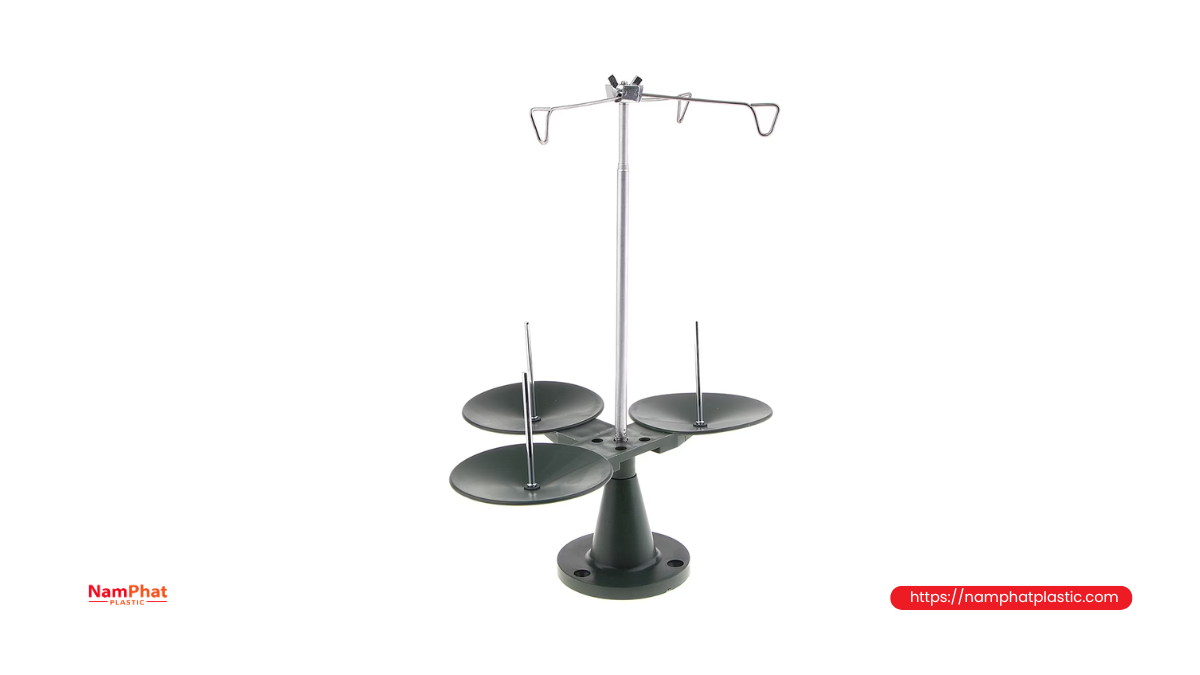
Spools for stationary machines should prioritize productivity and long-term operating stability.
Higher spool capacity
Large spools reduce the number of thread changes, especially on continuous bag-closing lines. However, their dimensions must match the thread stand and spacing between spools.
High uniformity
Spool diameter, height, cone angle, and winding density must remain consistent between production batches. Changes in specifications may require readjustment of thread guides and tension units.
High-speed unwinding capability
The spool must be tested at the actual operating speed. Pulling the thread by hand cannot fully simulate the dynamic forces generated during high-speed machine operation.
Few splices
A large splice may fail to pass through the thread guide, tension discs, or needle eye. On a stationary production line, one thread break can stop the entire conveyor.
A large spool with many splices is not necessarily more efficient than a smaller, splice-free and stable spool.
Shape stability during storage
Large spools are subjected to greater pressure when cartons or pallets are stacked. Packaging must protect the spools from compression, moisture, and oil contamination from other spools.
12. Can a stationary-machine spool be used on a handheld machine?
Technically, there are three possible cases.
Case 1: It cannot be installed
The spool is too tall, the core does not fit the spindle, or the outer diameter contacts the machine housing.
Case 2: It can be installed but does not run stably
This is the more problematic case because the operator may assume that the spool is suitable.
Signs include:
-
The machine becomes front-heavy.
-
The spool vibrates strongly.
-
Multiple thread loops slip off.
-
The seam becomes uneven.
-
Thread breaks when starting.
-
The spool contacts the housing.
-
Thread wraps around the spindle base.
Case 3: Using an external thread stand
Some operators place a large spool on a separate stand and guide the thread to the handheld machine. This can allow the use of a large spool but reduces mobility.
When the machine is moved far from the spool, the thread path changes and may catch on surrounding goods. This solution is suitable only when the handheld machine is actually used in a nearly fixed position.
13. Can a handheld-machine spool be used on a stationary machine?
In general, a small spool can still be used on a stationary machine if the core and unwinding direction are compatible. However, operating efficiency may be lower because:
-
Spools need to be changed more frequently.
-
The number of thread splices increases.
-
The risk of incorrect threading increases.
-
Operators must monitor the thread more frequently.
-
The machine may run out of thread in the middle of a seam.
-
Core and packaging waste increases.
-
Maintaining production-line efficiency becomes more difficult.
Therefore, small spools may be suitable for machine testing, short orders, or emergency backup, but are generally not optimal for continuous production.
14. Does thread size change the spool specifications?
Yes. At the same weight, PE 20/6, 20/8, and 20/9 thread have different lengths and packaging volumes.
Larger thread sizes generally cause:
-
Faster increases in spool diameter.
-
Fewer thread loops per layer.
-
A more uneven spool surface.
-
Different pressure at crossover points.
-
Changes in unwinding force.
-
The spool reaching its dimensional limit before reaching the desired weight.
Therefore, the winding specifications for PE 20/6 should not simply be copied unchanged for PE 20/9.
The manufacturer should adjust:
-
Winding traverse width.
-
Thread laying pitch.
-
Winding speed.
-
Winding tension.
-
Cone angle.
-
Target weight.
-
Core size.
-
Thread-end securing method.
Similarly, PP multifilament 900D, 1000D, and 1200D have different surface characteristics and stiffness compared with spun PE thread. Spool specifications should be tested separately rather than converted by weight alone.
15. Signs that the thread spool specifications are unsuitable for the machine
Businesses should review the spool specifications when one or more of the following conditions occur:
Thread slips off in multiple loops
This is commonly associated with a spool that is too soft, loose outer layers, an unsuitable cone angle, or excessive spool tilting.
Thread wraps around the spool base
Possible causes include a thread guide positioned too low, a core that is too wide for the post, or thread loops sliding toward the base.
Thread jerks periodically
Check for uneven winding, a deformed spool, surface grooves, or thread layers locking together.
The machine runs well when the spool is full but develops problems when nearly empty
The unwinding angle and spool diameter change, which can increase thread tension. The core edge may also rub against the thread when the thread layer becomes low.
The handheld machine vibrates more after installing a new spool
The spool may be too heavy, eccentric, or have an unsuitable core.
Thread breaks immediately when sewing starts
In addition to the tension unit and needle, check spool inertia, locked thread layers, and whether the thread is catching at the secured thread end.
The spool becomes deformed after transportation
Possible causes include low spool hardness, a weak core, excessive carton pressure, or unsuitable pallet stacking.
16. Procedure for testing a new thread spool on a handheld machine
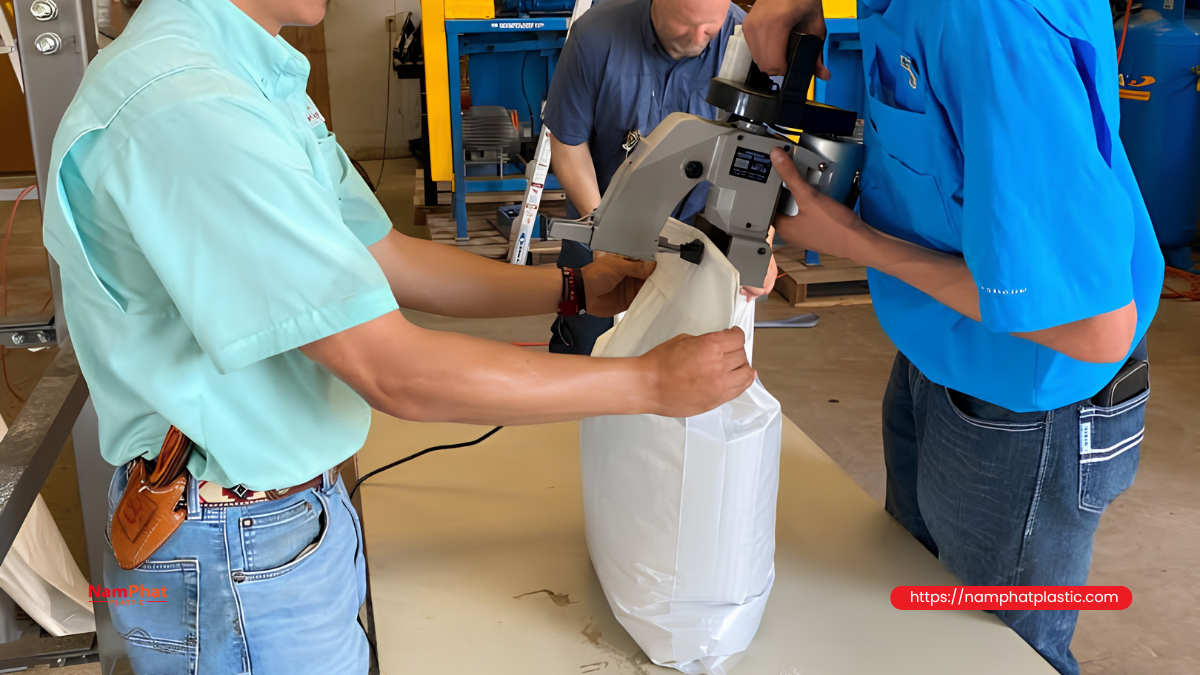
A thread spool should not be evaluated by sewing only one or two bags.
A basic testing procedure can include:
Step 1: Check installation
Confirm that:
-
The core fits the spindle.
-
The spool does not contact the machine housing.
-
The spool stopper operates correctly.
-
The spool does not wobble laterally.
-
The thread end is easy to access.
Step 2: Check the machine at different angles
Hold the machine upright, tilt it slightly to both sides, and simulate actual operation. Observe whether the outer thread loops slip.
Step 3: Sew continuously
Do not test only with the machine running unloaded. Sew actual bags with the required number of bag-mouth layers.
Step 4: Check three spool conditions
-
Full spool.
-
Approximately half-full spool.
-
Nearly empty spool.
Some problems appear only after the spool diameter decreases.
Step 5: Evaluate the operator
The operator should provide feedback on:
-
Machine weight.
-
Balance.
-
Hand fatigue.
-
Frequency of thread tangling.
-
Spool replacement.
-
Operating time per spool.
17. Procedure for testing a new thread spool on a stationary machine
For stationary machines, testing should focus on continuous operation.
Check the thread stand
Make sure the spool does not contact adjacent spools, the machine frame, or thread guides.
Run at actual production speed
Do not test only at low speed. Many unwinding problems appear only when thread consumption increases at high speed.
Monitor thread tension
Observe seam consistency, the sound of the thread passing through the tension unit, and any vibration of the thread loop above the spool.
Record machine stoppages
Classify them clearly:
-
Thread breakage.
-
Thread tangling.
-
Thread exhaustion.
-
Splice catching.
-
Spool deformation.
-
Loop slippage.
-
Thread catching on the core.
Evaluate the entire spool
A spool should be considered acceptable only when it runs stably from beginning to end, not merely during the first few minutes.
18. Information to provide when ordering thread spools from the manufacturer
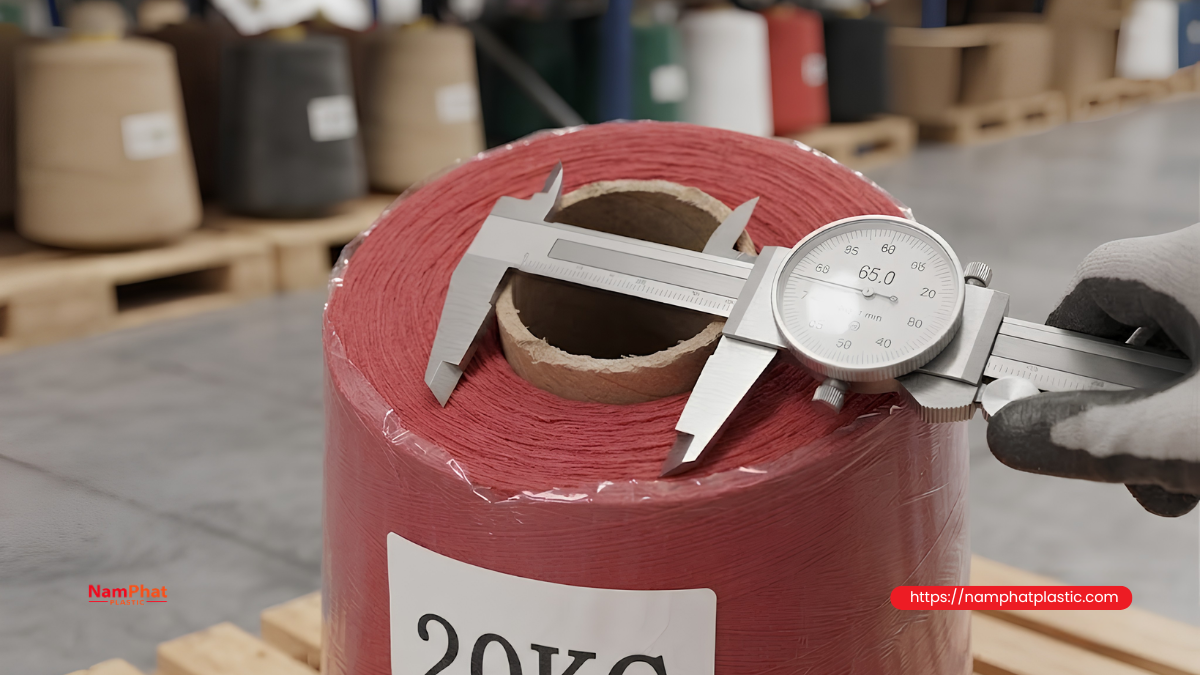
To avoid receiving the correct thread type with the wrong spool specifications, customers should provide:
-
Handheld or stationary machine.
-
Machine brand and model.
-
Photos of the spool mounting position.
-
Thread spindle diameter.
-
Usable spindle length.
-
Dimensions of the spool currently running successfully.
-
Thread type and specification.
-
Desired weight per spool.
-
Thread unwinding direction.
-
Operating speed.
-
Operating hours per shift.
-
Problems currently experienced with the existing spool.
If complete machine specifications are unavailable, a sample spool that currently runs well can be provided so the manufacturer can measure it and develop an equivalent specification.
19. Quality control criteria for thread spools before shipment
Bag sewing thread manufacturers should control at least the following factors:
-
Net weight.
-
Spool height.
-
Maximum diameter.
-
Inner core diameter.
-
Core length.
-
Cone angle.
-
Eccentricity.
-
Relative hardness.
-
Shape of both spool ends.
-
Unwinding performance.
-
Number of splices.
-
Thread-end position.
-
Surface lubricant condition.
-
Core and spool cleanliness.
-
Shape retention after packaging.
For customers using handheld and stationary machines simultaneously, the two spool specifications should be assigned separate product codes. It is not advisable to use only a general product name such as “PE 20/9 thread,” because warehouse operators may issue the wrong spool to each production area.
For example, a business could distinguish:
-
PE 20/9 – small spool – handheld machine.
-
PE 20/9 – large spool – stationary machine.
-
PP 1000D – cone core – external thread stand.
-
PP 1000D – cylindrical core – dedicated machine.
20. Should one spool specification be standardized for the entire factory?
Standardization helps reduce the number of product codes, simplify inventory, and make purchasing easier. However, one common specification should only be used after confirming that it performs well on all machines.
A common spool specification must simultaneously:
-
Fit the handheld machine.
-
Not make the machine excessively heavy.
-
Run stably on the stationary machine.
-
Avoid excessively frequent spool changes.
-
Be compatible with different thread stands.
-
Have a suitable unwinding direction.
-
Not increase the rate of thread breakage or tangling.
In many cases, using two separate spool specifications is more practical:
-
Compact, lightweight spools for handheld machines.
-
High-capacity spools for stationary machines.
The cost of managing one additional spool code may be significantly lower than the cost of machine downtime, reduced productivity, and increased waste caused by unsuitable spool specifications.
Frequently Asked Questions
1. Can a handheld machine use a 1 kg thread spool?
This depends on the machine design, thread spindle, and operating method. If the spool is mounted directly on the machine head, excessive weight can cause imbalance, vibration, and operator fatigue. The machine manual should be checked and the spool should be tested under actual operating conditions.
2. Must a stationary machine use a cone-shaped spool?
Not necessarily in every case. The spool shape must match the thread-feeding mechanism. If the machine uses end unwinding, a cone-shaped spool is often advantageous, but a cylindrical spool may also work if the thread guide and winding pattern are suitable.
3. Why does the same type of thread break more easily after changing the spool?
The cause may be spool hardness, winding tension, cone angle, eccentricity, splices, or the way the thread layers unwind. Thread quality is not the only factor determining machine performance.
4. Does tighter winding always mean less tangling?
No. A spool that is too soft may suffer from loop slippage, while a spool that is too tightly wound may cause the layers to lock together and create jerking. A good spool should retain its shape while still allowing smooth unwinding.
5. Should a thread spool be evaluated by weight or length?
Both are important. Weight is convenient for inventory management, while length directly relates to the number of bags that can be sewn. However, actual performance also depends on thread size, stitch length, number of thread lines, and waste rate.
6. Should thread ends be joined to keep the machine running continuously?
Thread splices can catch at thread guides, tension discs, or the needle eye. For high-speed production lines, it is preferable to use spools with fewer splices and control splice dimensions rather than relying on continuous spool joining.
Conclusion
Handheld and stationary bag sewing machines have different thread-feeding conditions, so thread spools cannot be selected based solely on thread type or weight.
Handheld machines require compact, lightweight, balanced spools with a suitable core and stable thread layers when the machine vibrates or tilts. Stationary machines can use larger spools but require high uniformity, stable unwinding, and few splices to maintain continuous production.
When developing thread spool specifications, the following factors should be considered together:
-
Machine configuration.
-
Spool-holding mechanism.
-
Thread unwinding direction.
-
Spool weight.
-
Core size.
-
Spool shape.
-
Hardness.
-
Winding pattern.
-
Thread size.
-
Operating speed.
A suitable thread spool should not merely allow the machine to “sew.” It should allow stable operation from the beginning to the end of the spool, reduce operator intervention, and minimize unplanned machine stoppages.
>>> See also:
- 0 Comment


