


 Phan Van Hoang
- 20/10/2026
- 8
A PE bag production line that starts with resin pellets has two main parts: producing film by blown-film extrusion and converting film rolls into bags by cutting, sealing, folding or punching handles. Printing presses, slitting and rewinding equipment, and recycling systems are added according to the product. A blown-film machine alone is not a complete bag production line.
Whether the product is a soft LDPE/LLDPE bag, a thin HDPE bag, a garbage bag on a roll or an industrial packaging bag, the first question is not “How many kilograms per hour can the machine run?” but “What type of bag is required, and what criteria must it meet?” This article helps production, engineering and purchasing teams define the configuration, quality-control points and acceptance-test conditions.
Table of Contents [Hide]
1. Finalize the bag specification before choosing machinery
A technical specification should state the bag width, length, single-wall thickness, tolerances, bottom style, opening, printing requirements and packing format. Gusseted bags need a drawing showing how the gusset is measured; bags on rolls need a specified bag count per roll, roll diameter and core or coreless format.
Do not overlook the conditions of use: dry or damp contents, load, sharp edges, packing operations and storage time. Bags of the same dimensions may still require different materials and seal designs. The custom PE bags page is useful for defining finished-product specifications before discussing the technology in detail.
How do LDPE, LLDPE and HDPE affect the production line?
- LDPE: often selected when a soft film and good processability are needed. Its melt strength helps stabilize the film bubble; clarity still depends on the resin grade, additives and cooling.
- LLDPE: used to meet toughness or puncture-resistance requirements, or to reduce thickness after validation through testing. Blending LDPE and LLDPE helps balance performance and processability; there is no universal blend ratio for every bag.
- HDPE: suitable for many thin-film applications requiring stiffness. The die, cooling and bubble-guidance configuration must suit HDPE blown-film processing, rather than simply changing the resin while retaining LDPE settings.
Select the appropriate film-grade resin and review its melt index, density and additive package. LyondellBasell also categorizes blown-film materials by end use and monolayer or coextruded structure. See also the guide to choosing LDPE and LLDPE for pallet covers.
2. Process flow from resin pellets to finished bags
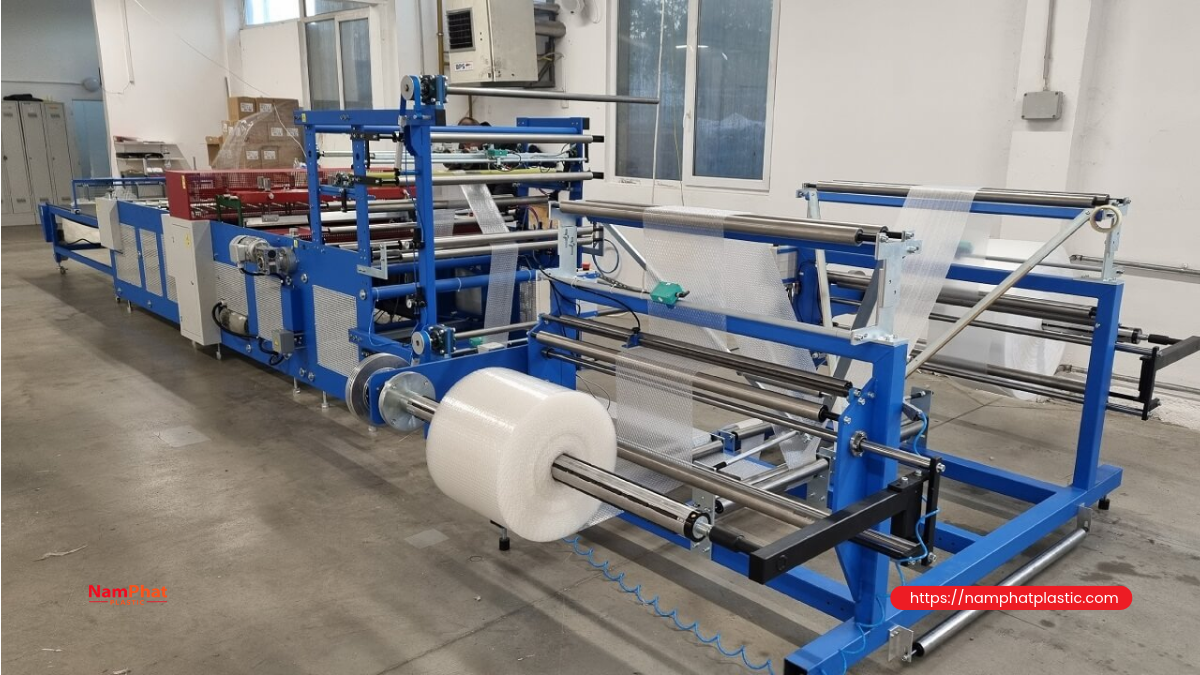
Inspect resin → dose and blend → melt-extrude → inflate and cool the bubble → haul off and flatten → treat the surface if required → wind → print/fold/slit according to the configuration → seal, cut or perforate → count and pack → final inspection before dispatch.
The order of some operations can vary. Gusseting may be integrated into the blown-film tower or carried out during converting; printing can be inline or on a separate press. A business that purchases film rolls may invest only in bag-making equipment, but must control the quality of incoming rolls.
How does blown-film extrusion differ from cast-film extrusion?
Blown-film extrusion forces resin through an annular die to form a tube, which is then inflated into a bubble. After cooling and flattening, the tubular film is well suited to bottom-sealed bags. Cast-film extrusion uses a slot die and chill-roll assembly to produce a flat web; making bags from it requires an appropriate folding and sealing arrangement.
Both technologies can produce PE film, but changing the die alone does not make them interchangeable. Compare the output film format, mechanical-property requirements and converting steps. Do not select a cast-film line simply because its catalogue lists a higher speed.
3. Equipment list: what is essential and what is optional?
| Equipment group | Function | Selection criteria |
|---|---|---|
| Feeding, weighing and blending | Feed the correct amounts of resin, colorant and additives into the extruder | Number of components, feed stability and cleaning during color changes; gravimetric dosing is an upgrade option |
| Extruder, filtration and annular die | Melt, homogenize and distribute resin into a tube | Resin grade, permissible pressure, target width and thickness, and raw-material quality |
| Air ring, tower and haul-off assembly | Cool and stabilize the bubble, haul off and flatten the film | Factory ceiling height, width stability and film uniformity |
| Winding and web guiding | Produce rolls suitable for downstream processing | Width, core, roll diameter and weight, and tension control |
| Corona treatment and printing press | Prepare the surface and print information | Required only when the product calls for them; check film–ink compatibility |
| Folding, slitting/rewinding, sealing and cutting | Create the bag style, dimensions and seals | Bottom or side sealing, gussets, handles, perforations, and roll or individual-bag format |
| Utilities, QC and scrap recovery | Provide power, cooling, compressed air, testing and scrap management | Size for the actual configuration; an on-site recycling machine is not mandatory |
Feeding and blending
A basic system needs scales, blending equipment and a stable resin-feeding arrangement. Vacuum loaders reduce manual handling; gravimetric dosing helps manage blend ratios and batch traceability. Maguire’s film-extrusion dosing solutions show how feeding, extrusion control and scrap management can be integrated.
PE does not automatically require drying in the same way as highly hygroscopic resins. However, surface water on recycled pellets, condensation or poorly stored material must still be addressed according to the material supplier’s guidance. Distinguish the removal of surface moisture from the drying requirements of a particular formulation.
Extruder, filter and die
The screw and barrel must accommodate the intended range of materials. The filter retains solid contaminants; pressure upstream of the filter is an important monitoring point, especially when using recycled resin. Finer filtration is not always better if it raises pressure beyond the equipment’s capacity.
The die distributes the melt around its circumference. Thermal stability, cleanliness and mechanical condition affect streaking and thick or thin areas in the film. When ordering machinery, request trials using the intended resin grade, width and thickness instead of only watching the machine run with the easiest material to process.
Cooling, haul-off tower and winding
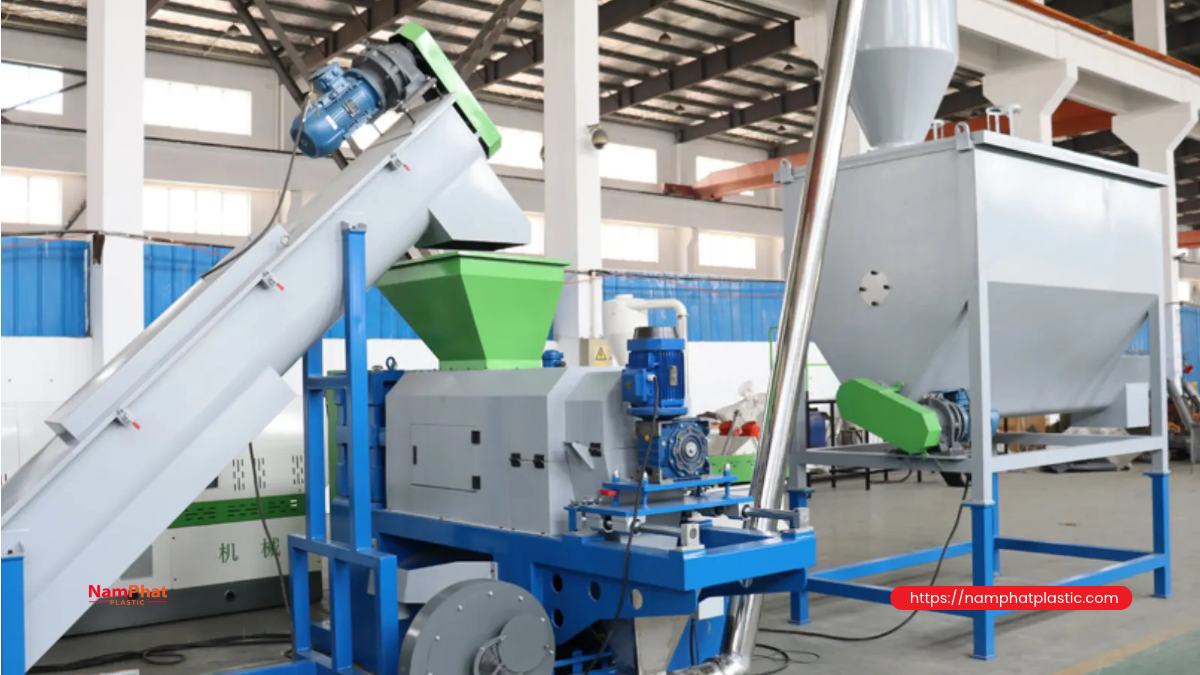
The air ring cools the outside of the bubble; internal bubble cooling, when fitted, provides additional heat-transfer capacity. The stabilizing cage, collapsing frame and haul-off rolls must work together to limit bubble movement, wrinkles and width variation.
A good roll is not simply a tightly wound roll. Excessive tension can cause deformation; insufficient tension can allow layers to slip. Trial the rolls on the actual printing press or bag-making machine. Automatic thickness control, an oscillating haul-off and automatic roll changes are upgrade options, not immediate requirements for every factory.
4. Monolayer film or ABA/ABC coextrusion?
Monolayer film can contain several blended resins. Coextrusion produces separate layers within the same film: ABA generally uses the same material for the two outer layers and a different stream for the middle layer; ABC allows three different layers to be managed. The number of layers does not equal the number of extruders in every configuration.
Coextrusion is useful when surface functions, colors or ingredients need to be allocated by layer. However, investment, cleaning for color changes and layer-ratio control become more complex. POLYSTAR’s ABA blown-film machine and W&H’s VAREX II illustrate the variety of configurations. Do not assume that every garbage bag requires ABA or that more layers always mean greater strength.
5. Choose bag-making equipment for the finished product
Flat-mouth bags, bottom-sealed bags and packaging bags
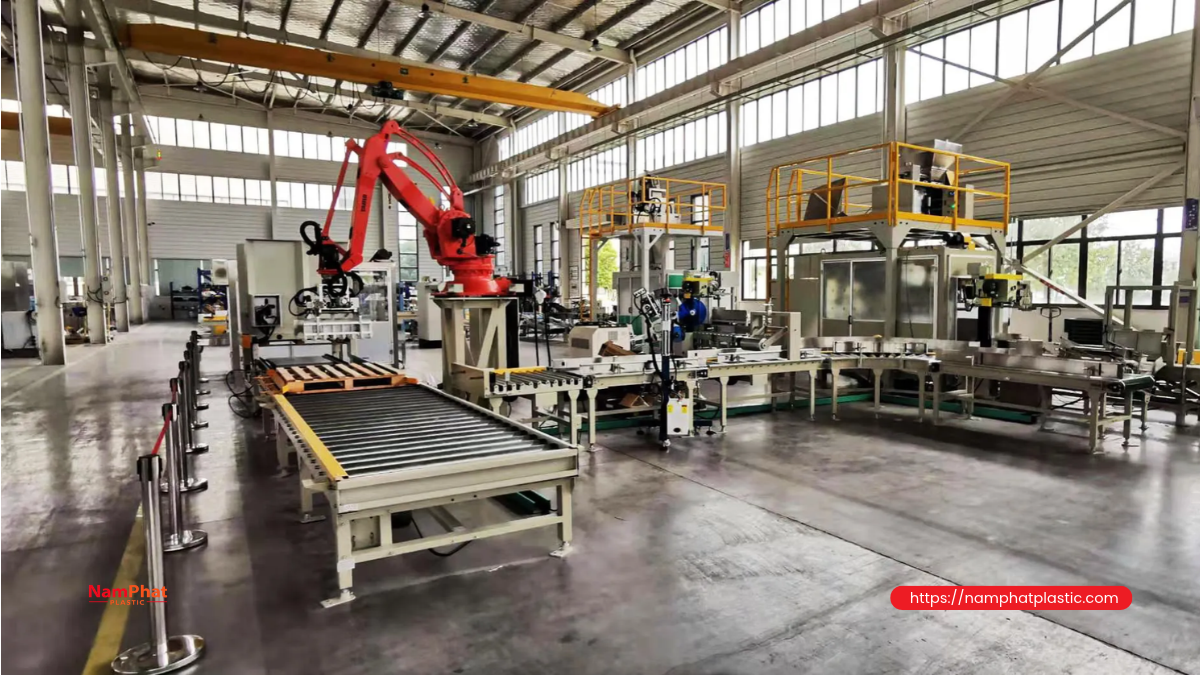
With tubular film, a bottom-seal machine creates a transverse seal and cuts to the required length. Folded film may use a side-seal configuration. Printed bags require a registration-mark sensor and suitable web-feed control to prevent the cut position from drifting from cycle to cycle.
Check the usable width, bag length, total thickness at the sealing area, and the ability to process both unprinted and printed film. Large bags such as PE pallet covers also require suitable draw length, folding and stacking arrangements.
Star-sealed garbage bags, bags on rolls and perforations
Star-sealed bags require the appropriate film-folding and sealing method; the bottom shape alone does not guarantee leak resistance. Garbage bags on rolls need perforating, counting and rewinding units, with or without a core. The distance between the perforation and the seal must remain consistent so that a bag can be torn off without damaging the bottom of the next bag.
Hemingstone’s bag-on-roll machinery range distinguishes star-seal, bottom-seal, gusseting and perforating configurations. Trials should evaluate leak integrity, tear-off force and roll consistency; counting bags per minute alone is not enough.
Carrier bags and drawstring bags
Die-cut handle bags need a punching unit and scrap collection; T-shirt bags require the corresponding cutting die. Drawstring bags need additional steps for folding the mouth, inserting the drawstring, sealing and creating drawstring access openings. These should not be treated as accessories that can be fitted to any sealing-and-cutting machine.
6. When are corona treatment, printing and slitting/rewinding needed?
PE film has low surface energy, so ink adhesion requires appropriate treatment and verification. Corona treatment is a common option for printable film. Vetaphone notes that treatment effectiveness decreases over time and is affected by additives and storage; check it before printing, not only immediately after film extrusion.
Choose a flexographic press or another printing technology according to image quality, color count, web width and production volume. Slitting and rewinding are needed only when changing the width, separating multiple lanes or preparing rolls for downstream machinery. Align the printing side, unwind direction, registration-mark position and tension requirements across process stages.
7. Quality control and troubleshooting
Set acceptance criteria from the outset: single-wall thickness and variation, dimensions, bag weight, appearance, film strength, seal strength, leak integrity and usability. Sample over time and at several positions across the width; one sample from the center of a roll does not represent the entire batch.
Tests may include machine-direction and transverse-direction tensile testing, falling-dart impact, propagation tear, load testing and leak testing appropriate to the product. ASTM lists D882 for tensile testing, D1709 for falling-dart impact and D1922 for propagation tear in its plastics film-testing literature. Agree on the method edition, sample conditions and acceptance limits; citing a standard does not by itself establish a pass threshold.
| Symptom | Potential causes to investigate | How to narrow down the cause |
|---|---|---|
| Uneven film thickness, unstable bubble | Feeding, die, cooling air and haul-off force | Compare thickness profiles with pressure, speed and changes in ambient conditions |
| Gels, black specks, pinholes | Contamination, excessive resin residence time, poor dispersion | Check the raw-material batch, filter pressure and cleaning history |
| Bag mouths difficult to open, blocking in rolls | Cooling, winding force, antiblock additives | Compare samples after storage; check temperature and winding conditions |
| Weak bottom seals or burnt edges | Sealing temperature, dwell time, pressure and folds | Test flat and multilayer areas separately; inspect the sealing bar |
| Bags tear when separated from the roll | Perforations, seal position and tension | Measure the spacing and test several consecutive tear-offs |
| Ink peeling or print misregistration | Surface, ink, drying and web guiding | Check ink adhesion and print registration at each stage |
Change each group of factors in a controlled manner and record the results. Do not keep increasing temperature to solve every sealing defect: the issue may be thickness, folds or contamination on the sealing surface. Settings must suit the resin grade, machine design and validated trial samples.
8. Power, cooling, compressed air and safety
Prepare an electrical-load list for extruders, heaters, fans, printing presses, bag-making machines and auxiliaries. Installed power is not the same as actual energy consumption. Have a qualified design provider check the supply, grounding, electrical protection and starting loads.
Select recirculating water or a chiller according to heat load and ambient conditions; not every line uses the same cooling arrangement. The compressor must meet the flow, pressure and air-quality requirements of the pneumatic equipment. Plan roll-transport routes, tower working platforms and raw-material areas in the initial layout.
Main hazards include hot surfaces, pressurized molten plastic, roller nip points, cutting blades, high-voltage corona equipment and work at height. Provide guards, interlocks, energy isolation during maintenance, local exhaust ventilation and fire controls for solvent-based printing. Refer to HSE’s plastics-machinery safety guidance; its application must suit the requirements at the operating location.
9. Recycled resin and scrap recovery: assess the end use
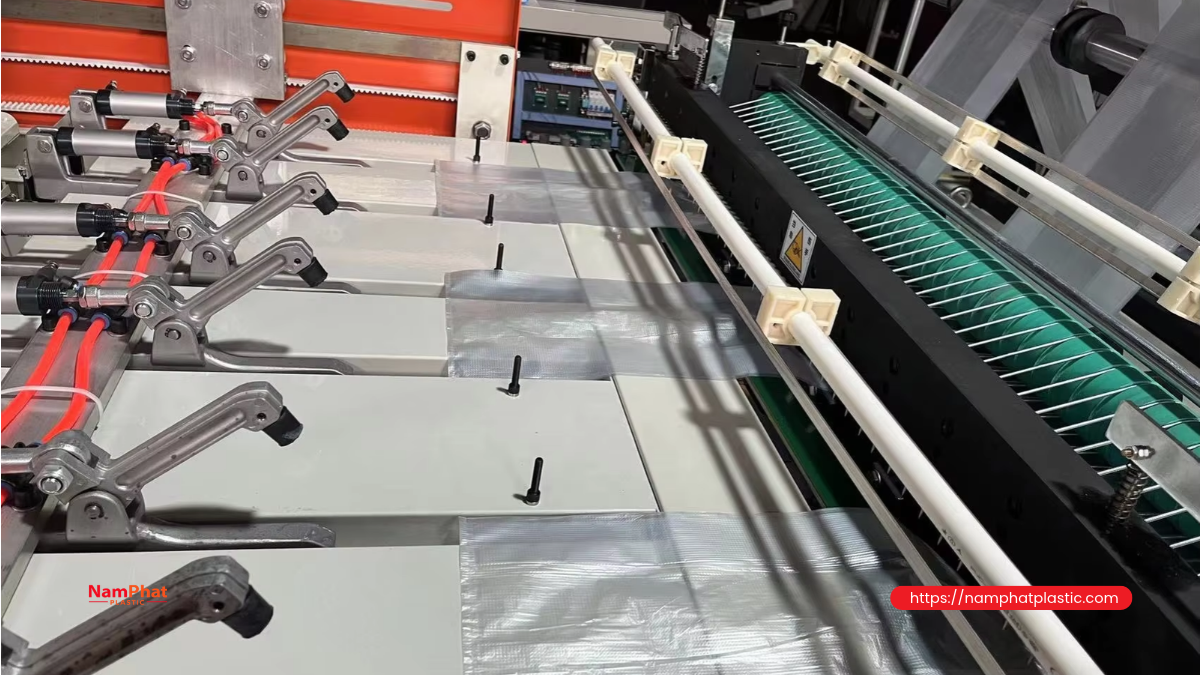
Clean in-house scrap of the same formulation is different from material collected after use. Classify sources, colors, moisture, contamination levels and processing history. Shredders or pelletizers with filtration and degassing help prepare material; POLYSTAR’s two-stage recycling configuration illustrates why heavily printed or washed material may need different treatment from clean scrap.
Do not use recycled-content percentage as the sole criterion. Test strength, odor, appearance, sealability and batch-to-batch variation. For food contact, do not assume that a recycled middle layer is permitted simply because the outer layers are virgin resin. FDA guidance on recycled plastics identifies the risk of residual contaminants migrating into food; it is a reference, not confirmation of compliance for the Vietnamese market or any individual product.
10. Calculate capacity and the investment budget
Convert machine capacities to the same units before balancing the line. If a bag weighs m grams and the actual speed is n bags per minute, the film conversion requirement is approximately m × n × 60 / 1,000 kg/hour. Allow for trimming, handle punching and converting scrap without counting losses twice.
For a flat, two-wall bag without gussets or handles, the theoretical weight is 2 × width × length × single-wall thickness × density, using meters and kg/m³ to obtain kilograms. Bags with folds or additional features must be calculated from the actual film area; weighing samples is an important cross-check.
Required capacity also depends on productive operating hours, order-changeover time, maintenance and the proportion of output meeting specifications. Require the supplier to demonstrate acceptance in kilograms of conforming finished product per hour at the selected specification. Maximum mechanical speed, kilograms of film per hour and bags per minute cannot be compared directly.
The budget should include main machinery, auxiliaries, transport, installation, electrical and water infrastructure, dies/blades, QC, training, spare parts and working capital. Also assess energy per kilogram of conforming output, start-up scrap, color-change time and technical service. A lower quotation does not necessarily mean a lower production cost.
Frequently asked questions
Can one machine produce both LDPE and HDPE bags?
Some configurations support several PE types, but the width range, thickness, die, cooling and trial results must be checked for each material. Do not assume the same output rate.
Do garbage bags require three-layer film?
No. Both monolayer and coextruded film must meet load, leak-integrity and economic requirements. Choose multiple layers when the benefits of allocating materials by layer have been demonstrated.
Can production start with only a sealing-and-cutting machine?
Yes, if consistent film rolls can be sourced. Control width, thickness, unwind force, printing side and sealability; bags on rolls require the corresponding additional functions.
What should the supplier demonstrate during trials?
Run both challenging products and core best-selling products, measuring conforming output, scrap, energy use, bag quality and order-changeover time. Retain acceptance samples and trial conditions for comparison after installation.
Discuss PE bag specifications with Nam Phát Plastic
A suitable production line starts with a specification that can be measured and tested. If you need bags for packaging goods, send the dimensions, proposed thickness, a sample of the contents, printing requirements and required volume to Nam Phát Plastic to discuss product options. Actual bag samples and conditions of use will help make the advice more relevant to your needs.
- 0 Comment


