


 Phan Van Hoang
- 24/09/2026
- 26
When goods have been loaded onto a pallet, many people assume that the packaging process is almost complete. However, in actual transportation and storage, the pallet only serves as a base for handling the goods. Cartons, raw material bags, or packaged products can still shift, tilt, fall, or come off the pallet if they are not properly secured.
That is why PE pallet stretch film has become one of the most commonly used packaging materials in manufacturing plants, logistics centers, and export warehouses. However, not all stretch films are the same. There are currently two main product groups on the market: hand-wrapped PE pallet stretch film (hand stretch film) and machine-wrapped PE pallet stretch film (machine stretch film).
Businesses that are new to using stretch film often focus only on thickness or the selling price per kilogram. In reality, these two types of film are designed for completely different operating conditions. Choosing the wrong type can increase material costs, reduce packaging productivity, or make the wrapping process more difficult.
Table of Contents [Hide]
1. What is PE pallet stretch film?
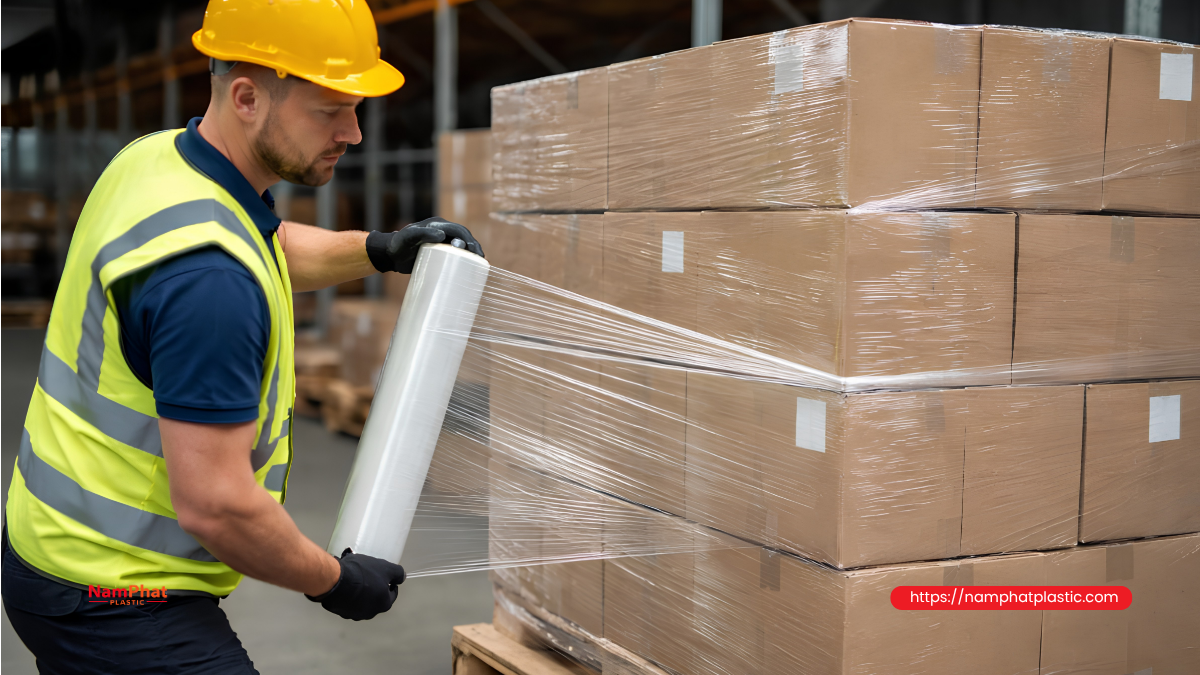
PE pallet stretch film, also known as stretch film, is a plastic film with high stretchability and elasticity, used to secure goods on pallets during storage and transportation.
When cartons, raw material bags, or packaged goods are stacked on a pallet, their weight only provides stability in the vertical direction. During forklift movement, loading and unloading, or long-distance transportation, the layers of goods can still shift relative to one another. If just a few cartons move out of position, the entire pallet can become unstable and fall over.
That is why stretch film is widely used in factories, logistics centers, and export warehouses. When stretched and wrapped around a pallet, the film creates continuous tension across the entire load. The film's elastic force helps the layers of goods stay together as a single unit.
In addition to securing goods, PE pallet stretch film also provides several other benefits:
- Helps prevent dust from settling on products.
- Reduces the effects of moisture in the warehouse environment.
- Helps prevent shifting during transportation.
- Improves the appearance of packaged loads.
- Helps reduce product loss during storage.
Currently, PE pallet stretch film on the market is generally divided into two main groups:
- Hand-wrapped PE pallet stretch film (Hand Stretch Film).
- Machine-wrapped PE pallet stretch film (Machine Stretch Film).
Although both are stretch films, these two types are not designed to completely replace one another.
2. What is hand-wrapped PE pallet stretch film?
Hand-wrapped PE pallet stretch film is stretch film designed to be manually wrapped around palletized goods.
The operator holds the roll directly and pulls and wraps the film around the pallet. The wrapping force therefore depends partly on the operator's handling technique and physical force.
Hand stretch film is commonly suitable for:
- Small and medium-sized warehouses.
- Businesses with moderate pallet volumes.
- Businesses with irregular packaging output.
- Pallets with different sizes and shapes.
- Areas where installing a wrapping machine is impractical.
Because it does not require a machine, hand stretch film offers high flexibility and a relatively low initial investment.
3. What is machine-wrapped PE pallet stretch film?
Machine-wrapped PE pallet stretch film, or machine stretch film, is stretch film designed for use with semi-automatic or automatic pallet wrapping machines.
Unlike hand stretch film, machine stretch film must withstand high pulling forces from the machine's film delivery system. Therefore, the product is generally optimized for stretchability, strength, and stability during operation.
Machine stretch film rolls are usually significantly heavier than hand-wrapped rolls.
| Item | Reference value |
|---|---|
| Usage method | Pallet wrapping machine |
| Common width | 500 mm |
| Common thickness | 15–35 microns |
| Roll weight | Approximately 12–18 kg |
| Stretchability | Higher than hand stretch film |
Modern pallet wrapping systems are often equipped with a pre-stretch mechanism. This component stretches the film before it is applied to the load, allowing the elastic properties of the material to be used more effectively.
As a result, businesses can reduce film consumption per pallet while maintaining load stability.
Machine stretch film is commonly used in:
- Large-scale manufacturing plants.
- Logistics centers.
- Export warehouses.
- Businesses with high pallet volumes.
When packaging volume reaches dozens or hundreds of pallets per day, machine stretch film can provide better operational efficiency than manual wrapping.
4. How are hand-wrapped and machine-wrapped PE pallet stretch films different?
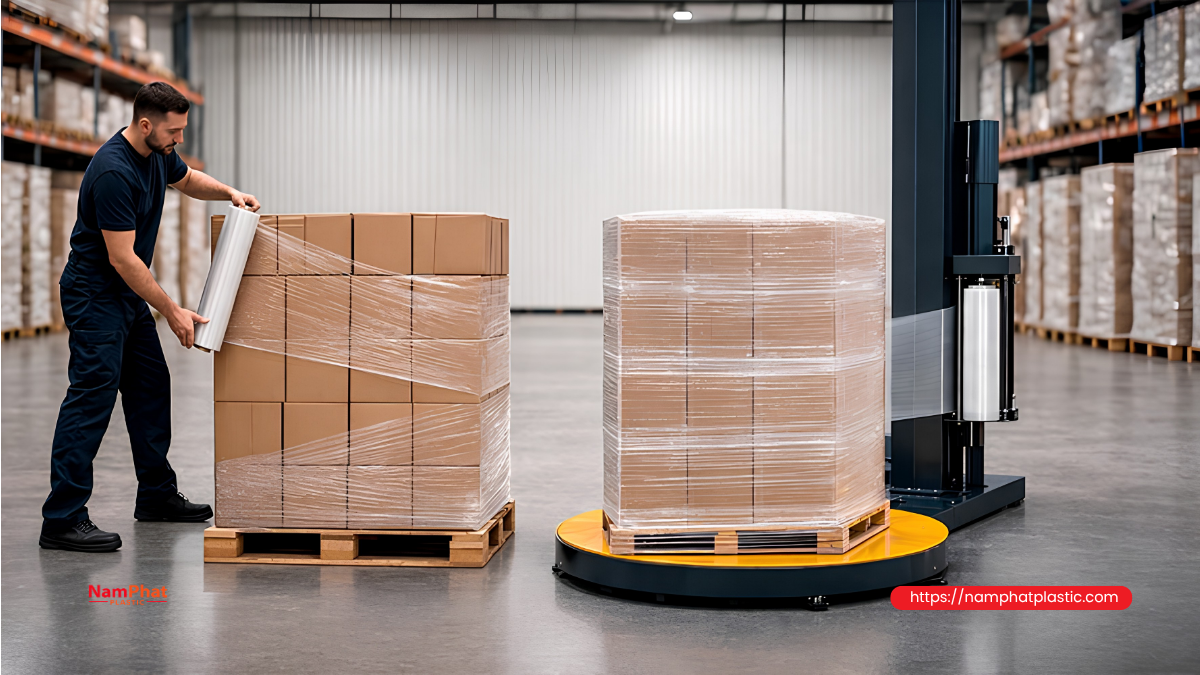
Although both hand stretch film and machine stretch film are used to secure goods on pallets, they are designed for different usage methods. The differences are not limited to roll weight but also include stretchability, load-holding force, and operational efficiency.
4.1. Difference in roll weight
This is the easiest difference to identify.
Hand stretch film is designed to be held directly by the operator during wrapping. Therefore, the roll is generally lighter to reduce fatigue during operation.
In contrast, machine stretch film is mounted on the pallet wrapping machine, allowing much larger rolls to be used.
| Criteria | Hand Stretch Film | Machine Stretch Film |
|---|---|---|
| Roll weight | Small | Large |
| Usage method | Held directly | Mounted on machine |
| Roll replacement frequency | Higher | Lower |
Using larger rolls reduces the number of machine stops required to replace film, especially on high-volume packaging lines.
4.2. Difference in stretchability
Stretchability is one of the most important factors when evaluating stretch film.
For hand stretch film, the pulling force mainly comes from the operator. Although the material still has good stretchability, the actual stretch level is generally limited by human strength.
Machine stretch film, on the other hand, is designed to work with the pre-stretch system of a pallet wrapping machine.
For example:
- An operator can stretch the film to a certain level.
- A pre-stretch system can stretch it considerably further before the film comes into contact with the pallet.
This allows the elastic properties of the material to be used more efficiently.
4.3. Difference in load-holding force
Load-holding force refers to the ability of the film to secure goods after wrapping.
When stretch film is properly stretched, the material creates continuous tension around the load. This force helps limit product movement during transportation.
Because machine stretch film is generally stretched more consistently, its load-holding force can also be more uniform from one pallet to another.
This is particularly important for:
- Tall loads.
- Heavy pallets.
- Long-distance export shipments.
- Multi-layered goods.
4.4. Difference in packaging productivity
Productivity directly affects operating costs.
An employee wrapping pallets manually can handle a certain number of pallets during a work shift. As volume increases, the business may need additional workers to maintain the required output.
A pallet wrapping machine, by contrast, can operate continuously at a consistent speed.
For example:
| Volume | Hand wrapping | Machine wrapping |
|---|---|---|
| 20 pallets/day | Suitable | Suitable |
| 100 pallets/day | More demanding | Suitable |
| 300 pallets/day | Difficult to maintain | More efficient |
The table above is for illustration only. Actual performance also depends on the type of goods, production process, and equipment configuration.
4.5. Difference in consistency
When wrapping manually, load quality depends on:
- Operator skill.
- Operating speed.
- Film tension.
- Actual number of wrapping turns.
Therefore, two pallets wrapped by two different operators may not be exactly the same.
A pallet wrapping machine, by contrast, operates according to preset programs. Tension, rotation speed, and number of wrapping turns can be controlled more consistently.
This is why many export and logistics businesses prefer machine stretch film combined with an automatic wrapping system.
5. Which type helps save more costs?
Many businesses tend to compare only the selling price of a roll of film. However, actual costs should be evaluated across the entire operation.
Suppose a business packages 20 pallets per day.
In this case, investing in a pallet wrapping machine may not yet provide a clear economic benefit. The initial investment may outweigh the savings in labor costs.
On the other hand, if a business handles hundreds of pallets per day, using machine stretch film together with a wrapping machine can significantly reduce:
- Labor costs.
- Packaging time.
- Film consumption.
- Costs associated with damaged or fallen goods.
A simple example:
A pallet has a circumference of approximately 4.4 meters.
If it is wrapped 12 times:
4.4 × 12 = 52.8 meters of film.
With manual wrapping, actual film consumption may be higher because the pulling force is not uniform.
With a pre-stretch system, the amount of material required per pallet can be significantly reduced.
Therefore, economic efficiency should be evaluated based on:
- Material costs.
- Labor costs.
- Equipment investment costs.
- Operating productivity.
- Product damage and loss rates.
6. When should you use hand-wrapped PE pallet stretch film?
Although automation is becoming increasingly common in warehousing and manufacturing, hand stretch film remains suitable for many businesses. Using hand-wrapped PE pallet stretch film does not necessarily mean low productivity or poor packaging quality. In many cases, it is a more economical and flexible solution than investing in machinery.
One of the most common situations is when businesses have low or inconsistent pallet volumes. If only a few dozen pallets are generated per day, the cost of investing in a pallet wrapping machine may not provide a proportionate benefit. Instead, using hand stretch film allows the business to implement the solution quickly without changing the facility layout or allocating space for machinery.
In addition, many production facilities regularly handle pallets with inconsistent dimensions. Some loads may be low, while others may have unusual shapes or protruding sections. In such cases, manual wrapping gives operators greater flexibility to reinforce areas that require additional load-holding strength.
Hand stretch film is commonly selected for:
- Small or medium-sized warehouses.
- Production facilities with inconsistent output.
- Newly established businesses.
- Packaging areas distributed across multiple locations.
- Goods with unusual dimensions or shapes.
- Businesses whose stretch film demand is not yet high enough to justify machine investment.
Hand stretch film can also serve as a backup solution when a pallet wrapping machine is undergoing maintenance or experiencing a breakdown. Many large businesses still maintain a certain quantity of hand stretch film to ensure that packaging operations are not interrupted.
However, when pallet volume increases continuously over time, businesses should reassess actual operating costs. A solution that is reasonable at an early stage may not remain the most suitable option as production scale expands.
7. When should you use machine-wrapped PE pallet stretch film?
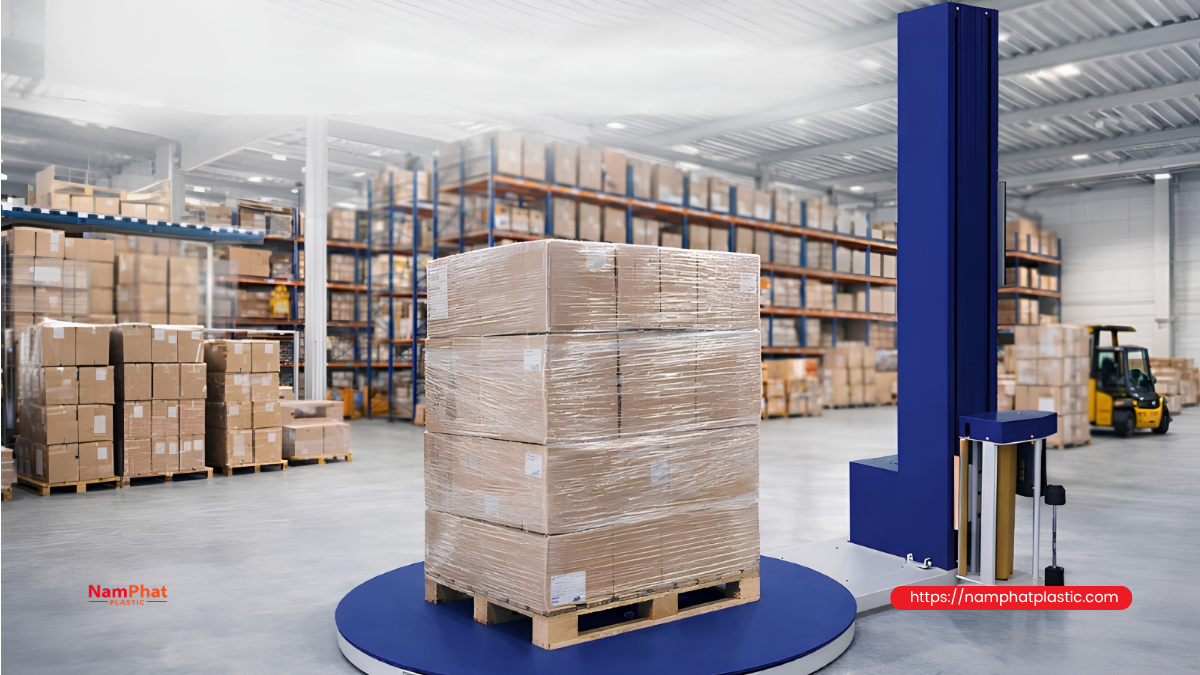
Machine stretch film provides clear benefits in environments with high volumes and a need for consistent packaging. This is why it is commonly found in industrial manufacturing plants, logistics centers, and export warehouses.
Unlike manual wrapping, machine wrapping is controlled through preset operating parameters. This allows pallets to achieve greater consistency in tension, number of wrapping turns, and film coverage.
A business may not notice a major difference when handling a few dozen pallets per day. However, when the volume reaches hundreds of pallets, the benefits in productivity and cost control become more apparent.
Machine stretch film is commonly suitable for:
- Factories with high pallet volumes.
- Cargo transfer warehouses.
- Distribution centers.
- Businesses that regularly export goods.
- Logistics and transportation companies.
- Automatic or semi-automatic packaging lines.
In addition to productivity, machine stretch film also reduces dependence on individual operator skill. Instead of each employee wrapping the load differently, the business can standardize the process and maintain consistent quality across production shifts.
For tall or heavy pallets, stable tension control can also contribute to safer transportation.
However, investing in a pallet wrapping machine is not always the right choice. Before switching from hand wrapping to machine wrapping, businesses should evaluate actual volume, available installation space, operating capability, and long-term investment costs.
8. Common mistakes when choosing PE pallet stretch film
Although stretch film is a relatively familiar packaging material, many businesses still have difficulty selecting the right product. Some seemingly minor mistakes can significantly increase operating costs or affect load quality.
8.1. Choosing film based only on selling price
This is the most common mistake.
Many people tend to compare prices per kilogram and select the product with the lower unit price. However, actual costs depend not only on the purchase price but also on the amount of film consumed per pallet.
A stretch film with a higher purchase price but better stretchability may reduce the amount of material used during packaging. When calculated per pallet, the actual total cost may sometimes be lower.
8.2. Using hand stretch film for a pallet wrapping machine
Because both are PE pallet stretch films, some businesses assume they can completely replace one another.
In reality, hand stretch film and machine stretch film are designed for different operating conditions. When hand stretch film is used on a pallet wrapping machine, the film may not withstand the pulling force of the film delivery system.
Possible consequences include:
- Film breaking during operation.
- Reduced packaging speed.
- Increased machine downtime.
- Higher material waste.
8.3. Choosing a thickness greater than necessary
Many businesses assume that thicker film is always better.
In reality, thickness is only one of many factors affecting performance. A film with a good material formulation and manufacturing technology can provide high load-holding performance even at a lower thickness.
Using film that is unnecessarily thick can increase material costs without providing a corresponding benefit.
8.4. Not evaluating transportation conditions
A pallet stored inside a factory has different requirements from one that must be transported long distances or exported.
If actual transportation conditions are not considered, a business may choose a film that does not meet its usage requirements.
8.5. Not testing samples before placing a large order
Stretch film performance is affected by many factors, including machinery, packaging processes, and product characteristics.
Therefore, testing samples under actual operating conditions often provides more reliable results than relying only on technical specifications or quotations.
9. Information to provide when requesting a quotation
To select the right stretch film, businesses should provide as much information as possible to the supplier.
Simply sending a general request such as "quotation for PE pallet stretch film" can make the consultation process longer and may result in an unsuitable selection.
Useful information includes:
- Hand wrapping or machine wrapping.
- Pallet dimensions.
- Pallet height after loading.
- Cargo weight.
- Type of packaged product.
- Storage conditions.
- Transportation conditions.
- Monthly usage volume.
For example, a pallet containing 25 kg raw material bags has different requirements from a pallet containing lightweight cartons. Similarly, goods transported domestically over short distances may require a different level of load securing than goods exported in containers.
Providing complete information helps the supplier recommend a more suitable thickness, roll specification, and type of stretch film.
10. PE pallet stretch film consultation at Nam Phát Plastic
Nam Phát Plastic provides PE pallet stretch film solutions for storage, transportation, and export applications.
When receiving a consultation request, the technical team considers factors such as product type, pallet weight, packaging method, and usage volume to recommend an appropriate specification.
For customers deciding between hand stretch film and machine stretch film, testing samples under actual operating conditions is often an effective way to evaluate material consumption, packaging speed, and load stability.
Customers can prepare the following information before contacting Nam Phát Plastic:
- Type of goods being packaged.
- Pallet dimensions.
- Load weight per pallet.
- Photos of the actual load.
- Current stretch film consumption.
- Monthly usage volume.
Phone: 0911 904 968
Email: contact.namphat@gmail.com
Website: namphatplastic.com
Frequently Asked Questions
1. Can hand-wrapped PE pallet stretch film be used on a wrapping machine?
It is not recommended. Hand and machine stretch films are designed for different operating conditions.
2. Is machine stretch film more economical than hand stretch film?
In many cases involving high volumes and pre-stretch machines, film consumption per pallet may be lower.
3. Are the two types of film made from the same material?
Both are generally made from polyethylene but differ in specifications and operating characteristics.
4. Can hand wrapping be completely replaced by machine wrapping?
This depends on packaging volume, warehouse scale, and the ability to invest in equipment.
5. What thickness in microns should be selected?
The appropriate thickness should be determined based on pallet weight, load shape, and actual transportation requirements.
- 0 Comment


