


 Phan Van Hoang
- 23/03/2020
- 2310
When talking about offset-printed packaging, this refers to packaging that incorporates offset printing technology. This printing technology is commonly used for paper packaging or paper-laminated packaging, such as woven PP bags laminated with Kraft paper. To help you better understand offset-printed packaging technology, the following article provides detailed information related to this type of packaging.
Table of Contents [Hide]
1. Applications of offset-printed packaging
In terms of applications, offset-printed packaging is widely used to meet various user needs. This is because it offers a range of advanced features compared with many other types of packaging:
- It has a strong and thick packaging structure. It is commonly composed of three different layers: OPP film, paper, and woven PP. This creates a complete packaging solution and helps prevent breakage or damage during packaging and transportation.
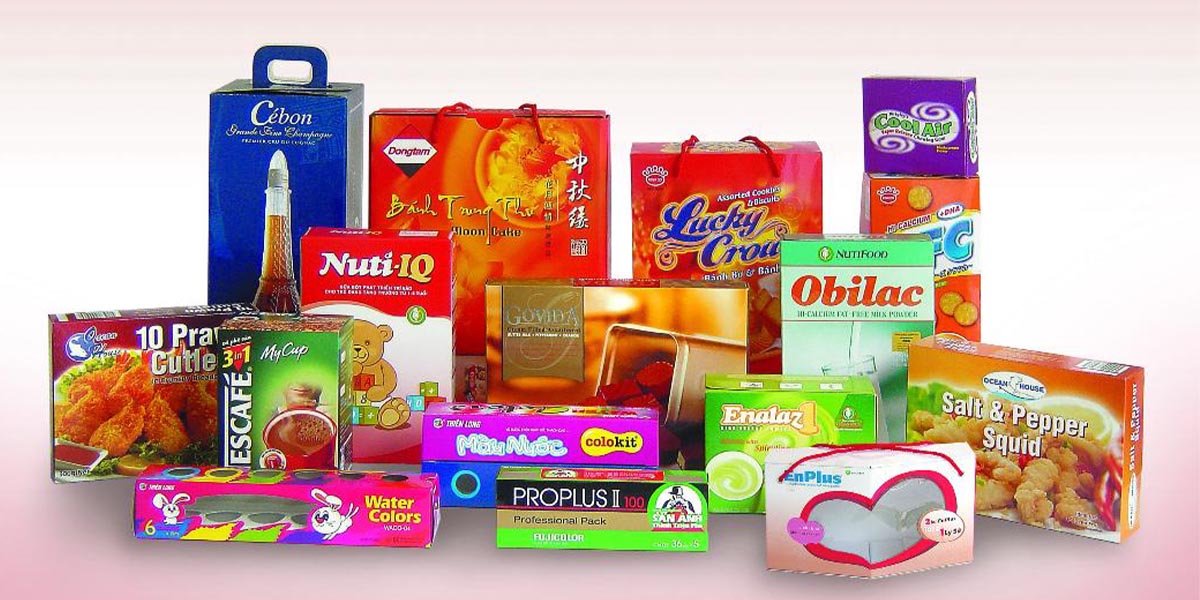
- Offset printing is highly regarded for its attractive colors, sharp printing, and high-quality, vivid images. This provides an aesthetically pleasing appearance and helps products attract customers and create a strong impression.
- Offset-printed packaging can also help limit initial investment costs and reduce business risks. Instead of investing a large amount in gravure printing cylinders, businesses may only need to spend around VND 1–2 million on printing plates and films for offset-printed packaging.
2. Advantages of offset-printed packaging
Choosing offset-printed packaging offers many important advantages:
- It provides high-quality, sharp images. Printing is also cleaner because the rubber blanket evenly transfers the ink onto the surface being printed.
- It can be applied to many different surfaces, including uneven surfaces such as fabric, leather, metal, rough paper, and wood.
- The printing plate production process is relatively simple.
- Printing plates have a longer service life because they do not come into direct contact with the surface being printed.

3. Factors affecting the quality of offset-printed packaging
The main factors affecting the quality of offset-printed packaging include:
First: The thickness of the ink layer on the paper.
Second: Dot size.
Third: Ink trapping, which is closely related to the order in which colors are overprinted.
In addition to visual inspection, measuring instruments should be used to objectively evaluate the influence of these factors and eliminate subjective visual errors. One of the most commonly used instruments is a densitometer.
Specifically, a densitometer can be used to measure ink trapping as follows:
The order in which colors are overprinted affects ink acceptance and therefore affects the resulting printed color. There is a difference between printing a color directly onto white paper and printing the same color over a previously printed ink layer. It is also possible to print three or four colors using wet-on-wet printing.
In wet-on-dry printing, multiple colors are printed on a single-color machine in separate stages, while wet-on-wet printing involves printing successive colors while the previous ink is still wet. These methods result in different levels of ink acceptance and can significantly affect the final printing result. In particular, with wet-on-wet printing, ink splitting and ink trapping play an important role. The values generally need to be gradually reduced from the first printing unit to the final unit.
The result also depends on the printing characteristics and requirements, whether the machine is a single-color or multi-color machine, and the desired color effect. Based on these factors, the order of color overprinting can be adjusted. If a proof has already been produced, the production printing should follow the same color sequence used during proofing.
In countries where offset packaging printing technology is highly developed, standardization is also applied to eliminate the influence of color overprinting order on the printing result. Accordingly, both proof printing and production printing are carried out according to established standards.
4. Offset packaging printing principles
For offset-printed packaging, the operating principle is as follows: Offset printing is an indirect printing method. The information and images on the printing plate are created through a photochemical process, forming ink-receptive printing areas and water-receptive non-printing areas. In addition, the image on the printing plate must be a positive image, so that it can be transferred appropriately and reproduced on the printed sheet.
The information above provides a better understanding of offset-printed packaging. If you are looking for an offset packaging manufacturer, please contact Nam Phat Import Export Investment Co., Ltd.
Nam Phat specializes in manufacturing and distributing offset-printed packaging, as well as woven PP bags, raffia bags, mesh bags, and other packaging products. With advanced machinery, professional working processes, and an experienced team, we are committed to providing high-quality products and services. Please contact Nam Phat for more detailed consultation.
- 0 Comment


