


 Phan Van Hoang
- 20/10/2026
- 2
A PP woven bag production line starting from resin pellets comprises three main stages: PP tape extrusion and drawing, fabric weaving, and fabric conversion into bags. Coating, BOPP film lamination, printing, PE liner insertion and block-bottom forming are additional operations determined by the product construction, not mandatory features of every factory.
Choosing the right equipment starts with the packaged product, bag specifications and acceptance criteria. A high-output tape extrusion line does not guarantee more conforming finished bags if weaving, printing or cutting and sewing becomes the bottleneck.
Table of Contents [Hide]
1. Define the bag type before selecting the configuration
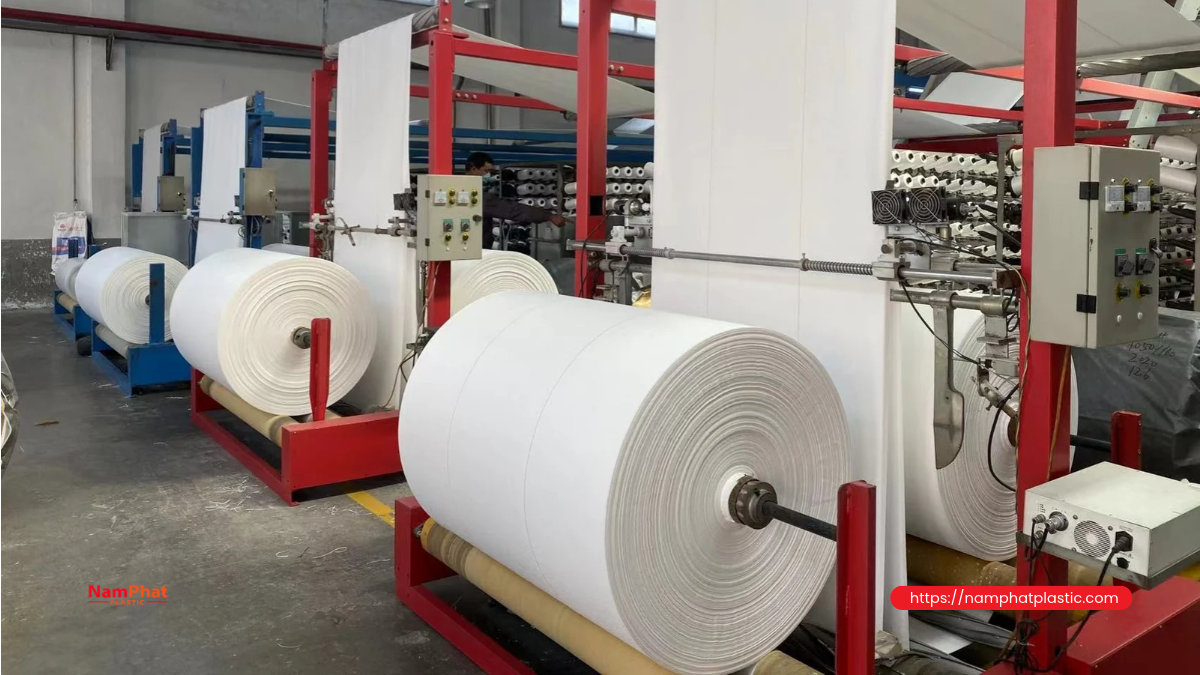
The technical specification should include dimensions, filling weight, fabric grammage, bottom construction, bag opening, printing requirements and storage conditions. For powders, consider dust leakage and air release during filling; for moisture-sensitive contents, assess the entire protective construction rather than the coating alone.
| Finished product | Configuration considerations | Points to verify |
|---|---|---|
| Standard PP woven bag with a sewn bottom | Tape extrusion, weaving, cutting and sewing; printing if required | Fabric strength, seam strength and containment |
| Coated or BOPP-laminated bag | Additional coating/lamination, surface treatment and printing according to construction | Adhesion, coating weight, image misalignment and wrinkles |
| Bag with a PE liner | Additional liner feeding, insertion and securing | Liner dimensions, sealing performance and fillability |
| Valve bag or block-bottom bag | Dedicated valve forming, bottom folding and bottom closing equipment | Filling spout compatibility, bottom strength and air release |
The article on types of PP woven bags provides product background. The following sections focus on equipment, coordination between stages and output control, rather than treating every bag type as the same process.
2. Raw materials and the difference between tape and multifilament yarn
The base material is generally a PP grade intended for raffia/tape applications. Check technical documentation for suitable processing characteristics and properties instead of selecting a material simply because it is called “PP resin.” Color masterbatch, fillers, stabilizing additives and recycled materials must be controlled according to the intended use.
Resin supplier LyondellBasell describes raffia technology as forming a film, slitting it into strips, heating and drawing the strips into tapes. These flat tapes form the warp and weft of bag fabric; they are not bundles of fine filaments like PP multifilament yarn.
Lohia's multifilament lines belong to a separate spinning equipment category. A multifilament yarn production machine or thread twisting machine should therefore not be considered a substitute for a tape extrusion line. Bag-closing thread is also a separate consumable and can be purchased to the appropriate specification without integrating a thread production line.
Incoming material records should identify the resin grade, batch, quality documentation and permitted use. Increasing filler or recycled resin content can change drawability, strength and appearance; there is no universal blend ratio for every bag. For food-contact bags, assess the resin, additives, inks, laminated layers and conditions of use. Do not assume that “virgin PP” means the finished product is already compliant.
3. Process flow and core equipment
Inspect raw materials → dose and mix → extrude film → cool and slit into tapes → heat, draw and heat-set → wind onto bobbins → weave and wind fabric rolls → coat/laminate/print if required → cut, form and close the bottom → inspect, count and bale.
The sequence of printing and lamination depends on the product. Direct printing on fabric differs from using BOPP film printed before lamination. Businesses can purchase tapes, fabric rolls or printed film externally and invest in only part of the process, but they must establish acceptance specifications for those semi-finished materials.
| Equipment group | Role | Requirement level |
|---|---|---|
| Weighing, mixing and feeding equipment; extruder, filter and die | Prepare the material and form the polymer melt into film | Core equipment when producing from pellets |
| Cooling, slitting, drawing, heat-setting and winding equipment | Produce tapes with consistent specifications and weaving performance | Core equipment for tape production |
| Creel, loom and fabric take-up | Produce fabric with the required width and weave density | Core equipment for in-house weaving |
| Cutting, folding, sewing or bottom closing equipment | Convert fabric into bags | Select for the bag type; do not assume interchangeability |
| Coating/lamination, printing, liner insertion and valve forming equipment | Add functional and visual features | Optional, depending on the order |
| Utilities, QC and scrap management | Support operation, measurement and traceability | Required; an on-site recycling machine is not mandatory |
4. How does PP tape extrusion and drawing work?
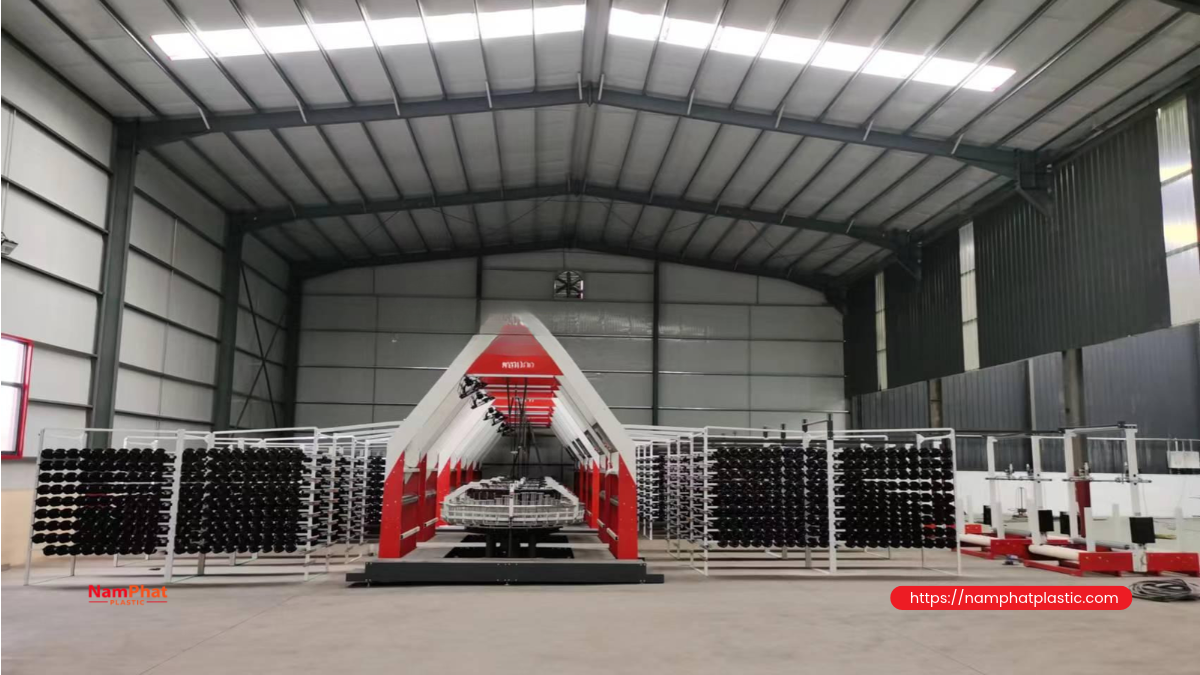
Film extrusion and cooling
In a flat-die configuration, the resin is melted, filtered and distributed into a film. The cooling section sets the film before slitting. Initial film quality directly affects tape uniformity: thick or thin streaks and contamination can become weak points after drawing.
Monitor feeding, actual temperatures, pressure and filter cleanliness. Do not simply raise the temperature to address every instance of tape breakage; the cause may also lie in the material, slitting blades or drawing system.
Slitting, drawing and heat-setting
Slitting blades divide the film into strips; the heating zone and roller groups operating at coordinated speeds draw the strips. Heat-setting and controlled relaxation then help manage shrinkage. Lohia's Lorex documentation distinguishes the holding section from the stretching and annealing sections and makes clear that configurations vary by model.
The slitting width is not the same as the final tape width. When ordering equipment, specify the required output tape range, strength, elongation and shrinkage using the agreed material, rather than asking only about maximum mechanical speed.
Bobbin winding and tape feeding performance
The winder must produce packages compatible with the creel or weaving shuttles. Winding tension, package shape and stable unwinding are just as important as the weight of each bobbin. Slipped layers, overlapping edges or twisted tapes can increase loom stoppages.
Test bobbins on the actual loom and monitor them from beginning to end. The Lohia equipment range lists tape winding, weaving and multifilament spinning as separate groups, helping avoid confusion about their functions when preparing an investment list.
5. PP fabric weaving: select width and density, not just shuttle count
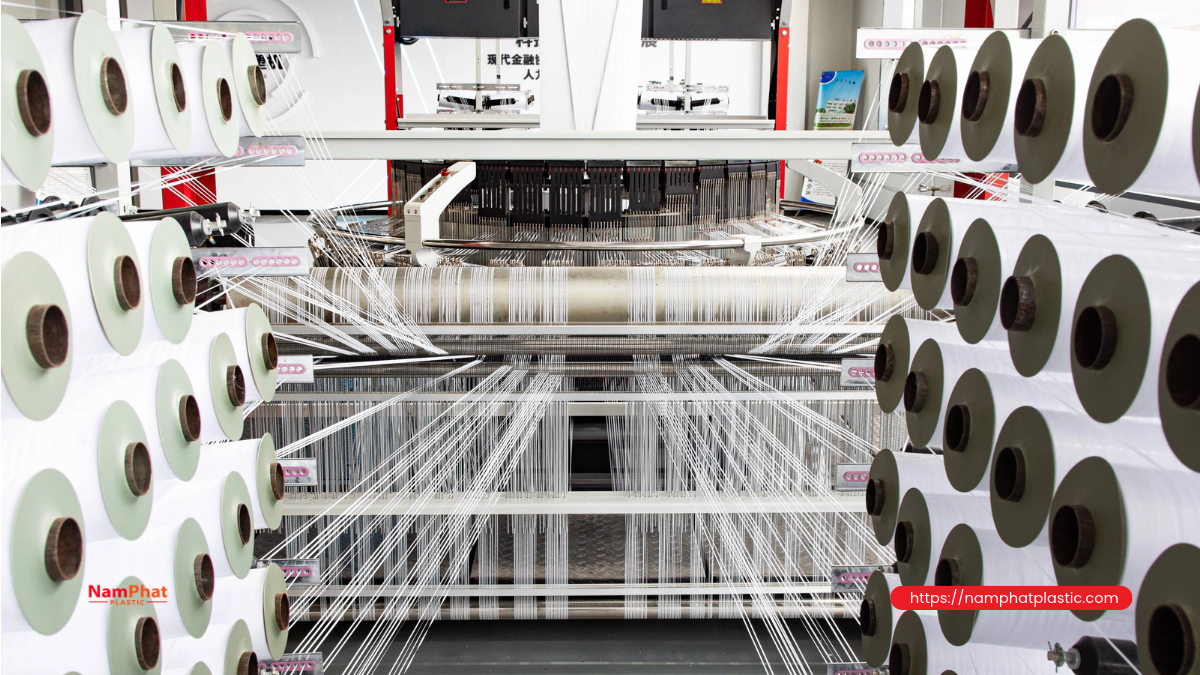
Circular looms interlace warp and weft tapes to form tubular fabric. The fabric width must suit the finished bag after coating, folding and cutting. Clearly distinguish “lay-flat tube width” from “opened fabric width” rather than using the same number for two different measurements.
When comparing machines, assess working width, compatibility with the intended tape, weave density, tape-break detection and fabric roll quality. Lohia distinguishes several circular loom families by construction and application; a loom for open-mesh fabric is not automatically equivalent to a standard sack fabric loom.
Two rolls with the same grammage in g/m² may still differ in strength because of warp/weft distribution, tape strength or damage during weaving. Test both fabric directions and record defect locations along the roll so that subsequent stages can remove affected sections on a documented basis.
6. Coating, BOPP lamination and printing: when are they needed?
Coating applies a polymer layer to the fabric; lamination adds another material, such as printed BOPP film. The machine must accommodate the substrate, width, single- or double-sided construction and required adhesion. Lohia's coating and lamination range includes configurations for PP/HDPE woven fabric, BOPP film and paper, but specific capabilities must be confirmed in the quotation.
A coating helps reduce dust leakage and the effects of moisture passing through the fabric body. However, pinholes, seams, the bag opening and vent holes still affect whole-bag performance. Coated fabric alone is not a basis for claiming that a bag is “completely waterproof.”
Direct flexographic printing and lamination with preprinted film have different requirements for graphics, color registration, web guiding and tension. Agree on the print side, unwinding direction, cutting marks and artwork position before handing over semi-finished material. Check ink adhesion, smearing, rub resistance and odor according to product requirements.
A BOPP film production line is not necessarily required to manufacture BOPP-laminated bags. Quality-controlled film can be purchased; similarly, PE liners can be sourced externally if they meet the required specifications and documentation requirements.
7. Cutting, sewing and alternative bottom closures
For sewn-bottom bags, the machine feeds fabric to length, cuts it, folds the edge, sews and stacks the bags. The cutting length must allow for the bottom fold, opening treatment and dimensional changes during processing; it should not simply be set equal to the usable bag length.
Starlinger multiKON servo is an example of a line that converts tubular fabric into cut-and-sewn bags, with options for coated or uncoated fabric and liners.
Select the thread, needle and stitch type for the bag construction and machine. High thread tensile strength is not enough if thread feeding is unstable or the needle damages the fabric. Refer to the industrial bag-closing thread category when defining consumable specifications and conducting trials.
Valve bags and block-bottom bags require a separate configuration
Block-bottom valve bags require dedicated forming, valve placement and bottom closing equipment. W&H describes CONVERTEX technology as using hot air to form the bottoms of PP woven sacks. This is not an ordinary cutting and sewing machine with a single accessory added. Nor should every valve bag be assumed to use the same bottom closing method.
8. Quality control from tape to finished bag
Set criteria according to the product and agreed test methods. Link every result to the material batch, machine, sampling time and measurement conditions. One visually good sample cannot represent an entire production shift.
| Stage | Recommended checks | Points to agree |
|---|---|---|
| Tape | Width, linear density, breaking force, elongation and shrinkage | Units, sample length, test conditions and variation |
| Woven fabric | Width, g/m², warp/weft density, tensile testing in both directions and weaving defects | Measure a single fabric layer; agree sampling positions and quantity |
| Coating, lamination and printing | Coating weight, adhesion, holes, wrinkles, color and cutting marks | Distinguish base fabric grammage from the grammage of the complete construction |
| Finished bag | Dimensions, weight, seams, bottom strength and use tests | Test load, filling method, drop conditions, dust leakage or sealing performance according to application |
Do not confuse denier with tape width
Denier is the mass in grams of 9,000 m of yarn; tex is grams per 1,000 m. Therefore, denier = 9 × tex. Two tapes of the same width can have different linear densities if their thickness or composition differs. Breaking force in N is also different from tenacity expressed per unit of linear density.
Use the correct area when calculating grammage and weight
Grammage (g/m²) = sample mass (g) ÷ area of the single-layer sample (m²). If a tubular fabric sample is weighed with both layers present, include the area of both layers or separate one layer for measurement. This simple error can double the result.
For flat tubular fabric without gussets, the theoretical fabric body weight is approximately 2 × lay-flat width × cutting length × grammage, with dimensions in meters. This excludes coating, liner, thread and accessories; gusseted bags require the actual circumference. This calculation supports material reconciliation but does not replace weighing and testing actual bags.
Hypothetical example: a lay-flat width of 0.50 m, cutting length of 0.90 m and grammage of 70 g/m² give a base fabric weight of 2 × 0.50 × 0.90 × 70 = 63 g/bag. This only illustrates the calculation; it is neither a recommended specification nor a guaranteed load rating.
9. Common defects and how to narrow down their causes
| Symptom | Potential cause groups | Initial checks |
|---|---|---|
| Broken, frayed or uneven tapes | Raw materials, filtration, slitting blades, heating and drawing | Compare positions across the width and check against material batch changes |
| Missing tapes, streaks or width drift in fabric | Tape feeding, tension, break detection and fabric take-off | Link defects to the loom and relevant tape packages |
| Wrinkled fabric rolls or slipped layers | Web guiding, fabric uniformity and winding tension | Inspect the roll as it unwinds on the next machine |
| Delamination or bubbles | Surface condition, laminating materials, heat, nip pressure and tension | Test adhesion at different positions and compare shift records |
| Incorrect bag length or misaligned artwork | Print marks, fabric feeding, feed slippage and shrinkage | Measure a sequence of consecutive bags rather than one bag |
| Bottom failure, skipped stitches or product leakage | Fabric, thread, needle, folded edge and bottom closure type | Distinguish thread breakage, fabric tearing and stitch unraveling |
This is a checklist, not a diagnosis. Change only one group of factors at a time within the manufacturer's permitted range, record the results and reconfirm quality after adjustment.
10. Line balancing and acceptance testing
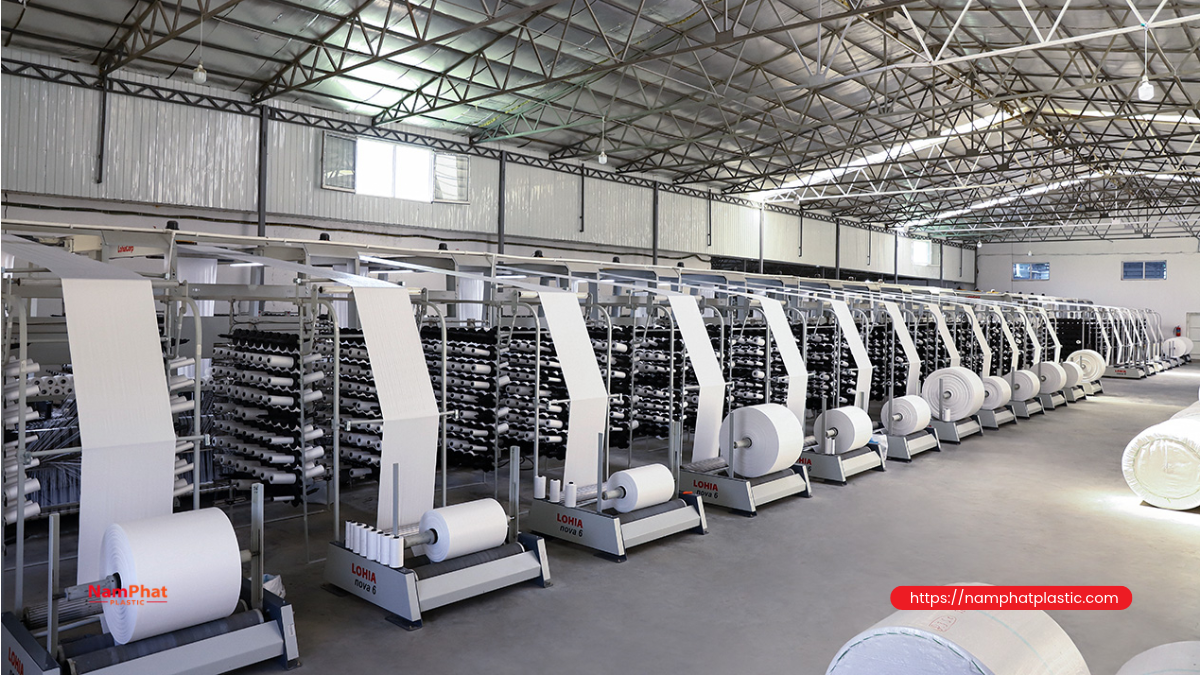
Machines use different output units: tape extrusion is often measured in kg/hour, weaving in fabric length or weft insertions per minute (picks/min), and conversion in bags/minute. Convert these figures to the same conforming product before comparing them.
Theoretical output (bags/hour) = fabric supplied to conversion (kg/hour) ÷ fabric used per bag (kg). Then account for scrap, stoppages, specification changes and actual operating time. Do not divide resin input capacity by a finished bag weight that includes laminated layers and a liner.
The number of looms should be based on fabric demand and each loom's conforming output at the intended width and weave density. Provide suitable semi-finished stock buffers so that printing, lamination or order changes do not leave the whole system waiting.
- Agree on the acceptance sample: materials, construction, drawings, tolerances, test methods and quality limits.
- Run under sufficient operating conditions: check main product codes, roll changes, specification changes and stable operation, rather than just a brief demonstration.
- Measure actual output: conforming bags, scrap, stoppages, electricity and materials over the same measurement period.
- Check compatibility between stages: tape bobbins must run on the looms, fabric rolls must be suitable for lamination, and finished bags must work on the intended filling system.
- Complete the operational handover: documentation, training, safety guards, spare parts and warranty scope.
Investment costs also include factory space, electricity, cooling, compressed air where needed, extraction, materials handling, QC equipment and inventory working capital. Compare the total cost per conforming bag rather than only machine prices or the highest figures in a catalogue.
11. Safety and scrap management
Drawing rollers, winders, cutting blades, sewing needles and drive assemblies need suitable guarding. Isolate energy sources before clearing jams or carrying out maintenance; do not disable interlocks. HSE's extrusion line safety guidance is a reference for identifying hazards, not a replacement for the assessment and requirements applicable at the factory.
Control hot surfaces, processing fumes, dust, noise and the handling of heavy rolls. Solvent-based printing requires appropriate ventilation and fire precautions. Separate clean in-house scrap from scrap contaminated with ink, oil or foreign matter; suitability for reintroduction into production must be confirmed against bag quality and intended use.
12. Frequently asked questions
Can one machine produce an entire PP woven bag?
Not in a conventional configuration starting from resin pellets. Tape production, weaving and conversion must work together; even an automatic cutting and sewing unit requires input fabric rolls.
Is coating mandatory?
No. Uncoated bags suit certain applications. The choice of coating, lamination or liner insertion depends on the contents, dust containment and moisture requirements, and the closing method.
Is a heavier bag necessarily stronger?
Weight alone cannot establish strength. Tape quality, weave construction, processing damage and bottom closure strength must also be considered.
Do you need to produce bag-closing thread in-house?
No. Thread suitable for the machine and bag construction can be purchased. Test feeding stability, stitch formation and seam strength on the actual product.
Can this line produce jumbo bags?
Some equipment has related application ranges, but compatibility of the entire line cannot be assumed. Jumbo bags/FIBCs require their own design, materials, processing and testing systems.
From understanding the line to specifying the right bag
A suitable line must consistently produce bags that meet the intended use requirements, not merely run fast. If you are defining the product construction, consult Nam Phát Plastic's PP woven bag information and prepare details of the contents, filling weight, dimensions, printing requirements, liner and transport conditions.
Send a sample or specification to discuss suitable packaging and bag-sewing consumables. This article is a general technology guide, not an offer to sell machinery or confirmation that Nam Phát operates all the equipment described.
- 0 Comment


