


 Phan Van Hoang
- 20/10/2026
- 4
A PE pallet stretch film production line turns resin pellets into stretch film that can be elongated, cling to itself and secure unit loads. A complete system includes feeding, dosing, polymer extrusion, film formation, cooling, thickness measurement, edge trimming and winding. Slitting or pre-stretch conversion is added according to the finished product.
This article follows the material through the factory, focusing on technology and quality control. For packaging material selection, see Nam Phát's pallet stretch film product page.
Table of Contents [Hide]
1. Define the product before selecting a production line
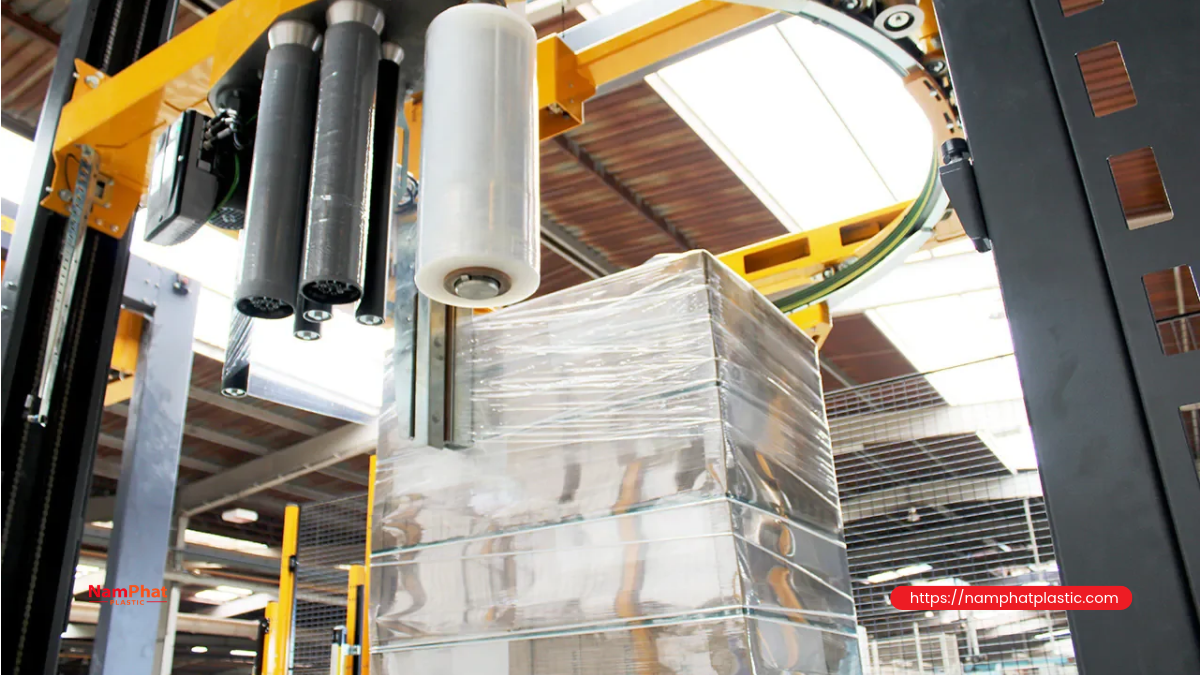
Stretch film holds loads through the force generated when the film is stretched and wrapped around them. Shrink film requires heat to contract around a product. Both may use PE, but their design goals differ; a shrink-film production configuration should not be assumed to suit pallet stretch film.
Also distinguish stretch film rolls from tubular pallet covers and PE bags. Sharing the PE material name does not mean that these products use the same die design or finishing process.
Define the output at the start:
- Hand-wrap film: prioritize convenient hand force, cling between layers, roll weight and stable unwinding.
- Machine-wrap film: must run consistently at the wrapper's speed, pre-stretch setting and wrapping force.
- Pre-stretch film: is stretched during product conversion and then rewound; the remaining stretch and edge quality must be controlled.
“Film for a machine with a pre-stretch unit” is different from “a roll of film that has already been pre-stretched.” Confusing these terms can lead to incorrect equipment selection and acceptance criteria. ExxonMobil separates hand-wrap, machine-wrap and power-prestretch applications, illustrating why material requirements should be tied to the method of use.
2. Two film-forming technologies: cast extrusion and blown film
Cast extrusion: cooling on a chill roll
In cast extrusion, molten polymer passes through a flat die, forms a film curtain and contacts a chill roll. A suitable vacuum box or air-assisted solution such as an air knife helps the film maintain stable contact with the roll. After cooling, the film passes through thickness measurement, edge trimming and winding.
This configuration supports control of surface quality and thickness and continuous roll production. SML offers stretch-cast lines; W&H features FILMEX II Stretch in its film production equipment range; Colines offers ALLrollEX for stretch cast. Final quality still depends on the structure, resin and operating conditions.
Blown extrusion: forming a bubble through a circular die
In blown-film extrusion, polymer passes through a circular die and is inflated into a bubble, cooled by air, drawn through a haul-off and collapsed before slitting and winding. Typical assemblies include an air ring, bubble cage, haul-off tower, collapsing frame and a winder suited to cling film.
Differences in orientation and cooling lead to differences in film properties. Do not conclude that every blown film is tougher or every cast film is better. Test against the same end use, thickness and stretch conditions. Reifenhäuser describes modular blown-film systems; the supplier must confirm suitability for the specific application.
The equipment sections below use a multilayer cast line as the reference configuration. For blown film, the flat die and chill roll are replaced by the bubble-forming, cooling and haul-off system.
3. What do raw materials and layer structure determine?
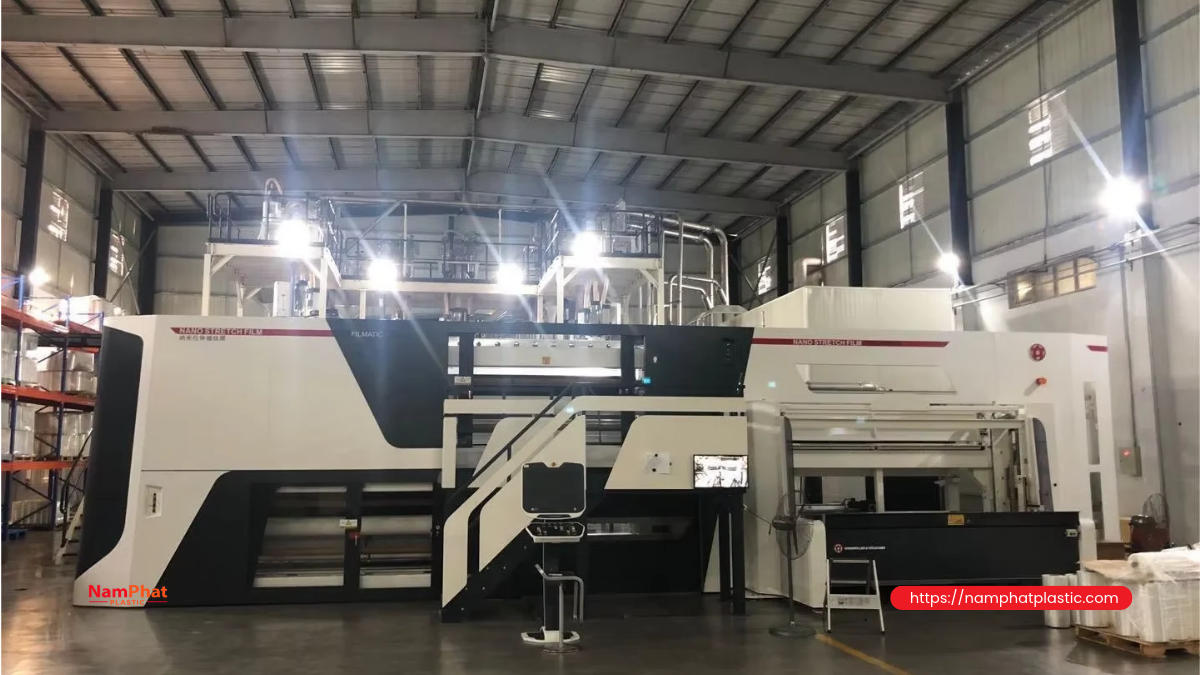
The roles of LLDPE, mLLDPE and LDPE
LLDPE is an important stretch-film resin because it balances stretchability and toughness. mLLDPE grades, meaning LLDPE made with a metallocene catalyst system, can support thin-film design, puncture resistance and stretch performance; results depend on the specific resin grade and structure.
LDPE may be included in a blend to adjust processability and melt-flow behavior. There is no universal LLDPE/mLLDPE/LDPE ratio for every machine. When changing resin grades, review melt index, density, existing additives and processing data, then confirm the change in a production trial. DOWLEX 2107GC documentation is an example of an LLDPE grade used in cast stretch film, with slip and cling status specified separately.
Cling, slip and surface design
Cling is the adhesion between contacting film layers. It can be developed through resin and cling-additive selection, including PIB-based systems. Some additives need time to migrate to the surface, so results immediately after production may differ from those after storage. Polytechs describes PIB- and APP-based cling masterbatches.
Film may be designed to cling on one or both sides. With one-sided cling film, the inside, outside and winding direction must be controlled. Slip additives can reduce friction in a suitable construction but may affect cling; do not add them solely to ease unwinding without checking interactions and additive migration.
Multilayer structures for functional allocation
Coextrusion allows functions to be allocated between surface and inner layers: interlayer cling, unwinding properties, toughness or controlled use of recovered edge trim. The number of layers is not the same as the number of extruders, because one resin stream can be divided among multiple layers.
More layers do not automatically make better film. The design record should specify each layer's function, distribution stability and test results. Clean in-house edge trim must also be distinguished from post-consumer recycled resin; the two sources have different contamination risks and variability.
4. What equipment is needed for a PE film production line?
“Core” below refers to functions needed in a complete cast line; multiple functions may be integrated into one machine. The quotation and acceptance documents should clearly state the scope of supply.
| Equipment group | Main role | Requirement |
|---|---|---|
| Resin storage/hoppers, vacuum loaders and dust filters | Feed the correct resin source while limiting contamination and interruption | Core; automation level depends on scale |
| Gravimetric feeders and blending | Control resin and additive quantities and ratios for each extruder | Core in the reference configuration where repeatability is important |
| Extruders, heaters, drives and sensors | Melt and homogenize polymer and deliver a stable melt stream | Core; number of extruders depends on structure |
| Melt filtration, screen changer and melt pump | Control contamination and melt flow | Filtration is core; pump depends on design |
| Feedblock and flat die | Combine layer streams and distribute polymer across the width | Core for the reference coextrusion configuration |
| Chill roll, water temperature control, vacuum/air knife and edge pinning | Cool the film and stabilize contact with the roll | Core; contact method depends on machine design |
| Thickness measurement and control | Track thickness distribution and support adjustment | Inspection is essential; online measurement is strongly recommended |
| Edge-trim knives, trim extraction and grinder or pelletizer | Remove nonconforming edges and recover clean material | Trimming/collection is needed; recycling may be inline or offline |
| Guide rolls, tension sensors, winder and roll change system | Wind consistently and control roll shape and tightness | Core |
| Slitter-rewinder | Convert master rolls into saleable widths | Needed for jumbo-roll output; may be omitted with direct winding |
| Paper cores, core cutter and core loader | Prepare cores with the right dimensions and strength | Needed for cored products; pre-cut cores may be purchased |
| Dedicated pre-stretch and rewinding unit | Pre-stretch, stabilize and finish rolls | Optional, depending on product |
| Electrical, cooling water, compressed air, ventilation and lifting systems | Support operation and safe handling | Core according to installation requirements |
| QC instruments, scales and lot traceability | Inspect film, weight and product identification | Core; specialized tests may be outsourced |
SML stretch-wrap line documentation illustrates the combination of dosing, extruders, feedblock, die, chill roll, thickness measurement and edge recovery. It is an equipment example, not a statement about Nam Phát's machinery configuration.
Items that are easy to overlook
Select the chiller or cooling-water system according to the actual heat load. Include pumps, filtration, piping and water quality. Compressed air must meet the needs of pneumatic components; electrical design must account for drives, heating and auxiliary equipment operating together.
Do not assume that all PE resin needs drying like moisture-absorbing polymers. Drying or conditioning depends on storage, condensation, blend components and supplier instructions. Also allocate space for die removal, screen changes, roll movement and maintenance, rather than measuring only the machine footprint.
5. Process from resin pellets to finished rolls
- Receive and approve raw materials. Verify resin grade, lot, quality documents and packaging condition; segregate unapproved material.
- Dose and blend. Check feeders, recipe codes and material routes to avoid incorrect additives or feeding the wrong layer.
- Extrude and filter. Monitor temperatures, pressure, motor load and melt-flow stability within the validated operating window.
- Combine layers, form film and cool. Control polymer distribution, roll contact and film surface.
- Measure thickness, trim edges and recover trim. Track cross-web distribution and change over time; segregate contaminated trim.
- Wind, slit or pre-stretch. Use the confirmed product route, cling side and winding parameters.
- Stabilize, inspect and package. Record production time, retained-sample storage conditions and QC results before releasing the lot.
Machine settings must follow the resin, structure, die design and equipment manufacturer's instructions. Temperatures or speeds copied from another line are not a safely transferable recipe.
6. Direct winding, jumbo rolls and pre-stretch conversion
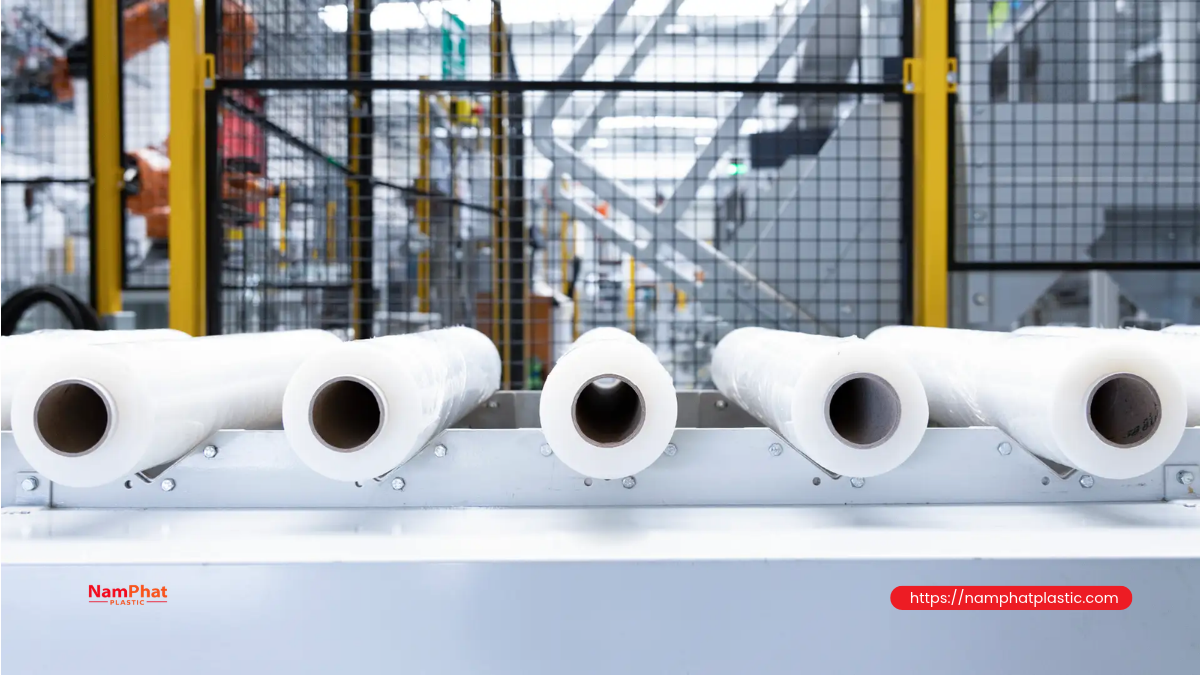
Direct winding into finished rolls can eliminate a conversion step if the winder meets width, core and weight requirements. Jumbo rolls are semi-finished material for a slitter-rewinder. They offer more flexibility when orders require different widths, but add handling and yield-loss controls.
Whether a winder can produce hand rolls, machine rolls or jumbo rolls is a feature of the specific winder. SML's winding range shows these differences. Do not assume that every line needs a separate slitter-rewinder.
For pre-stretch, speed-differential roller groups elongate the film before rewinding. Control width reduction, edges, tension and unwinding performance. Both inline and offline solutions are available. The selected option should match output volume, changeover capability and actual quality, not just mechanical speed.
7. Quality control: measure the right properties
Elongation at break differs from working pre-stretch
Elongation at break is measured by stretching a sample until it fails. Working stretch must leave enough capacity to withstand sharp edges, acceleration and vibration during wrapping. Therefore, do not use the elongation-at-break percentage directly to set the pre-stretch unit.
Using the increase-in-length convention, stretch ratio (%) = (length after stretching − original length) / original length × 100. For example, 1 m stretched to 3 m is a 200% increase, not 300%. Agree on the calculation convention with the machine supplier when discussing settings.
Connect film sample tests to pallet performance
- Thickness: record the average, cross-web distribution and any abnormal thin spots. Verify online gauges against sampled measurements.
- Tensile and tear: record machine direction (MD), transverse direction (TD), test speed and sample conditions.
- Puncture: assess with a suitable method such as ASTM D5748. Peak force alone may overlook deformation capacity and energy to failure.
- Cling: use the correct contacting surfaces, sample age and peel condition. ASTM D5458 describes a method for measuring cling between film layers.
- Recovery and stress retention: track after stretching. ASTM D5459 is a reference method for this property group.
Holding force (the film's retaining force after stretching) must be clearly defined in the method and measurement timing. Containment force on a pallet is also affected by wrapping force, number of layers, overlap and load geometry. A film sample that performs well in a laboratory is not enough to conclude that a pallet is stable. Check after wrapping, after a suitable waiting period and under representative transport testing.
QC records should state the method edition, test conditions and agreed acceptance criteria. Citing an ASTM method name in a document does not by itself prove that a product was tested or passed.
8. Calculate actual film weight separately from the paper core
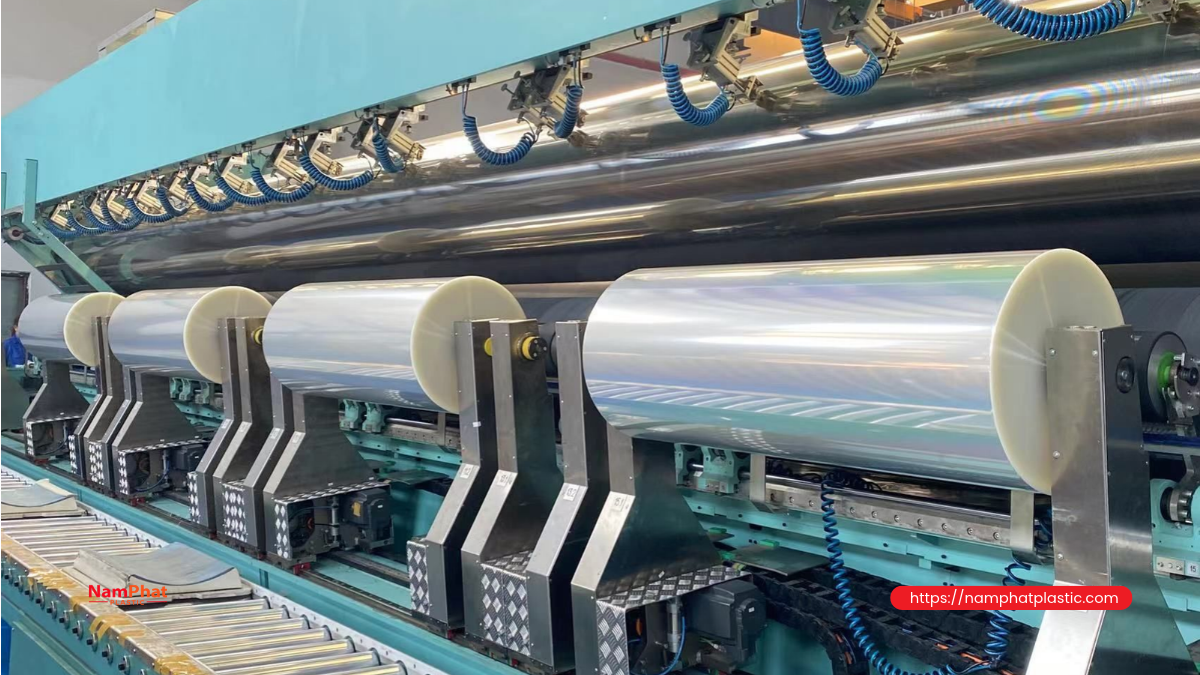
Net film weight = roll weight − core weight − any accessories weighed with the roll. Example: a roll weighs 3.00 kg and the core weighs 0.50 kg, with no accessories; the film weighs 2.50 kg. Two rolls with the same gross weight may contain different amounts of film.
For a dimensional cross-check: film weight (kg) ≈ width (m) × length (m) × average thickness (µm) × density (kg/m³) × 10−6. Use a density appropriate to the blend; do not use one default value for every film.
This formula is an estimate. Thickness variation, shrinkage or stretch during length measurement, and material structure all affect the result. Verification weighing and lot-based core-weight control help avoid confusing the actual plastic quantity delivered to the customer.
9. Common defects and troubleshooting directions
| Symptom | Cause groups to check |
|---|---|
| Thickness bands and raised rings in the roll | Die distribution, melt flow, roll contact, measurement data and winding force |
| Gels, black specks and pinholes | Raw-material contamination, long residence time, melt-path cleaning, filtration and recovered-edge sources |
| Breaks during stretching or tears from the edge | Knife edge, thin spots, gels, structure and stretch level on the wrapper |
| Weak or excessive cling | Additive grade, feed ratio, film age, cling side, storage conditions and slip interaction |
| Wrinkles, telescoping or overly tight rolls | Roll alignment, tension, winding pressure, core and film temperature before winding |
These are troubleshooting directions, not definitive diagnoses. Compare when the issue began with resin-lot changes, screen changes, blades or winding conditions. Controlled changes and retained samples help identify causes better than changing many settings at once.
10. Safety and line acceptance
Dies and hot polymer can cause burns; melt paths may retain pressure; haul-off rolls, knives and winders can trap or draw in operators. Cleaning, jam removal and tool changes must follow energy-isolation procedures, safety-state verification and equipment-maker instructions. Do not reach in to adjust film edges while the machine is running.
Acceptance records should cover target products, roll quality, conforming-product rate, material loss, electricity use and changeover capability under agreed trial conditions. Advertised capacity cannot replace performance results using the actual resin and product specifications. Check guards, interlocks, emergency stops, ventilation, lifting equipment and training as well.
Frequently asked questions
Are multilayer lines always better?
No. Evaluate layer functions, distribution quality, materials and actual process capability. Layer count is one configuration characteristic.
Is a slitter-rewinder mandatory?
No, if the main winder can produce the required finished rolls. If jumbo rolls are converted into multiple specifications, a suitable slitter-rewinder is needed.
Can film edge trim be returned to production?
It may be possible for clean, traceable trim at a validated ratio. Control contamination, thermal history and effects on film properties; do not treat all film scrap as equivalent.
Why check cling after storage?
Some additive systems develop cling over time. Define sample age and storage conditions to compare production lots on an equal basis.
Can Nam Phát advise on a film specification for a particular need?
You can send roll width, net film weight, wrapper details and pallet photos through Nam Phát's pallet stretch film page. Clear input information helps align the discussion with material requirements and sample-testing methods.
- 0 Comment


