


 Phan Van Hoang
- 20/10/2026
- 1
Nam Phát Plastic · Packaging Technical Library
A jumbo bag/FIBC production line involves more than tape extrusion, weaving and sewing machines. It is a system that translates containment requirements into a verified load-bearing construction, in which fabric, lifting loops, sewing thread and liners must work together.
A fabric roll that meets its specified mass per unit area does not guarantee that the bag meets its load rating. Likewise, increasing extrusion speed will not necessarily increase finished output if loop sewing, liner insertion or final inspection is overloaded. This article examines the line through three questions: what each stage produces, what must be controlled and what evidence supports acceptance.
Table of Contents [Hide]
1. Define the bag design before selecting machinery
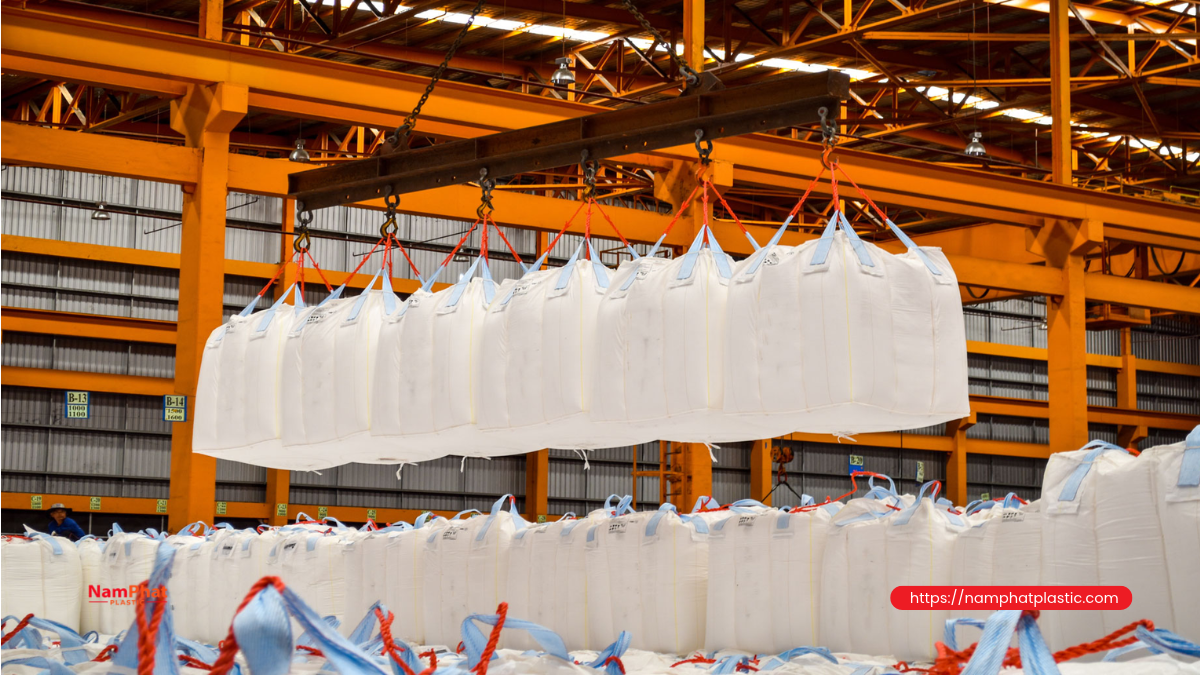
FIBC stands for Flexible Intermediate Bulk Container, commonly called a jumbo bag or big bag. A typical construction uses woven PP fabric, lifting components, and filling and discharge features suited to the contents. It differs from a small woven PP sack in its load-bearing design requirements and assessment of the entire lifting system.
The design brief should specify the contents, loose bulk density, flow properties, particle fineness, moisture sensitivity, filling temperature, lifting method and operating environment. Only then should dimensions, safe working load, body construction, number of lifting points, coating and liner be finalized. The FIBCA FIBC Design Guide provides a useful form for gathering this information.
Two bags of the same volume may require different configurations. Dense contents increase strength requirements; fine powders highlight the risk of leakage through seams; hygroscopic materials require barrier assessment. Machinery or fabric mass should therefore not be selected solely from a product's trade name.
2. Jumbo bag production line flow
Design approval → raw material inspection → film extrusion, slitting and PP tape drawing → heat setting and winding → fabric weaving → coating if required → component cutting → sewing the body, base, top and lifting loops → liner insertion if required → cleaning and inspection → baling and batch traceability.
Lifting loops, sewing thread and liners run alongside the fabric production stream. These components may be manufactured in-house or purchased to approved specifications. An integrated factory does not have to make every component itself; what matters is incoming quality control and compatibility among components.
| Equipment group | Main output | Acceptance points to agree |
|---|---|---|
| Extrusion, drawing and tape winding | PP warp and weft tapes for weaving | Linear density, strength, elongation at break, thermal shrinkage and unwinding performance |
| Body fabric looms and webbing looms | Fabric and webbing | Width, weave density, defects and strength in the load-bearing direction |
| Coating, cutting and sewing | Bag construction to drawing | Coating, dimensions, seams, loop position and anchorage |
| Liner processing, cleaning and inspection | Finished bags | Leak integrity, cleanliness, batch labels and applicable test results |
These equipment categories appear in Lohia's woven packaging technology range. However, a machinery catalog does not replace line design for a specific product mix.
3. PP tape extrusion and drawing: the foundation of load-bearing performance
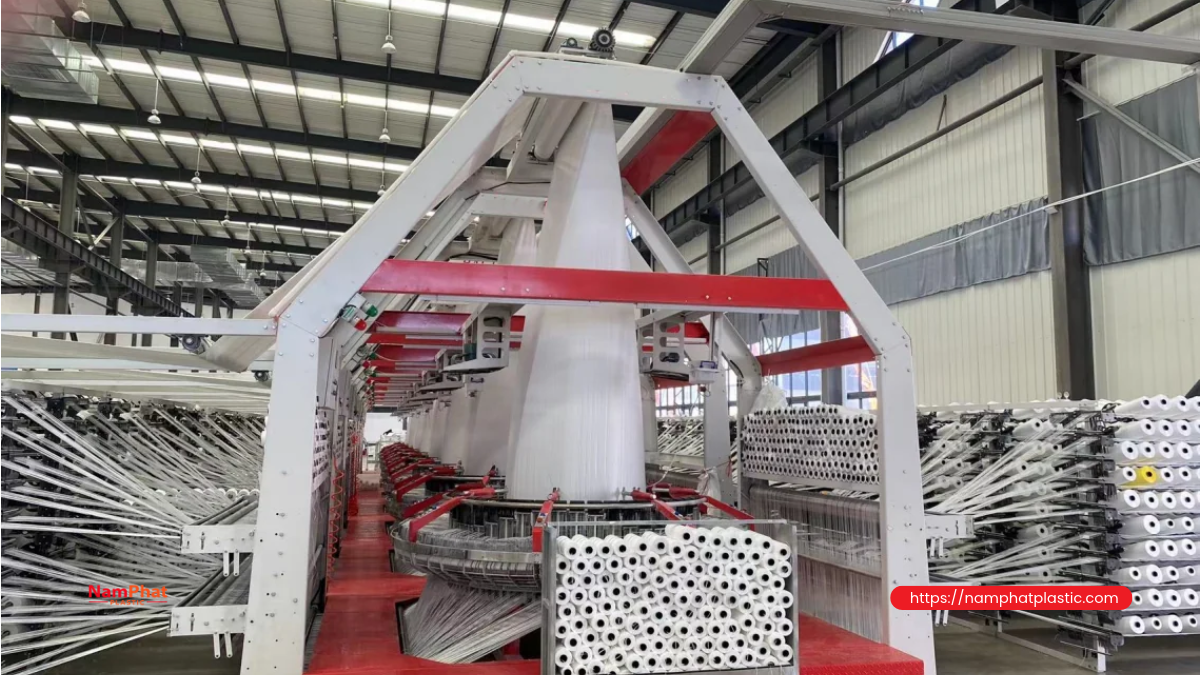
Blending, film extrusion and tape slitting
PP pellets are metered, blended with approved ingredients and melted in an extruder. The melt passes through filtration and a flat die to form film, which is cooled before being slit into narrow tapes. The base material, dispersion and melt flow stability influence tape uniformity.
A single additive, filler or recycled resin formulation should not be applied to every FIBC. Blend changes require reassessment of mechanical properties, processability, customer requirements and food-contact conditions where relevant. A machine's ability to process a material does not by itself establish that the finished bag is suitable for its intended use.
Drawing, heat setting and winding
Tapes are heated and drawn to orient the polymer structure, followed by heat setting to control residual shrinkage, then cooling and winding. The Starlinger starEX 800 documentation describes separate drawing and annealing sections. These are functional stages, not a universal set of machine settings for every tape.
Linear density is commonly expressed in denier or tex. Denier is the mass in grams of 9,000 m of yarn; tex uses 1,000 m. When testing tapes, consider both breaking force and tenacity, because a heavier tape may have a higher breaking force without better material efficiency.
Monitor the distribution of results across sampling positions and production times rather than recording only an average. Variations in tape linear density or elongation at break can cause breaks, uneven tension and weaving defects. Packages also require checks for uniformity, winding edges, cores and unwinding performance; principles of stable winding are presented in Lohia's winding systems.
4. Weaving body fabric and lifting webbing are different tasks
Circular looms produce tubular fabric; flat looms produce flat fabric. Tubular fabric may be retained for a circular bag body or slit to suit the conversion process. Machine selection should consider usable width, the ability to weave reinforced zones, yarn density and operating stability, not only shuttle count or nominal speed.
Lohia's technology brochure describes looms for tubular or flat PP/HDPE fabrics used in various applications, including FIBCs. For production control, fabric mass in g/m² must be considered alongside fabric width, warp/weft density and tensile testing in each direction. Two samples of equal mass per unit area may still differ in structure and mechanical properties.
Lifting webbing is usually woven on suitable narrow-fabric equipment, such as needle looms. It is not a bag-closure tie. Webbing requires material documentation, specified width and mechanical properties, and compatibility with its anchorage area on the body. The strength of webbing alone does not establish the strength of the sewn lifting assembly.
Flat PP tapes for body fabric differ from the multifilament yarns used in some types of webbing and sewing thread. Read more about woven PP bag construction and types.
5. Coating and liners: complementary functions, not substitutes
Extrusion coating applies a polymer layer to the fabric substrate. The machine includes unwinding, extrusion, a die, cooling nip and rewinding; tension control helps limit wrinkles and substrate distortion. The Lamicoat Prime documentation confirms LDPE/PP coating capability on woven fabrics, including FIBC fabric.
| Option | Functions to consider | Limitations to remember |
|---|---|---|
| Uncoated fabric | Air release through the weave; eliminates one processing stage | Do not assume it retains fine powder or prevents moisture ingress |
| Coated fabric | Limits particle passage through the substrate; adjusts permeability | Needle holes, seams and bag openings still require attention |
| Internal liner | Provides a separate contact layer and protective barrier | Film, seals, fit and attachment method must be checked |
A coated bag should not be advertised as “completely waterproof” merely because it has a coating. Where water vapor or oxygen transmission must be controlled, corresponding specifications, test methods and measurement conditions are required. The moisture barrier performance of a film alone is not the performance of a sewn, closed and transported bag.
PE liners may be produced from blown film, then cut, sealed and shaped. A simple tubular liner differs from a form-fit liner shaped to the bag; multilayer structures are an option for higher barrier requirements. W&H describes blown-film and film-bag conversion technology, while Material Motion presents FIBC liner configurations.
During insertion, avoid twisting, insufficient length, folds obstructing the discharge spout or film tension at corners. Fixing with tabs, ties or other methods must follow a tested design. Replacing a liner in a static-protective bag is a significant technical change, not simply an equivalent accessory substitution.
6. Cutting components for 4-panel, U-panel, circular and baffle constructions
Cutting drawings must identify weave direction, dimensions, seam allowances, filling opening, discharge base and lifting-loop attachment zones. Hot cutting, ultrasonic cutting or die cutting is selected according to material and purpose. Excessive cutting heat may harden or distort edges; inadequately finished edges may fray.
| Construction | Processing features | Points to check |
|---|---|---|
| 4-panel | Four body panels joined to a base | Yarn direction, vertical seams and corner consistency |
| U-panel | One panel forms the base and two opposite sides, with two additional side panels | Fold positions, panel joints and loop arrangement to drawing |
| Circular | Tubular fabric body reduces vertical seams | Base and top seams and loop anchorage areas still carry loads |
| Baffle | Internal baffles limit bulging | Material-flow openings, baffle seams, liner compatibility and discharge |
Baffles are an additional feature and do not necessarily exclude other body constructions. Load ratings cannot be ranked by construction name alone. Final strength also depends on materials, geometry, seams and test results. Terminology is cross-checked against the FIBCA terminology glossary.
Webbing cutting should include positioning marks to reduce anchorage-length errors during sewing. Baffle production also requires control of scraps left after punching. Lohia's FIBC conversion machinery distinguishes fabric, webbing and profile cutting, showing that they are different processing requirements.
7. Sewing the body, lifting loops and filling/discharge spouts: control the entire joint system
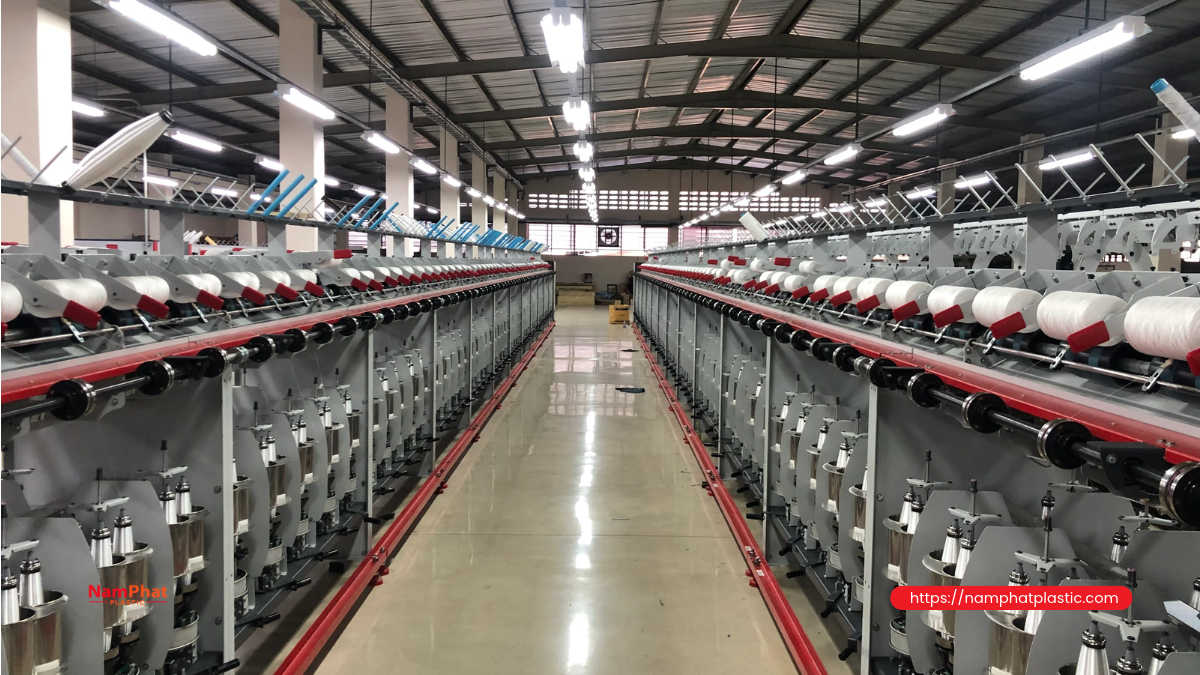
Seams transfer forces between components. Approved parameters should include stitch type, seam construction, edge distance, stitch density, number of rows, seam termination and loop anchorage length. Unconditionally increasing stitch density is not a strength solution: excessive needle perforation may create a weakened line in the fabric.
Thread selection depends on material, size, breaking force, elongation at break, uniformity, abrasion resistance, sewability and operating environment. Coats' thread technical documentation emphasizes that multiple yarn properties influence seam performance. A designation such as “1000D/2” therefore cannot establish suitability for every jumbo bag.
Selection should start with actual fabric, webbing, seam construction and machinery. Conduct sewing trials, assess appearance, test joints and then test complete bags according to the plan. Analyze the failure location: thread breakage, fabric tearing beside needle penetrations or loops slipping from their anchorage point to different corrective actions.
Filling spouts, discharge spouts, ties and protective covers must suit the filling equipment. For fine powders, leakage control may combine coating, seam-filling material and liners. Results must be verified under representative use conditions, not merely by observing a neat seam.
8. Cleaning, foreign-object inspection and traceability
Loose thread, fabric scraps and foreign matter must be removed after sewing. Cleaning equipment may use filtered air with extraction, as described in Lohia's special-purpose FIBC machinery documentation. Blowing operations should not transfer dust from one bag to another.
Metal detection is an additional measure where risk assessment or customer requirements call for it, not a universal rule for every FIBC. Detection capability must be validated using the actual bag configuration, test pieces and a procedure for segregating defective products. A detector does not replace broken-needle control, tool management or visual inspection.
Finished-product identification should link to resin batches, tapes, fabric rolls, webbing, thread, liners, production shifts and inspection results. When suppliers or materials change, the change history must be linked to approved samples. Without this connection, identifying affected batches is slow and may lead to unnecessarily broad rejection.
9. Quality control and acceptance criteria
Distinguish in-process checks, batch acceptance and design validation testing. Measuring fabric mass or testing a fabric strip does not replace complete-bag testing. Conversely, a previously successful design sample does not guarantee that all subsequent batches are manufactured correctly.
| Control level | Typical characteristics | Acceptance basis |
|---|---|---|
| Raw materials and purchased components | Identification, batch, specifications and material documentation | Bill of materials, purchasing requirements and approved samples |
| Tapes, fabric, webbing and thread | Linear density, mass per unit area, tensile strength, elongation and dimensions | Approved limits, test methods and conditions |
| Sewing, liners and finishing | Construction, dimensions, joints, seals and cleanliness | Drawings, inspection plans and defect classification |
| Complete bags | Load testing and tests within the applicable scope | Contractual standard, sample configuration and test reports |
For FIBCs for non-dangerous goods, ISO 21898:2024 specifies requirements for materials, design, type testing and marking. This second edition replaces ISO 21898:2004. Test planning must use the correct edition and contractual scope; this article does not replace the full standard.
SWL is the safe working load assigned to a bag. SF is a factor associated with test requirements, not permission to load beyond the SWL. Single-trip and multi-trip bags have different use regimes; a single-trip bag does not become reusable simply because it still looks good. Read the label, reports and manufacturer's instructions rather than drawing conclusions from an SF ratio alone.
For lifting and cyclic lifting tests, confirm the suspension arrangement, test samples, load, cycles and failure criteria. Do not select an arbitrary test load and then label the bag compliant. Batch acceptance must also specify sampling, handling of critical defects, segregation, reinspection and who is authorized to release products.
10. Static electricity, dangerous goods and food contact
Types A, B, C and D are not load classes
IEC 61340-4-4:2018, edition 3.0 addresses the electrostatic classification of FIBCs and liners and related test methods. Selection must be based on the contents, the possibility of an explosive atmosphere and assessment at the filling/discharge location.
| Type | Main meaning | Operating precautions |
|---|---|---|
| A | No dedicated static-protection measures | Do not use as a solution for electrostatic fire or explosion hazards |
| B | Limited breakdown voltage; does not actively dissipate charge | Do not equate with C/D; check the permitted use conditions |
| C | Conductive paths connected to an earthing point | Earth correctly before and during filling/discharge; stop if earthing is lost |
| D | Static-protective material that does not require earthing of the bag itself | Appropriate use conditions, contamination control and compatible liners remain necessary |
This summary is based on FIBCA's classification guidance and does not replace bag selection for hazardous areas. “Type D does not require bag earthing” does not mean that earthing of personnel, equipment or conductive objects in the area can be omitted. Bag type cannot be confirmed by color, visual appearance or the presence of a few conductive yarns.
Do not substitute non-dangerous-goods ISO documentation for UN documentation
FIBCs carrying dangerous goods must be assessed against applicable transport regulations, permitted packaging designs, testing and corresponding marking. UN Model Regulations Rev.24 (2025) is the current United Nations reference; implementing requirements also depend on transport mode and route. A Type C/D label or ISO 21898 test result does not automatically provide UN certification.
Likewise, virgin resin, a white color or the presence of a liner does not by itself demonstrate food suitability. Contact-material documentation, destination-market compliance, migration assessment where applicable, production hygiene and traceability are required. Management-system certification does not replace conformity evidence for the specific contact material. See the FIBCA Food Safety Guide.
11. Line balancing: measure conforming bag output, not the sum of machine speeds
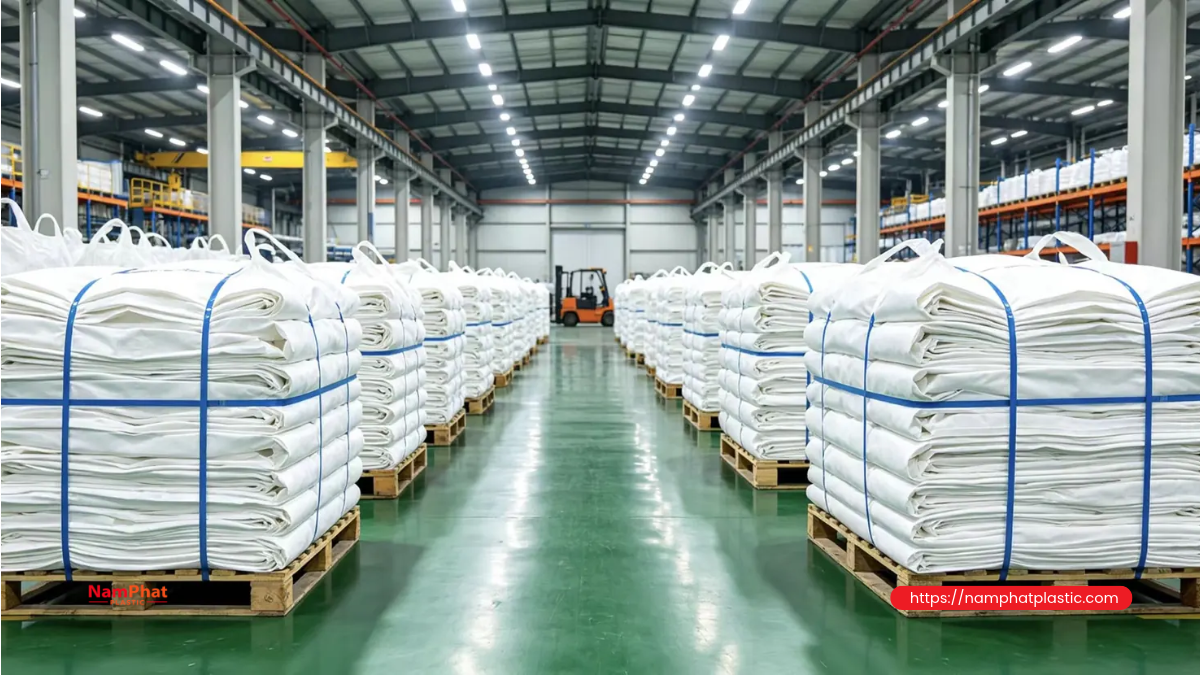
Extruders are rated in kg/hour, looms in meters of fabric and sewing teams in bags. To balance the line, convert these figures into conforming bags over the same period using the material consumption of each product code. Theoretical capacity must be adjusted for downtime, changeovers, scrap and rework.
One management calculation divides conforming material output by the material consumption per bag. For sewing, use measured operation times and the capacity of the assigned workforce. Fabric allowances must include the body, base, top, baffles and verified waste, not just the surface area of the finished box shape.
The bottleneck may shift from weaving to sewing when the proportion of baffle bags rises, or to liners when orders require complex insertion and attachment. Signs include work-in-progress accumulating before a stage and shortages afterward. Measure by product family rather than committing to complex-bag output based on the productivity of a simple bag.
For line acceptance, agree on representative product codes, raw materials, operators, run duration, conforming output, defect rate and consumption per conforming product. A short high-speed run does not demonstrate stable capacity. Costs should also include electricity, compressed air, cooling, inspection, maintenance, changeovers and work-in-progress inventory, not only machinery purchase prices.
12. Common defects and diagnostic checks
| Symptom | What to verify | Priority action |
|---|---|---|
| Frequent tape breaks and warp-direction fabric defects | Tape mechanical properties, packages, guides and tension | Identify the affected batch and defect locations before changing the formulation |
| Wrinkled fabric or unstable width | Tension, winding, residual shrinkage and coating | Measure under consistent conditions; check preceding and following stages |
| Tearing beside seams | Needles, stitch density, seam allowance and yarn direction | Retest the joint rather than merely increasing thread size |
| Loop slippage or tearing at the anchorage | Anchorage length, stitch pattern and reinforcement area | Segregate affected configurations; assess the design and retest |
| Powder leakage or leaking liners | Leak location, seams, needle holes and seals | Correct the actual failure mechanism, then verify samples |
| Liner pulled out during discharge | Fit, attachment points and flow behavior | Conduct representative filling/discharge trials with the adjusted configuration |
These are diagnostic directions, not machinery-repair recipes. Products with load-bearing defects or lost static-protection performance must be segregated; they must not be released merely because their appearance has been repaired.
13. Operating safety and checks before ordering
Risk areas include winding shafts, nip points, cutting blades, hot dies, electricity, compressed air and pressing mechanisms. Guards, interlocks, training and energy-isolation procedures are required before maintenance; a stop button does not replace isolation. OSHA's plastics machinery safety guidance is a technical reference, not a substitute for Vietnamese legal requirements or machinery documentation.
Lifting-test areas need barriers and exclusion zones. When handling bags, do not stand under suspended loads, exceed the SWL or use lifting points contrary to instructions. The FIBCA Safe Handling Guide should be read alongside site procedures.
Before ordering machinery or approving bags, request drawings and bills of materials; reference samples; applicable standards; inspection plans; acceptance-run conditions; traceability documentation; spare parts, training and warranty scope.
Frequently asked questions
Can a woven PP sack line produce jumbo bags?
Some technology platforms can be shared, but weaving width, material mechanical properties, cutting and sewing equipment, webbing production and FIBC testing capability must be checked. A factory's existing production of small woven PP sacks is not sufficient evidence.
Do jumbo bags always need coating and a PE liner?
No. The configuration depends on the contents and environment. If a liner is required, specify its material, thickness, shape, seals, attachment and electrostatic requirements rather than simply stating “with PE bag”.
Which sewing thread works for every FIBC?
There is no universal thread size. Select and test the thread with the fabric, webbing, seams, machine and use conditions. A commercial thread designation does not replace evidence of the complete bag's load-bearing performance.
Does a higher SF allow loading above the SWL?
No. SWL remains the assigned working load limit. The test factor is not an allowable operating overload.
Does the extruder determine the capacity of the entire line?
Not necessarily. The slowest stage, after conversion to conforming bags, determines throughput. Product mix, changeovers, rework rate and finishing operations must be considered.
Conclusion: start with the intended-use configuration and finish with test evidence
An effective FIBC line is not a collection of the fastest machines, but a sequence of stages producing the same approved configuration. Conforming materials, correct sewing, suitable liners and traceable testing must be treated as one system.
Explore Nam Phát industrial bag sewing thread or the PE product range, then discuss fabric samples, seam construction, machine type and use requirements to confirm which specifications can be supplied. Suitability for FIBCs must be verified through separate samples and documentation.
- 0 Comment


