


 Phan Van Hoang
- 21/10/2026
- 1
An EPE foam sheet/roll production line converts polyethylene into lightweight cushioning material through physical foam extrusion. Quality depends on more than the extruder: raw-material dosing, blowing-agent dispersion, melt cooling, shaping, haul-off, winding and post-extrusion stabilization all determine whether the product retains the required thickness, resilience and dimensions when it reaches the customer.
For packaging businesses, the key question is whether a line delivers conforming output in the actual specifications to be sold, rather than merely reaching the highest catalogue capacity. This article examines equipment, control points and investment requirements; it is not a guide to operating gas systems or a production recipe.
Table of Contents [Hide]
1. What are EPE foam sheets and rolls? Identify the technology before selecting machinery
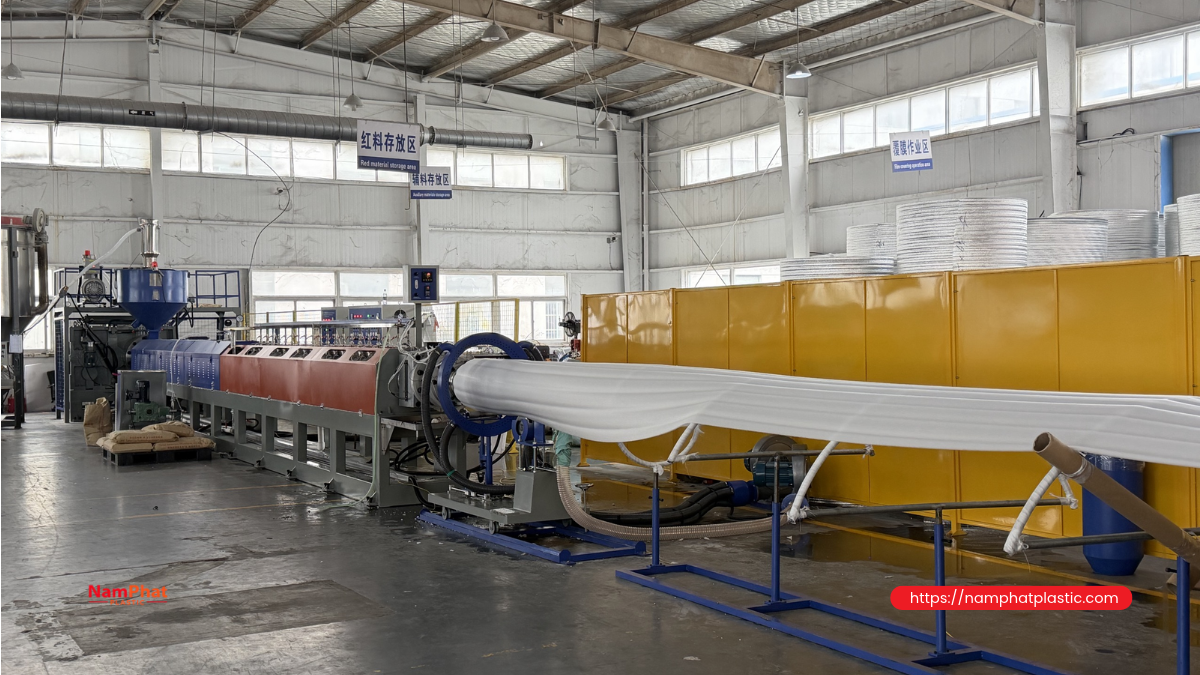
This article covers non-crosslinked PE foam, typically based on LDPE, extruded and expanded into a closed-cell structure and then continuously wound or cut into sheets. The commercial term EPE is sometimes used broadly for various expanded polyethylene products; machinery procurement documents should therefore specify non-crosslinked extruded PE foam sheet/roll, not simply “foam-making machine.”
| Material category | Process characteristics | Important distinction |
|---|---|---|
| EPE sheets/rolls covered here | Molten PE, physical foaming, continuous extrusion | Not bead expansion followed by molding |
| EPS beads | Expandable polystyrene beads, pre-expansion and molding | Different raw materials, equipment and structure from EPE rolls |
| XPE/IXPE | PE crosslinked chemically or by irradiation, depending on the type | A conventional EPE extruder is not a direct substitute |
| PU and EVA foam | Polymer systems and foaming methods vary by product | Processing parameters and recycling conclusions are not interchangeable |
EPE can be used as an anti-abrasion separator, cushioning insert or material for converted, shaped packaging. However, thickness or a soft feel alone does not demonstrate impact protection. Heavy goods, sharp edges and electrostatic-sensitive items require separate criteria. The material’s moisture resistance also does not mean that the finished packaging is watertight.
2. Raw materials and physical foaming: what determines cell structure?
LDPE must suit foam extrusion, not merely have the right polymer name
The resin must flow sufficiently for processing while retaining cell walls during expansion. Melt flow index does not fully describe melt strength, molecular distribution or cell stability. For example, Dow describes LDPE 450E in terms of the balance between melt strength and extensibility for foam extrusion. This illustrates grade-selection logic; it is not a requirement for every line to use this grade.
The factory needs to control resin grades, batches, technical documentation, pre-existing additives and formulation history. When changing suppliers, appearance, apparent density, mechanical properties and storage stability must be reassessed. Do not assume that two resins with the same melt flow index will provide the same speed, scrap rate or quality.
The roles of additives and blowing agents
Nucleating additives support cell formation; dimensional-stability modifiers help balance gas exchange; colorants and functional additives must be compatible with the resin system. Uncontrolled fillers or contaminants can alter mass, surface quality and cell-wall strength. These groups have different functions and should not be lumped together as “foaming powder.”
In physical foaming, the agent is metered into the polymer melt and dispersed under the conditions for which the equipment was designed. As the material leaves the die, a pressure change promotes nucleation and cell growth. Some commercial EPE systems use hydrocarbons such as butane; the gas choice must be confirmed by the OEM and the safety-design specialist. Never substitute another gas simply because it costs less. Foamtech Korea publishes information on PE foam equipment principles and related raw-material categories, but its equipment-specific parameters are not a universal formulation.
3. Line layout and the function of each unit
The general sequence is: raw-material receipt and dosing → plasticization → blowing-agent feeding and mixing → melt temperature conditioning → die and expansion → cooling and shaping → haul-off, slitting and edge trimming → winding or sheet cutting → stabilization and inspection → converting and dispatch. The exact locations of filtration, mixing and cooling must follow the OEM design.
| Equipment unit | Function | Acceptance checks |
|---|---|---|
| Feeding, weighing and blending | Maintain consistent composition and flow | Weighing repeatability, batch identification, prevention of incorrect feeding |
| Extruder | Plasticize, convey and homogenize the resin | Conforming output, stability, ability to change product specifications |
| Blowing-agent dosing unit | Supply the agent according to process design | Measurement, leak tightness, interlocks and safety documentation |
| Melt mixing and cooling | Equalize temperature and agent distribution before the die | Controllability under changing loads and ambient conditions |
| Die, shaping and cooling | Create the cross-section and stabilize cell structure | Cross-web uniformity, surface quality, maintainability |
| Haul-off, slitting and winding | Produce usable width and roll specifications | Tension, length, cut edges, roll stability |
| Stabilization and converting area | Manage intermediate products before lamination/cutting | Ventilation, traceability, criteria for release to the next operation |
How do single-stage and tandem systems differ?
A single-stage machine integrates the main functions within a purpose-designed extrusion system. A tandem system places extruders in series, allowing plasticization, mixing and cooling duties to be separated. Tandem does not mean twin-screw: the number of extruders in series and the number of screws in each extruder are two different classifications.
Pacific Industry publishes single-extruder and tandem EPE configurations. This demonstrates that no single configuration suits every product. Comparisons should require trials using the same resin grade, width, thickness, apparent density and tolerances. Cooling capacity, stability at low loads, order-changeover time and floor-space requirements may matter more than the configuration name.
Pre-die melt cooling differs from post-die cooling
Before the die, the aim is to bring the agent-containing melt to a condition suitable for expansion while maintaining homogeneity. After the die, the aim is to support stable cell walls and dimensions. Insufficient temperature-conditioning capacity can limit output even when the motor has spare power. Technical specifications therefore need to address cooling-water systems, heat exchange and actual thermal loads.
Promix describes dosing, homogenization and cooling modules for physical foam extrusion. This functional separation is useful when assessing a line; its microcell CO2/N2 systems must not be taken to mean that a hydrocarbon EPE machine can switch gases without redesign.
4. From die to roll: controlling thickness and tension
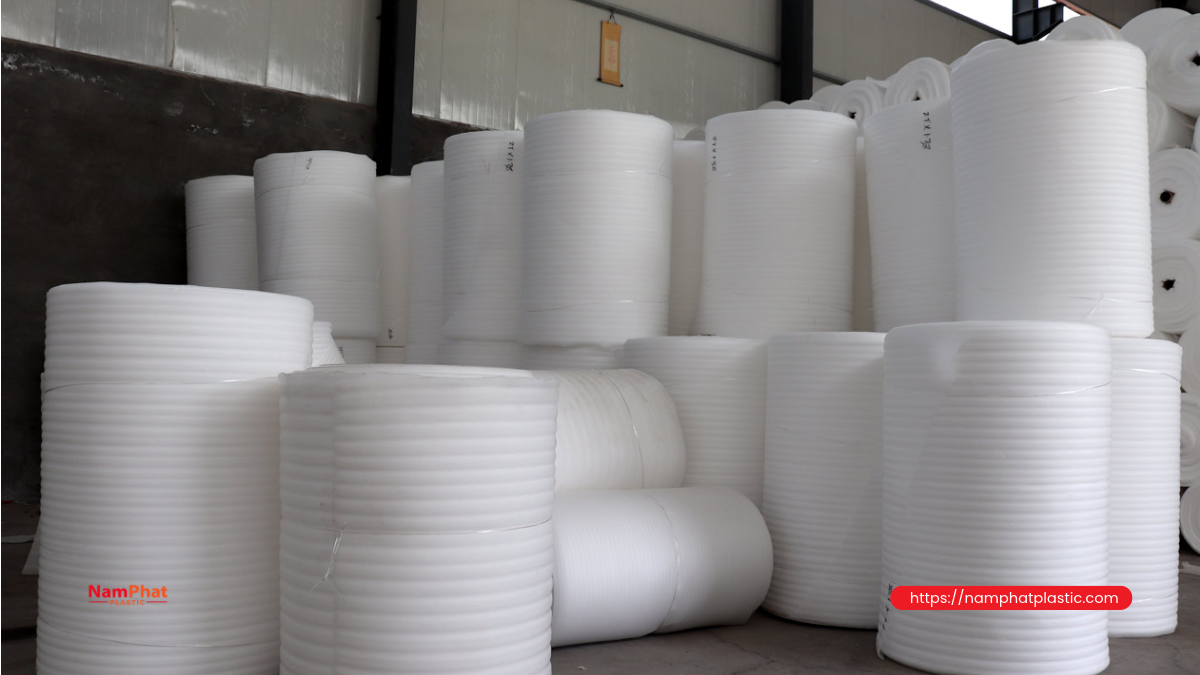
On a line using an annular die, the material may form a foam tube that is shaped and then slit open into a sheet. Flat-die systems form the material differently; the choice depends on the product range. A PE foam patent publication describes die types and the step of slitting a tube into a sheet. This supports the existence of a process option, not an operating standard.
Final thickness results from the combined effects of mass flow, expansion, width and haul-off speed. Increasing haul-off speed may make the sheet thinner but also changes orientation and stress; speed cannot be treated as an independent adjustment. Measuring thickness at multiple cross-web positions helps distinguish localized deviations from whole-line fluctuations.
The haul-off unit must minimize cell crushing and slippage that distorts length. Edge trimming creates clean edges but also reduces usable output. Excessively tight winding may cause compression, wrinkles and differences between inner and outer layers; loose winding can allow rolls to shift out of alignment. Inspection samples should include the beginning, middle and end of the roll after the agreed stabilization conditions.
5. Post-extrusion stabilization and gas safety: not unnecessary waiting time
After leaving the machine, foam continues to exchange gas with its surroundings and may change dimensions. Stabilization time depends on the resin system, agent, cell structure, thickness, winding method and storage conditions. No universal number of hours guarantees that every roll is ready for lamination, enclosed packaging or transport.
Businesses should establish batch-release criteria: dimensions and mass show stability over monitoring, the material is suitable for the next operation, and residual-gas controls and safety requirements established by qualified specialists are met. A faint smell or no detectable smell does not prove that gas concentrations are safe; sensory assessment is no substitute for measurement.
Flammable hydrocarbons may create hazards in gas-supply areas, at machinery, around fresh rolls, in stabilization storage and during thermal converting. The NIOSH publication on butane is an occupational-health reference, not a replacement for an on-site assessment. Systems must be designed, inspected and accepted by the OEM and competent engineers in accordance with applicable requirements.
- Identify hazardous areas, potential gas-accumulation locations and appropriate extraction and make-up air arrangements.
- Provide leak detection, alarms and safe-shutdown interlocks, and verify their functions against the design.
- Control ignition sources, hot surfaces, welding/cutting work and electrostatic discharge; select appropriate electrical equipment.
- Manage grounding, equipotential bonding, scrap housekeeping and emergency response; never disable safeguards to maintain output.
HSE provides fire-control guidance for cellular plastics, including ignition sources, static electricity and storage. This is an international technical reference, not a determination of compliance with Vietnamese law. This article does not provide pressures, temperatures, gas-feed concentrations or emergency procedures for readers to operate a system themselves.
6. Thick sheets, thermal lamination and multilayer materials
Directly extruded thickness depends on machine and die design, apparent density and cooling capacity. It is incorrect to claim that all thick EPE sheets are laminated, or that every roll line can directly extrude thick sheets. Foamtech Korea publishes separate sheet and board lines; the published range of a particular model cannot be attributed to another factory.
Thermally laminating multiple layers is one way to obtain thickness or a structure suited to converting. Bond quality must be checked alongside actual thickness, flatness, compression deformation and resistance to delamination. A laminated sheet can have the correct total nominal thickness and still fail if the bond is weak or the contact region is excessively compressed.
When laminating PE film, paper, metallic film or adhesive-bearing layers, define the purpose: surface protection, increased strength or another function. Added layers alter mechanical properties, gas exchange and recycling routes. Do not automatically apply single-layer foam dispatch criteria to enclosed laminate structures. Thermal operations should take place only after intermediate products have been released under a validated safety procedure.
7. Quality specifications to agree with customers
An order for “thick, lightweight, resilient foam” is difficult to inspect against. Descriptions must be converted into properties with measurement methods, specimen conditions, tolerances and sampling locations. Resin density differs from foam apparent density: an LDPE datasheet cannot replace testing of the finished product.
| Property | Useful specification approach | Practical significance |
|---|---|---|
| Apparent density | kg/m³; specimens of defined dimensions and stabilization conditions | Controls material mass per volume; does not replace all cushioning tests |
| Thickness, width and length | mm, m; specify thickness measurement pressure and tolerances | Avoids disputes caused by foam compression during measurement or winding |
| Cell structure and surface | Criteria for coarse cells, voids, streaks, hard particles and limit samples | Related to uniformity and the risk of scratching goods |
| Compression and recovery | Deformation/load level, hold time, recovery time and temperature | Distinguishes immediate resilience from permanent set |
| Tensile and tear properties | Test method and machine/transverse direction | Evaluates convertibility and directional load resistance |
| Odor, cleanliness and dimensional stability | Sample storage conditions, assessment timing and acceptance criteria | Suitability for product surfaces and storage duration |
| Lamination and electrical function | Bond testing; resistance testing to application requirements | No inference from color or trade name |
For impact protection, test the complete packaging system with the product or an agreed substitute: load-bearing area, cushion placement, gaps and transport conditions all affect performance. Reducing apparent density may save resin but must not compromise protection. Painted surfaces, glass and glossy components require contact-compatibility, abrasion and storage trials.
“Antistatic” does not mean conductive
Ordinary PE is electrically insulating. Surface treatments or antistatic additives do not automatically make it conductive foam with durable properties throughout its bulk. Some mechanisms depend on humidity, time or surface condition. Zotefoams’ electrical-properties document explains the differences between mechanisms; results for its crosslinked foam must not be used to certify a different EPE product.
Pink or black coloration, or an “antistatic” label, is not enough to guarantee component protection. Test reports must cover the correct resistance type, humidity conditions, storage time and customer criteria; where needed, assess charge generation and shielding performance of the complete packaging system as well.
8. Calculating capacity: kg/h cannot be compared directly with m/min
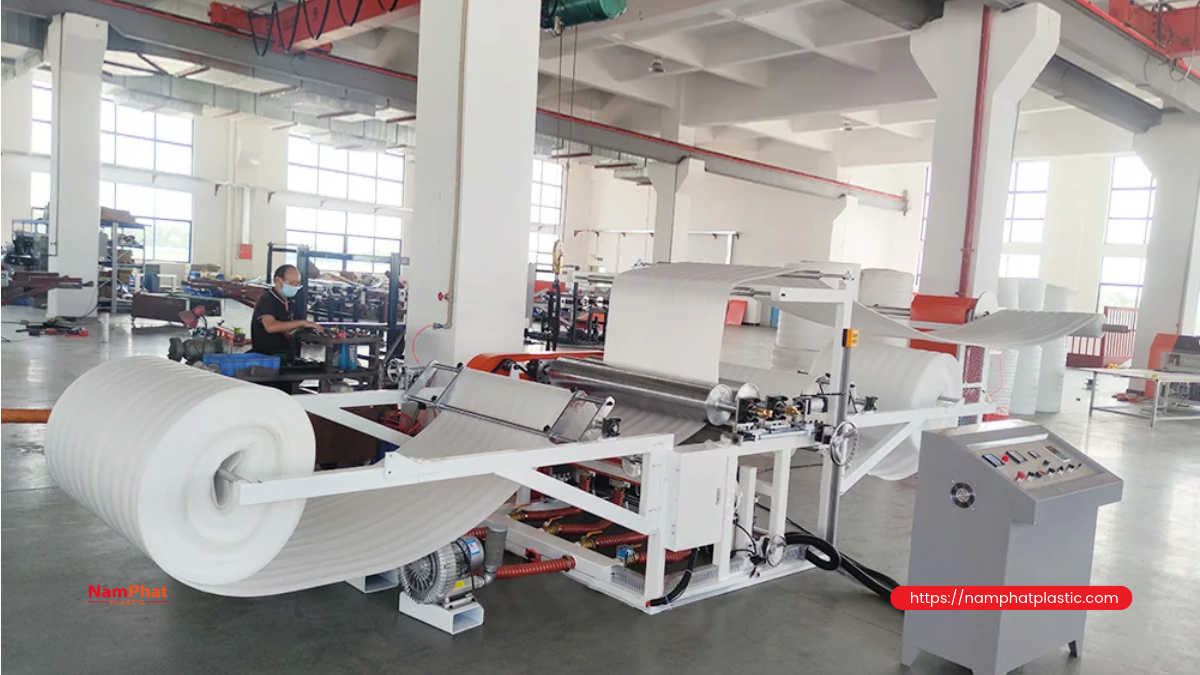
For a uniform sheet after stabilization, finished-product mass can be estimated using this geometric relationship:
Q = 60 × v × W × t × ρ
Here Q is kg/h, v is m/min, W is total usable width in m, t is thickness in m, and ρ is apparent density in kg/m³. If t is entered in mm: Q = 0.06 × v × W × t(mm) × ρ. For multiple webs with different thicknesses or apparent densities, calculate each separately and add the results; do not use an unsupported average.
Entirely hypothetical example: a sheet 1.2 m wide and 2 mm thick, with an apparent density of 25 kg/m³, running at 30 m/min corresponds to Q = 0.06 × 30 × 1.2 × 2 × 25 = 108 kg/h of usable finished product. Mass per area is 0.002 × 25 = 0.05 kg/m², or 50 g/m². This is an illustrative calculation, not a capacity or specification commitment by Nam Phát.
If width, apparent density and speed remain unchanged while thickness doubles, the required mass output also doubles. If the machine cannot increase conforming throughput, speed must decrease or the configuration must change. The formula expresses only a mass-balance relationship; it does not demonstrate thermal, geometric or cell-stability capability.
Distinguish resin feed rate, foam mass on the line and saleable mass after edge trimming, start-up scrap, grade changes and inspection. Shift planning must account for productive running time and the conforming-product rate; do not multiply maximum capacity by all shift hours and treat that as dispatch output. The material balance must also separate released gas and recirculating streams to avoid double counting.
9. Common defects and data-based troubleshooting
The following table offers inspection directions, not a definitive single-cause diagnosis or instructions for adjusting gas systems yourself. If there are signs of leakage, alarms or interlocks, the factory safety procedure takes priority over every quality objective.
| Symptom | Potential cause groups to verify | Data to compare |
|---|---|---|
| Uneven cross-web thickness | Flow distribution, die, cooling and shaping | Thickness map, defect location, cleaning/maintenance history |
| Variation along the length | Feeding, throughput, haul-off or temperature control | Process trends synchronized with sampling times |
| Coarse cells, voids or collapsed areas | Dispersion, melt condition, raw materials | Cross-section images, apparent density, resin batches and change history |
| Shrinkage after storage | Gas stabilization, cell structure, winding/storage conditions | Dimensions over time, position within the roll |
| Wrinkles, misaligned rolls, crushing | Tension, alignment, contact pressure | Samples from individual roll layers, slippage and winding data |
| Unusual odor, black specks, hard particles | Contamination, retained material, thermal degradation or additives | Raw-material samples, cleaning history, recycled-scrap traceability |
| Delamination after bonding | Surface condition, foam condition, bonding process | Failure location, flatness, batches before and after lamination |
An effective approach retains reference samples, records changes by batch and tests hypotheses under controlled conditions within OEM-approved limits. Changing several factors simultaneously prevents reliable cause identification. A batch that passes immediately after extrusion still needs post-stabilization assessment when defects appear later.
10. Recycling and investment costs: assess the whole system
Non-crosslinked EPE can enter a suitable thermomechanical recycling route, but not all EPE scrap is collected or reused in the same way. Clean, single-source scrap differs from post-use material contaminated with oil, adhesive, paper or other films. Multimaterial lamination, functional additives, odor and processing degradation may limit end uses.
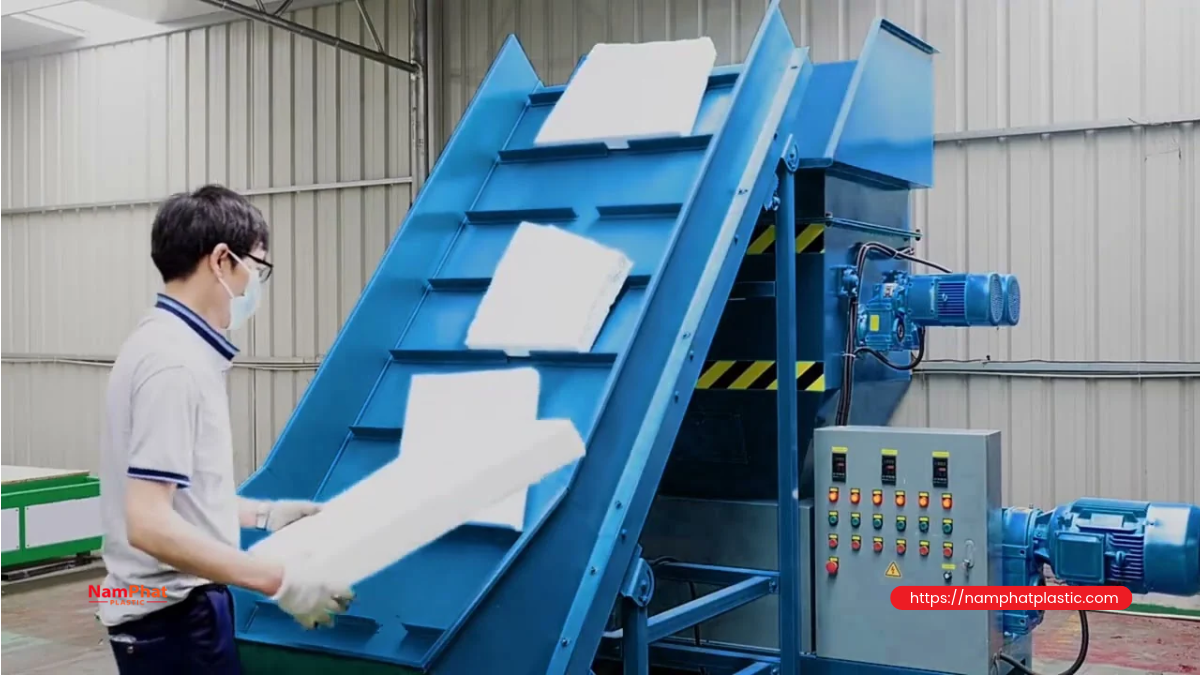
Scrap must be sorted, residual gas managed, and processing carried out using appropriately designed equipment; densification, pelletizing and reintroduction into formulations require quality and safety assessment. Do not claim “100% recyclable” or a fixed recycled-resin content without establishing the receiving recycling route, finished-product standards and test results. Recovering material does not mean zero losses or suitability for reuse in every application.
The budget must include the main machine and commonly overlooked items: gas systems, cooling, electricity, ventilation, fire protection, stabilization space, measuring instruments, winding/cutting, converting, scrap management, training and spare parts. A reliable line price cannot be determined from the name “EPE machine” alone because supply scopes can differ substantially.
When comparing quotations, require the same product matrix and acceptance conditions. Unit cost should be based on kg or m² of saleable conforming product, including resin, additives, blowing agent, electricity, labor, maintenance, losses, inventory and transport. Foam is light but bulky, so storage and logistics can become bottlenecks even when the machine has spare capacity.
11. Checklist before approving an EPE line purchase
- Finalize the range: sheets/rolls, usable width, thickness, apparent density, single-layer or laminated construction.
- Define the purpose: scratch separation, load-bearing cushioning, shaped converting or specialized electrical requirements.
- Request samples and trials using the planned raw materials; measure after agreed stabilization conditions.
- Document guaranteed capacity for each specification, quality, scrap and utility scope.
- Review gas-system design, ventilation, interlocks, fire protection and acceptance authority.
- Agree handover documentation, training, maintenance, spare parts and responsibilities if acceptance criteria are not met.
From an industrial-packaging perspective, begin with the characteristics of the goods to be protected before choosing material and technology. You can consult Nam Phát Plastic’s PE packaging range when developing an overall packaging approach. This educational content does not claim that Nam Phát sells machinery or owns an EPE production line.
12. Frequently asked questions
Can an EPE line produce EPS bead foam?
They should not be treated as the same line. The EPE sheets/rolls discussed here are continuously extruded PE foam, whereas EPS beads use different raw materials and forming processes. Technical requirements must clearly specify the material, structure and product form.
Is a tandem system always better than a single-stage machine?
No. The suitable configuration depends on product range, cooling capacity, stability, floor space and conforming-output efficiency. Trials against the same specifications are more valuable than comparing configuration names or maximum capacities.
Must thick EPE sheets be laminated from multiple layers?
Not necessarily. Some equipment directly extrudes thick sheets or boards, but limits depend on the model and product conditions. Multilayer lamination is another option and requires control of bonding, flatness and deformation.
Can EPE be enclosed and dispatched immediately after extrusion?
No general conclusion is possible. Dimensional stability, residual gas, safety and subsequent processing requirements must be met. A fixed waiting time or odor assessment does not replace a validated batch-release procedure.
Does pink EPE necessarily protect electronic components?
No. Color is only an identifier. Electrical performance must be verified using suitable test methods and conditions of use; antistatic, static-dissipative and conductive are not interchangeable concepts.
Conclusion: An effective EPE production line must coordinate foam quality, usable output and safety from raw-material feeding through stabilization storage. The more clearly the investment specification defines products, inspection methods and acceptance conditions, the better a business can avoid purchasing a machine that meets nominal capacity but fails to deliver the products it needs.
- 0 Comment


