


 Phan Van Hoang
- 21/10/2026
- 17
A Raschel net knitting machine forms netting by interlooping systems of warp yarns. Typical applications include shade nets, crop-protection nets and produce mesh bags. Selecting a machine by width and speed alone overlooks decisive factors: yarn supply, loop construction, aperture stability and quality after finishing.
This guide works from the finished-product requirements to equipment configuration, quality control and acceptance testing. OEM information illustrates technology; it does not state that Nam Phát owns, sells or supplies every machine discussed.
1. How does Raschel differ from leno and extruded netting?
| Technology | How the structure is formed | Key distinction |
|---|---|---|
| Raschel warp knitting | Needles and guide bars form loops with connecting sections or inlaid yarns | Aperture geometry changes under tension; stretch and structural stability require testing |
| Leno weaving | Crossing warp yarns secure the weft to create an open woven structure | The loom, weft supply and fabric-forming mechanism differ from Raschel knitting |
| Directly extruded netting | Molten polymer forms strands and junctions through a net die | There are no knitted loops; extrusion, cooling and drawing determine the product |
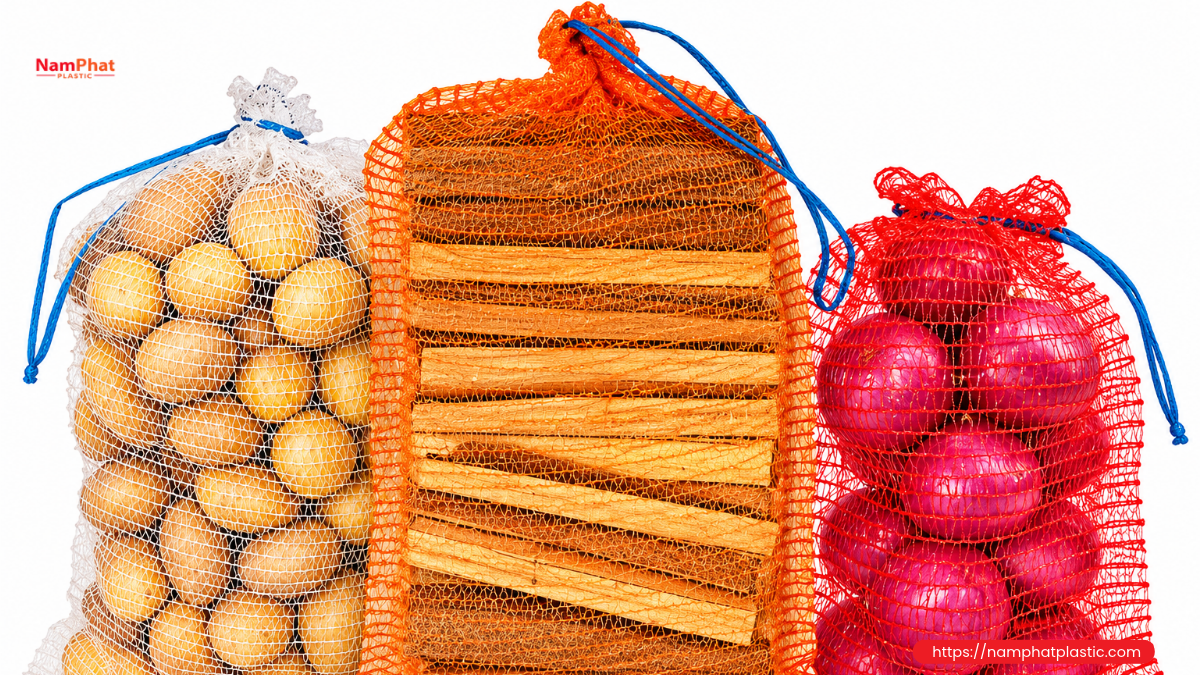
Starlinger FX leno is an example of a loom producing tubular leno fabric from PP or HDPE tapes. LyondellBasell's netting overview distinguishes knitting from continuous extrusion. The commercial term “mesh bag” therefore does not identify the manufacturing technology: inspect the construction or provide a sample.
Do not treat agricultural netting as fall-arrest netting, a lifting net or a tensioned shade structure for people. Those applications need separate design and validation; thickness or a sturdy feel is not sufficient evidence.
2. Define the product before selecting the machine
For shade nets, specify the shading value and measurement method, usable width, mass per unit area, mechanical requirements, outdoor durability and attachment method. For bird-protection or harvesting nets, add the aperture dimensions in a defined condition, aperture shape, product-retention performance and entanglement risks. Insect netting requires validation against the intended pest, not an assumption based on the description “fine mesh”.
For knitted bags, establish dimensions when empty and filled, filling mass, ventilation, retention of small produce, opening and bottom construction, labelling and delivery format. Individual bags, bag rolls for automated filling and tubular netting require different finishing interfaces.
| Parameter | Convention to agree |
|---|---|
| Width and length | Measured after relaxation or under tension; whether edges and joins are included |
| Aperture | Clear opening or centre-to-centre pitch; measurement direction and applied load |
| Mass per unit area | g/m² for the body alone or including edges; sampling and conditioning |
| Elongation and strength | Lengthwise and crosswise directions; specimen dimensions, grips and test speed |
| Shading and outdoor exposure | Radiation range and measurement method; exposure cycle and deterioration criteria |
3. Prepare yarns, tapes and warp beams
A Raschel machine does not directly turn resin pellets into netting. Monofilament yarns or flat tapes must be prepared appropriately; the upstream production line may be in-house or operated by an outside supplier. Select the polymer, colour and stabilisation system for the application, then verify machine runnability with actual material.
Incoming controls should cover linear density in tex or denier, filament diameter or tape width and thickness, strength, elongation, uniformity and package quality. The same linear density does not imply the same friction, stiffness or loop-forming behaviour. Do not substitute multifilament or flat tape for monofilament solely because their mass per unit length is equivalent.
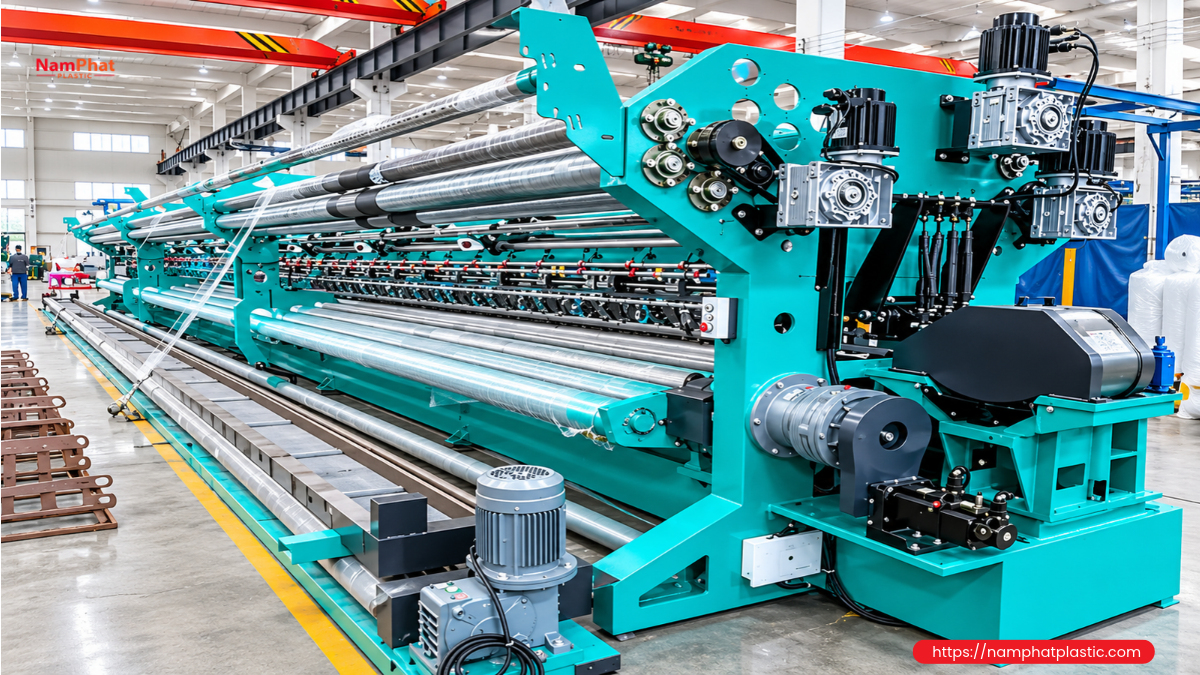
According to KARL MAYER's yarn-feeding documentation, options include sectional warp beams, package creels, FTL tape-feeding units and combinations. An FTL slits and draws film into tapes for machine feeding; this does not mean every Raschel machine includes film extrusion.
When warp beams are used, warping must maintain suitable end counts, lengths and tension across sections. Uneven beam build or tension differences can cause stripes, irregular apertures and additional stoppages. Check flange diameter, beam load, mounting position, let-off drive and lifting-equipment compatibility, rather than comparing only the number of beams.
For frequent product changes, include warping time, threading time and beam inventory. A feeding system with a lower initial cost may increase waiting time or residual-yarn inventory if it does not suit the order mix.
4. The knitting zone: gauge, guide bars and pattern
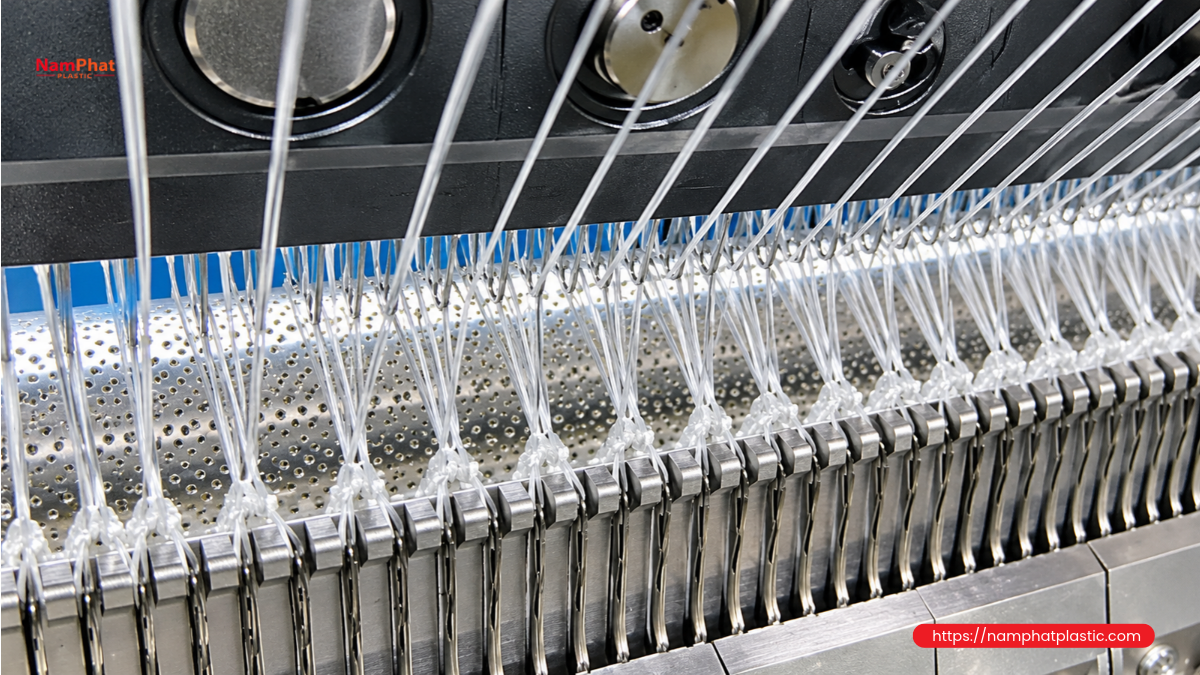
The needle bar forms loops, while guide bars control yarn paths according to the pattern. Stitch-forming bars and inlay bars have different roles. More guide bars can enable additional constructions, but do not automatically guarantee output, strength or suitability for every bag type.
Gauge describes nominal needle density, commonly expressed by an E designation indicating needles per inch. Threading arrangements and the number of needles actually used also affect construction. Gauge is not the final mesh-opening size, and E6, E9 or any particular lapping pattern should not be treated as a universal recipe.
For example, KARL MAYER RS 4 Net lists four ground guide bars and E6, E9 and E12 gauge options. RS 2 Net, meanwhile, is designed for two-bar net constructions using PE tapes. These are configuration differences to assess against a sample, not a machine ranking.
Ask the OEM to confirm lapping patterns, needle type, pattern control, parameter storage and recovery, yarn-break monitoring, pattern-change procedures and wear parts. Also inspect quality after restarting from a stop: a continuing defect can spoil a long section even when the machine achieves its nominal speed.
5. Take-up, winding and finishing are not secondary operations
Fabric take-up works with the loop-forming rate to establish course density. Winding controls tension and roll formation. The functions are related but are not identical. Unstable take-up or winding tension can make width and aperture measurements on the machine differ from those after unwinding.
State knitting width, actual open width, relaxed width and folded delivery width separately. Check edges, folds, roll hardness, cores, maximum roll diameter and mass. Where several strips run side by side, provide individual traceability and length control as required by the design.
Finishing may include dimensional stabilisation, cutting, hemming, panel joining, adding cords or bag conversion. Do not assume all nets require the same heat-setting conditions. Unsuitable heating can change mechanical properties and geometry; conditions must be validated for the material and equipment.
KARL MAYER's Raschel bag application description explains that dedicated configurations can produce bags closed on three sides or bag rolls. This does not mean any shade-net machine can produce finished bags. The RFQ must identify what is formed during knitting and what requires subsequent conversion.
6. Shade factor is not g/m², and black colour does not establish UV durability
g/m² measures material mass per area, not directly the reduction in transmitted light. Two nets with the same mass can provide different shading because of aperture geometry, tape width, colour and yarn distribution. A “70% shade” specification must identify the actual property and measurement method.
GALE's Commercial Light 220 technical table reports shade factor, PAR transmission and UVR block separately. It illustrates why crop shading cannot substitute for evidence of UV protection for people. That product's values must not be applied to other nets.
Internal checks can compare transmitted light with a reference sample under consistent measurement conditions. However, the sensor, light spectrum, incidence angle, tension state and sampling procedure all need recording. A quick check does not replace a test report using the contractually agreed method.
Resistance to outdoor degradation depends on the material, stabilisation system, processing and service conditions. Request retained mechanical properties after exposure, along with the cycle, light source, temperature and humidity. ASTM G154 addresses operation of fluorescent UV exposure equipment; citing the standard alone is not a service-life certification. Do not convert exposure hours into years of use with an invented factor.
7. Measure aperture and elongation in the service condition
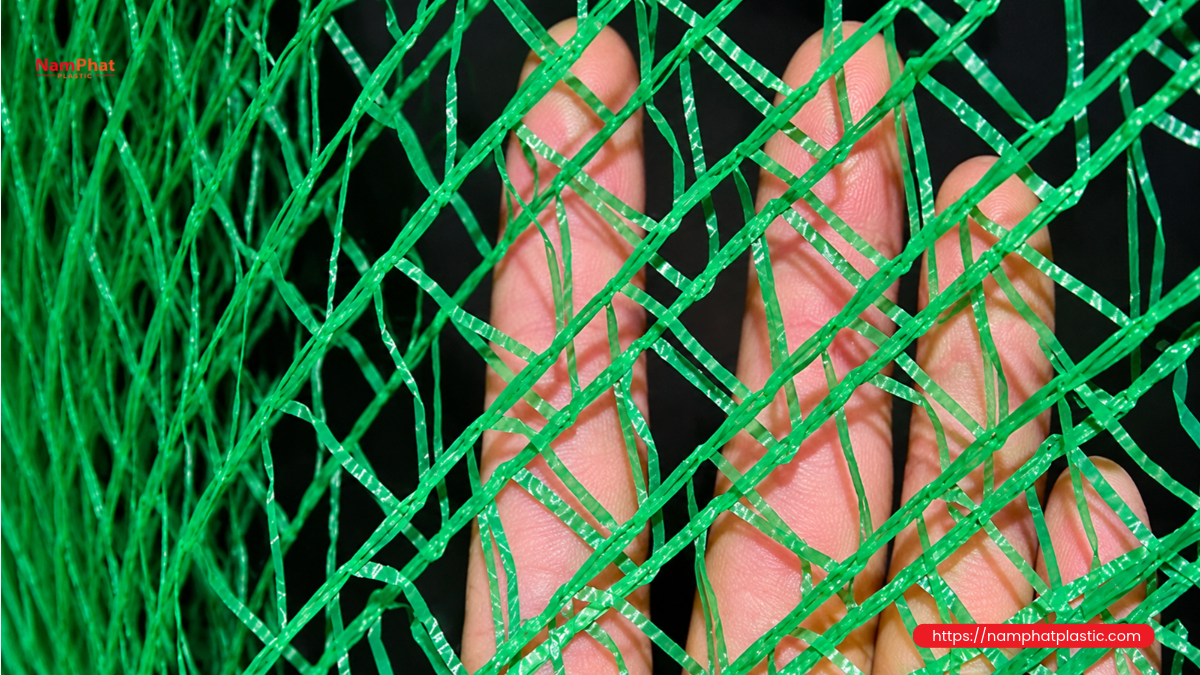
Knitted netting can change geometry under load. Lengthwise tension can alter its width and clear openings. Distinguish relaxed specimens from loaded or biaxially tensioned specimens; a single diagonal measurement does not fully describe an aperture.
For produce bags, test representative contents at the intended filling mass with the specified closure. Monitor deformation, product loss, tearing at the bottom or label zone and handling performance. Filling mass is not a safe lifting load, especially when users lift a bag at one point.
For outdoor netting, assess joins, seams, edges and anchorage together with the net panel. The strength of a specimen strip does not establish the wind resistance of the entire system. Installation methods and design loads need assessment by a suitably qualified person for the application.
8. Calculate output as acceptable length, area and mass
Revolutions per minute, courses per minute, metres per minute and kilograms per hour are not interchangeable. Before calculating, confirm how many courses correspond to a machine cycle. If f is courses per minute and c is courses per metre, theoretical line speed is f/c m/min.
Illustrative calculation, not a machine guarantee: f = 600 courses/min and c = 300 courses/m gives 2 m/min, or 120 m/h. At 80% running-time availability and a 95% acceptable-length yield while running, acceptable output is 91.2 m/h. Do not apply these factors again if the input already represents actual output.
With a combined usable width of 4 m, acceptable area is 364.8 m²/h. At a finished-net mass of 80 g/m² measured in the same condition, the corresponding mass is 29.184 kg/h. Account correctly for edge waste, roll joins and changes after relaxation; machine width is not necessarily saleable width.
Quotations must state output for the same product, material, density, width, test duration and acceptance criteria. For bags, also consider lane count, bag pitch and cutting or packing limits. Installed electrical power is not energy consumption: measure kWh per kg or per 1,000 m² of acceptable product within a defined equipment boundary.
9. Quality-control planning and fault isolation
| Symptom | Areas to investigate | Verification |
|---|---|---|
| Lengthwise stripes or irregular apertures | Yarn consistency, beam let-off, tension and threading | Mark the cross-width position and compare with beam and material-lot records |
| Missed loops or abnormal holes | Broken yarns, damaged needles or guides, mechanism synchronisation | Inspect samples and stop history; isolate the machine before mechanical checks |
| Width contraction or wrinkled rolls | Take-up, winding, relaxation and finishing | Measure in the agreed states and compare both edges |
| Bags tearing at the bottom or edge | Closure construction, conversion and load-concentration points | Test complete bags with representative contents and record the failure location |
| Brittleness or premature deterioration | Material lot, thermal history, exposure and chemical contact | Compare retained samples, trace the lot and test retained mechanical properties |
Sample the beginning, middle and end of rolls and positions across the width according to a risk-based plan. Check appearance, dimensions, mass per area, mechanical properties and function. For tensile testing of open nets, agree gripping arrangements and treatment of grip slippage; results from different methods should not be compared directly.
Keep an approved reference sample and retained samples by lot. Make controlled fault-correction changes within OEM limits and record before-and-after results. Avoid changing many factors simultaneously and then claiming a cause. Measurement equipment needs appropriate verification and calibration.
10. Utilities, safety and ownership cost
Plan electrical supply, compressed air, cooling and ventilation for the actual configuration. The knitting machine, FTL, yarn-production line and finishing equipment have different requirements. Check floor loads, vibration, maintenance clearances, beam-lifting height, roll-transport routes and material-storage areas.
Guard needles, drives, nip points and slitting blades. Isolate energy before clearing jams, changing needles or handling beams; do not bypass interlocks. If heated surfaces or heated tape-drawing equipment are present, add burn and fire controls. Lifting plans must suit actual beam and roll masses.
Calculate cost per acceptable product: material, waste, electricity, labour, needles, guides, maintenance, changeovers and inventory capital. Do not quote a fixed machine price or payback period without supplier quotations, a production plan and trial data.
11. RFQs and acceptance: use demanding samples as proof
An RFQ should include samples or drawings, proposed material, width range, mesh construction, g/m², shading requirements, mechanical properties, delivery format and output by product. State changeover frequency, yarn source, existing equipment, utilities and scope of supply. Ask suppliers to separate mandatory equipment, options and purchaser-supplied items.
Factory acceptance testing (FAT) and site acceptance testing (SAT) need agreed run durations, raw materials, products, sampling methods and acceptance limits. Select samples representing wide products, demanding densities, sensitive materials or bags with multiple requirements, not only the easiest product. Check stopping and restarting, beam changes, pattern changes, finished rolls and downstream operations.
Handover documents should include drawings, safety instructions, spare-parts lists, maintenance plans, training, support scope and traceability data. Accept the equipment on good output and quality together, not merely a video of it moving.
12. Discussing mesh-bag requirements with Nam Phát
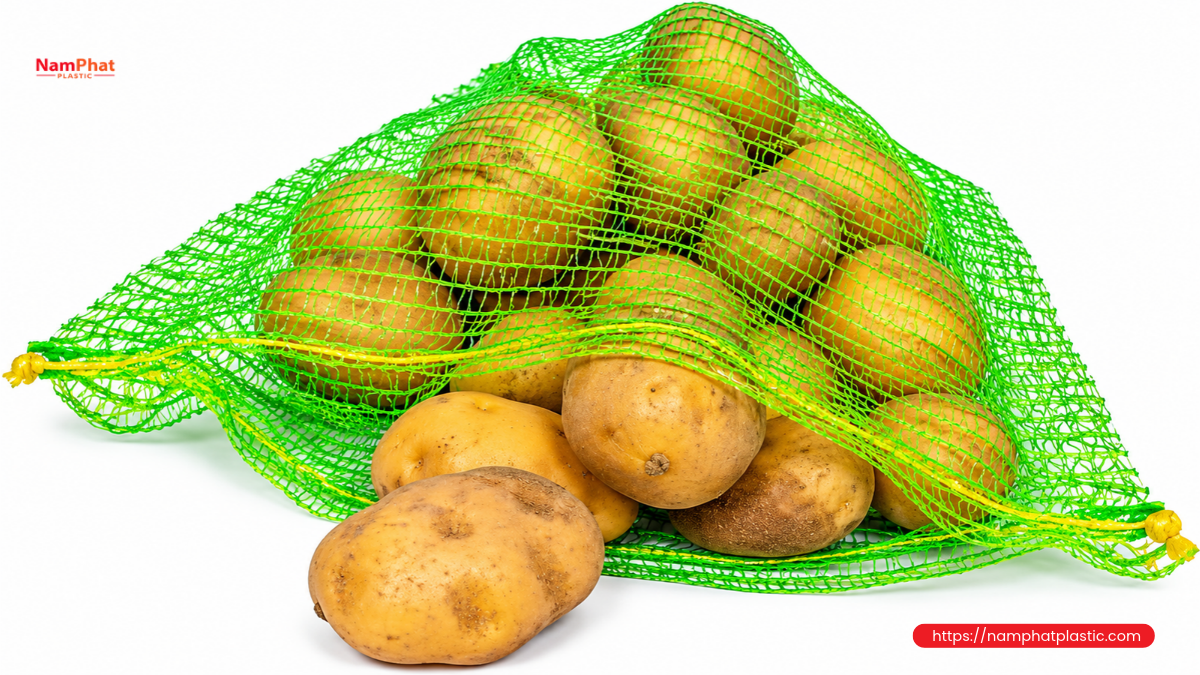
Nam Phát introduces mesh bags and packaging supplies. When discussing requirements, provide the produce type, filling mass, dimensions, closure method, ventilation needs and an existing sample. Confirm the specific bag construction; do not assume every Nam Phát mesh bag is Raschel-knitted or has UV-resistant properties.
If the aim is equipment investment, use a requirement sheet and finished-product samples when working with the OEM. Separating bag procurement from machine procurement enables a relevant comparison and avoids assumptions beyond the confirmed scope.
Frequently asked questions
1. Can a Raschel machine make both shade nets and produce bags?
Potentially, with an appropriate configuration, but not every machine can do both. Confirm guide bars, knitting patterns, yarn feeding and bag-forming or finishing equipment.
2. Does a higher gauge always produce a better net?
No. Gauge must suit the yarn, aperture and intended construction. Assess quality through samples that perform the required function, not needle density alone.
3. Do nets with the same g/m² have the same shading?
Not necessarily. Colour, aperture geometry and material distribution affect transmission. Compare results obtained with the same method and specimen condition.
4. Can outdoor service years be guaranteed from UV testing?
Not from exposure hours alone. Evidence linking results to service conditions, deterioration criteria and a defined warranty scope is needed; do not independently convert hours into years.
5. Should quotations be compared in kg/h or m/h?
Use acceptable length, area and mass at the same specification. For bags, include acceptable bag count and functional tests; a single unit can conceal product differences.
- 0 Comment


