


 Phan Van Hoang
- 21/10/2026
- 14
A roll of woven PP fabric can become a BOPP-laminated sack with attractive printing, an open-mouth sack with a sewn bottom, or a block-bottom valve sack for powder filling. However, a PP coating, lamination and valve sack line is not one universal configuration. The important decisions are layer structure, closure method and filling requirements; only then should coating, printing, converting and inspection equipment be selected.
This article focuses on the stages after weaving: coating adhesion, film lamination, web handling, valve formation and acceptance testing with filled sacks. Parameters must be validated using the actual materials and equipment. This is neither an operating recipe nor a statement about Nam Phát's machinery capabilities.
1. Distinguishing BOPP-laminated sacks from block-bottom valve sacks
“BOPP laminated” describes the material construction: biaxially oriented polypropylene film is bonded to woven fabric through a suitable bonding layer. “Block-bottom valve sack” describes geometry and the filling route: the product enters through a valve, and the sack takes a block shape when full. Both features can be present in one sack, but they are not interchangeable terms.
| Criterion | BOPP-laminated PP sack | PP block-bottom valve sack |
|---|---|---|
| Design priority | Print appearance, surface protection and laminate bond strength | Valve filling, powder retention, bottom stability and pallet stacking |
| Closure | Sewing, folded adhesive closure or another specified design | Formed bottoms; valve and bottom patches require the correct bonding construction |
| Critical equipment | Film unwind, laminating station and print registration control | Bottom opening, folding, valve insertion, patch application and geometry inspection |
| Required trials | Peel, wrinkles, ink, scuffing and sack closure | Spout application, air release, valve tightness and filled-sack strength |
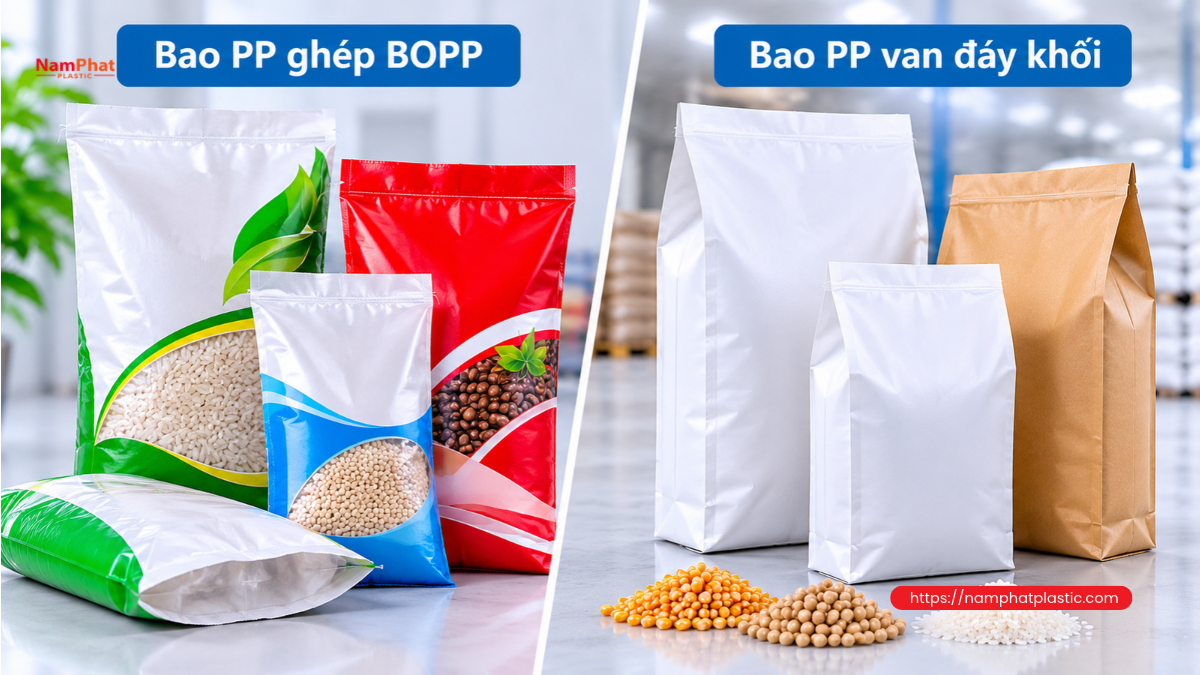
AD*STAR® is a Starlinger trademark, not a generic name for every valve sack. Starlinger describes this construction as coated or BOPP-laminated PP fabric, joined using hot air and pressure. W&H presents AD PROTEX® as another woven valve sack solution. Use trade names correctly and verify the actual technology rather than applying a trademark to an unverified sack. Sources: Starlinger on AD*STAR®; W&H valve sack concepts.
2. Define the sack requirements before configuring the line
The input specification should state filling weight, bulk density under filling conditions, particle size, dustiness, moisture, product temperature and transport conditions. At the same weight, a light powder needs a different sack volume from dense granules. For heavily aerated powder, volume during filling can differ from volume after settling; choosing dimensions from an empty sack alone is unreliable.
Next specify the filling spout, feeding method, manual or automatic operation, dust-control requirements, waiting time before palletizing and how the user will open the sack. For food packaging, define the contact requirements of the entire construction, including ink and bonding layers, rather than inferring suitability from the name PP. Moisture protection must also be assessed on the complete sack, including its valve, joins and venting zones.
Tape extrusion, winding and weaving need to be controlled as the upstream foundation. Fabric width consistency, basis weight, machine- and cross-direction strength, and heat shrinkage influence downstream operations. See the woven PP sack classification guide in Vietnamese; this article does not repeat the complete tape-production process.
3. Two process routes after weaving
The BOPP lamination route typically includes preparing the fabric roll, checking printed film, surface treatment where required, extruding the bonding layer, nip lamination and cooling, rewinding, then cutting and closing sacks. Reverse printing on the inside face of BOPP can place the printed image inside the laminate. Confirm the printed side, unwind direction and ink-system compatibility.
The valve sack route uses suitable rollstock to form the body, cut lengths, open and form bottoms, insert the valve, apply bottom cover patches, bond, cool and stack sacks. The detailed sequence varies with the machine and whether the input is tubular or flat fabric. An ordinary cut-and-sew machine cannot be assumed to make valve sacks merely by changing a knife.
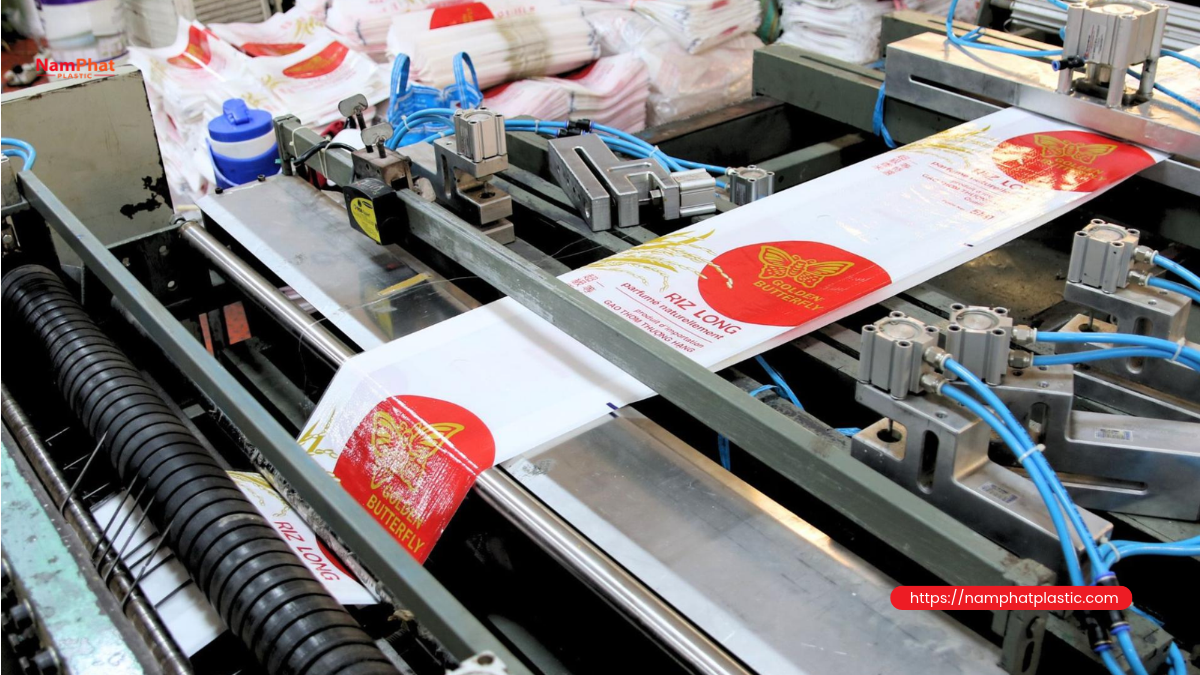
The W&H ECOTEX brochure distinguishes extrusion and coextrusion configurations, film unwinds, print registration and thickness measurement. When comparing quotations, identify standard items, options and unavailable functions rather than comparing model names alone.
4. Extrusion coating and lamination: controlling the bonding layer
Separate coating weight from fabric basis weight
Molten polymer passes through a flat die, is drawn into a melt curtain and is pressed onto the fabric. During lamination, a second web enters the nip to create a multilayer structure. Distinguish the sack's total basis weight from the polymer actually used for coating or bonding. Heavier fabric can conceal an insufficient coating layer if only the finished material is weighed.
For an illustrative calculation, a single-side coating of 20 g/m² on a useful width of 1.0 m at 100 m/min represents 120 kg/hour of polymer in the product. The calculation is 20 × 1.0 × 100 × 60 ÷ 1,000. It excludes edge trim, start-up and rejected material. This is a hypothetical material balance, not a recommended coating weight or operating speed.
Adhesion depends on the entire laminating zone
Consider resin type, throughput, actual temperature, residence time, substrate surface, die-to-nip distance, nip pressure and cooling together. Simply raising temperature to correct delamination may introduce odor, film deformation or poorer sealability. LyondellBasell's polyolefin extrusion coating guide illustrates why these variables must be considered together; do not transfer PE conditions mechanically to PP.
Melt-curtain narrowing, known as neck-in, makes the actual coated width different from the die opening width. Excessively thick edges waste material and impair roll uniformity; insufficient coating at the edges can create a delamination path. Nordson EDI emphasizes polymer distribution and edge-profile control. Acceptance records should therefore include a cross-web coat-weight profile, not just an average.
Evaluate the chill roll under load, including water flow, supply and return temperatures, and surface-temperature stability. An attractive roll produced at low speed does not establish sufficient cooling capacity at higher output. Maxcess describes the heat-transfer roll as a web-temperature control component, not merely an idler.
5. Surface treatment, printing and bond verification
Assess the wettability of PP and BOPP before printing or lamination. Corona treatment can support adhesion, but the original treatment level does not prove that a stored roll is still suitable. Vetaphone notes that treatment effectiveness decays over time and depends on storage conditions. Confirm the treated side, roll age and measurement at the time of use.
Do not prescribe one universal dyne threshold for every ink and bonding layer. A wetting test is an indicator, not a substitute for a peel test. Enercon likewise distinguishes dyne level from adhesion performance. Agree sample conditioning, cutting direction, specimen width, pulling speed and testing time with the receiving party.
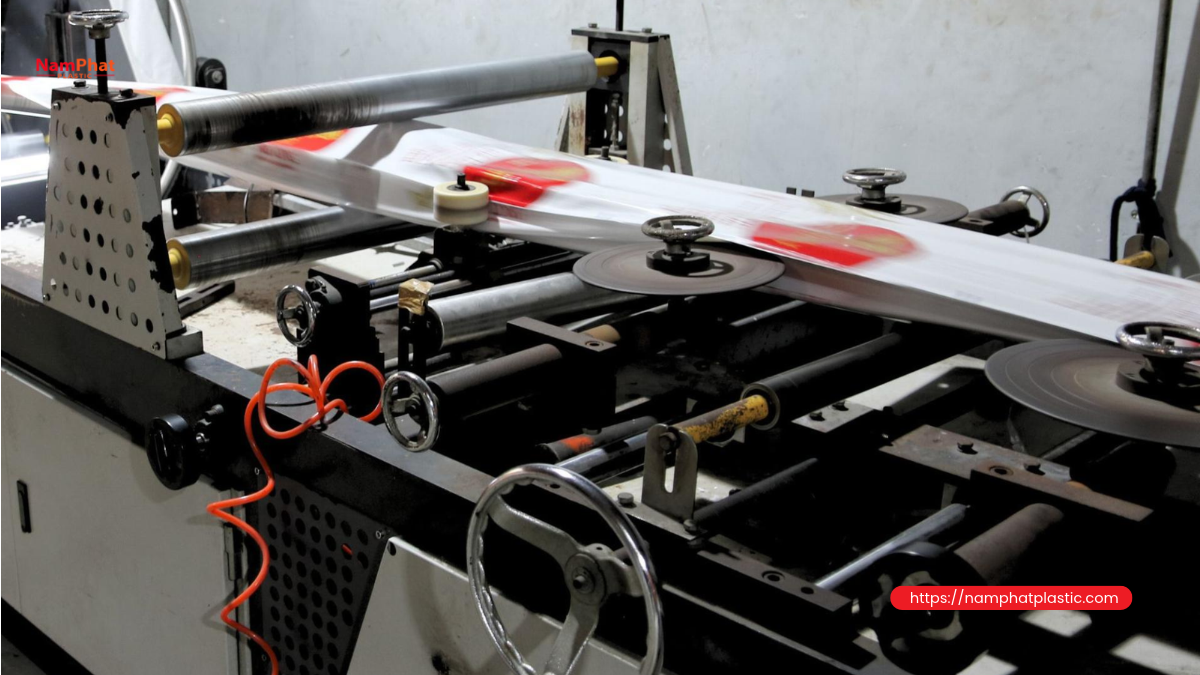
For reverse-printed film, check ink drying, ink integrity within the bond, odor and color changes after lamination. For direct printing on coated fabric, check ink adhesion, drying, rub resistance and code readability. A sample that looks good on a table is insufficient: folds, bottom creases and pallet contact areas can reveal additional defects.
6. Web handling: stabilize geometry before increasing speed
Woven fabric and BOPP film differ in stiffness, elongation and thermal response. Control tension separately across unwinding, lamination and rewinding zones rather than using the same tension for both materials. Misaligned rolls, out-of-round incoming rolls, slack edges or thickness variation can generate wrinkles that become locked into the laminate.
The Maxcess guide to web wrinkling considers the incoming roll, alignment and roll mechanics. In practice, take samples before and after the nip to identify where defects originate. Do not keep raising tension to flatten a roll with a geometry defect.
Also inspect edge sensors, registration marks, splices and behavior during acceleration or deceleration. Accuracy at steady speed does not represent roll-change performance. Finished rolls must unwind at the next process without blocking, telescoping or winding so hard that permanent creases develop.
7. Valve sack conversion: geometry and the thermal bonding window
The drawing should state cut length, body width, bottom width, fold positions, valve dimensions, valve orientation and bottom-patch overlap zones. Valve geometry determines spout application and the product passage; it is not simply an extra patch covering an opening. Small deviations accumulated from the fabric roll through folding can skew the bottom or leave inadequate bonding overlap.
In a suitable hot-air-sealed construction, heat and pressure create a bond in areas designed for sealing. The objective is sufficient strength without damaging the oriented-tape substrate. Evaluate temperature, airflow, contact time, nip pressure and cooling as a process window. The displayed temperature alone is not evidence of the energy delivered to the sack.
For example, the ad*starKON HX brochure describes checks on dimensions, geometry and valve-patch presence. This illustrates inspection functions worth specifying when evaluating machinery; it does not establish that every line has the same system.
8. Filling, deaeration and valve closure must be considered together
Powder valve sacks must release air introduced during filling. An overly airtight sack can inflate, make the target weight difficult to achieve or extend the cycle. Arbitrarily adding vent holes, however, can cause powder leakage and reduce moisture protection. Test the venting design with the actual product, particle-size distribution and intended filling conditions.
The air permeability of a flat specimen does not fully represent the venting performance of a complete sack. HAVER & BOECKER distinguishes whole-sack air-release testing, material air-permeability testing and filled-sack drop testing. Record filling time, settling time, dust at the spout and shape after filling.
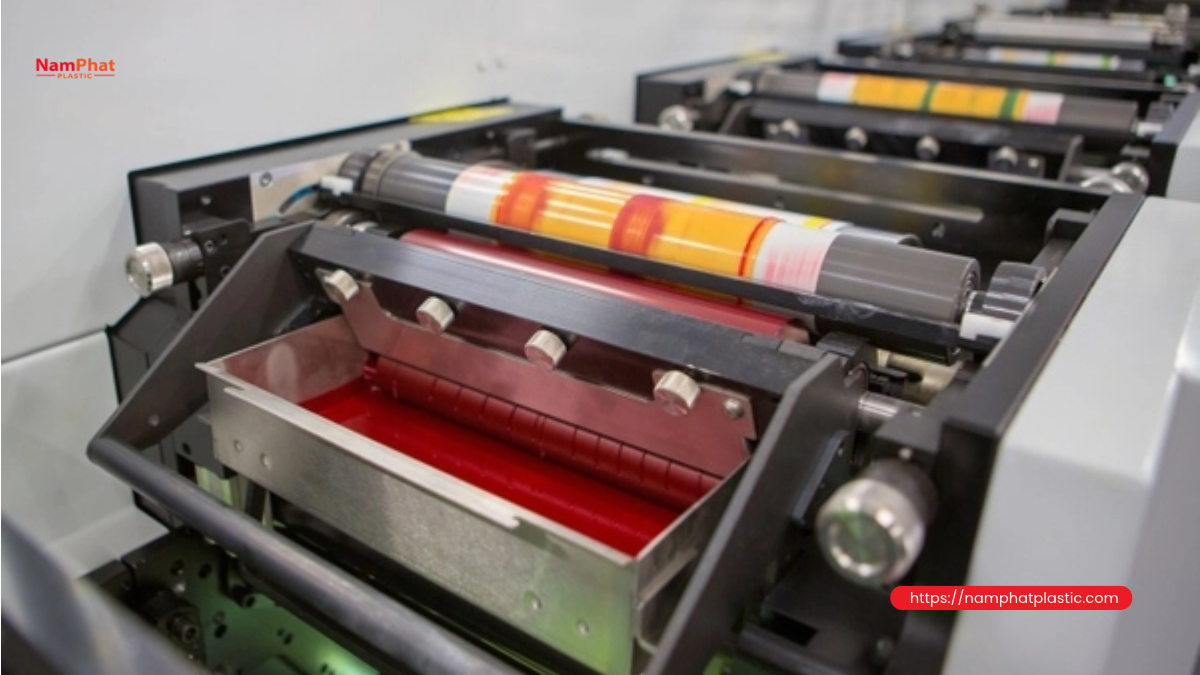
A self-closing valve and a valve sealed after filling are different options. If active sealing is required, match valve materials with the closing equipment. HAVER & BOECKER's SEAL system is an example of ultrasonic sealing of a compatible valve after the sack leaves the spout. It does not establish that every PP valve can be sealed by every machine.
9. Quality checks from rollstock to filled sack
| Inspection stage | Records required | Decision value |
|---|---|---|
| Incoming fabric and film | Lot, width, basis weight, heat shrinkage and treated side | Separate substrate defects from lamination defects |
| After coating and lamination | Cross-web coat weight, peel, wrinkles, holes and odor | Prevent an acceptable average from concealing local failures |
| After printing | Color, registration, rub resistance, readable codes and folds | Assess information function as well as appearance |
| After conversion | Dimensions, valve position, overlaps and bond strength | Check filling compatibility and bottom mechanics |
| After filling | Weight, filling time, dust, drops and stacking | Validate the combined sack and packing-machine system |
State test conditions clearly: filling product, weight, conditioning, drop orientation and failure criteria. Two reports cannot be compared merely because both say “pass.” For sewn closures, see industrial bag-closing thread information in Vietnamese; seam results do not replace weld or valve testing.
10. Diagnose defects by location rather than guesswork
| Symptom | First checks | Avoid premature conclusions |
|---|---|---|
| Strip-like delamination | Surface, coating profile, nip pressure and cross-web position | Do not blame every defect on corona treatment |
| Wrinkles after lamination | Incoming roll, alignment, individual web tensions and heat | Do not simply increase pulling force |
| Burnt or brittle bottom area | Sealing energy, contact time, material and cooling | Do not raise pressure to mask substrate damage |
| Powder leaking at the valve | Spout application, valve orientation and dimensions, dust in closure area | Do not assume the entire sack needs more coating |
| Inflated sack or slow filling | Whole-sack venting, product and filling-machine settings | Do not add holes before testing powder leakage |
| Leaning pallet | Post-fill volume, bottom geometry, retained air, friction and stacking pattern | Do not attribute the issue solely to sack thickness |
During improvement trials, quarantine suspect output, retain reference samples and change groups of variables in a controlled manner. Recording the raw-material lot and defect onset helps distinguish input variation from machine drift. If access to knives, dies or nip rolls is necessary, isolate energy under the safety procedure; never inspect by hand while running.
11. Utilities, safety and acceptance testing
Ask the supplier for electrical loads, cooling capacity, compressed-air flow and quality, local extraction where fumes arise, ozone extraction when corona is used, floor loads and roll-lifting arrangements. Distinguish installed power from consumption under the agreed production conditions.
The risk assessment should cover hot polymer, dies and hot air, nip points, knives, roll lifting, corona high voltage, and dust or solvents where present. Check guarding, interlocks, emergency stops, safe shutdown sequences and training before trials. Do not disable protection to reach demonstration speed.
Acceptance should use the agreed materials, representative formats and demanding formats. Record good sacks within an agreed period, start-up waste, size-change time, rejects, electricity and utilities within clearly defined measurement boundaries. Then test filling, internal transport and pallet stacking. No-load mechanical speed is not commercial productivity.
12. Frequently asked questions
Is a BOPP-laminated sack always a valve sack?
No. BOPP describes the laminated film; a valve describes the filling route. A BOPP-laminated sack can have an open mouth and sewn closure or be designed as a compatible valve sack.
Can one coating machine make every sack construction?
Do not assume so. Check fabric type, width, number of coated sides, bonding material, film feed, registration and the limits of downstream conversion.
Does an acceptable dyne level mean the laminate cannot delaminate?
No. Dyne testing indicates wettability under the test conditions. Bond performance also depends on ink, resin, cleanliness and lamination conditions. An agreed peel test is required.
Why must a moisture-resistant sack still release air?
Some powder-filling processes introduce substantial air. The design must balance air release, powder retention and moisture protection, then be verified using filled sacks under service conditions.
What should be prepared for a packaging-requirements discussion?
Prepare a product sample, filling weight, proposed dimensions, filling-machine details, printing requirements, storage conditions and test criteria. Product needs can be discussed with Nam Phát Plastic; availability of a specific construction must be confirmed separately.
- 0 Comment


