


 Phan Van Hoang
- 21/10/2026
- 21
A plastic straw production line combines pellet feeding, tube extrusion, cooling, haul-off and cutting. Depending on the product, it adds corrugating, telescopic-straw assembly or packaging. Selection should start with the number of conforming straws after packaging, not just extruder output. A fast line with incorrect wall thickness, excessive burrs or a wrapping bottleneck can still struggle to fulfil orders.
This article is for factories and equipment buyers preparing technical requirements. Its tables provide selection guidance, not guaranteed Nam Phát specifications. PP is one material option. PLA or PHA should enter the configuration only after the resin supplier and machine manufacturer confirm suitability and trials demonstrate it.
1. Define the straw specification before selecting equipment
Start with samples and a dimensioned drawing with tolerances. Straws with the same outside diameter but different wall thickness can differ considerably in stiffness, mass, bending behaviour and packaging speed. For beverages containing solids or applications requiring lid-film penetration, test functionality using the intended cup, lid and beverage.
| Input information | What to confirm | Effect on configuration |
|---|---|---|
| Geometry | Outside diameter D, wall thickness t, length L, tolerances and ovality | Die, guides, haul-off, cutter and product feeder |
| Straw ends | Square or angled cut; cut-edge requirements | Cutter design, scrap collection and feeding orientation |
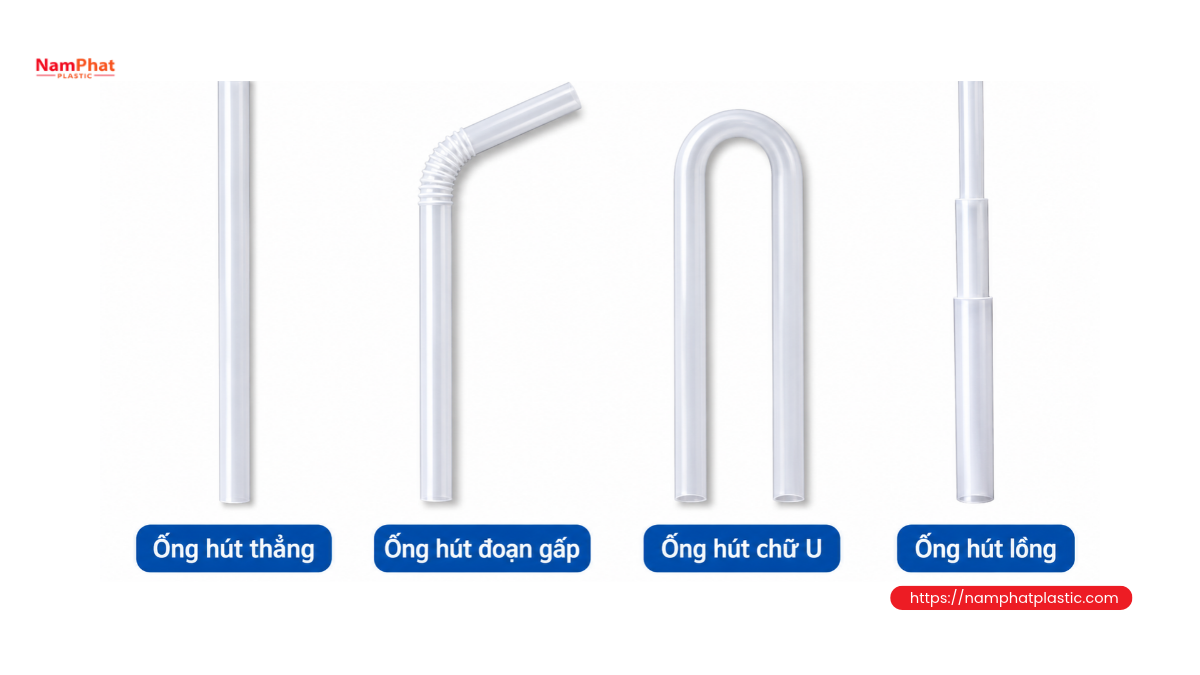
| Product type | Straight, bendable, U-shaped or telescopic | Additional forming and inspection equipment |
| Colour | Single colour or coloured stripes; approved colour sample | Dosing and auxiliary extruders where needed |
| Packaging | Individual wraps, counted bags or continuous strips | Wrapper, sensors, printing and cartoning |
Avoid simply specifying a machine that “makes every type of straw”. Request a product-code list, included change parts and verified changeover times. For straws supplied to beverage-carton applicators, packaging-strip pitch and end orientation are interface requirements, not merely aesthetic choices.
2. The process from pellets to finished straws
Pellet feeding and dosing
Track base resin, masterbatch and additives by grade and batch. The dosing unit must suit the small consumption of the colour stream. Check it by actual weighing rather than relying solely on the percentage displayed. Keep hoppers, feed paths and tools clean to prevent colour or material carryover. Drying depends on the instructions for the exact resin grade and its storage conditions.
Single-colour extrusion and multicolour co-extrusion
The screw melts the resin and delivers it through a hollow-tube die. The main stream forms the straw body, while auxiliary streams can form stripes according to the die design. Multiple colours do not necessarily mean multiple functional layers. OEM literature describes extruders, cooling, haul-off and cutting, with different colour options; the actual configuration must be confirmed for the product. See ANBO's PP extruder and TECHNO's three-colour line.
Cooling, haul-off and cutting
The extruded tube is cooled and stabilised before it carries the haul-off load. Control water condition, circulation and guides; sizing or vacuum equipment is included only where the configuration requires it. Excessive pulling while the tube remains soft can distort its cross-section. Synchronise the cutter with tube movement and arrange collection to avoid crushing or scratching the finished product.
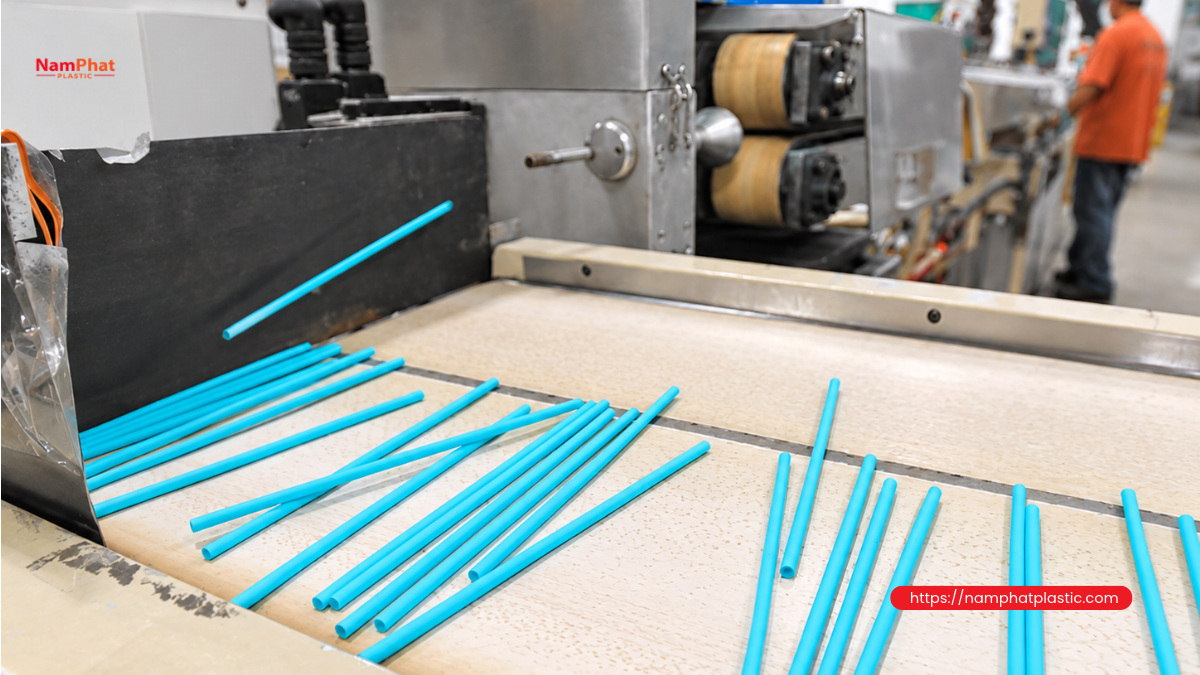
Do not copy barrel temperatures, screw speeds or water temperatures from one resin to another. Establish the processing window from material documentation, machine instructions and recorded trials. Colour or material changes require a cleaning procedure, segregation of transition product and approval of the new batch before it enters accepted stock.
3. PP, PLA and PHA: select the grade, not just the polymer name
| Material family | What to assess | Evidence before ordering equipment |
|---|---|---|
| PP | Stiffness, bend-section durability, processability and colour system | Identified grade, technical documentation and acceptable trial samples |
| PLA or PLA blends | Moisture, thermal history, brittleness and beverage-use conditions | Grade-specific drying and processing instructions; cutting, bending and storage trials |
| PHA or PHA blends | Commercial formulation, extrusion stability, cooling and forming | Written compatibility confirmation and full-line trials |
NatureWorks' Ingeo crystallising and drying guide illustrates the importance of moisture control for this material. It concerns material preparation, not a straw-production recipe; its settings must not become defaults for every PLA resin.
Jumbo Steel offers a PHA straw-machine configuration, but the existence of a model does not prove that every PP machine can process PHA simply by changing temperatures. Review feeding, drying, screw, die, cooling, haul-off, cutting and downstream forming.
Do not apply claims such as “compostable”, “degrades in nature” or “food safe” solely on the basis of a polymer name. Supporting documentation must cover the finished product, additives, colours, use conditions and destination market. Resin certification does not automatically cover a coloured, packaged straw. This article does not establish the legal status or certification of any particular product.
4. How straight, bendable, U-shaped and telescopic straws differ
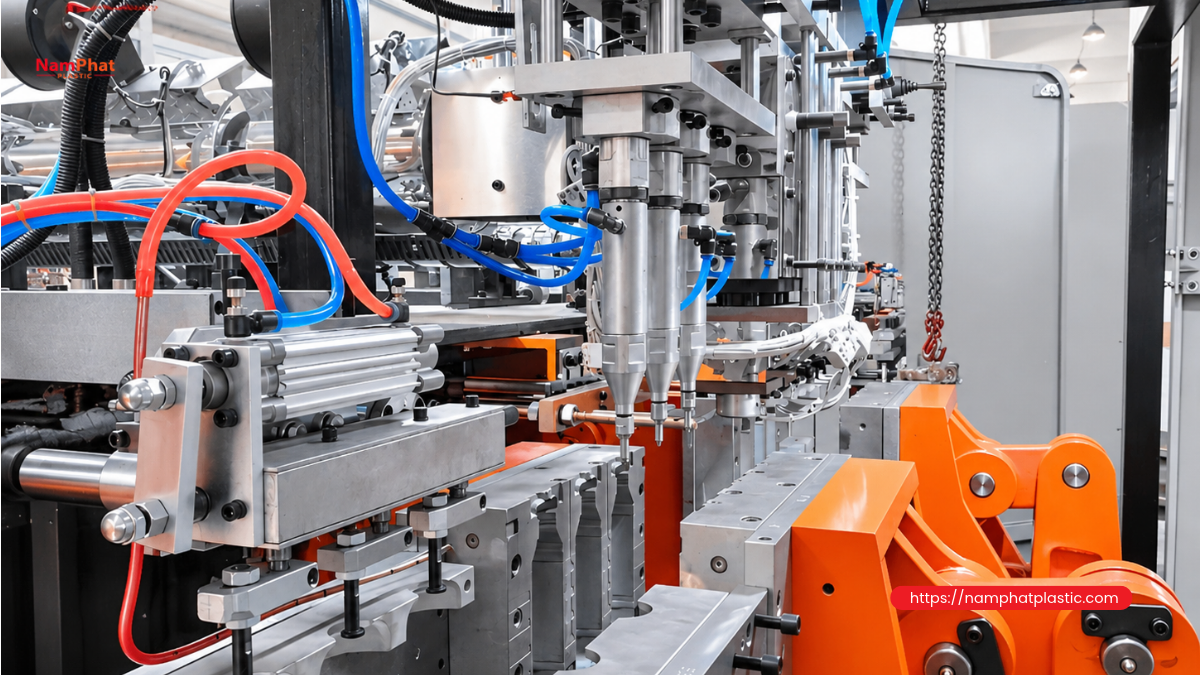
Straight straws can move from cutting to inspection and packaging. Bendable straws require an additional operation to form a bellows-like section in the tube blank. Assess bend position, angle retention and flow while bent, rather than appearance alone. The straw-equipment catalogue describes a separate corrugating machine after extrusion.
U-shaped straws require folding and packaging equipment suited to bendable blanks. Jieyang's JY033 is an example. Confirm pack pitch, package dimensions and feeding into the straw applicator; do not assume compatibility with every beverage-carton system.
Telescopic straws have inner and outer sections with mating dimensions. Jieyang's JY069 illustrates this category of forming and wrapping equipment. Alongside collapsed and extended length, check extension force, pull-out retention, joint sealing and stable feeding. These are not standard capabilities of a straight-straw machine.
5. Control diameter, wall thickness and eccentricity
An acceptable outside diameter alone does not establish straw quality. Measure at several positions around the cross-section and along the length. Contact instruments can flatten thin-walled tubes, so agree on the method, measuring force and sample-conditioning procedure. The mass of a group of straws is useful for trend monitoring, but it cannot replace local wall-thickness inspection.
- Nominal inside diameter: d = D − 2t, with D, d and t in the same unit.
- A simple expression for ovality: maximum D − minimum D on the same cross-section.
- Wall non-uniformity can be tracked as E = (maximum t − minimum t)/(maximum t + minimum t) × 100%. This is a convention that must be agreed, not a universal acceptance limit.
For example, maximum t = 0.16 mm and minimum t = 0.14 mm give E ≈ 6.67%. This only illustrates the calculation. Set tolerances from customer requirements and functional testing. Local thin spots can weaken the corrugated section even when average mass is acceptable. Increasing overall wall thickness to hide eccentricity consumes more material without resolving the cause.
6. Calculate output: distinguish kg/hour, metres/minute and pieces/minute
For a uniform circular straw, estimate resin volume from the annular cross-section. The following example is only for a material balance, not a machine rating or real order specification. Assume D = 6.0 mm, t = 0.15 mm, L = 200 mm and density ρ = 0.90 g/cm³.
| Step | Illustrative calculation | Result |
|---|---|---|
| Inside diameter | d = 6.0 − 2 × 0.15 | 5.70 mm |
| Resin cross-sectional area | A = π × (D² − d²)/4 | ≈ 2.7567 mm² |
| Volume per straw | V = A × L/1000 | ≈ 0.5513 cm³ |
| Mass per straw | m = V × ρ | ≈ 0.4962 g |
| Theoretical output at 30 kg/hour | N = 30 × 1000/(60 × m) | ≈ 1008 pieces/minute |
At 120 metres/minute on one lane with a 0.200 m cut length, the geometric limit is 600 pieces/minute before losses and cutter limitations. Corresponding resin throughput is only about 17.86 kg/hour. Therefore, 30 kg/hour and 120 metres/minute cannot both represent this exact product's output on one lane.
Suppose packaging handles only 500 pieces/minute, effective running time is 90% of the shift and first-pass yield is 98%. Equivalent good output is 500 × 0.90 × 0.98 = 441 pieces/minute, or 26,460 pieces per elapsed hour. The two percentages are separate assumptions, not guarantees. If the input figures already account for downtime or rejects, do not deduct them again.
7. Balance packaging from the outset
Individual wrapping suits applications that aim to limit handling before use. Counted bags serve a different distribution format. Individual wrapping followed by bulk bagging is possible, but feeding, buffer space and inspection points must be included. ANBO's individual wrapper uses paper or BOPP according to configuration, while its multiple-straw packer counts and groups straws.
The wrapping material must suit the machine's joining or sealing mechanism. Not all papers or BOPP films are interchangeable. Run the actual packaging roll and check print-register cutting, seam integrity, opening behaviour and the risk of straw ends puncturing the pack. An attractive bag does not establish cleanliness or correct quantities inside.
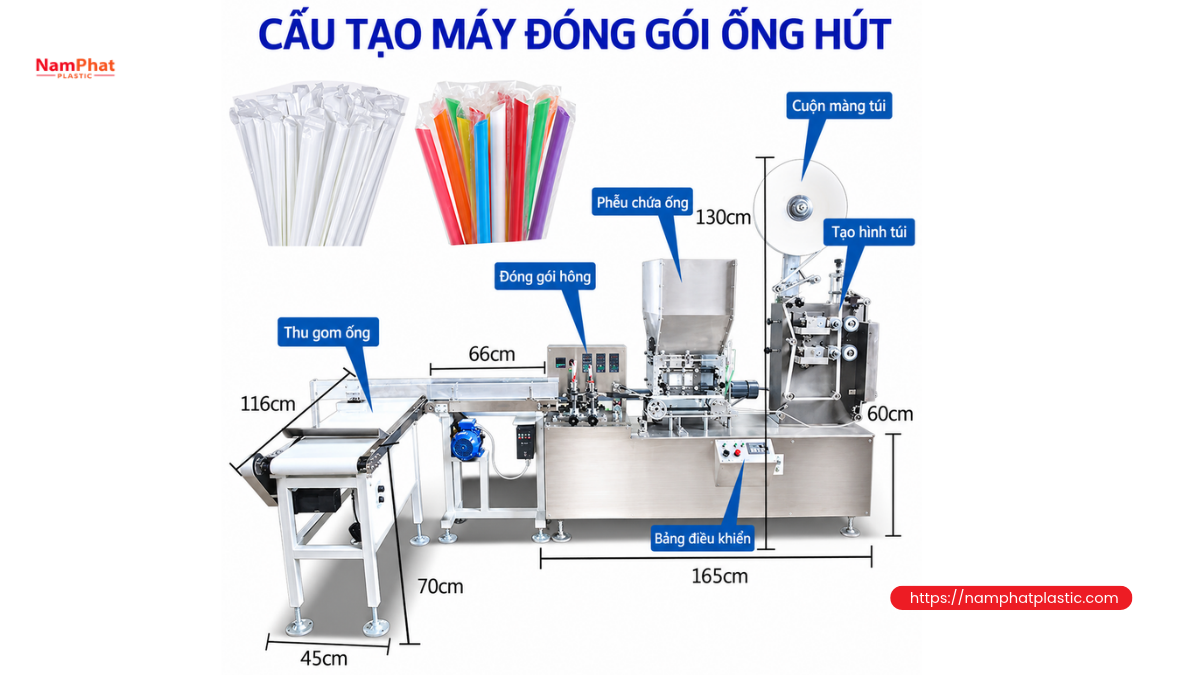
For directly connected machines, agree on stop signals, packaging-material shortage alarms, feeding jams, buffer-fill limits and reject segregation. A buffer can absorb short interruptions but cannot resolve a sustained capacity mismatch. Protect intermediate stock, identify its batch and use an appropriate first-in stock rotation procedure.
8. Inspect quality and troubleshoot systematically
| Symptom | Potential causes to investigate | Response and verification |
|---|---|---|
| Diameter fluctuates | Feeding, melt flow, pulling force or cooling | Compare time-based trends; change one factor at a time within permitted limits |
| Uneven wall or oval tube | Die centring, guides or squeezing during haul-off while soft | Measure cross-sections before and after haul-off; maintain and align according to procedure |
| Burrs or crushed ends | Worn blade, tube support, cutting synchronisation or blank stiffness | Stop safely for inspection; retest cut edges and scrap collection |
| Cracked or collapsed corrugations | Material, local thin walls or corrugating tooling | Test bending and flow; revalidate the forming window |
| Black specks or unusual odour | Contamination, retained resin or thermal history | Quarantine the batch and trace the source; clean and verify before restarting |
| Short-count bags or open seams | Double/missed feeding, sensors, register marks or unsuitable wrap | Check counts independently and inspect seams; test reject handling |
The inspection plan should cover incoming materials, start-up, product changes, checks during the shift and packaged goods. Record diameter, wall thickness, length, mass, cut edges, cleanliness, bending function and pack quantities. Agree sampling quantities, frequency, limits and quarantine criteria with the customer rather than choosing them after a defect occurs.
A visibly clean surface does not establish every food-contact requirement. Control resin, colour and additive sources, contacting water, tools and packaging materials. Test documentation must match the product and use conditions. Do not describe individual wrapping as “sterilisation” without a validated process. Keep nonconforming batches separate rather than blending them into accepted stock to improve reported yield.
9. Utilities, safety and line acceptance
The utilities list should state voltage, frequency, installed power and measured operating load; cooling-water and heat-rejection capacity; compressed air where needed; ventilation, floor space and maintenance access. Do not estimate whole-line electricity from the extruder motor alone. Cost per thousand accepted straws also includes packaging, labour, scrap, spare parts and changeover time.
The machinery has hot zones, rotating parts, nip points and cutting blades. Only trained personnel should operate it, with guards and interlocks maintained. For cleaning, blade changes, jam clearing or maintenance, isolate energy according to the machine and site procedures. Never reach into running haul-off or cutting equipment. Hot-resin purging requires a controlled area, suitable protective equipment and ventilation consistent with the material's safety documentation.
- Before trials: approve the drawing, resin grade, colour sample, wrapping roll and acceptance criteria.
- At the supplier's factory: measure product quality and good output on representative product codes, including difficult ones.
- During full-line trials: record downtime, scrap, packaging defects and reject-removal effectiveness over an agreed period.
- Test changeovers and stops: confirm restart procedures, not only steady running speed.
- At the production site: verify actual utilities and hand over documentation, spares, training and retained samples.

A short video cannot establish sustained productivity. The acceptance record should include trial conditions, personnel, measuring instruments, raw data and acceptance criteria. When PLA/PHA or special straw formats are required, use the specified material and packaging in acceptance trials rather than approving the line on an easier-running PP sample.
10. Information to prepare for discussions with Nam Phát
For a productive discussion, prepare straw and packaging samples, a D–t–L drawing, end-cut style, bend format, colour count, proposed resin grade, required conforming output per shift and factory conditions. State priority products and planned extensions. Supply scope, capabilities, documentation, services and schedules should be settled only through a confirmed project-specific proposal.
This article is a technical reference. It does not confirm that Nam Phát manufactures or supplies straw-making machinery, or supports every material and configuration described above. The actual scope of support must be confirmed separately.
Compare suppliers using the same specifications and acceptance conditions. A solution with appropriate inspection or packaging equipment may reduce manual operations. A larger extruder does not necessarily reduce unit cost if corrugating or individual wrapping remains the bottleneck.
11. Frequently asked questions
Does a straw extruder automatically make bendable straws?
Not by default. The extruder makes tube blanks; the corrugated section normally needs separate equipment selected for diameter, material and bend position. Check functionality after forming.
Can PP be replaced with PLA or PHA simply by changing pellets?
Do not assume so. Confirm material-machine compatibility, drying instructions, processing window and downstream capability. Trial the exact grade before committing to output.
Should line selection use kg/hour or pieces/minute?
Use both, together with straw dimensions and mass. Converting them to accepted, packaged straws per hour or shift gives a more complete comparison.
Do individually wrapped straws automatically meet food-contact requirements?
No. Individual wrapping limits handling, but does not replace material controls, production hygiene, relevant testing and batch traceability for the intended use.
Which factors have the greatest effect on investment cost?
The specification range, material, colour count, good output, additional forming, automation level and packaging format all matter. Compare the total scope and operating cost, not just the extruder price.
- 0 Comment


