


 Phan Van Hoang
- 21/10/2026
- 8
A leno bag weaving line should be selected around bag construction and packaging requirements, rather than loom speed alone. A suitable line must coordinate yarn, the leno interlacing mechanism, fabric width, cutting and sewing, and finished-bag inspection. For agricultural produce, the objective is to balance ventilation, product retention, seam strength and bag weight.
This article covers woven leno. Raschel warp-knitted mesh and extruded plastic netting are different technologies, although all may be described as “mesh bags”. The calculations below illustrate design and acceptance methods only. They are not output or product specifications guaranteed by Nam Phát.
1. Identify the construction before selecting equipment
In leno construction, warp yarns work in pairs or groups according to the design, changing position around the weft to stabilize the openings. This interlacing differs from the yarn loops of Raschel fabric or junctions formed during net extrusion. Colour and apparent openness are insufficient for identification; inspect the yarn path or compare an approved construction sample.
| Route | Bag-making sequence | What to confirm |
|---|---|---|
| Circular leno weaving | Produce tubular fabric, cut to length, then sew the bottom and finish the mouth | Lay-flat width, leno mechanism, condition of both folds and ability to open the tube |
| Flat leno weaving | Fold flat fabric, then sew a side and bottom in an L-shaped construction | Selvedges, seam allowances, the seam intersection and transfer mechanism |
| Raschel or extruded netting | Create mesh by knitting or extrusion, not leno weaving | Do not automatically reuse output models, yarn-making equipment or defect criteria |
Starlinger FX leno is an OEM example of equipment producing tubular leno fabric from PP or HDPE tapes. For the flat-fabric route, an L-seam leno conversion machine illustrates folding, side sewing and bottom sewing. The two architectures require their own bag drawings and fabric-feeding arrangements.
2. Define bag specifications around service conditions
The requirements sheet should identify the produce, size distribution, nominal fill weight, filling method, closure method and transport arrangement. Onions, garlic and fruit differ in susceptibility to scuffing, moisture and shape. A sufficiently strong bag can still damage skins if tape edges, labels or seams make unsuitable contact.
Agree on lay-flat bag width, cut length, usable length after folding and sewing, mesh opening dimensions and measurement methods. Tubular bags have no longitudinal body seam, but the bottom and mouth still require inspection. An L-seam bag adds a side seam and corner intersection. These need separate testing; fabric results alone cannot predict them.
The openings must retain the smallest acceptable produce in the lot. Measure both the relaxed state and an agreed deformed state because openings can enlarge as the bag stretches. Large labels, solid woven strips and stacking arrangements may reduce the effective area available for air exchange.
3. Yarn preparation: flat tape and monofilament are not freely interchangeable
PP and HDPE are material options to assess against construction, mechanical properties, equipment and end use. Tape yarn normally goes through film extrusion, cooling, slitting, drawing, thermal stabilization and winding. Monofilament is formed through die holes, cooled, drawn and wound on a suitable line. Equal denier does not establish that both yarn forms can run on the same loom.
Lohia's tape-line information and its monofilament systems describe distinct equipment groups. Tape, monofilament or combinations in warp and weft must be approved by the OEM for the specific leno sample, including guides, shedding and weft-feeding equipment.
| Yarn characteristic | Measure or observe | Downstream effect |
|---|---|---|
| Linear density and geometry | Mass per length; tape width and thickness or monofilament diameter | Fabric mass, opening size and contact with produce |
| Mechanical properties | Breaking force, elongation and variation within the lot | Breaks during weaving, bag deformation and seam consistency |
| Residual shrinkage and surface | Shrinkage after agreed thermal conditions; scratches, tape splitting or contamination | Distorted openings, roll wrinkles and damage at friction points |
| Yarn package | Core dimensions, hardness, package shape and unwinding to the end | Tension variation, sloughing and stoppage time |
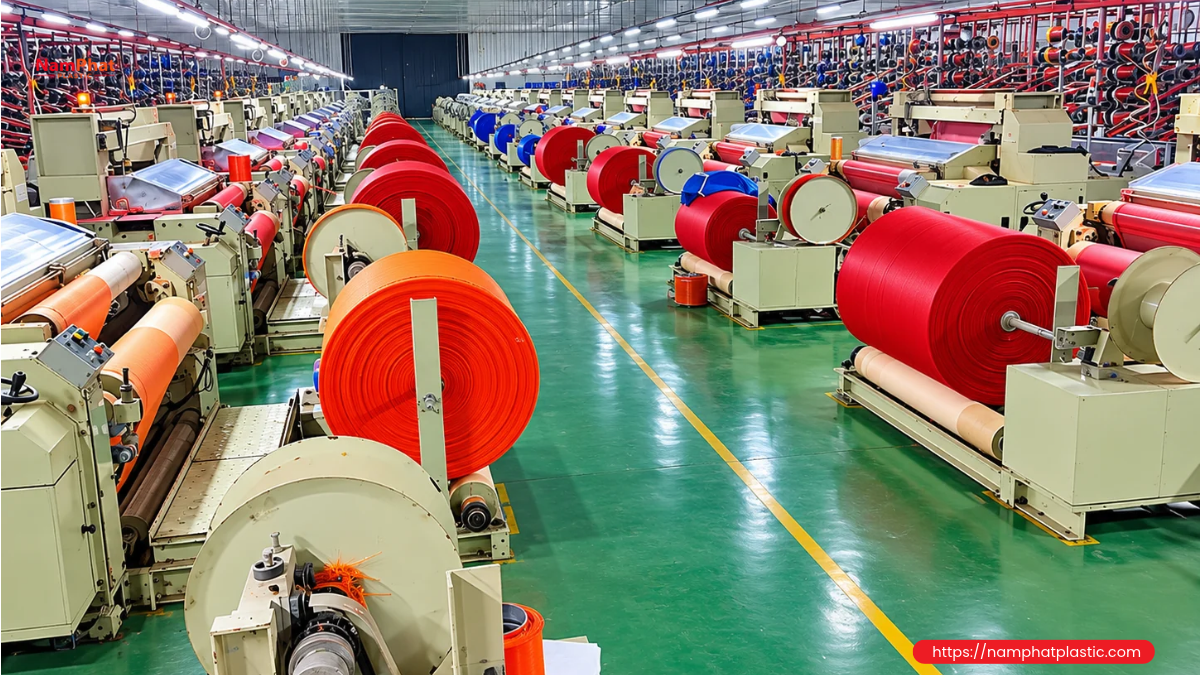
Drawing affects strength, elongation and residual shrinkage. Increasing draw does not automatically improve every property. Establish a validated processing window for the resin grade and equipment rather than using one universal temperature or draw ratio. When purchasing yarn, incoming acceptance criteria should include weaving performance and lot traceability.
4. The loom: control tension and leno interlacing
The creel, brakes, guides, leno mechanism, weft supply, take-up and winder should be treated as one system. A flat loom may require warp-beam preparation depending on its configuration; do not assume every machine uses the same package creel. The quotation must identify which yarn-preparation equipment is included.
Uneven warp tension causes yarn groups to carry different loads, producing distorted openings or breaks along the yarn path. Insufficient tension can produce slack yarns or loose interlacings, while excessive tension increases friction and deformation. Monitor multiple positions throughout package life, not only with full packages.
Check threading order, the leno interlacing sequence, warp/weft break sensors and take-up synchronization. Mark transition zones after yarn joining or restart for classification; missing-yarn sections must not enter accepted bags. Inspect tubular-fabric folds and flat-fabric selvedges separately because checking only the centre can miss these defects.
Published speed must be considered with width, pick density, yarn type and package quality. The Nova Leno 4 brochure notes that actual speed depends on fabric construction and yarn. Compare machines running the same approved sample rather than comparing rotational speed alone.
5. Cutting, sewing, bag mouths and optional drawcords
Fabric rolls need stable unwinding tension and accurate length feeding. With thermal cutting, check both fray resistance and mouth opening: excessive heat can create a hard edge or bond the two layers. Cold-cut designs require a suitable way to secure the edge. A neat cut is not proof of adequate bag strength.
Seam performance depends on thread, needle, stitch type, fold allowance, stitch density and fabric transport. Excessively dense stitches or an unsuitable needle can damage load-bearing yarns; overly sparse stitches can leave gaps. Assess samples under actual filling conditions and record both failure force and failure location: thread breakage, stitch unravelling, fabric-yarn breakage or edge pull-out.
For L-seam bags, check fold direction, side seam, bottom seam and their corner intersection. Drawcord bags need a cord channel, cord-end checks, pull-force assessment and a closure method. A drawcord is not automatically a load-bearing lifting handle. Position labels and print strips so they do not interfere with sewing or reduce ventilation beyond the accepted level.
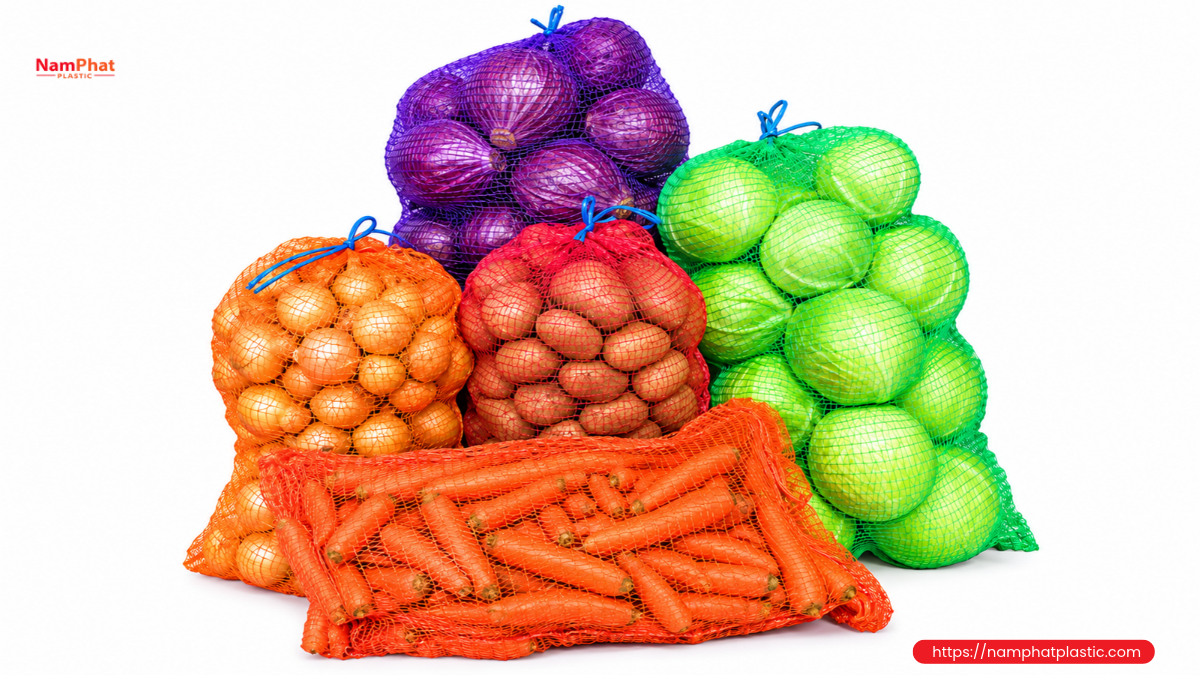
For sewing supplies, see the guide to selecting C8, C9 and C10 bag-closing threads. Confirm the composition behind the commercial term “PE thread”; do not equate it automatically with the HDPE of a bag body or treat a C number as a certified load rating.
6. Calculate output from fabric length and the whole-line bottleneck
First distinguish revolutions per minute, weft insertions per minute and metres of fabric per minute. For a multi-shuttle loom, do not multiply by the shuttle count again if the input already represents total weft insertions. Measure pick density using the same convention as the controller.
Illustrative assumptions: 12 looms, each running at I = 320 picks/min; density p = 400 picks/m; running-time fraction A = 85%; acceptable-fabric yield Yw = 97%. Cut length L = 0.75 m includes folding and sewing allowances. One cutting/sewing machine runs at 15 bags/min, with 90% running time and finished conversion yield Yc = 98%.
| Calculation step | Illustrative formula | Result |
|---|---|---|
| Fabric speed per running loom | v = I ÷ p = 320 ÷ 400 | 0.80 m/min |
| Total fabric before rejection | 12 × 0.80 × 60 × 0.85 | 489.60 m/h |
| Acceptable fabric expressed as blanks | 489.60 × 0.97 ÷ 0.75 | 633.22 blanks/h |
| Cutting/sewing intake capacity | 15 × 60 × 0.90 | 810 blanks/h |
| Accepted finished bags | min(633.22; 810) × 0.98 | Approximately 621 bags/h |
The example assumes adequate yarn supply, roll buffering and no transfer losses beyond the stated factors. Weaving is the bottleneck; increasing conversion speed does not produce a corresponding increase in bags. Fabric yield has already been deducted when calculating blanks, so it must not be deducted again at the end. If an overall efficiency figure already includes quality, do not multiply by quality again.
Costs also depend on product changeovers, package changes, cleaning, intermediate inventory and inspection time. Model the order mix, not just one easy-running product. Report continuous running-hour output separately from shift output involving several width changes.
7. Material mass, mesh dimensions and ventilation
For tubular fabric with lay-flat width W, cut length L and fabric mass G in g/m² measured over geometric area including openings, theoretical body mass is m = 2 × W × L × G. If W = 0.50 m, L = 0.75 m and G = 60 g/m², the body weighs 45 g. This excludes thread, drawcord, labels and material outside that developed layout.
Do not multiply by two again after using circumference 2W. Flat-fabric bags require the actual cut area, including seam overlap and trim. In the example, fabric flow before rejection is equivalent to 489.60 × 1.00 × 60 ÷ 1000 = 29.38 kg/h. This supports yarn-supply balancing but excludes extrusion scrap, yarn ends and start-up waste.
For roughly rectangular openings, geometric open area can be estimated as a × b ÷ (px × py), where a and b are opening dimensions and px and py are repeat pitches. This is only a preliminary model; leno crossings, angled yarns and deformation make actual geometry more complex. Agree on the measurement state and sample multiple positions.
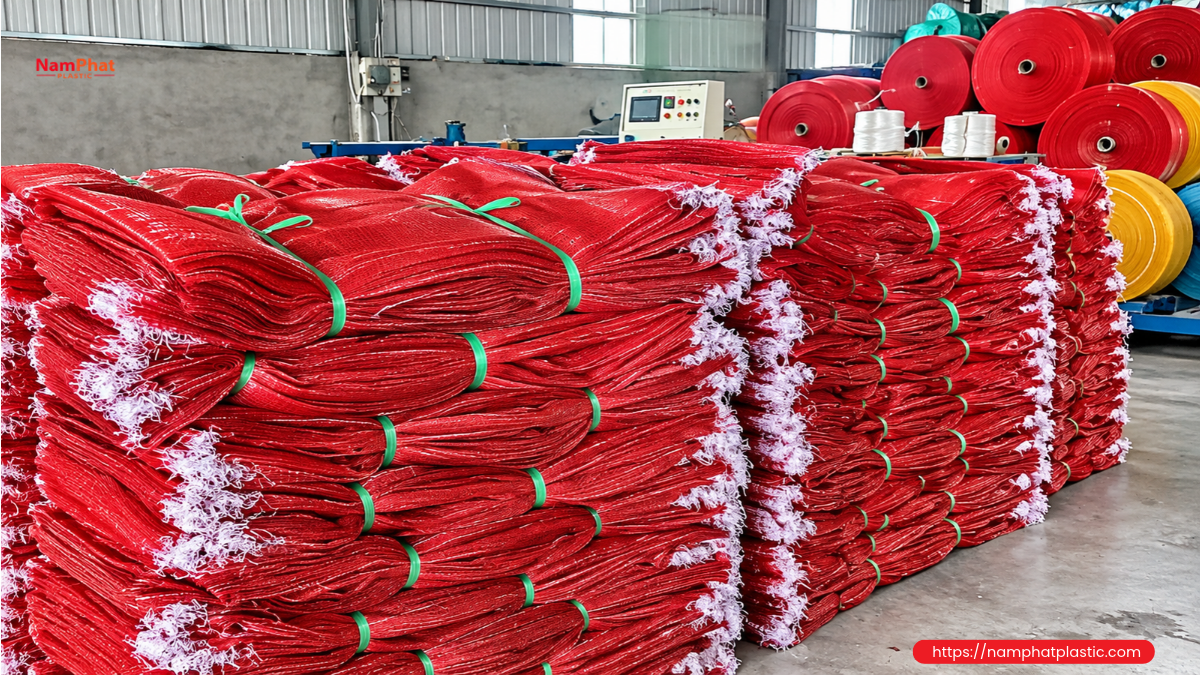
Open area is not airflow. Filled-bag condition, compression in a stack, label strips and ventilation conditions determine actual performance. For produce-storage requirements, test the bag in its stacking arrangement. Do not infer days of freshness or mould resistance from mesh dimensions.
8. Inspection planning and fault isolation
| Control point | What to record | Signs requiring investigation |
|---|---|---|
| Incoming yarn | Lot, linear density, breaking force, elongation and unwinding | Repeated breaks at one location or near package exhaustion |
| Leno fabric | Width, openings, pick density, mass per area and missing yarns | Opening slippage, streaks, damaged folds or misaligned rolls |
| Seams | Fold allowance, stitch type, force and failure mode | Unravelling, tearing along needle holes or L-corner failure |
| Actual filled bag | Fill weight, closure, handling and storage conditions | Product escape, deformation, bottom tears or skin scuffing |
Seam-strength results must identify specimen width, pull direction, grip separation, test speed and agreed conditioning. Filled-bag, drop and stacking tests need a plan based on the service journey and risk assessment. No safe load can be inferred from GSM, denier or bag width alone.
For uneven openings, examine tension, threading and take-up together. For repeated warp breaks, check the yarn lot, guide surfaces and friction locations before increasing braking. For bottom failures, distinguish insufficient fold allowance, broken thread and needle-weakened fabric. For stuck mouths, inspect thermal cutting and layer separation. Change one evidence-supported factor at a time and record the result.
9. UV, food contact and storage conditions
UV requirements should describe the place of use, exposure duration, season, temperature and retained mechanical-property criterion. Accelerated ageing is meaningful only when equipment, light source, cycle and assessment method are recorded. Do not freely convert laboratory hours into months outdoors. Colour or the presence of additives does not establish service life.
Evaluate fabric, seams and drawcord after the selected exposure conditions. Reassess equivalence when colour, resin source or recycled feedstock changes. For contact with food produce, confirm documentation for materials, additives and colours, and destination-market requirements, with a competent organization. The names PP and HDPE are not compliance certificates.
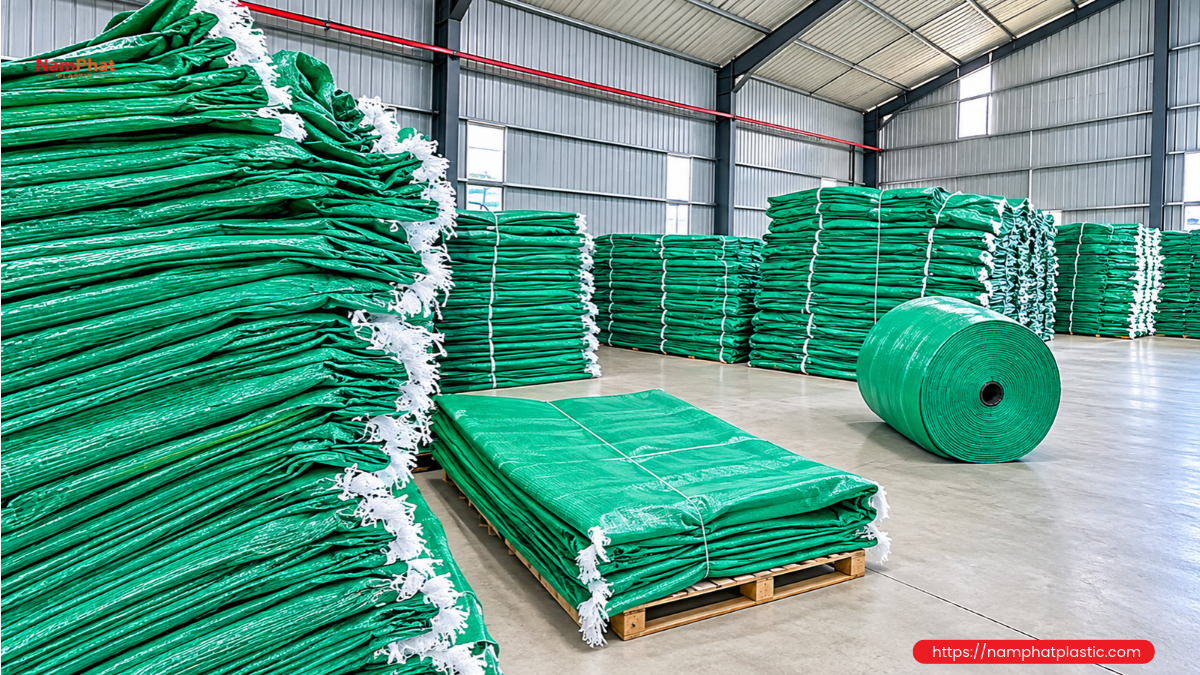
Store rolls and bags clean, away from direct sunlight and heat sources, while controlling dust, pests and contamination. Mesh bags do not provide a sealed barrier against dust or moisture. Product-storage conditions must be managed separately rather than assigning the entire preservation function to the packaging.
10. Utilities, safety and line acceptance
The investment dossier should distinguish installed electrical load from actual consumption. Compare kWh/kg of accepted fabric or kWh/accepted bag on the same basis. Confirm cooling water, compressed air, extraction near heated areas, floor loading, maintenance clearances and roll-handling routes. If selecting a water-using flat loom, evaluate supply, recirculation and drying for the actual configuration.
Guard winding shafts, nip points, shuttles, needles and blades; test emergency stops and interlocks. Isolate energy before clearing jams or maintaining equipment under an approved procedure. Assess noise, roll lifting, wet floors and hot surfaces. Never disable safeguards to reach an acceptance speed.
Factory acceptance testing at the machine builder and site acceptance testing at the plant should use samples representing the most demanding widths, openings and seam constructions. Record continuous accepted output, scrap, yarn breaks, changeovers, consumption and bag quality. Include acceptance criteria, spare parts, training, maintenance and responsibilities if requirements are not met.
When discussing requirements with Nam Phát Plastic, prepare a bag sample, drawing, produce description and the defects to improve, so that needs for produce-packaging mesh bags or sewing supplies can be clarified. The specific supply scope must be confirmed separately. This article is not a machinery quotation, certification or commitment about Nam Phát's equipment capabilities.
Frequently asked questions
1. Can an ordinary PP sack loom produce leno?
Only if it has a suitable leno mechanism and yarn-feeding configuration. Using PP does not mean a close-weave loom can create leno openings simply by reducing pick density. OEM confirmation or an approved conversion is required.
2. Should I choose tubular fabric or flat fabric with an L seam?
Tubular fabric removes one longitudinal seam; flat fabric suits its own product and conversion architecture. Decide on width, yarn construction, accepted output, changeover flexibility and bag-test results, not seam count alone.
3. Do larger openings always preserve produce better?
No. Larger openings may allow produce to escape, snag on other objects or change load distribution. Balance retention, mechanical performance and the ventilation of filled bags in the actual stacking arrangement.
4. Can machine speed directly predict bags per shift?
No. You need pick density, cut length, loom count, actual running time and yield, then a comparison with cutting/sewing, packing and yarn supply. Changeovers and inspection must be included in the shift plan.
5. Can a drawcord bag be lifted by its cord?
Not by default. Drawcords usually close the mouth. Lift by the cord only when the complete design, cord attachment points and handling method have been assessed, tested and approved for that purpose.
- 0 Comment


