


 Phan Van Hoang
- 21/10/2026
- 7
A conventional EPS foam production line converts expandable polystyrene beads into foam blocks or molded products through pre-expansion, bead conditioning, mold filling, steam heating, cooling and finishing. Evaluating a line requires considering saleable output, steam quality, silo capacity and safety controls together, rather than focusing only on pre-expander capacity.
This article covers a plant that converts purchased expandable EPS beads. It does not cover styrene polymerization to manufacture virgin resin and is not an operating manual for pressure equipment. Specific operating settings must follow the resin supplier’s documentation, the equipment manufacturer’s instructions and the facility’s safety design.
1. Identify the technology before selecting equipment
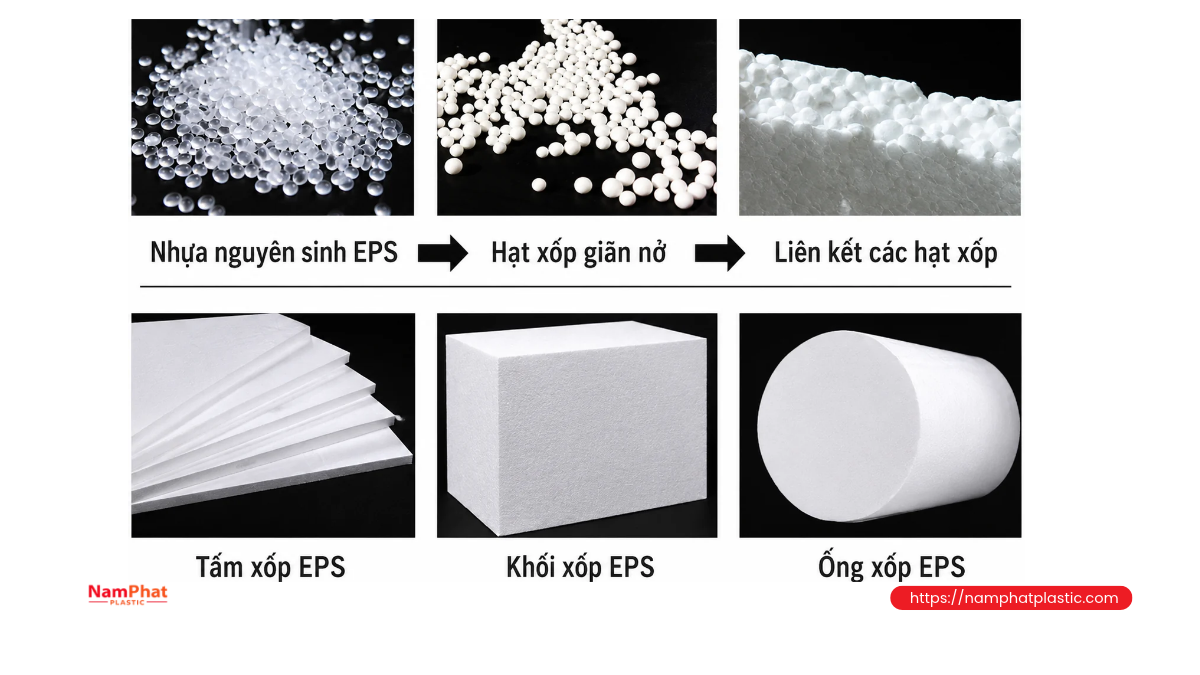
At the raw-material stage, EPS commonly means expandable polystyrene: polystyrene beads capable of expansion. After processing, the product is expanded polystyrene, a cellular foam. Steam supplies heat to soften the beads and activate the blowing agent; the beads subsequently fuse in a mold. Kurtz explains pre-expansion and bead stabilization.
| Material and product | Typical processing route | Equipment selection distinction |
|---|---|---|
| EPS blocks, boards or molded parts | Bead pre-expansion, conditioning and molding; blocks are subsequently cut | Requires bead, silo and mold management; a sheet extruder is not the central machine |
| Flexible EPE packaging rolls and sheets | Polyethylene foam extrusion, cooling, winding or further conversion | Different polymer and machinery route; EPS settings do not apply |
| Rigid XPS boards | Continuous polystyrene foam extrusion, shaping and cutting | Different forming mechanism from molded EPS beads |
The table describes common routes, not a claim that all EPE is extruded roll foam: polyethylene bead-foam technologies also exist. Similarly, extrusion can be used upstream to manufacture EPS beads, but that is outside the purchased-bead conversion route discussed here. Sulzer describes extrusion-produced EPS beads; ASTM C578 distinguishes molded EPS and extruded XPS boards.
2. Line layout: a shared front end and two molding routes
The basic sequence is: raw-bead reception → weighing and feeding → pre-expansion → configuration-appropriate drying and cooling → silo conditioning → conveying and mold filling → molding → cooling and demolding → product conditioning → finishing, inspection and packing.
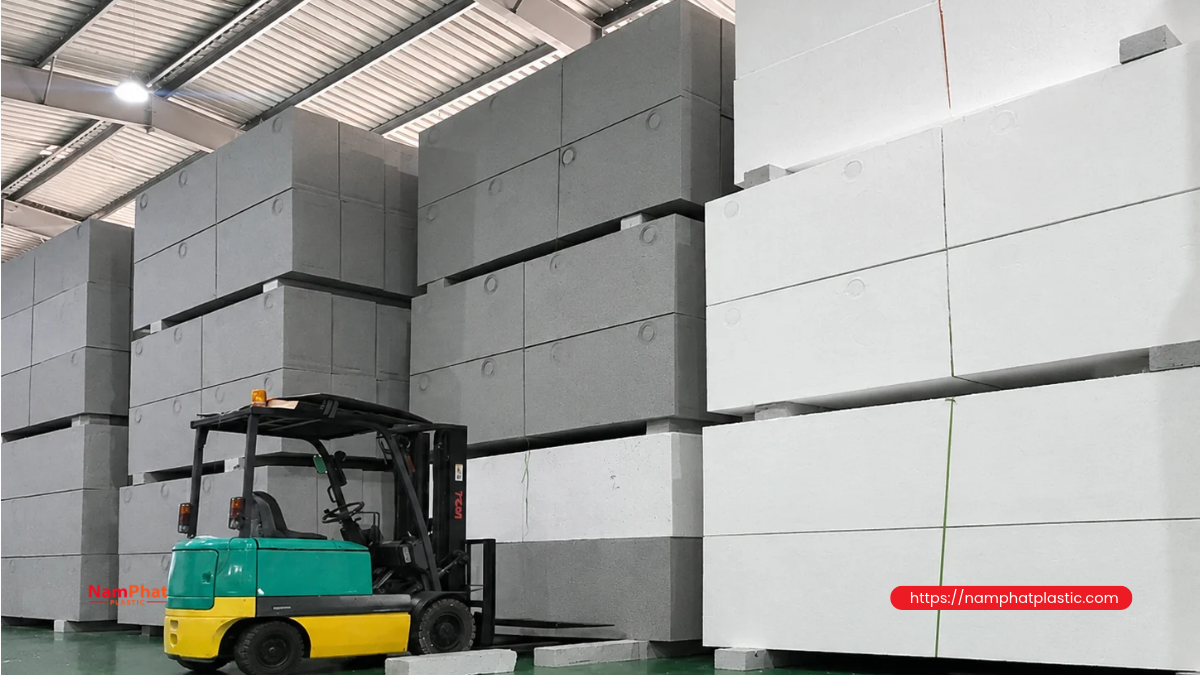
After the silos, processing follows two routes. Block molding produces large blanks for cutting into boards, packing inserts or profiles. Shape molding produces boxes, trays, protective corners or other parts defined by a mold cavity. These routes may share some infrastructure, but cannot automatically share every bead grade, validated process or acceptance criterion. Epro describes pre-expansion, silos and the two conversion routes.
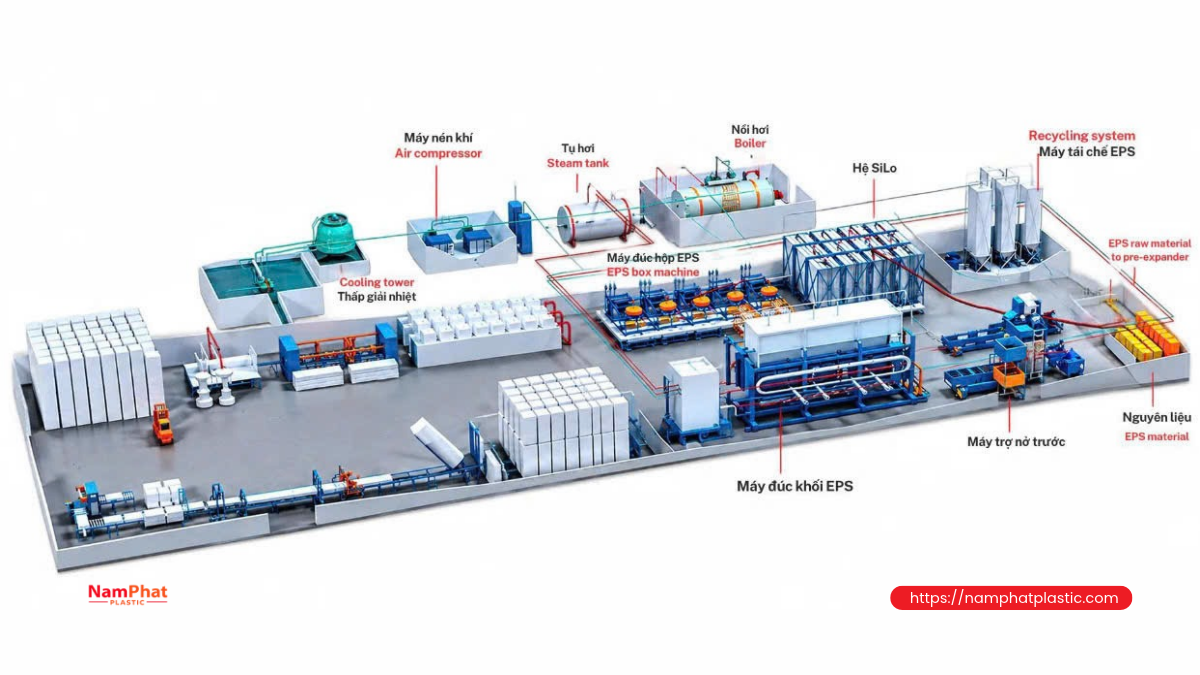
| Equipment group | Function | Information to request |
|---|---|---|
| Pre-expander and metering scale | Produce expanded beads at a suitable loose bulk density | Throughput by bead grade, density and operating mode; weighing variation |
| Fluid bed where fitted, silos and conveying lines | Condition beads and supply the correct batch | Usable volume, traceability and prevention of unintended mixing |
| Block or shape molding machine | Fuse beads inside the mold | Accepted output for the trial product, mold and utility configuration |
| Cooling, vacuum and demolding | Remove heat and help the product retain its shape | Heat load, water conditions and actual cycle time |
| Cutting, finishing and clean-scrap recovery | Meet delivery dimensions and segregate material | Tolerances, losses, extraction capacity and dust control |
3. Pre-expansion: control density from the start
Beads are weighed into a continuous or batch pre-expander. Heat increases their volume and reduces loose bulk density. Weighing and volume measurement support output control, but results also depend on bead grade, storage condition, steam stability and machine repeatability.
Distinguish the loose bulk density of pre-expanded beads from the apparent density of the molded product. Loose beads have spaces between them; mold filling, further expansion and fusion change the material’s condition. A cup measurement of loose beads therefore cannot replace finished-product density testing.
Where a fluid bed is fitted, airflow helps cool the beads, reduce surface moisture and stabilize them before transfer to silos. Not every line has a separate dryer, and surface drying does not mean internal conditioning is complete. This description is consistent with Kurtz’s pre-expansion configuration; check the actual machine documentation.
During acceptance trials, sample several consecutive batches rather than one favorable batch. Record bead grade, raw-material lot, time, instruments and sampling method. Density variation affects part weight, mold-cycle consistency and predicted material consumption.
4. Conditioning silos are more than buffer storage
After pre-expansion, gas conditions and pressure inside the cells continue to equilibrate with the surroundings. Beads require conditioning before mold filling. Suitable time depends on resin grade, density, ambient conditions and product requirements; no single number of hours applies to all EPS. BASF’s Styropor P 26 technical sheet also relates conditioning time to density and ambient conditions.
Silos need clear batch identification: material name, bead grade, target density, pre-expansion time and release status for molding. Mixing freshly expanded beads with conditioned beads may leave the stock-volume figure correct while obscuring whether that stock is ready for production. Bead color alone is not reliable grade identification.
Layout calculations should use usable rather than geometric silo volume. Allow for silo rotation, product changes, cleaning and continued supply while a batch is not yet ready. Do not compensate for inadequate ventilated silo capacity by increasing stock in enclosed rooms; blowing-agent emissions still require control.
5. Bead conveying and mold filling directly affect the product
Conveying lines, distribution valves and filling devices must deliver the right material to the right machine without excessive segregation, dust accumulation or batch confusion. For thin walls, small corners and difficult-to-fill regions, filling performance should be assessed during mold design, not postponed until series production.
Variable part weight, underfilled regions or voids may relate to feeding and mold venting rather than insufficient heat alone. Investigate in sequence: correct material, released beads, consistent supply, and clean, unobstructed mold venting. Do not increase steam arbitrarily to conceal a filling problem.
The feeding system must match the machine cycle. A faster molding machine waiting for beads does not increase actual output. Kurtz PRO FOAMER options illustrate that filling injectors, blending stations and vacuum are configuration elements, not incidental details.
6. How do block molding and shape molding differ?
In conventional steam processing, the mold holds the beads in the intended shape while steam supplies heat for further expansion and fusion. Heat and residual steam are then removed by the designed cooling system. Fusion must be assessed in the core as well as on an attractive outer surface. VIRO describes the role of the block mold and cooling system.
| Criterion | Block molding | Shape molding |
|---|---|---|
| Output after molding | Large block requiring conditioning and cutting | Part close to its final-use shape |
| Flexibility | Board sizes can change through the cutting plan within block limits | Depends on cavity geometry, demolding mechanism and filling system |
| Control points | Density uniformity, core fusion, warpage and post-molding shrinkage | Complete filling, thin walls, mating dimensions and demolding marks |
| Losses and inventory | Cutting trim, block inventory and cutting schedules | Mold costs, mold changes and part-number-specific inventory |
Vacuum can help remove steam and heat from a block, but must be selected together with heat exchangers, pipework and water or heat-rejection conditions. Having vacuum does not guarantee identical moisture levels or cycle times across machines. Epro describes a dry-cooling vacuum arrangement, illustrating the range of utility configurations.
Demold only when the machine requirements and validated process permit it. Early demolding to shorten a cycle can damage the shape or increase downstream rejects. Electromagnetic fusion technologies also exist, so steam-line utility requirements should not be applied to every EPS machine. Kurtz WAVE FOAMER is one alternative technology.
7. Post-molding conditioning, hot-wire cutting and finishing
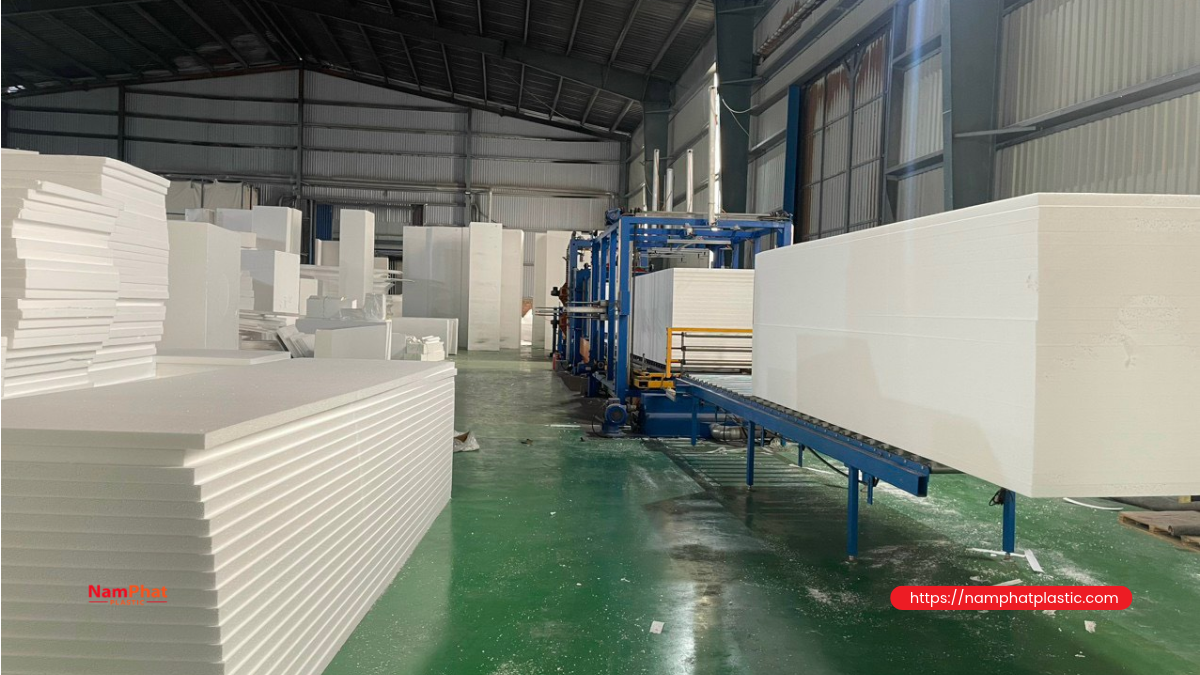
A newly demolded block should not automatically be considered ready to ship. Temperature, moisture and material condition must stabilize against the product criteria. Measure dimensions at specified intervals to understand changes, then establish cutting and packing readiness for the bead grade, block and factory conditions.
Hot-wire cutting produces boards or profiles from blocks. Cut quality depends on block stability, wire tension and position, machine movement, support arrangements and equipment condition. Check thickness at multiple positions, squareness, flatness, surface finish and trim losses. Faster cutting that causes ripples or incorrect thickness can reduce saleable output.
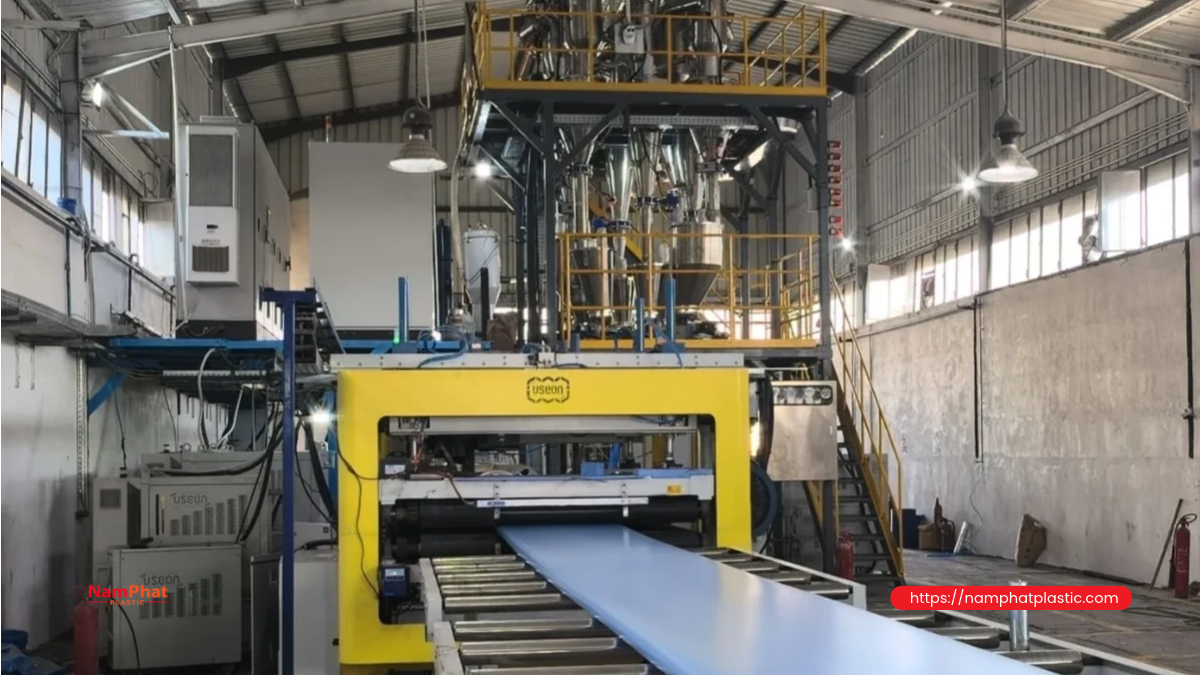
The cutting area needs appropriate extraction and controls against contact with hot wires. BASF notes that hot-wire cutting vapors require extraction because they contain small quantities of styrene as well as pentane. Requiring workers to wear ordinary face masks is not a substitute for extraction. Source: Styropor P 26 safety guidance.
8. Utilities determine whether machines achieve capacity
Having all the main machines but insufficient infrastructure can leave a project below its expected output. Engineering must consider peak demand when several machines cycle together, not only average consumption over a shift. The following items are an engineering review checklist, not a mandatory configuration for every facility.
| System | What to check | Effect of inadequate or unstable supply |
|---|---|---|
| Boiler and steam distribution | Steam quality, peak load, insulation, condensate drainage and inspection | Variable cycles, uneven heating and heat loss |
| Water and heat rejection | Quality, inlet temperature, recirculation and scale control | Reduced cooling performance and longer waits |
| Compressed air | Filling and actuator demand, leaks and air quality | Inconsistent filling, downtime and higher electricity use |
| Vacuum | Steam load, tightness, heat exchanger and cleaning schedule | Inconsistent heat removal and extended cycles |
| Condensate and feedwater | Recovery suitability for water quality, pumps and water treatment | Heat loss, increased makeup water and operating costs |
| Ventilation and fire protection | Pentane assessment, ignition sources, accumulation zones and engineered protection | Fire and explosion risk; unsafe operation |
Require a clear supply boundary: what is included in the machine quotation and what belongs to the factory infrastructure. Assign responsibility for meters, connection pipework, integrated commissioning and training. A promised cycle time is meaningful only when its steam, water and air supply conditions are specified.
9. Quality control: correct density is not enough
Samples with the same density can differ in strength because of bead fusion, material distribution, moisture or processing history. Choose tests according to use. For insulation boards, ASTM C578 provides a relevant set of criteria, but conformity should be claimed only after appropriate assessment against the standard and its scope.
| Property | Inspection approach | Related decision |
|---|---|---|
| Density and weight | Representative samples with location and conditioning status recorded | Material consistency and lot comparison |
| Bead fusion and uniformity | Inspect sections and core regions alongside suitable mechanical tests | Identify weak regions despite an acceptable exterior |
| Compression, flexure or protective performance | Use agreed test methods and conditions | Assess against real loads and applications |
| Moisture, dimensions and stability | Specify weighing and measurement timing, conditioning and instruments | Cutting, packing and acceptance readiness |
| Thermal or special requirements | Test the actual product configuration against relevant standards and use conditions | Do not infer performance from bead color or density |
Batch records should link resin, silo, machine, mold, shift and test results. Protective packaging drop or transport tests must consider the protected item, outer carton and packing arrangement together. Food-contact use requires appropriate documentation for the specific resin and finished product, contact purpose, temperature and duration; the name EPS alone does not establish food safety.
10. Output calculations: kg/h, m³/h and quality yield belong together
Capacity in kg/h describes mass flow; m³/h describes volume flow. Density relates them, but only on a consistent measurement basis. Do not simply divide raw-bead input by finished-foam density and call the result shipped output without considering mass changes, scrap, trim and rejects.
Hypothetical planning example, not a capacity promise: if a stage produces 300 kg/h of foam in an agreed measurement condition, at an apparent density of 20 kg/m³, its corresponding volume is 300 ÷ 20 = 15 m³/h. If only 90% becomes accepted product after cutting and inspection, accepted output is 13.5 m³/h. The 90% yield is an illustrative assumption only.
For the same product, suppose molding achieves 12 m³/h, cutting 10 m³/h, and the bead and silo plan can supply 15 m³/h. Cutting is then the immediate constraint: at most 10 m³/h before other downtime and losses. Raising pre-expander capacity alone does not remove this bottleneck.
For shape-molded products, also track parts per hour: cavities per mold × completed cycles per hour × quality yield, then consider actual availability. If the report already uses measured accepted output over an entire shift, do not apply another efficiency factor containing the same losses; that would double-count them.
A preliminary silo-volume estimate can use required expanded-bead volumetric flow multiplied by validated conditioning time, then allow for batch separation and operational reserve. This is only a calculation framework. Final design must consider loose bead bulk density, usable fill level and the product schedule; do not arbitrarily substitute finished-board density.
11. Costs, energy and overlooked bottlenecks
Compare energy per unit of accepted product within the same product group, such as kWh per accepted m³ or fuel or steam per accepted m³. Per-cycle figures can mislead when volume, cavity count or reject rate differs. Measure startup, product changes and steady operation.
Start improvement with data: repair compressed-air leaks, check steam traps, insulation and heat-exchanger cleanliness, stabilize feeding, reduce mold waiting and organize cutting schedules. Do not cut cooling or conditioning time outside the validated operating window merely to meet output targets.
Total investment also includes molds, boilers, water treatment, ventilation, fire protection, electrical systems, block-conditioning space, testing facilities, staff and spares. Compare quotations on identical scope. Machine-maker saving claims can inform trial questions but cannot replace measurements on the project’s own products and infrastructure.
12. White EPS, graphite grades, flame retardants and regrind
White and graphite-containing EPS may serve different objectives. Graphite is used in certain EPS grades to improve thermal-insulation performance; this is a property of a specified grade and product, not a blanket guarantee for every gray bead. BASF explains Neopor’s composition.
A flame-retardant grade does not mean that a product is noncombustible, indefinitely fire resistant or automatically approved for every building. Check the resin grade, test standard, installed construction and finished-product documentation. BASF’s EPS portfolio differentiates grades by application, bead size and properties; sharing a polymer name is not sufficient justification for substitution.
Clean in-house EPS scrap can be ground, dedusted and considered for reintroduction where the technology, product and customer requirements permit. No universal regrind percentage applies to all molds and applications. Validate cleanliness, size, density, segregation risk, strength and traceability. Post-consumer scrap adds contamination and collection challenges and differs from clean internal scrap.
Material recoverability does not mean every EPS product is actually recycled. Results depend on sorting systems, receiving processors, logistics and scrap quality. Claims of complete recyclability should not ignore losses or local conditions.
13. Pentane, hot steam and moving-equipment safety
EPS beads can release pentane during storage and processing. Flammable vapor can accumulate in poorly ventilated places, including receiving areas and freshly produced goods storage. HSE provides specific guidance on pentane fire and explosion hazards in EPS; risk assessment must cover the whole route, not just the pre-expander.
Competent personnel should design appropriate ventilation, ignition-source and static controls, assessed grounding arrangements, electrical equipment suitable for hazardous areas, and necessary detection and fire-protection measures. Open factory doors or domestic fans are not evidence that the hazard is controlled. The Sunpor EPS SDS addresses prevention of pentane accumulation and static discharge.
Also manage pressure equipment, hot surfaces, mold pinch points, cutting-machine movement, block handling and energy isolation during maintenance. Guards, interlocks, extraction and safe procedures are primary controls; personal protective equipment supplements them according to task assessment. This article provides no steam pressure, wire temperature or gas threshold for readers to set equipment themselves.
14. Checklist before approving an EPS line
- Define the product, drawing, density, tolerances and application-specific testing criteria.
- Confirm bead grade, technical documentation and SDS; distinguish white, graphite, flame-retardant and recovered materials.
- Request trials using representative products, not merely no-load demonstrations.
- Measure accepted output over an operating period that captures changes, waiting and inspection.
- Check the balance between pre-expansion, silos, molding, cooling, conditioning and cutting.
- Agree utility scope, safety, inspections, training and spares.
- Plan change control for resin-grade, mold or regrind-content changes.
For packaging buyers, the useful question is whether the product protects the goods, holds its dimensions and meets use conditions, rather than simply asking for foam density. Explore packaging products and knowledge at Nam Phát Plastic. This article is technical reference material, not a claim that Nam Phát manufactures EPS or supplies EPS production lines.
Frequently asked questions about EPS foam production lines
1. Is an extruder the main machine in an EPS line?
Purchased-EPS-bead conversion normally uses a pre-expander and molding machine. Extruders belong to other routes, such as upstream EPS bead production or XPS foam extrusion; these routes should not be conflated.
2. Can silos be omitted and freshly expanded beads go straight into the mold?
Do not omit conditioning on assumption. Molding readiness must be confirmed for the bead grade, density and technology. Silos also support batch segregation and production balancing, but must be designed with safe ventilation.
3. Does higher density always mean a better product?
No universal conclusion is possible. Assess strength, bead fusion, dimensions and use requirements. Higher density may consume more material without resolving filling defects or poor fusion.
4. Can one regrind percentage be used for every product?
No. Permitted content must be validated through testing and customer requirements, considering scrap source, cleanliness, particle distribution and final performance. Special applications require separate review.
5. How can a buyer judge whether quoted capacity is realistic?
Request the bead grade, product, density, mold, utilities, measurement period and quality yield. Compare full-line output after finishing, not just pre-expander kg/h or the fastest molding cycle.
- 0 Comment


