


 Phan Van Hoang
- 21/10/2026
- 7
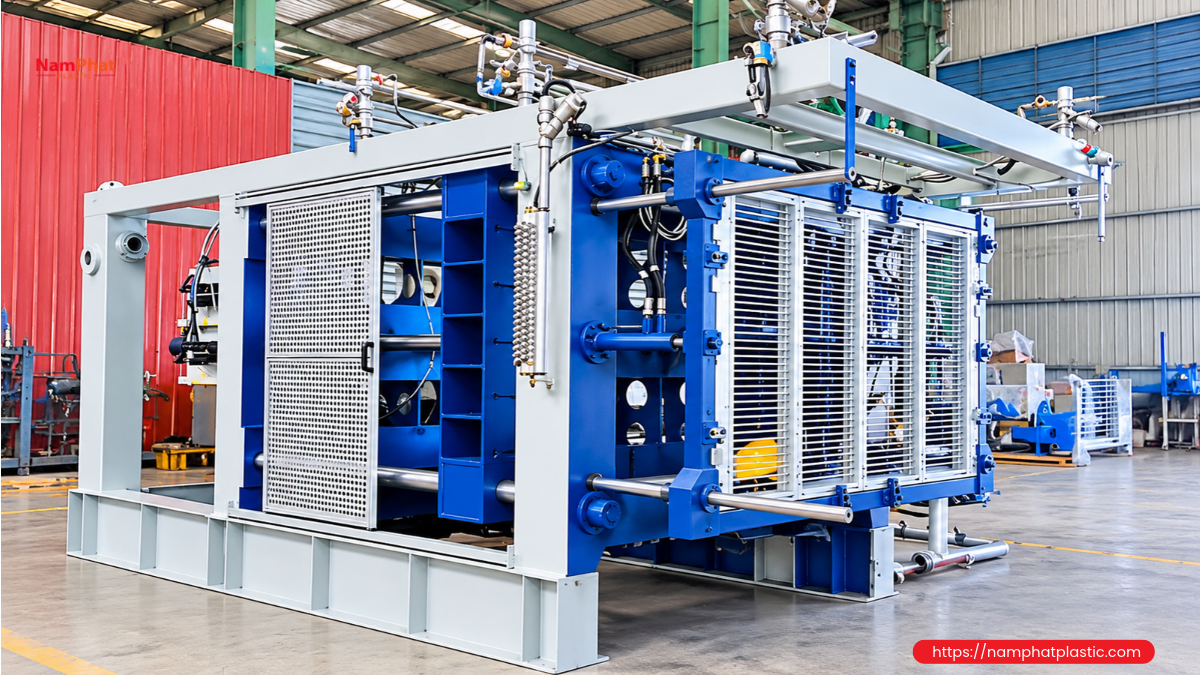
An EPP shape molding machine bonds expanded polypropylene beads into a component defined by the mold cavity. Selecting the right machine starts with the product: geometry, density, compression performance, recovery and assembly tolerances. Platen area or an advertised cycle time is not enough to establish whether a line is suitable.
This article takes a production-control and packaging perspective: the beads must fill the cavity, bond adequately, stabilize after demolding and protect the packaged goods. Operating parameters must be confirmed by the bead, mold and machine suppliers for the specific configuration. A single temperature or pressure recipe should not be applied to all EPP.
Understanding EPP shape molding and its boundaries with other foams
EPP stands for expanded polypropylene in bead-foam form. In conventional steam-chest processing, beads are loaded into a mold, heated with steam to form bonds, cooled and demolded. Kaneka describes EPERAN-PP as a material that can be molded into complex shapes using this technique.
A shape molding machine is not the same as a line that manufactures EPP beads from virgin PP resin. Nor is it a solid-PP injection molding machine: material feeding, heat transfer, product structure and ancillary equipment differ. Making this distinction at the quotation stage prevents comparisons between proposals with different scopes.
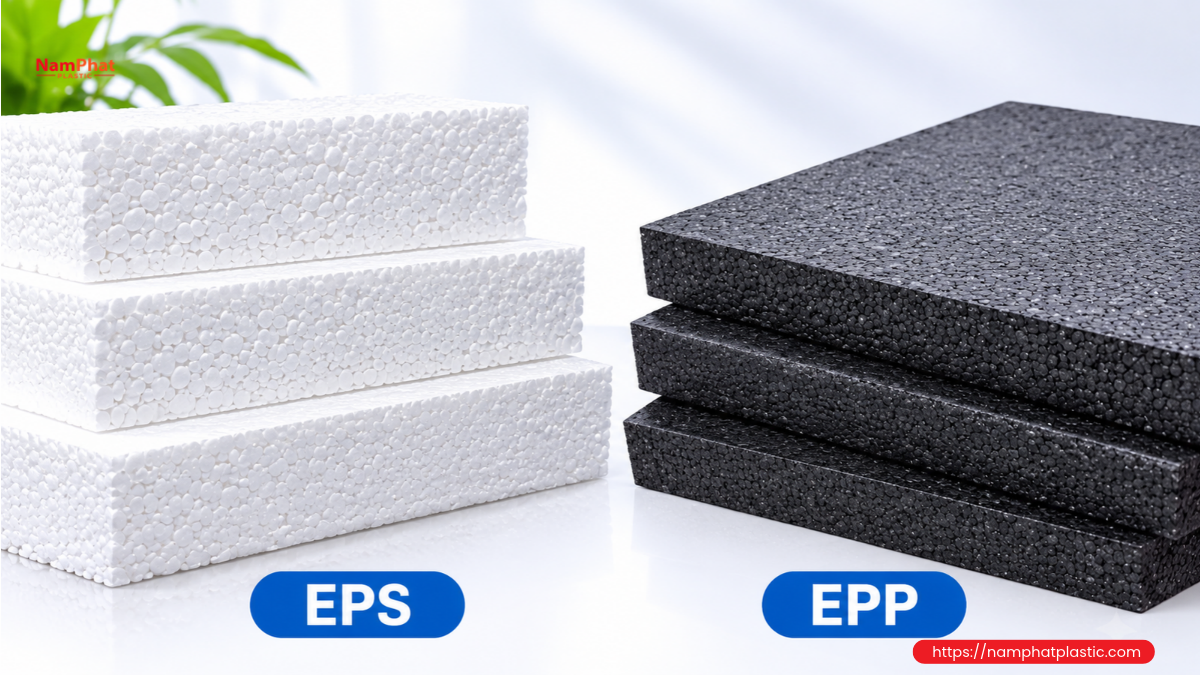
| Material/process | Difference to check | Equipment-selection implication |
|---|---|---|
| EPP beads | Bonding of expanded PP beads; filling compression and bead condition affect the finished part | Specify a coordinated grade, filling method, mold and thermal system |
| EPS beads | A polystyrene base, not polypropylene | An EPS label does not establish EPP capability; confirm configuration and run samples |
| EPE | A polyethylene base; available as beads and in many sheet/roll products | Distinguish bead molding from extrusion, cutting or sheet lamination; one line does not cover all processes |
| Reaction-foamed PU | Reactive chemicals form polyurethane, unlike the bonding mechanism of EPP beads | Requires separate metering, mixing and chemical-safety arrangements |
For example, BASF's Autofroth PU system combines reactive components at the mixing nozzle. Machines making lightweight cellular materials should not all be treated as the same kind of “foam machine.”
Select the beads before finalizing the machine configuration
The material specification should record the grade, bulk density, bead-size distribution, color and target molded density. Loose-bead bulk density is not finished-part density. Two lots described simply as EPP may still differ in filling behavior, surface appearance and compression response.
Thin walls, small ribs and concealed regions require trials to verify that beads can pass through the feed system and fill the actual geometry. Smaller beads do not automatically resolve every defect: fill-point count, vent paths and insert positions can still cause underfilled areas. Color, antistatic properties and flame retardancy must be supported by the relevant grade and test documentation, not inferred from the EPP name.
Pretreatment may include temperature equalization and pressure conditioning according to the material manufacturer's guidance. This manages the gas state inside the cells; it is not an arbitrary compaction step. The ARPRO 5126 datasheet provides different pretreatment guidance for different filling methods and notes that excessive internal cell pressure can impair fusion. Do not transfer that grade's complete cycle to another grade.
Track lot identification, conditioning start and finish times, storage conditions and waiting time before molding. Material changes should include cleaning the feed route under an approved procedure to prevent color contamination or mixing materials with different electrical-resistance requirements. Recovered material should return to production only after its proportion and quality have been validated for the application.
What happens during a molding cycle?
Bead filling and venting
Two common approaches are crack-fill and pressure-fill. Crack-fill loads beads while the mold is held at a designed opening, then closes it to compress them. Pressure-fill uses controlled pressure differentials in the feed system and mold. The choice must suit the machine, grade and geometry rather than the process name alone. The machine builder should demonstrate the proposed modes with samples.
Air needs an escape route for complete filling. Review the filling injectors, vents, parting line and areas around inserts together. Dirty or unsuitable vents can leave a remote corner porous even when total part weight remains close to target. Simply extending fill time may temporarily hide the problem while increasing regional variation.
Heating and bead fusion
In a steam cycle, the important issue is whether heat reaches the regions requiring fusion, not merely whether the supply gauge reaches its setpoint. Steam delivery, air evacuation and condensate drainage must be assessed together with the mold. Research on interbead bonding in EPP steam-chest molding links thermal conditions and bond development with the part's mechanical properties.
The objective is adequate core and surface bonding without damaging the structure or geometry. An attractive exterior therefore does not establish core quality. Process records should retain measured traces, recipe revisions and alarms rather than only the final setpoints.
Cooling, demolding and stabilization
After heating, the part must cool and stabilize under the validated configuration. Water, vacuum or combined approaches depend on the machine and mold design. Demolding too early can cause distortion; unnecessary cooling time consumes capacity and distorts the assessment of machine efficiency.
Ejectors, robots and manual removal must avoid pulling thin walls out of shape, marking surfaces or displacing inserts. If the grade and part require thermal post-treatment, include it in the production route, floor-space plan and dimensional-inspection timing. Measurements immediately after demolding do not replace measurements after the agreed conditioning period.
Steam, specialized thermal technologies and claims that require verification
Steam molding is widely used, but not every thermal improvement is “steam-free.” Kurtz's THERMO FOAMER combines thermal control and closed-loop cooling for EPP while still using a reduced quantity of steam. Lower steam consumption must be distinguished from eliminating steam altogether.
RF technology, which heats through an electromagnetic field, exists within the bead-foam molding equipment category. However, Kurtz's FOAMER product matrix does not establish that every commercial RF machine processes conventional EPP. When offered a steam-free solution, request confirmation of the grade, tooling material, actual samples and acceptance conditions. Do not transfer EPS or E-TPU results to EPP.
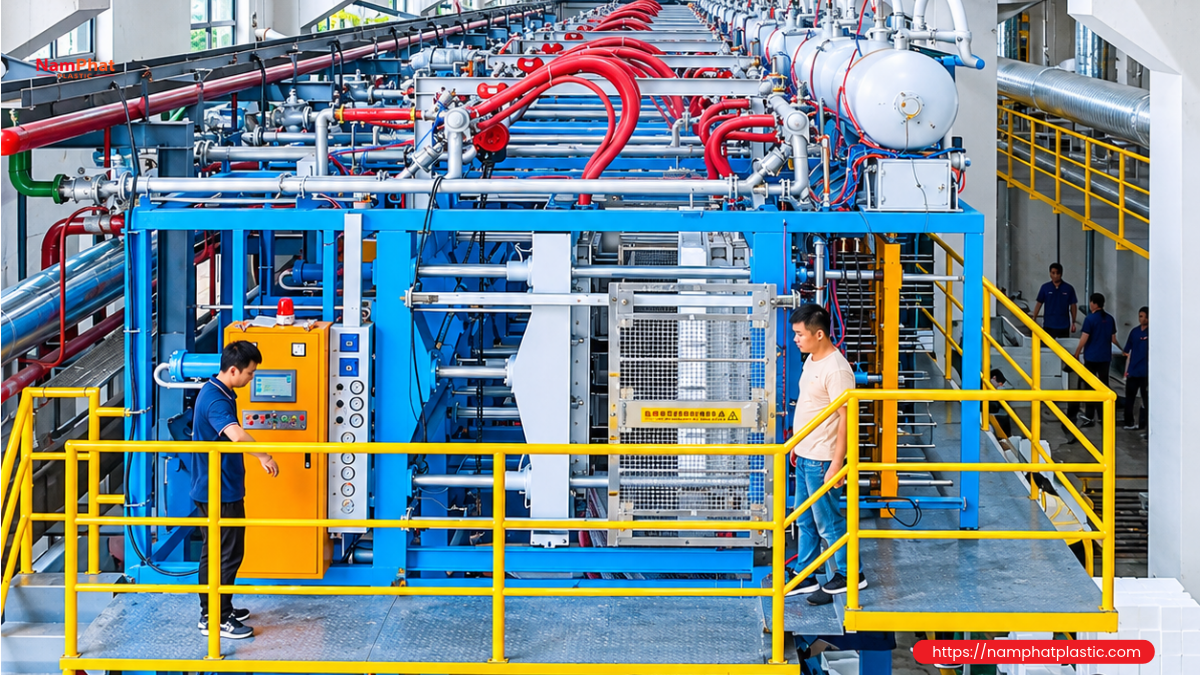
Energy comparisons require the same acceptable product, cavity count and measurement boundary. Electricity consumed by the machine alone does not represent total electricity, steam, compressed air and post-treatment demand. Savings claims are meaningful only when the baseline and trial conditions are defined.
Equipment modules and utilities that belong in the quotation scope
| Item | What to confirm | Risk if omitted |
|---|---|---|
| Bead storage, conditioning and feeding | Usable capacity, lot management, grade changes and continuous supply | Machine starvation or mixed materials |
| Clamping unit and mold | Mounting dimensions, opening stroke, mold weight, cavity count and ejection | A mold fits the machine but the part cannot be removed |
| Steam and condensate | Demand at the machine, peak load, valves, steam traps, return lines and insulation | Insufficient heat at the mold or poor condensate drainage |
| Cooling water and vacuum | Flow, water quality, heat-rejection capacity and seasonal stability | Cycle time and dimensions drift in hot weather |
| Compressed air and electricity | Air quality, simultaneous flow demand, electrical load and connection points | Unstable feeding or actuator operation |
| Controls and ancillary systems | Recipes, data logging, access levels, robots, post-treatment and spare parts | Missing traceability or underestimated costs |
The PRO FOAMER listing illustrates why mold-temperature sensing, foam-pressure measurement, central vacuum and dual-density functions need confirmation rather than being assumed standard. Buyers need a supply-boundary diagram showing what the OEM supplies, what the factory provides and who owns integration.
Molds, inserts and surface quality
Approve the mold design alongside the product drawing and measurement criteria. Abrupt thickness transitions, deep recesses and mating surfaces deserve early attention. Do not compensate shrinkage with one fixed percentage across all grades, directions and locations. Run samples, measure after conditioning and agree any required tooling revisions.
Metal or plastic inserts add requirements for location, bead filling, heat transfer and demolding. Define whether retention relies on mechanical interlocking, a material bond or another solution; do not assume EPP adheres securely to every surface. Pull-out, torsional or service-load testing should reflect the component's actual function.
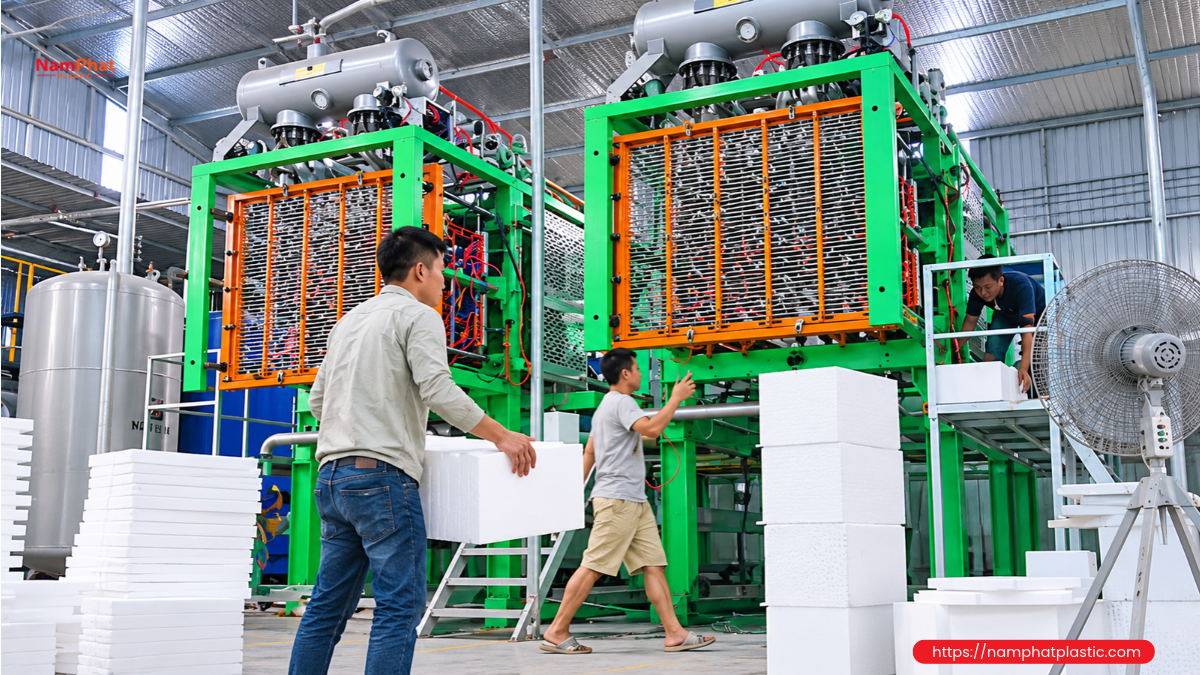
Kurtz's ROTO FOAMER is an example of equipment for insert-containing parts, with insert loading and finished-part removal occurring in parallel with molding. The productivity benefit still needs verification against the project's handling times and safety criteria.
For visible surfaces, agree limit samples covering bead texture, vent marks, injector marks, parting lines and acceptable color variation. “Good appearance” is not a measurable acceptance criterion. Surface design must balance appearance, cleanability and the part's protective function.
Quality control from density to recovery
| Characteristic | How to define the inspection | What to avoid |
|---|---|---|
| Density | Weigh and determine foam volume using an agreed method; distinguish whole parts from cut specimens | Using the bounding-box volume of a part with empty recesses |
| Bead fusion | Assess fracture surfaces in representative regions alongside approved mechanical tests | Inspecting only the exterior or applying one universal bead-break percentage |
| Compression and recovery | Agree strain, load-hold time, cycle count and recovery interval | Comparing results obtained under different conditions |
| Dimensions and stability | Define datums, measuring force, fixtures, environment and timing after conditioning | Indenting the foam with the instrument or measuring it while hot |
| Application performance | Test fit, transport, stacking load or impact against the agreed application | Converting bead datasheet values into guarantees for every finished product |
A preliminary calculation example: if foam volume is 0.018 m³ and target density is 45 kg/m³, theoretical foam mass is 0.81 kg. These are assumed values for a consistency check, not Nam Phát specifications or machine performance figures. Separate insert mass and retained water when comparing measurements.
Returnable packaging needs evaluation over repeated use, while energy-absorbing components require testing against the relevant load scenario. Recovery after compression does not mean all mechanical properties remain unchanged after every impact. Food-contact, ESD or flame-retardancy requirements need documentation for the specific grade, construction and conditions of use.
Common defects: investigate before changing the recipe
| Observation | Potential cause groups to investigate | Priority verification |
|---|---|---|
| Underfill or porous corners | Feeding, vents, difficult-to-fill geometry and insert position | Compare defect locations between cavities and inspect the feed route |
| Bead separation or weak core | Bead condition, heat reaching the core, air evacuation and condensate | Inspect section/fracture surfaces and cycle data |
| Shrinkage, warpage or swelling | Uneven heating, cooling, demolding and post-treatment | Measure against the same datums at specified conditioning intervals |
| Weight variation | Bead lot, filling mode, leakage and retained water | Separate cycle-to-cycle from cavity-to-cavity variation |
| Surface marks or color variation | Contamination, mold surface, vents and thermal conditions | Compare with limit samples and cleaning records |
| Misplaced or loose inserts | Location, filling forces, retention design and removal handling | Check position alongside functional load tests |
This table guides investigation; it does not diagnose a cause from one symptom. Change one factor at a time within an approved trial plan, retain sample traceability and compare with the baseline. Do not exceed design-pressure limits to address a fusion defect.
Safety and acceptance: quality requires a safe operating state
Hot steam, condensate, stored pneumatic energy, clamps and heavy molds create distinct hazards. Trained personnel must check door interlocks, guarding, safety valves and mold-opening permissives against the machine documentation. Never defeat interlocks or open a pressurized system.
Before maintenance, isolate and lock out energy sources under the factory's procedure, depressurize in a controlled manner and verify a safe state and suitable temperature. Do not rely on one pressure gauge alone. Erlenbach's technical guidance calls for trained personnel and a safe system state before repairs, cleaning or maintenance.
Acceptance should include trials at the machine builder, verification after installation and a sustained production demonstration. Use agreed representative tooling, grades and parts. Check quality after complete conditioning rather than merely counting machine cycles. Include scrap, downtime, mold changes and utility consumption within the measurement scope.
RFQ checklist and cost comparisons on a consistent basis
The request for quotation should include drawings and samples, output by part number, planned shifts, surface requirements, inserts, density, tolerances and functional tests. Add proposed grades, existing steam/water/air/electricity infrastructure, available space, mold-lifting arrangements and the desired automation level.
Ask suppliers to separate the costs of the machine, molds, bead conditioning, utilities, installation, training, spare parts and commissioning. Specify acceptance criteria, required data handover, responsibility for resolving failed samples and service scope. Express capacity as acceptable parts over a defined production period rather than the shortest cycle achieved.
Cost per acceptable part should include material, energy, labor, maintenance, scrap and depreciation under consistent assumptions. A cheaper machine that needs lengthy post-treatment or difficult mold changes can raise total cost. Where many part numbers change frequently, flexibility and recipe traceability deserve separate assessment.
5 frequently asked questions about EPP shape molding machines
Can an EPS machine mold EPP?
Only if the machine builder confirms a suitable configuration for design pressure, feeding, tooling, controls and utilities. Trial the target grade and part; do not infer compatibility from the machine's appearance.
Is pressure conditioning mandatory for all EPP beads?
It should not be treated as a universal rule. The need and cycle depend on grade, filling method and target molded density. Follow the material documentation and the supplier-confirmed process.
Why can a part meet its weight target but still have a weak core?
Correct weight does not demonstrate uniform fusion. Check bead distribution, heat paths, air evacuation and condensate drainage, then compare fracture surfaces and mechanical results. Increasing heat should not be the automatic response.
Is there a standard temperature, pressure and cycle for EPP?
No parameter set is safe and effective for every grade, mold and machine. Equipment limit ratings are not recommended processing settings either. A validated operating window is needed for each product.
Does Nam Phát sell EPP shape molding machines?
This article provides technology-selection guidance and does not confirm that Nam Phát sells EPP machines. For packaging that combines protective trays with an outer covering, see Nam Phát's PE packaging range and discuss the required specification. EPP machinery supply should be verified separately with an equipment vendor.
- 0 Comment


